Introduction
As AI and cloud computing continue to expand, businesses and regular people are relying on these technologies more than ever. This has triggered a race to build data centers all over the world. The United States, having the biggest economy globally, is determined to lead this digital shift because it knows the tech industry will power the future economy.
To make sure it stays ahead, the US is building countless data centers across different states. Today, America holds the top spot for the number of AI data centers, largely because of how much electricity it produces. Between its nuclear power keeping prices stable and its rich supply of oil and gas, the US has no problem providing the massive energy required to keep these servers running.
Beyond just power, the US also controls the hardware side. Thanks to major chipmakers like NVIDIA and AMD, the country secures the supply chain for GPUs, which are the essential building blocks for running AI.
Top 10 AI Data Centers in the United States
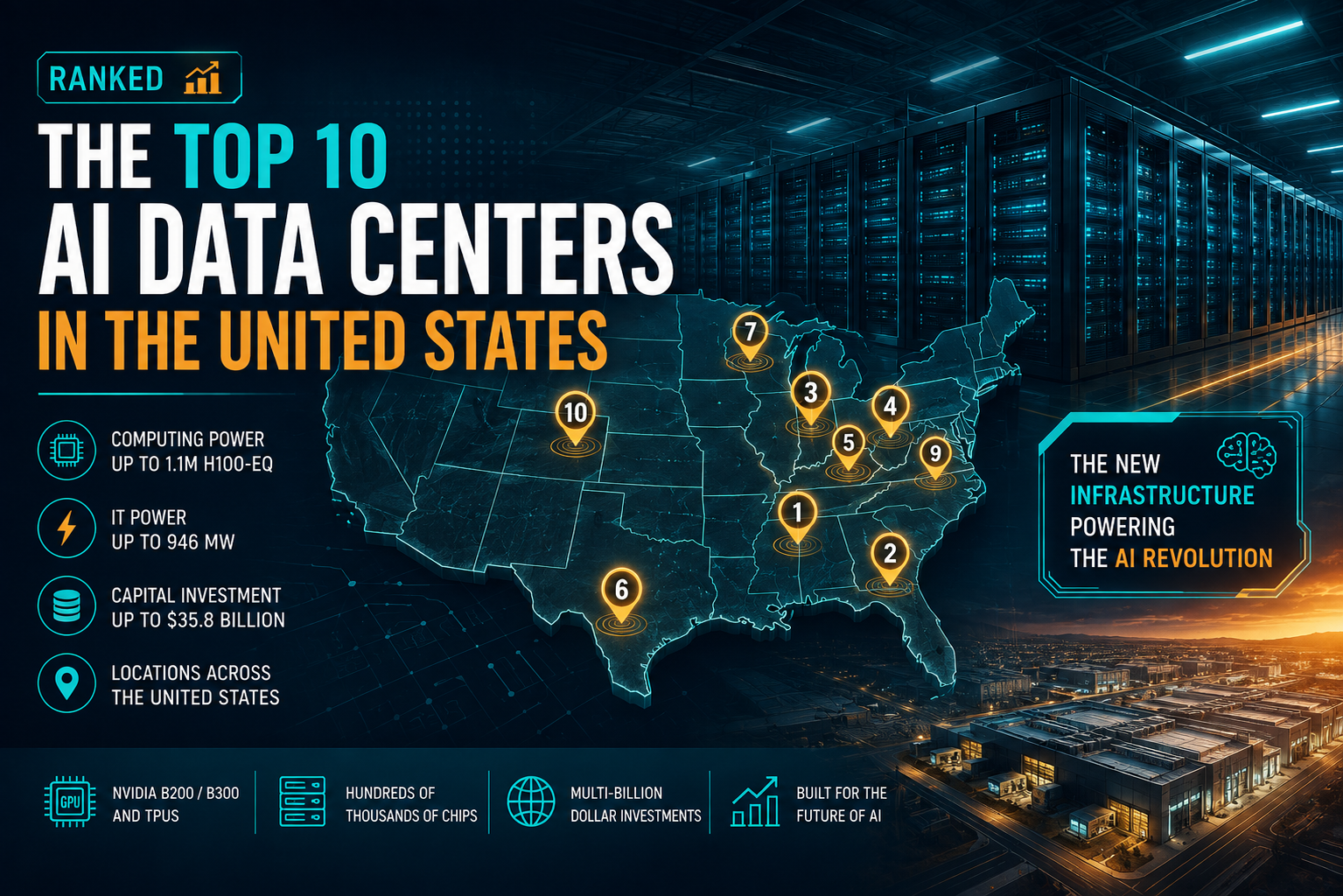
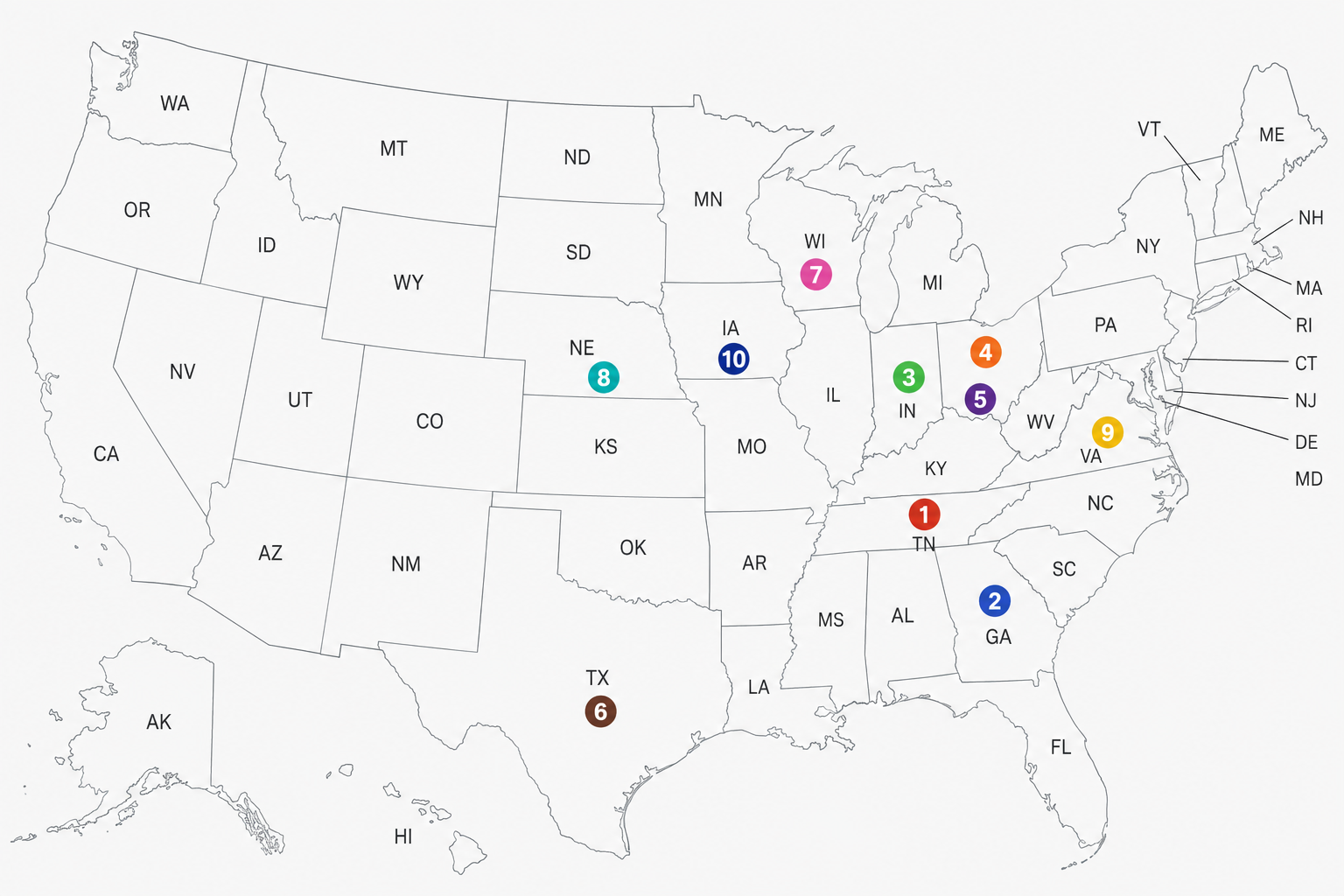
To see what this computing footprint looks like on the ground, the overview below breaks down ten of the largest AI data center facilities operating across the United States.
This dataset tracks key operational metrics for each facility, including total IT power capacity in megawatts (MW), estimated capital expenditure, and the primary chip architectures driving their workloads—ranging from NVIDIA’s Blackwell series (B200/B300) to custom hardware like Google TPUs and Amazon Trainium2 accelerators. It also details the tech giants owning and operating these sites (including xAI, Microsoft, Amazon, Meta, and Google), their primary AI partners, and their overall compute scale measured in H100 equivalents.
(Note: Data reflects available industry updates; certain figures for sites like Google New Albany are based on conservative estimates due to limited public disclosure).
| Rank | AI Data Center | Location | Owner / Operator | Tenant / AI User | Status | Operational Since | AI Chips / GPUs | Chip Count | H100-eq Compute | IT Power | Capital Cost | Coordinates | Google Earth |
|---|---|---|---|---|---|---|---|---|---|---|---|---|---|
| 1 | Colossus 2 | Memphis, Tennessee | SpaceXAI | Anthropic, Cursor, SpaceXAI | Operational | 2026 | NVIDIA B200 / B300 | — | 1,112k | 946 MW | $35.8B | 34.9980, -90.0349 | View |
| 2 | Microsoft Fairwater Atlanta | Fayetteville, Georgia | Microsoft | OpenAI (likely), Microsoft (likely) | Operational | 2026 | NVIDIA B200 | 304.3k | 769k | 636 MW | $24.1B | 33.4486, -84.5222 | View |
| 3 | Anthropic-Amazon New Carlisle | New Carlisle, Indiana | Amazon | Anthropic | Operational | 2026 | Amazon Trainium2 | 1,045k | 686k | 910 MW | $34.5B | 41.6933, -86.4608 | View |
| 4 | Meta Prometheus | New Albany, Ohio | Meta | Meta | Operational | 2026 | NVIDIA B200 | — | 763k | 631 MW | $23.9B | 40.081, -82.809 | View |
| 5 | Google New Albany | New Albany, Ohio | Google DeepMind (speculative) | Operational | — | Google TPU v5e / v5p / v6e / v7 | — | 352k | 453 MW | $17.2B | 40.0582, -82.7657 | View | |
| 6 | OpenAI Stargate Abilene | Abilene, Texas | Oracle | OpenAI | Operational | 2025 | NVIDIA B200 / B300 | 201.6k | 509k | 421 MW | $15.9B | 32.475*, -99.82* | View |
| 7 | Microsoft Fairwater Wisconsin | Mount Pleasant, Wisconsin | Microsoft | OpenAI (likely), Microsoft (likely) | Operational | 2026 | NVIDIA B200 | 176.4k | 446k | 369 MW | $14.0B | 42.6951, -87.9238 | View |
| 8 | Google Lincoln | Lincoln, Nebraska | — | Operational | May 12, 2026 | Not disclosed | — | 288k | 141 MW | $5.3B | — | Search | |
| 9 | Google Bristow | Bristow, Virginia | Google DeepMind | Operational | May 20, 2026 | Google TPU v5e / v5p / v6e / v7 | 400.1k | 284k | 279 MW | $10.6B | 38.7665, -77.5263 | View | |
| 10 | Google Council Bluffs (East) | Council Bluffs, Iowa | Google DeepMind (speculative) | Operational | July 7, 2026 | Google TPU v5e / v6e / v5p / v7 | 316.2k | 335k | 237 MW | $9.0B | 41.228*, -95.86* | View |
FAQ
Q1: What facility is currently taking the crown for the biggest AI data center in the US?
Colossus 2 down in Memphis, Tennessee (operated by xAI) is sitting at the top spot. It pulls a massive 946 MW of IT power and pushes around 1,112k H100-equivalent compute, leaning heavily on NVIDIA's B200 and B300 hardware.
Q2: Are we really seeing near-gigawatt power draws on these single sites?
Pretty much. Colossus 2 is knocking right on the door of 1 GW at 946 MW, and the Anthropic-Amazon facility in New Carlisle isn't far behind at 910 MW. These setups consume as much juice as small cities, which is why they're built near stable nuclear and fossil-fuel energy grids.
Q3: Is NVIDIA running a total monopoly on the chips inside these builds, or are custom ASICs and TPUs actually making a dent?
NVIDIA’s Blackwell series dominates a lot of the major spots (like Meta Prometheus and Microsoft's Fairwater sites), but custom silicon has a massive footprint. Amazon's New Carlisle site is packed with over a million Trainium2 accelerators, and Google's facilities in Bristow and Council Bluffs rely heavily on their in-house TPU v5e, v6e, and v7 architectures.
Q4: Who is actually footing the bill for these multi-billion dollar buildouts?
The usual tech giants and hyperscalers. Microsoft, Amazon, Meta, Google, and xAI are driving the capital expenditure. Facilities like Microsoft Fairwater Atlanta cost upwards of $24.1 billion, while Colossus 2 tops out near a staggering $35.8 billion.
Q5: How are they measuring total compute scale when everyone is using completely different hardware?
Engineers use the "H100-equivalent" (H100-eq) metric to normalize things. Since comparing raw specs across NVIDIA GPUs, Google TPUs, and custom Amazon chips gets messy, this metric standardizes the output so everyone can easily track who actually has the most processing horsepower.
Note: Some values have been updated by the source after the figures originally supplied. For Google New Albany and a few site coordinates, the available public data does not provide a sufficiently clear current site-level figure, so these values should be treated as estimates rather than exact measurements.