Introduction
Cold wallets are built to shield your private keys even if the PC or smartphone you plug them into is crawling with malware. But there's another security threat that catches a lot of users off guard: what if someone physically tampers with the device before it ever reaches your hands?
That’s why physical integrity matters just as much as key isolation. A hardware signer can look brand new out of the box while hiding unauthorized internal mods that were never part of the original factory design.
Physical Supply Chain Attacks: Hardware Implants & Malicious Interceptors
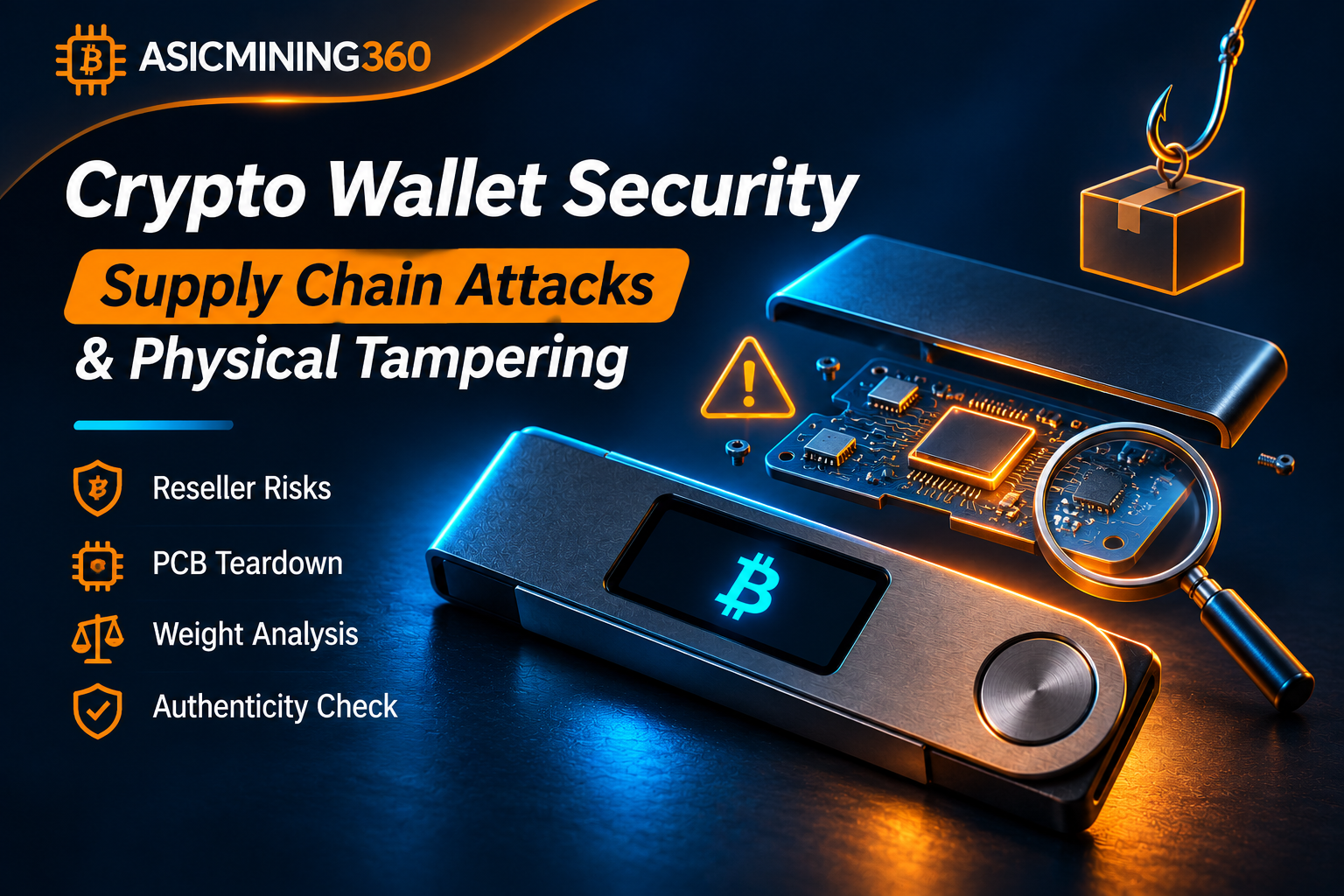
Recent reports of physical hardware implants in Ledger signers bought through third-party resellers have exposed a threat that goes beyond software bugs. In these supply-chain attacks, attackers opened genuine devices and soldered extra components onto the circuit board—specifically designed to siphon off recovery phrases during initial setup.
The core threat here is simple: if an attacker gets hold of your recovery phrase, they control your crypto. Depending on how the implant is wired, it might sniff out sensitive data across internal traces, tamper with inter-component communications, or log recovery words as they're generated on screen.
This doesn't mean every reseller unit out there is compromised, nor does it mean Ledger’s overall hardware architecture is fundamentally broken. What it does highlight is that where you buy your cold wallet—and whether its physical internals remain untouched—matters just as much as its software code.
Supply Chain Integrity: Reseller Risks & Genuine Check Cryptographic Attestation
The safest starting point is to purchase directly from the manufacturer's official website or an authorized reseller listed by the company.
Buying from an unknown marketplace seller introduces additional uncertainty. A genuine wallet could have been intercepted, opened, modified, and repackaged before being sold as new. Even convincing packaging, intact-looking seals, and familiar branding cannot independently establish that the device has remained untouched throughout its distribution.
After purchase, use the manufacturer's official software and follow its authenticity-verification procedure. For Ledger devices, the Genuine Check verifies the authenticity of the device's secure element. However, Ledger acknowledges that this check cannot detect every unauthorized physical modification if the original secure element remains intact.
Never enter your recovery phrase into a website, computer application, or message claiming to verify your wallet. The recovery phrase must remain secret.
PCB Teardown Inspection: Identifying Unexpected Microcontrollers & Test Pads
For technically experienced users, inspecting a device's internal electronics can provide another layer of evidence. The aim is to compare the actual hardware against the manufacturer's official component images and documentation.
Pay attention to the following:
-
Unexpected chips: Additional integrated circuits that do not appear in the manufacturer's reference images may warrant investigation.
-
Unusual wires or soldering: Extra wires, irregular solder joints, unexplained connections, or signs of rework can indicate that a circuit board has been modified.
-
Altered connections: Pay particular attention to the connections between the display, the main circuit board, and other communication interfaces.
-
Physical damage or adhesive inconsistencies: Scratches, damaged clips, disturbed adhesive, or tool marks may suggest that a device has been opened. These signs are not proof of malicious activity on their own.
-
Differences from official reference images: Compare both sides of the circuit board, the location of the main chips, and the overall component layout. Manufacturing revisions can produce legitimate differences, so unexplained variations should be checked against the correct hardware revision.
A small malicious circuit may be difficult to distinguish from legitimate electronics without technical expertise. A clean-looking board is therefore not proof that a wallet is safe.
Volumetric & Weight Analysis: Precision Mass Verification in Cold Storage
Weight can be useful as a secondary screening method, but it should never be treated as an authenticity test.
In theory, soldering extra chips onto a board increases a wallet's overall mass. In reality, modern micro-implants are so lightweight that the difference is easily lost within standard manufacturing variances—such as slight batch differences in batteries or plastic housing.
If you're using weight as a diagnostic check, grab a high-precision digital scale and weigh the bare device without any attached cables or keyrings. Compare that number against official factory specs or a confirmed authentic unit from the same production run.
Just don't rely on the scale as a silver bullet. A slight variation doesn't automatically mean your device was intercepted, and a perfect match doesn't mean it's safe—sophisticated fake or tampered devices are often engineered to match factory weight down to a tee.
Hardware Teardown Benchmarks: Nano X, Nano S Plus, Flex & Stax Analysis
To illustrate what internal inspection involves, I examined four Ledger models: the Nano X, Nano S Plus, Flex, and Stax. Each has a different physical design, so the way its enclosure opens and its internal components are arranged also differs.
Ledger Nano X: Packed into its small housing are the main logic board, screen assembly, internal battery, and swivel cover. Your main priority during an inspection should be comparing the circuit board and its connections directly against verified reference images for that specific production batch.
Ledger Nano S Plus: Because the S Plus uses a completely different enclosure and board design, you'll want to inspect both sides of the bare PCB. Watch closely for unexplained micro-chips, added wiring, or any evidence of manual soldering that shouldn't be there.
Ledger Flex: With its larger touchscreen format, the Flex packs in more internal hardware—including extra module connectors, battery assemblies, and an integrated NFC antenna. Because there are more moving parts inside, taking clear photos at every step and cross-checking them against a verified unit is especially important.
Ledger Stax: Its curved E Ink display and more complex internal assembly make disassembly especially challenging. Opening the device can damage its enclosure, adhesive, connectors, or other components. Unless you have the necessary experience, leave internal inspection to a qualified technician.
In every case, the objective is not to assume that a particular chip or wire is malicious. It is to establish whether the device's actual hardware matches the manufacturer's documentation and to investigate any unexplained differences.
Engineering Risk Assessment: Physical Disassembly vs. Cryptographic Security
In short, trying to crack open a hardware wallet usually does more harm than good. You run a real risk of breaking sensitive connectors, exposing the board to static electricity, or ruining the casing—all while voiding your warranty.
For standard self-custody, your best line of defense is far simpler: buy straight from the official source, run the manufacturer’s cryptographic check, keep your firmware updated, and protect your seed phrase like gold. Leave the physical teardowns to hardware engineers.
Ultimately, a hardware signer is only as safe as its physical journey to your desk. Taking basic supply-chain precautions upfront is what actually keeps your crypto secure.