Real-World HGX B300 Deployments: Pricing, Lead Times & TCO Insights
Beyond benchmark charts and manufacturer specifications, some of the most useful information about high-end AI servers comes from people discussing what it is actually like to deploy and operate them.
We looked through discussions from AI infrastructure, HPC, and local AI communities, and one thing quickly became clear: people are not only interested in how fast the B300 is. They are asking much more practical questions.
How much does the complete system cost? How difficult is it to get one? How much power does it need? And what happens when you have to run it continuously?
One discussion from an AI-focused community came from a company considering an HGX B300 for its own model deployment. The discussion was less about benchmark numbers and more about the economics of owning the hardware. The poster estimated that the machine itself could cost around €1.1 million in their case and pointed out that purchasing the server was only the beginning. Space, maintenance, engineering time, and the relatively short hardware-generation cycle all had to be considered.
That is an important perspective.
A B300 server can provide an enormous amount of inference capacity, but the economics are very different from buying a normal workstation. When a system costs hundreds of thousands of dollars or more, utilization becomes extremely important. An organization that keeps the GPUs busy throughout the day can potentially make much better use of the investment than a company that only runs occasional experiments.
Availability is another recurring topic.
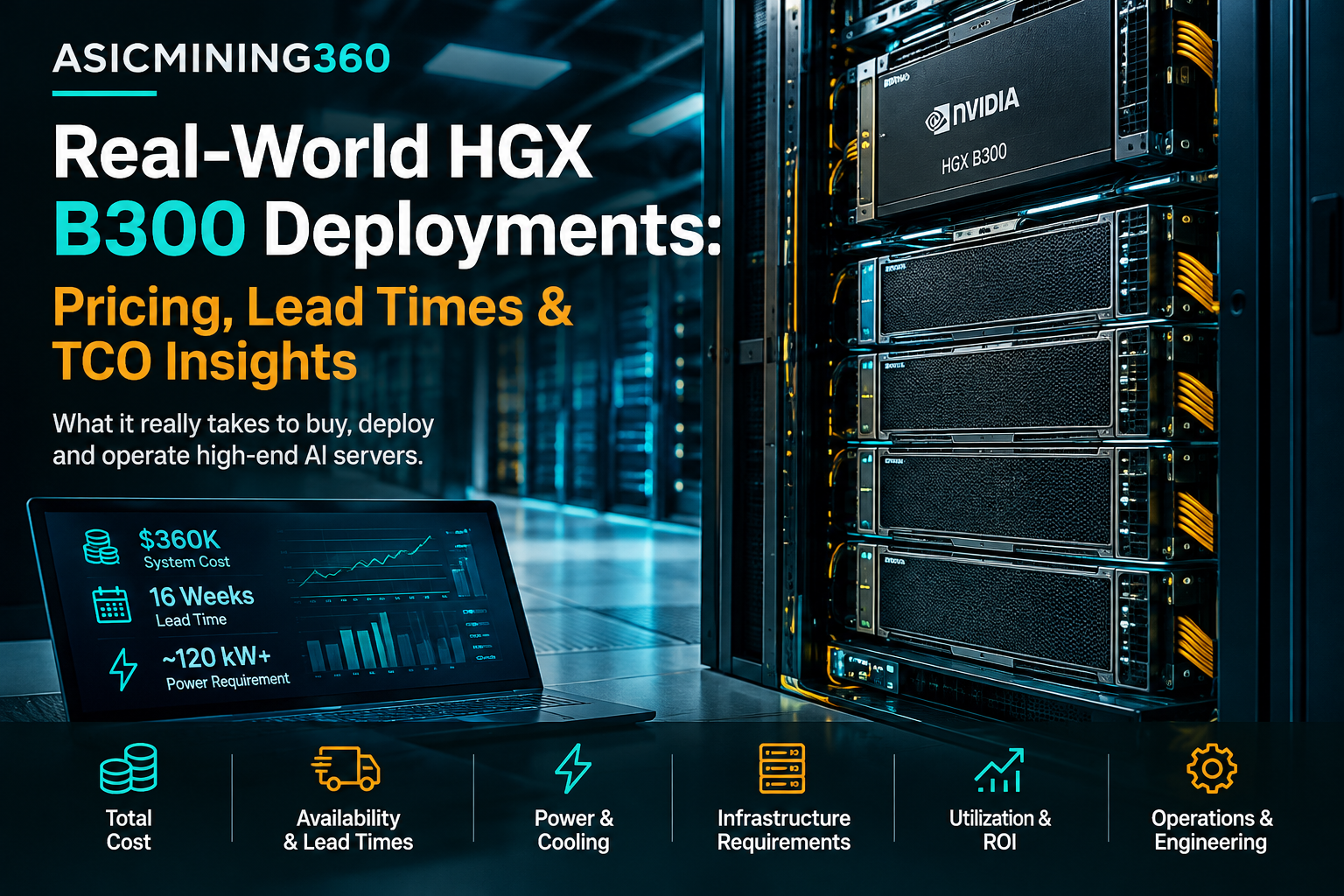
In an HPC discussion, users were comparing prices for eight-GPU B300 systems and discussing delivery times. One participant reported ordering an 8-way B300 system for around $360,000 with a reported 16-week delivery time. Other participants were considering different architectures because of the cost and availability of HGX systems.
These discussions also show why the price of the GPU itself is not the only number buyers should consider.
Data Center Power Density & Cooling Bottlenecks for B300 Racks
Another recurring theme in community discussions is power.
With previous generations of GPUs, infrastructure teams already had to pay close attention to electrical capacity and cooling. B300-class systems push that problem considerably further.
One discussion specifically focused on deploying high-power B300 GPUs and asked whether power delivery or cooling was becoming the bigger bottleneck. The responses emphasized that the supporting infrastructure can become just as challenging as the GPUs themselves. The discussion mentioned high rack-level power requirements, power distribution, thermal management, monitoring, and failure detection.
This is something that can easily be overlooked when looking at a product page.
A specification sheet tells you how many GPUs are inside the server. It does not tell you whether your existing rack, electrical system, air conditioning, PDUs, and facility cooling infrastructure can actually support it.
For a large AI deployment, these questions need to be answered before the server arrives.
Evaluating AI Capacity per Dollar: Concurrency ROI & Software Optimization
Another interesting point from these discussions is that users increasingly think about AI servers in terms of capacity per dollar, rather than simply peak GPU performance.
For example, an inference provider may care more about how many concurrent users a system can support than about how quickly it can generate tokens for a single user.
This changes the way a machine such as the X9000 should be evaluated.
If the server can keep a large model in GPU memory and serve many users simultaneously, its value comes from the amount of useful work it can perform throughout the day.
That is also why software optimization matters so much.
A poorly configured multi-GPU deployment can waste a considerable amount of expensive hardware. Efficient batching, model parallelism, memory management, networking, and inference software can make a substantial difference.
The community discussions reinforce the same point we see in benchmark testing: the hardware is only one part of the equation.
Enterprise Buyer Checklist: 6 Practical Feasibility Factors for B300 Rigs
The overall impression from these conversations is surprisingly consistent.
People who are seriously considering B300 systems are not questioning whether the GPUs are powerful enough. That part is already well established.
Their concerns are more practical:
Can we afford the system?
Can we actually obtain one?
Can our facility provide enough power?
Can we remove the heat reliably?
Will we have enough utilization to justify the investment?
And do we have the engineering resources to operate it properly?
Those are arguably more important questions for a business than another peak benchmark result.
For a company building an AI inference platform, an eight-B300 server can be an extremely powerful piece of infrastructure. But it also represents a serious commitment to power, cooling, networking, maintenance, and software engineering.
That is perhaps the biggest lesson from the wider AI infrastructure community: buying the GPUs is only the beginning.
The real challenge is turning all that hardware into a reliable service that stays busy, stays cool, and delivers enough useful inference capacity to justify its cost.
FAQ on NVIDIA HGX B300 Server Deployments
Q1: What’s the real-world price tag and lead time on an 8-way NVIDIA HGX B300 server?
A: Depending on your exact spec—HBM memory configuration, InfiniBand or Spectrum-X networking, and vendor SLAs—an 8-GPU HGX B300 system typically lands anywhere between $360,000 and €1.1M+. On the delivery front, don't expect off-the-shelf speed: global allocation and supply chain demand keep lead times hovering around 16 weeks from PO to rack deployment.
Q2: Which hits first: power limits or cooling bottlenecks?
A: It’s a neck-and-neck race. B300-class nodes push rack-level power density into territory that instantly overwhelms legacy air-cooled data centers. You can't just plug an HGX B300 into a standard rack—you need to audit your facility’s MW capacity, verify PDU headroom, and ensure your direct-to-chip (D2C) or liquid cooling loops can handle continuous high-wattage thermal loads long before the hardware arrives.
Q3: Why shouldn't you buy an 8-GPU B300 rig based on "peak tokens per second"?
A: Single-user peak benchmarks are vanity metrics—they measure speed when a single prompt has the entire system to itself. In production, enterprise AI is about concurrency per dollar. A fast single stream means nothing if the server chokes when 50 employees or API clients hit it at once. The real value of an 8-GPU B300 lies in its aggregate throughput, KV cache management, and ability to keep latency stable across high-batch parallel streams.
Q4: What hidden Opex line items eat into the budget after you buy the hardware?
A: The sticker price is just the entry ticket. True Total Cost of Ownership (TCO) is driven up by continuous MW-scale power bills, facility cooling overhead (PUE), high-density rack space, and the ongoing software engineering time required to tune inference engines like vLLM or TensorRT-LLM. Factor in an aggressive 3-year GPU depreciation curve, and your operational costs quickly rival your initial Capex.
Q5: How do you actually justify dropping $500k+ on B300
infrastructure?
A: Compute saturation is everything. Because fixed acquisition and facility overheads are so steep, letting these GPUs sit idle on intermittent dev experiments is a money pit. You justify the Capex by locking in high, continuous workload density—serving enterprise-wide coding assistants, RAG document pipelines, or commercial inference APIs—where the effective cost per token drops dramatically at scale.