Introduction
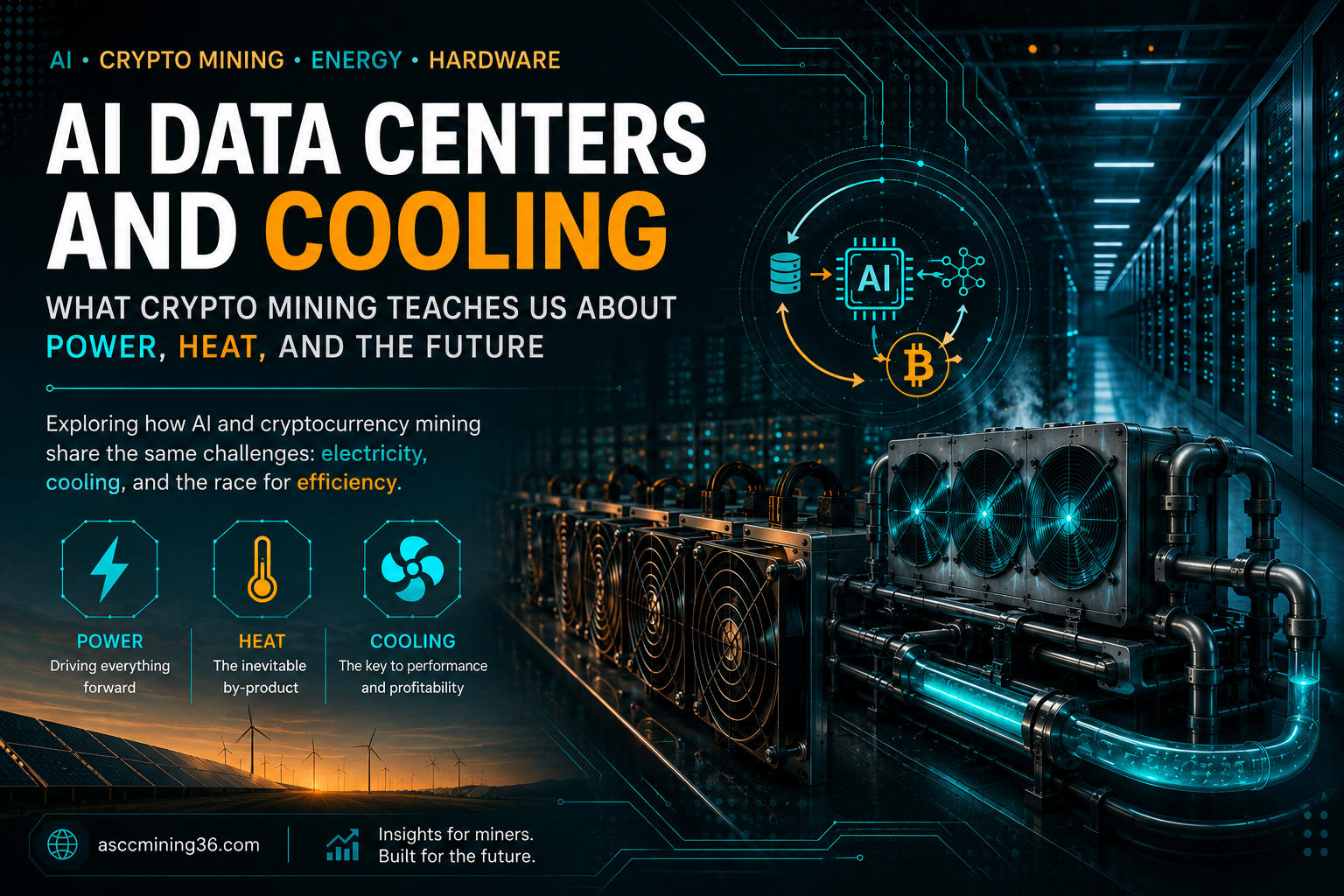
Although our work focuses primarily on cryptocurrency mining, ASIC hardware, mining profitability, and the energy costs behind running these machines, artificial intelligence is becoming increasingly difficult to separate from the same physical infrastructure that supports large-scale mining.
At first glance, AI and cryptocurrency mining appear to belong to completely different worlds.
Artificial intelligence is being used to write, design, analyze, automate, and perform tasks that once required human labor and decision-making. Cryptocurrency mining, meanwhile, is part of a digital financial system built around cryptography, decentralized networks, and specialized machines that use computing power to secure and maintain blockchains.
But beneath the software, the algorithms, the models, and the blockchains, the two industries share more than it might seem.
Both are part of a much larger technological transition.
For centuries, economic development was driven primarily by mechanical industry. Factories, engines, steel, machines, and physical production defined the industrial world. Then came the electronic and information age, when semiconductors, computers, and the internet changed the way people communicated, worked, and exchanged information.
Now, another layer is being built on top of that digital infrastructure.
Artificial intelligence is pushing automation into areas that were once considered uniquely human. At the same time, cryptocurrencies introduced the idea that parts of a financial system could operate through decentralized networks rather than relying entirely on traditional centralized institutions.
These two technologies are obviously not trying to solve the same problem. But both depend on something extremely physical.
Electricity: The Physical Foundation Behind AI and Cryptocurrency Mining
Cryptocurrency mining is already known for its large electricity requirements. A mining farm can operate thousands of ASIC miners continuously, 24 hours a day, converting electricity into computational work and, inevitably, heat.
Artificial intelligence is creating a similar challenge.
The race to build more powerful AI models is driving the construction of increasingly large data centers filled with GPUs, TPUs, CPUs, memory, networking equipment, and other high-density computing infrastructure. The largest of these facilities now require hundreds of megawatts of power for their IT equipment alone, while future projects are increasingly being discussed at the gigawatt scale.
And that leads to another major connection between cryptocurrency mining and artificial intelligence:
Cooling: The Second Major Challenge Shared by AI Data Centers and Mining Operations
Whether it is an ASIC miner operating inside a mining farm or a high-performance GPU processing AI workloads inside a hyperscale data center, electricity eventually becomes heat.
If that heat is not removed efficiently, hardware performance can fall, components can degrade, and equipment can eventually fail.
For a cryptocurrency mining operation, cooling can directly influence profitability. Excessive temperatures can reduce efficiency, increase failure rates, and force operators to spend more on ventilation, fans, or air conditioning.
For artificial intelligence, the same physical problem exists, but on an entirely different scale.
Instead of thousands of ASIC miners, some AI facilities are now operating or planning to operate hundreds of thousands of advanced processors. These machines generate enormous quantities of heat, and that heat has to be removed continuously if the infrastructure is expected to operate reliably.
In that sense, AI data centers and cryptocurrency mining farms are solving a surprisingly similar problem.
- Both depend on electricity-intensive hardware.
- Both generate large amounts of heat.
- And both require cooling systems capable of operating continuously, often every hour of every day throughout the year.
The difference is mainly one of scale.
A large mining farm may contain thousands or even tens of thousands of machines. The largest AI data centers are increasingly becoming industrial-scale computing facilities measured in hundreds of megawatts of IT power.
That makes them an important place to look if we want to understand where the future of high-density computing—and industrial-scale cooling—is heading.
So, while this article comes from a website primarily focused on cryptocurrency mining and mining hardware, the subject is much closer to our industry than it may initially appear.
The same questions that matter to a mining operator are becoming increasingly important for AI companies:
- How much electricity does the hardware consume?
- How much additional infrastructure is required simply to manage the heat?
- Is it better to rely on air, water, or more advanced cooling systems?
- And as computing density continues to increase, can traditional cooling technologies continue to keep up?
To understand the problem, imagine something much simpler.
Imagine opening an AI image generator and typing a prompt. A few seconds later, an image appears on your screen. From the user's perspective, the process feels almost weightless. You type a few words, wait briefly, and receive an image.
But somewhere else, in a physical data center, that request has triggered a chain of calculations.
Powerful processors begin working alongside thousands of other requests. GPUs and other AI accelerators consume electricity as they perform billions or trillions of calculations. The hardware generates heat. The servers become hotter. And at the same time, another enormous system begins doing its job quietly in the background.
The cooling infrastructure.
Without it, the machines processing those requests would eventually become too hot to operate safely.
Why AI Data Centers Need So Much Cooling
Cooling has been part of computing since the earliest generations of electronic machines.
Some of the first large computers built during the 1940s relied on vacuum tubes that generated significant amounts of heat. Fans and ventilation systems were already necessary to prevent the equipment from overheating.
Modern AI processors are incomparably more powerful, but the underlying problem has not changed.
Electricity enters the machine. The machine performs calculations. And a significant amount of that energy eventually becomes heat.
What has changed is the scale of the infrastructure.
Instead of cooling a room containing a relatively small number of computers, companies are now building massive AI clusters containing hundreds of thousands of processors.
The largest facilities are no longer simply "server rooms." They are industrial computing complexes filled with high-density racks, power systems, networking infrastructure, and enormous cooling equipment.
This is why cooling has become one of the central challenges behind the rapid expansion of artificial intelligence.
The problem is no longer just how to keep a processor cool. It is how to continuously remove enormous quantities of heat from a facility consuming hundreds of megawatts of electricity.
The Two Main Cooling Approaches Used in Large AI Data Centers
There are several ways to cool modern computing hardware.
Some facilities rely primarily on air. Others use water-based or evaporative systems. Newer approaches are bringing liquid directly to the hottest processors, while more experimental designs can immerse entire servers in specially engineered non-conductive fluids.
However, when we examined several of the largest and most prominent AI data centers associated with major technology companies, two cooling approaches appeared repeatedly: air-based cooling and evaporative cooling.
Air Cooling: Reducing Water Dependence
Air cooling remains one of the most widely used approaches in large data centers.
At the hyperscale level, this does not simply mean placing fans around servers. Facilities can use large air-cooled chillers, condensers, industrial fans, and other mechanical systems to transfer heat away from computing equipment and eventually release it into the surrounding environment.
The advantage is that these systems can reduce dependence on large quantities of water.
But there is a trade-off.
Moving and conditioning massive volumes of air requires substantial infrastructure and electricity, particularly when temperatures outside the facility are high.
A data center located in a hot climate may have to work significantly harder to maintain the same operating temperatures.
Evaporative Cooling: Trading Electricity for Water
Another widely used approach is evaporative cooling.
These systems take advantage of the physical cooling effect created when water evaporates. Cooling towers transfer heat away from the data center's cooling infrastructure, allowing water to absorb and carry away thermal energy.
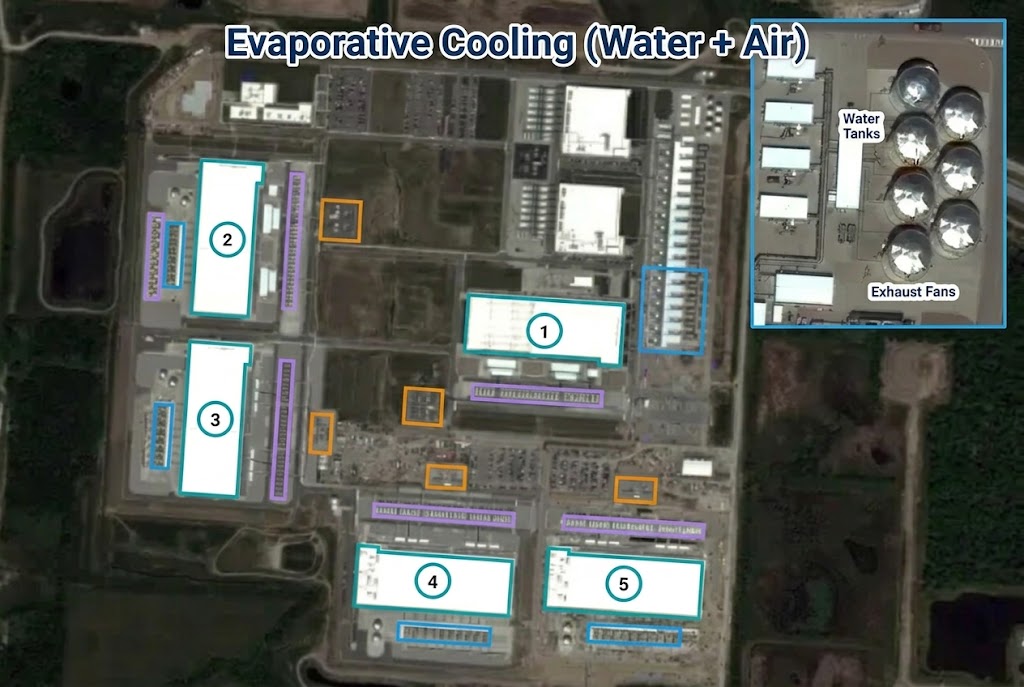
In suitable conditions, this can reduce the amount of electricity required for mechanical cooling compared with systems that depend more heavily on compressors and refrigeration.
But the trade-off shifts from electricity toward water.
This creates an important environmental question.
A cooling strategy that performs efficiently in a region with abundant water may be much more controversial in an area facing water scarcity.
The AI industry is already beginning to encounter this tension.
As more large data centers are built, operators must increasingly consider not only where electricity is available, but also where the infrastructure can be cooled without placing excessive pressure on local resources.
A recent example of this debate can be seen in the United States, where the rapid expansion of data centers has increased concern over their impact on local electricity grids and water supplies. In some regions, new facilities are becoming large enough to compete directly with other users for infrastructure that was never designed around the arrival of massive AI computing clusters.
The central problem is simple: the larger the computing infrastructure becomes, the more heat has to be removed.
How Four Major AI Data Centers Are Cooled
To see what this looks like in practice, we examined several large and well-known AI data centers associated with some of the biggest companies in artificial intelligence and cloud computing.
The comparison below focuses on the estimated IT power of each facility and the estimated capacity of its cooling infrastructure.
| Data Center | Location | Estimated IT Power | Cooling Type | Cooling Infrastructure | Estimated Cooling Capacity | Cooling Capacity Relative to IT Power* |
|---|---|---|---|---|---|---|
| Colossus 2 | Memphis, Tennessee, United States | 946 MW | Air-based cooling | 217 air-cooled chillers and 153 air-cooled condensers | 703 MW | 74.3% |
| Microsoft Fairwater Atlanta | Fayetteville, Georgia, United States | 636 MW | Air-based cooling | 672 air-cooled chillers | 794.9 MW | 125.0% |
| Google New Albany | New Albany, Ohio, United States | 453 MW | Evaporative cooling | 80 evaporative cooling towers | 605.6 MW | 133.7% |
| Google Bristow | Bristow, Virginia, United States | 279 MW | Evaporative cooling | 40 evaporative cooling towers | 413.9 MW | 148.4% |
The final column compares the estimated cooling capacity of the installed equipment with the facility's estimated IT power. It is important to note that this percentage does not represent the actual electricity consumed by cooling, as capacity and energy consumption are two different measurements. The variation in these percentages across facilities (such as Colossus 2 at 74.3% versus others exceeding 120%) generally reflects differences in structural engineering, operational phases, ongoing expansions, and local climate conditions. Actual cooling electricity use will always fluctuate based on weather, temperature, humidity, season, workload, and equipment efficiency.
When we look at some of the biggest AI data centers, one thing stands out: even with all the hype around liquid and immersion cooling, traditional air and evaporative systems are still the backbone of massive AI facilities.
What the Numbers Actually Mean
The comparison shows just how large cooling infrastructure has become.
Colossus 2 in Memphis, for example, operates at an estimated IT power approaching one gigawatt. Supporting that level of computing requires a massive collection of cooling equipment.
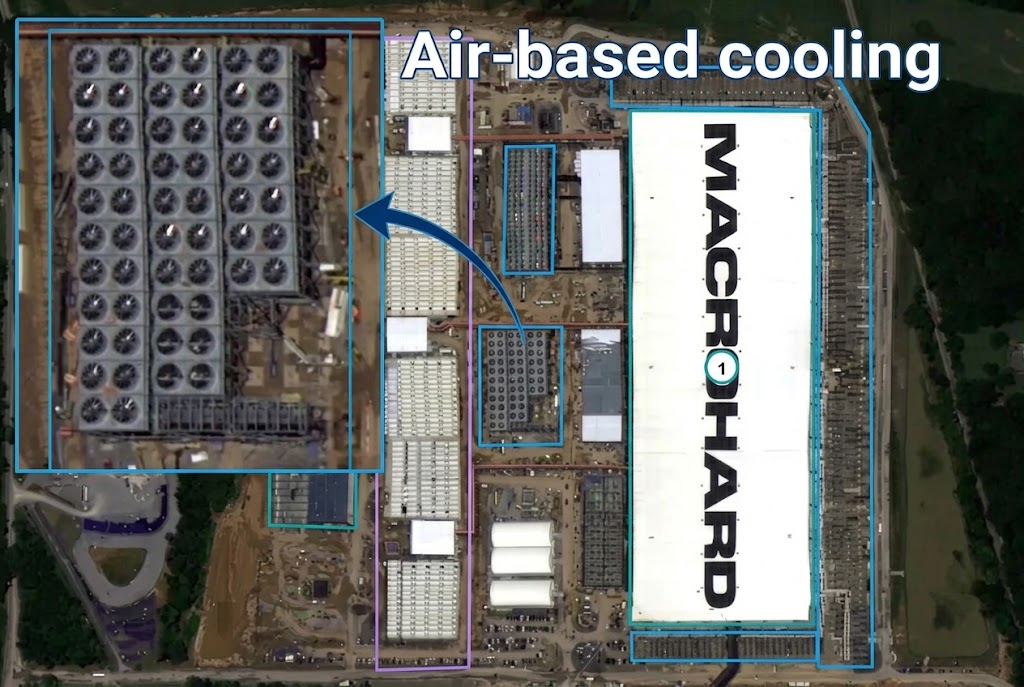
Microsoft Fairwater Atlanta follows a similar pattern. The facility supports hundreds of megawatts of IT infrastructure and is associated with hundreds of air-cooled chillers.
Google's New Albany and Bristow facilities use a different approach, relying on evaporative cooling towers rather than primarily air-cooled equipment.
The technologies differ, but the underlying challenge remains the same.
AI hardware generates heat, and that heat has to go somewhere. Because capacity requirements and environmental conditions vary so widely, there is no single universal answer to the question of how much electricity a data center uses for cooling.
Why Aren't Immersion Cooling and Direct-to-Chip Cooling Everywhere Yet?
The data center industry is not limited to air cooling and evaporative cooling.
More advanced alternatives already exist. One of them is direct-to-chip liquid cooling.
Instead of attempting to cool an entire server room with large volumes of cold air, a liquid cooling loop can be brought directly to the components producing the most heat.
Cold plates attached to high-performance processors absorb heat and transfer it into a circulating liquid.
This approach makes sense as AI hardware becomes increasingly dense. Air is relatively limited in how much heat it can transport. Liquids, on the other hand, can move significantly larger amounts of thermal energy through a smaller volume.
Another, even more radical approach is immersion cooling.
Instead of attaching cooling plates only to the hottest chips, entire servers can be placed inside specially engineered dielectric fluids. Ordinary water would destroy electronic hardware, but dielectric cooling fluids are designed specifically to remove heat without conducting electricity in the same way.
In theory, immersion cooling can reduce or eliminate the need for traditional server fans and allow computing hardware to be packed more densely.
It sounds like an obvious solution for increasingly powerful AI systems.
But after looking at several of the largest and most prominent AI data centers associated with major technology companies, something interesting becomes clear.
The facilities examined for this article still rely primarily on more established large-scale cooling infrastructure. The systems identified in these major facilities were based on air-cooled equipment or evaporative cooling towers.
That does not mean direct-to-chip cooling or immersion cooling do not exist. Both technologies are already being developed and used in different parts of the industry.
However, they have not yet become the dominant cooling architecture across the large AI facilities examined here. In other words, AI hardware is moving forward extremely quickly, while the physical infrastructure surrounding it is still undergoing its own transition.
The Electricity and Water Trade-Off Behind AI Cooling
There is no perfect cooling technology.
Air-based cooling can reduce dependence on water, but it may require substantial amounts of electricity to move and condition air. Evaporative cooling can reduce some of the energy required for mechanical refrigeration, but it depends on water.
Direct-to-chip liquid cooling can remove heat more efficiently from extremely powerful processors, but it requires new infrastructure, plumbing, pumps, heat exchangers, and hardware designed to support the system.
Immersion cooling takes the concept even further, but it introduces its own engineering, maintenance, and operational challenges.
Every cooling system is therefore a compromise.
The real question is not simply which technology is "best." It is which combination of electricity, water, climate, hardware, and infrastructure produces the most efficient result in a specific location.
A cooling system that works extremely well in a cool region may perform very differently in a hot and dry climate.
The same data center can also experience different cooling requirements in winter and summer, or during periods of low and extremely high computing demand. That makes cooling one of the most location-dependent parts of AI infrastructure.
Cooling the Chip Instead of Cooling the Entire Building
One possible direction for the future is to focus cooling efforts more directly on the components generating the heat.
Modern AI accelerators are becoming increasingly powerful, and their energy consumption is concentrated into increasingly dense systems.
Instead of filling an entire data hall with cold air, operators may increasingly use liquid systems designed to remove heat directly from GPUs, TPUs, and other high-power chips.
This could make cooling more efficient at extremely high rack densities. But even then, the heat does not disappear.
The liquid absorbs it. The heat is transported elsewhere. And eventually, it still has to be released into the environment through another cooling system.
The problem changes, but it does not disappear.
Why Cooling Could Become One of AI's Biggest Infrastructure Challenges
The growth of artificial intelligence is often discussed in terms of models, algorithms, GPUs, and computing power.
Cooling receives far less attention.
But every additional megawatt of computing capacity creates more heat that must be removed.
As companies move toward increasingly large AI clusters, the infrastructure supporting those processors must grow with them.
That includes chillers, cooling towers, fans, pumps, heat exchangers, power conversion systems, and increasingly complex methods of transporting heat away from densely packed computing hardware.
The real energy footprint of artificial intelligence is therefore larger than the electricity consumed by the processors alone.
The chips are only one part of the system. And this is where the connection with cryptocurrency mining becomes particularly clear.
Mining operators have spent years dealing with the same fundamental problem. More electricity means more heat. More machines mean more cooling. And inefficient cooling can affect the economics of the entire operation.
AI companies are now confronting the same physical limitations, but at a scale that may eventually exceed anything seen in traditional cryptocurrency mining.
The machines may be different. The workloads may be different. But thermodynamics remains the same.
Can AI Reduce Its Own Cooling Problem?
Building larger cooling systems is not the only possible solution.
Another approach is to reduce the amount of unnecessary computation before that electricity is converted into heat.
AI workloads could potentially be shifted toward cooler periods of the day or toward regions where climate conditions reduce the amount of mechanical cooling required.
Data centers could also be located closer to more suitable sources of low-carbon electricity or in areas where water resources can support evaporative cooling without creating significant pressure on local communities.
Model efficiency matters as well.
Not every task requires the largest available AI model. Smaller and more specialized models can sometimes perform specific tasks with far less computing power.
Better algorithms, more efficient processors, and smarter workload management could all reduce the amount of energy that eventually becomes heat.
The cheapest megawatt, after all, is the one that never has to be generated.
And the easiest heat to remove is the heat that was never produced in the first place.
Conclusion: The Shared Physical Future of AI and Crypto Mining
Ultimately, the physical link between artificial intelligence and cryptocurrency mining is undeniable. The innovations being developed to sustain the immense power generation and thermal management needs of AI data centers are the exact same technologies that can be deployed to optimize giant cryptocurrency mining farms. Both industries are fighting the exact same battle against thermodynamics.
There is no shortage of excitement around next-generation cooling technologies. The industry is actively experimenting with radical solutions, ranging from sinking data server pods into the ocean, to immersing entire ASIC rigs and AI servers in engineered oil-based dielectric fluids, and piping liquid directly to the chips themselves.
However, as the data in our table clearly proves, these solutions remain largely in the experimental phase or are restricted to much smaller-scale deployments. The world’s largest and most heavily funded data centers have not yet adopted direct-to-chip or immersion cooling on a truly massive scale. When operators are building facilities approaching a gigawatt of capacity, they are still relying on the proven brute force of traditional air-based chillers and evaporative cooling towers.
The hardware will continue to evolve, but until those experimental cooling technologies can be scaled efficiently and economically, both AI facilities and massive crypto mining farms will remain tied to the same physical limitations.
FAQ
Q1: Why do AI data centers and cryptocurrency mining operations share the same physical infrastructure challenges?
Both industries rely on continuously running massive amounts of high-density computing hardware. Whether it's an ASIC miner or an AI GPU, the equipment consumes enormous amounts of electricity, which inevitably converts into massive quantities of heat. Both industries are ultimately fighting the same battle against thermodynamics: figuring out how to cool industrial-scale computing facilities running 24/7.
Q2: With all the hype around liquid and immersion cooling, why aren't the biggest data centers using them everywhere?
While direct-to-chip and immersion cooling are highly efficient at the chip level, they haven't yet become the dominant architecture for the largest facilities. Implementing them requires completely new infrastructure, plumbing, and hardware designs. Right now, operators building gigawatt-scale facilities still largely rely on the proven, brute-force scale of traditional air-cooled chillers and evaporative cooling towers.
Q3: What's the real trade-off between air and evaporative cooling?
It basically comes down to picking your penalty: huge power bills or massive water consumption. Air cooling saves water, but you end up burning a ton of electricity to run giant mechanical chillers and fans—which gets expensive fast in hot climates. Evaporative cooling, on the other hand, saves electricity by using water evaporation to naturally chill things down. The catch? It drinks up local water supplies, which is becoming a serious issue in regions prone to drought.
Q4: Besides just building bigger cooling systems, how can AI companies keep temperatures down?
The smartest fix is simply generating less heat to begin with.The best way to handle heat is to stop making so much of it. If developers match the task to a smaller, more efficient model instead of a massive one, power use drops instantly. Throw in smart scheduling—like running the heavy-duty processing at night—or just stick the data center in a naturally cold climate, and you get Mother Nature to cover half your cooling bill for free.
Sources
.
- DW (Deutsche Welle) — Background information and reporting on the growing energy, water, and cooling challenges associated with AI data centers and artificial intelligence infrastructure.
- Epoch AI — Data and estimates used to examine the IT power and cooling infrastructure of major AI data centers, including Colossus 2, Microsoft Fairwater Atlanta, Google New Albany, and Google Bristow.
- DiePost.ae — Additional background information and reference material used during the research and development of this article.