The Blurring Lines of Cryptocurrency Mining and AI
As we navigate the fiscal realities of early 2026, the lines between cryptocurrency mining, high-fidelity rendering, and generative AI inference have almost entirely blurred. For the serious investor or the industrial-scale miner, the "hardware arms race" is no longer just about hash rates; it is about VRAM density, architectural efficiency, and multi-functional versatility.
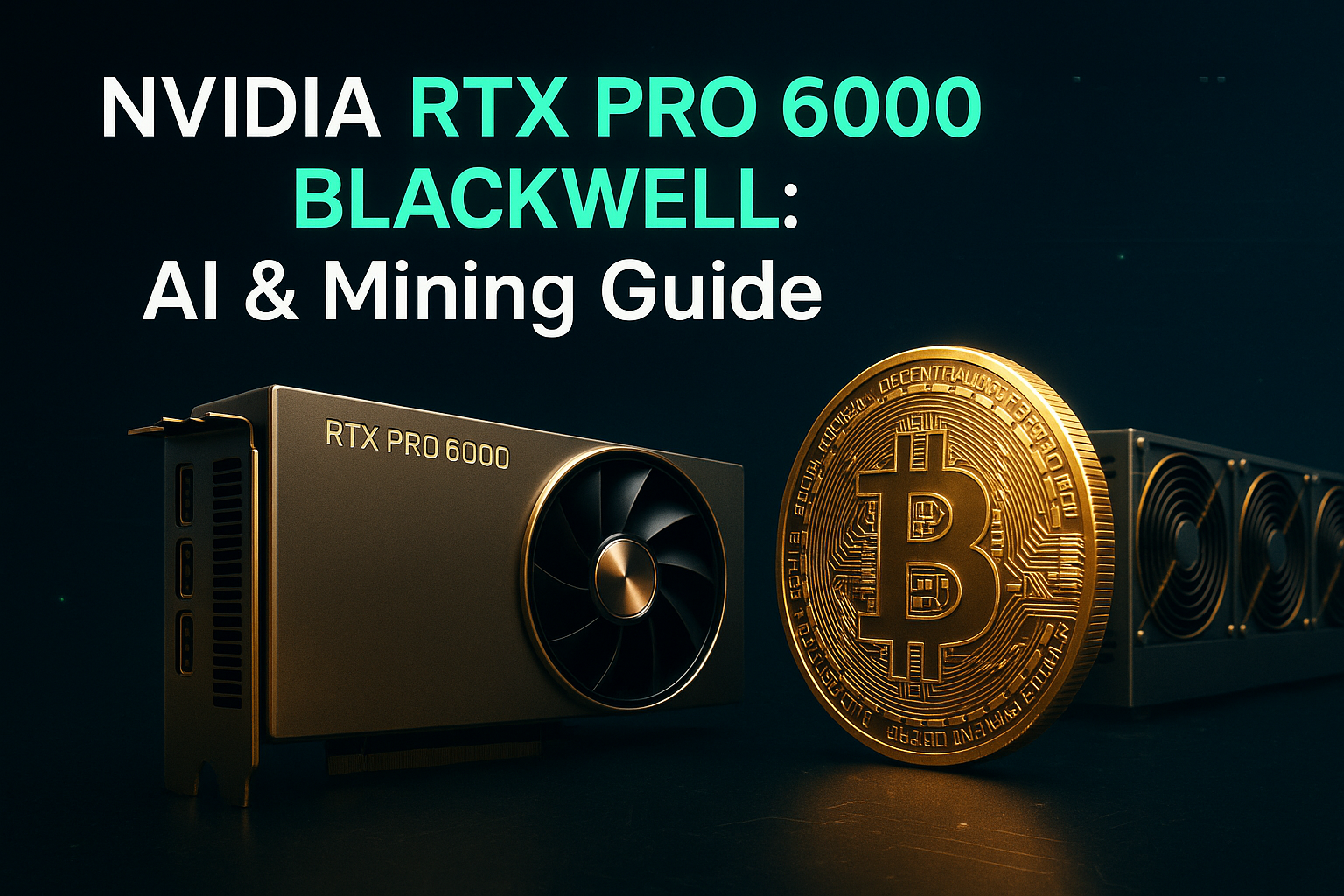
The NVIDIA RTX Pro 6000 Blackwell has emerged as the quintessential "Monster of a Card"—a $10,000 professional-grade powerhouse that many retail enthusiasts might overlook in favor of the consumer-facing RTX 5090. However, in a market where proof-of-work (PoW) has evolved and AI compute-rentals are a primary revenue stream for GPU farms, the Pro 6000 represents a strategic pivot.
Blackwell Architecture Deep Dive: GB202, 96GB GDDR7 & Enterprise Design
To understand why this card demands a five-figure premium, we must look beneath the shroud. While the RTX 5090 is the king of the consumer hill, the Pro 6000 Blackwell utilizes a nearly "full-fat" version of the GB202 silicon, manufactured on the refined TSMC 4N process.
| Feature | RTX 5090 (Consumer) | RTX Pro 6000 (Blackwell) |
|---|---|---|
| CUDA Cores | 21,760 | 24,064 |
| VRAM Capacity | 32 GB GDDR7 | 96 GB GDDR7 (ECC) |
| Memory Bandwidth | 1,500 GB/s | 1,792 GB/s |
| Power (TGP) | 600W | 600W Enterprise Grade |
| Market Positioning | High-End Gaming | AI & Data Science |
The most staggering metric here is the 96 GB of GDDR7 memory. For the modern miner or AI node operator, memory capacity is the new bottleneck. While the RTX 5090 is "Head and Shoulders" above its competition in raw gaming speed, the Pro 6000 offers triple the memory capacity. This isn't just for 8K textures; it is for loading massive Large Language Models (LLMs) like Llama-4 or complex datasets that would otherwise require four separate 5090s linked together—a configuration that often suffers from PCIe lane saturation and thermal throttling.
Cooling, Power Variants & Data Center Form Factors
NVIDIA has released this beast in three distinct flavors to suit different data center densities:
-
Fanless (Server Edition): Designed for high-airflow 2U/4U racks.
-
Max-Q (300W): A dual-slot blower tuned for workstation stability and lower noise.
-
Workstation Beast (600W): The version featured in our analysis, utilizing a compact board with high-efficiency blow-through fans.
Expert Insight: Beware the 600W configuration in a standard mid-tower chassis. While the cooling is exceptional, the "blow-through" design effectively turns your GPU into a furnace for your SSDs and RAM. In a 2026 build, dedicated NVMe heatsinks and high-static pressure intake fans are non-negotiable requirements for this card.
RTX Pro 6000 vs RTX 5090: Real-World 4K/8K Gaming & VRAM Scaling
When we push these cards into the crucible of 8K gaming and professional inference, the results are telling. At 1080p, the RTX 5090 often matches or even beats the Pro 6000 due to its higher localized boost clocks. However, as the resolution and data complexity scale, the Pro 6000 begins to flex its industrial muscle.
Gaming at the Edge: 4K and 8K
At 4K, the Pro 6000 takes a measurable lead, particularly in 1% low frame times. By the time we reach 8K (the current "holy grail" for ultra-premium setups), the Pro 6000 shows a 15-20% performance delta over the 5090.
- The VRAM Advantage: In games like Cyberpunk 2077 at 8K with Path Tracing enabled, the VRAM usage can spike well above 30GB. The RTX 5090 begins to swap data to the system RAM (a massive latency penalty), while the Pro 6000 remains comfortably within its 96GB buffer.
AI Inference Hosting & Crypto Mining Profitability in 2026
For the crypto-investor, mining Ethereum Classic (ETC) or Ergo (ERG) is only part of the story. In 2026, the most profitable "mining" is actually Inference Hosting.
-
Throughput: The Pro 6000 is approximately 62% faster in high-throughput vLLM inference scenarios than the 5090.
-
Efficiency: While the 5090 is faster for a single user (lower latency for one prompt), the Pro 6000 can serve dozens of concurrent users without breaking a sweat, thanks to its 5th Gen Tensor Cores and fifth-generation NVLink support.
RTX Pro 6000 Investment Strategy: Who Should Buy in 2026?
If you are an investor looking to deploy capital into compute hardware, the decision-making matrix has shifted toward longevity and multi-purpose utility.
Professional AI Developers & LLM Hosting Operators
Who should buy the RTX Pro 6000?
-
Professional AI Developers: If your livelihood depends on local training or hosting LLMs, the 96GB buffer is a hard requirement. The ability to run FP4 precision models natively on Blackwell architecture provides a 3x throughput boost over the previous Ada generation.
-
Hedge-Fund "Miners": For those building Inference Farms, the Pro 6000 offers higher density. You can fit more compute power into a single rack with Pro 6000s than you can with bulky 5090s, which often require 3-4 slots per card.
-
The "Price is No Object" Enthusiast: If you have already looked at a $4,000 ASUS ROG Matrix 5090, the jump to an $8,500–$10,000 professional card isn't about logic—it's about owning the absolute apex of silicon.
Who Should Choose the RTX 5090 Instead?
-
Traditional Gamers: Even at 4K, the price-to-performance ratio of the Pro 6000 is abysmal for gaming alone.
-
Hobbyist Creators: Unless your project files regularly exceed 32GB of VRAM, the extra $6,000 is better spent on a faster CPU and more system-level NVMe storage.
Risks, Depreciation & Power Delivery Concerns
Investing in professional-grade GPUs is not without significant peril. In 2026, the hardware market is volatile, and several factors could erode your ROI:
-
The 12V-2x6 Connector: Despite revisions, the high-wattage power delivery system remains a point of failure. Ensuring a high-quality ATX 3.1 power supply and avoiding tight cable bends is critical to prevent the "melting connector" syndrome that plagued earlier 600W cards.
-
Depreciation: Professional cards often lose value faster than consumer cards once the next "enterprise" generation is announced. Unlike ASICs, which are "burn-and-turn" devices, the Pro 6000 requires a maintenance schedule to retain its resale value in the secondary workstation market.
-
Software Bottlenecks: At 8K or during complex AI training, the CPU can often become the bottleneck. We recommend pairing this card with nothing less than a 32-core Threadripper 9000-series to ensure the GPU isn't waiting on the processor to feed it data.
Final Verdict: Is the RTX Pro 6000 Blackwell Worth It for AI & Mining?
The NVIDIA RTX Pro 6000 Blackwell is a magnificent, albeit specialized, piece of engineering. It represents the pinnacle of what is possible when power constraints and budget are secondary to raw compute capability. For the beginner investor, it is a reminder that the most "expensive" tool is often the one that fails to meet the specific requirements of the job.
In the current 2026 climate, if your goal is simple gaming or hobbyist mining, the RTX 5090 remains the rational choice. But if you are building the foundation of a modern "Compute-as-a-Service" (CaaS) operation, or if you simply must have the fastest gaming PC on the planet for 8K dominance, the Pro 6000 is the only card that truly clears the bar. It isn't just a graphics card; it's a 96GB insurance policy against the ever-increasing demands of the AI revolution.
FAQ: RTX Pro 6000 Blackwell, AI Inference & Mining in 2026
Q1: Is the RTX Pro 6000 Blackwell better than the RTX 5090 for AI workloads?
Yes, for large-scale AI inference and LLM hosting, the RTX Pro 6000 is superior due to its 96GB GDDR7 VRAM and enterprise-focused architecture. It handles high-throughput, multi-user inference more efficiently, while the RTX 5090 is better suited for single-user, latency-sensitive tasks and gaming.
Q2: Is the RTX Pro 6000 worth it for crypto mining in 2026?
For traditional GPU mining alone, the price-to-performance ratio is difficult to justify. However, when combined with AI inference hosting or compute rental services, the card becomes significantly more viable as part of a diversified revenue strategy.
Q3: How much VRAM do you need for LLM hosting in 2026?
For large models like Llama-4 and high-parameter LLMs, 48GB may be limiting. A 96GB buffer allows full model loading without sharding across multiple GPUs, reducing latency and avoiding PCIe bandwidth constraints.
Q4: Can the RTX Pro 6000 handle 8K gaming better than the RTX 5090?
At 8K with path tracing and ultra textures, the Pro 6000 maintains more stable performance due to its massive VRAM capacity. The RTX 5090 can experience memory swapping, which increases latency and reduces frame consistency.
Q5: What power supply is required for the 600W RTX Pro 6000?
A high-quality ATX 3.1 power supply with proper 12V-2x6 cable management is strongly recommended. Avoid sharp cable bends and ensure adequate airflow to prevent overheating and connector stress.
Q6: Is the RTX Pro 6000 a good long-term investment for compute farms?
For Compute-as-a-Service (CaaS) models and inference farms, the Pro 6000 offers strong longevity due to its memory capacity and enterprise features. However, investors must consider depreciation risks and rapid generational hardware updates.
Q7: Does the CPU matter when using the RTX Pro 6000 for AI or 8K workloads?
Yes. In high-resolution gaming and complex AI training scenarios, CPU bottlenecks can limit GPU utilization. Pairing the card with a high-core-count processor, such as a 32-core workstation-class CPU, ensures balanced system performance.