
Introduction
⚡ 2026 Strategy: Executive Summary
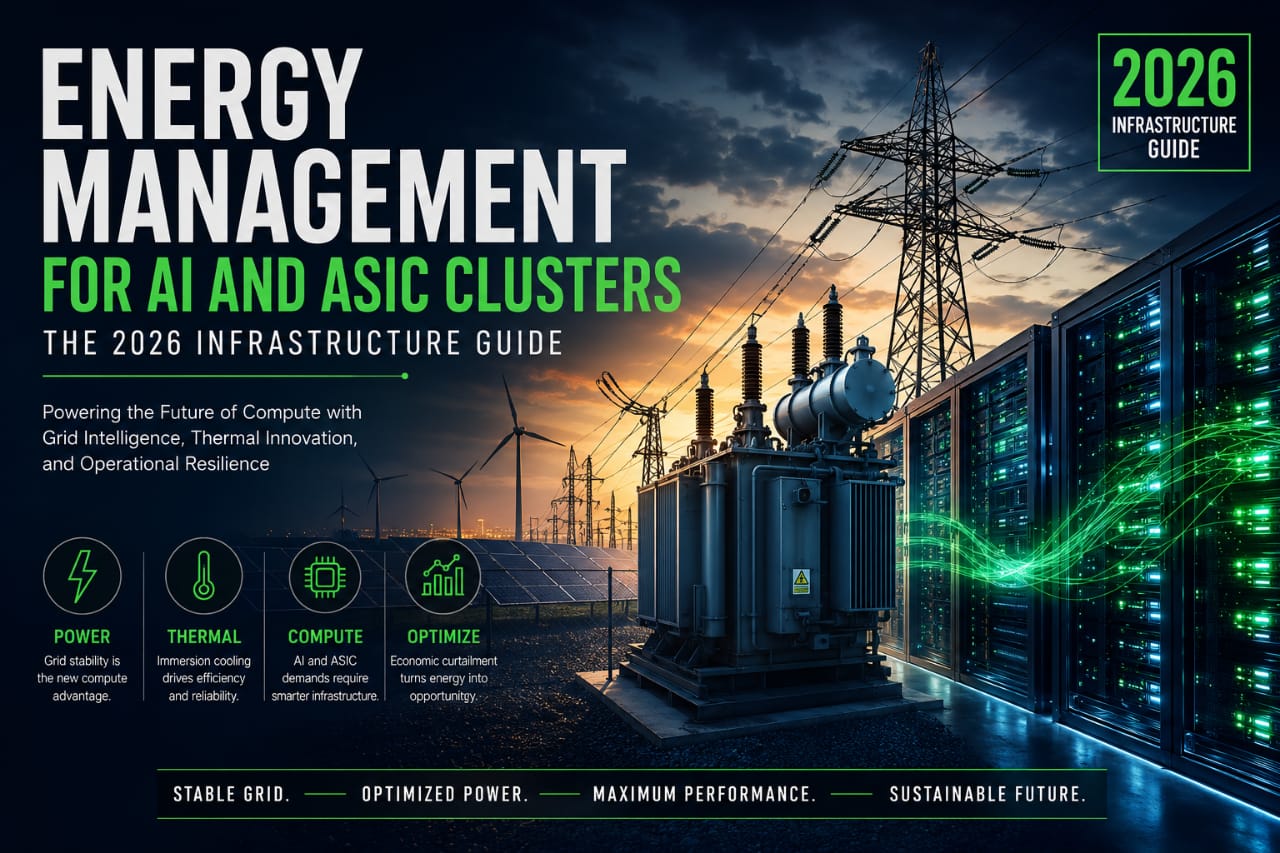
⚡ The Power Shift: Compute has officially transitioned into a global commodity backed by grid stability and energy density.
⚡ Infrastructure Barrier: Lead times for high-voltage transformers (12–18 months) remain the primary bottleneck for AI cluster scaling.
⚡ Thermal Revolution: Immersion cooling has surpassed air cooling in ROI, enabling a 20% reduction in hardware failure rates.
⚡ Grid Interaction: Success is now defined by “economic curtailment” — the ability to sell power back to the grid during peak demand.
In 2026, the intersection of high-performance computing and the electrical grid has moved from a niche engineering challenge to a matter of national economic security. Whether you are operating a massive H100/B200 GPU cluster for LLM training or a fleet of next-gen ASIC miners, the bottleneck is no longer just the silicon—it is the substation.
The reality on the ground is stark: our grid is facing a 2-terawatt interconnection queue, and lead times for high-voltage transformers still exceed 12 months. For operators and investors, understanding the nuanced relationship between power draw, thermal management, and grid interaction is the difference between a profitable deployment and a stranded asset.
2026 Energy Landscape: Managing Power Demand and Grid Delivery Challenges
We have moved past the era of stagnant energy demand. The duck curve has sharpened, and the rise of intermittent renewables (solar/wind) has made grid frequency stabilization more volatile. For high-power hardware operators, this creates a two-fold challenge:
-
The Reliability Gap: While the cost to generate a watt has decreased due to solar efficiency, the cost to deliver it has skyrocketed. In many markets, transmission and distribution fees now account for over 50% of the utility bill.
-
Decentralized Mandates: 2026 has seen a shift toward "behind-the-meter" generation. Large-scale AI clusters are increasingly co-locating with modular nuclear reactors (SMRs) or dedicated natural gas peaker plants to bypass the congested public grid.
Technical Power Breakdown: AI GPU Clusters vs. ASIC Mining Rigs
While both are high-consumption environments, their electrical "signatures" are fundamentally different.
AI GPU Clusters Power Requirements and Dynamic Workload Management
AI workloads are dynamic. A cluster training a foundational model exhibits a bursty power profile. When a gradient synchronization step occurs across thousands of GPUs, the instantaneous power draw can spike and dip significantly.
-
Power Density: We are now seeing rack densities exceeding 100kW per rack.
-
Sensitivity: AI hardware is highly sensitive to voltage sags and harmonic distortions. A minor brownout doesn't just pause the work; it can corrupt a checkpoint that cost millions of dollars in compute time to reach.
ASIC Mining Rigs Efficiency and Steady-State Grid Interaction
ASICs are steady-state loads. Once a miner is hashed, it pulls a near-constant current. This makes them ideal for grid balancing.
-
Grid Interaction: Many 2026 operators utilize ASICs as interruptible loads. Because an ASIC can be shut down in milliseconds without data loss (unlike an AI training run), operators can sell curtailment services back to the grid during peak demand.
-
Efficiency: The focus is purely on Joules per Terahash (J/TH). At current 2026 difficulty levels, any hardware operating above 15J/TH is nearing obsolescence unless powered by sub-0.03/kWh energy.
Advanced Thermal Management Solutions for High-Density Computing Facilities
| Cooling Strategy | PUE Efficiency | Investment Level | Best Use Case |
|---|---|---|---|
| ⚡ Air Cooling | 1.4 - 1.6 | 🟢 Low CapEx | Standard ASIC mining & legacy GPU data centers. |
| ⚡ Direct-to-Chip | 1.1 - 1.2 | 🟡 Moderate | High-performance AI GPU clusters (H100/B200). |
| ⚡ Immersion Cooling | 1.03 - 1.05 | 🔴 High CapEx | Ultra-dense ASIC farms & industrial AI infrastructure. |
The Benefits of Immersion Cooling for ASIC and AI Operations
Immersion cooling—submerging hardware in a dielectric fluid—has become the standard for 2026 ASIC operations. It eliminates fan power (which can account for 10-15% of an ASIC's draw) and allows for significant overclocking. By maintaining a stable thermal environment, we see a 20% reduction in component failure rates compared to dusty, air-cooled environments.
Electrical Infrastructure Planning and Facility Deployment Strategies
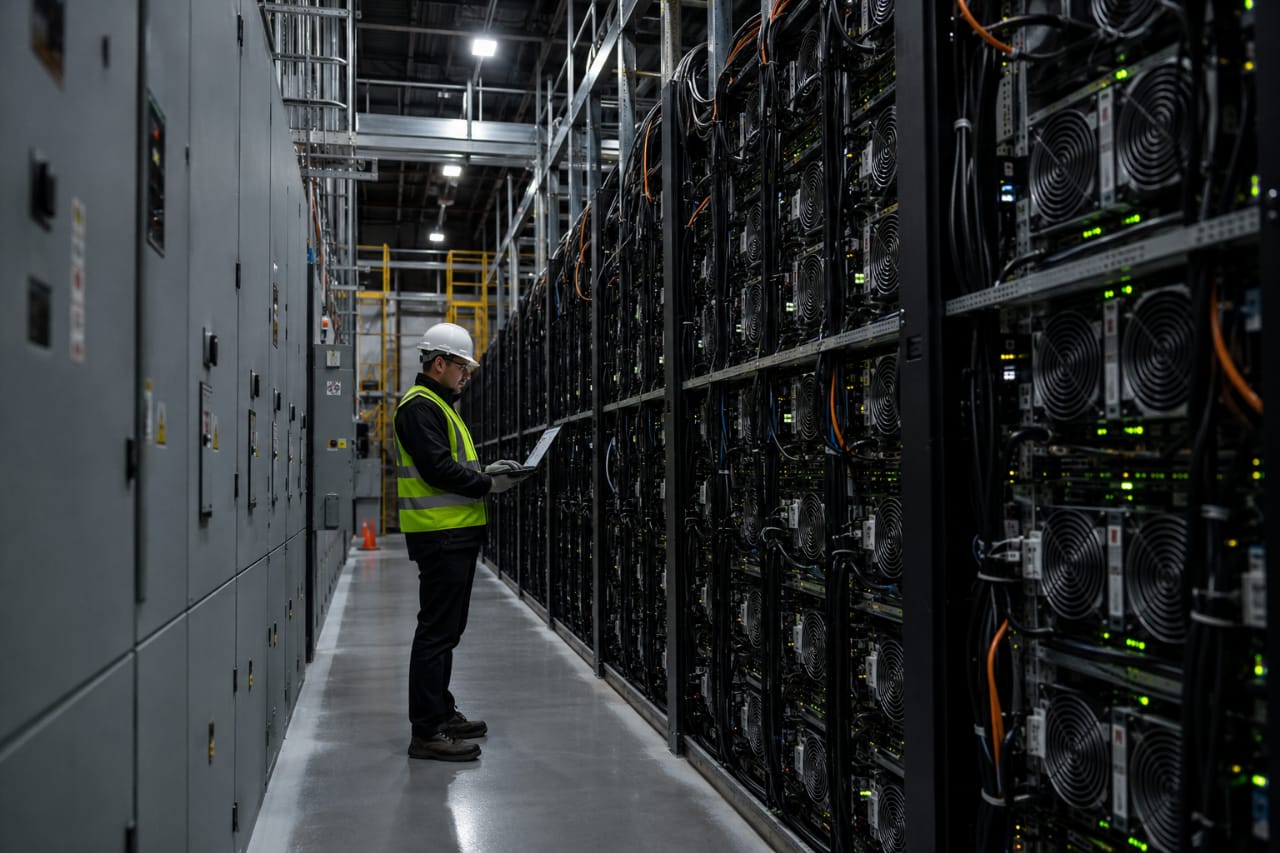
When designing a facility in 2026, the electrical architecture must prioritize Power Quality and Redundancy.
Optimizing Voltage Drop and Power Distribution in Data Centers
For a 10MW+ facility, even a 1% voltage drop due to improper cable sizing results in massive financial leakage. We now utilize 480V or 415V distribution directly to the rack, skipping the step-down to 208V to minimize resistive losses.
UPS Systems vs. Power Ride-Through for High-Performance Computing
-
For AI: High-capacity Flywheel UPS systems are favored over lithium-ion for their ability to handle massive, frequent power surges without chemical degradation.
-
For ASICs: Most operators forgo massive UPS systems entirely, opting for n+1 transformer redundancy instead. If the grid goes, the miners go—the cost of the UPS outweighs the lost mining time.
Data Center Cost Modeling and Operational Trade-offs for Better TCO
The Total Cost of Ownership (TCO) in 2026 is dominated by the Electricity-to-Depreciation ratio.
-
1. Electricity vs. Performance: In high-cost regions (>0.08/kWh), it is often more profitable to "underclock" hardware. Reducing voltage by 10% can lead to a 20% decrease in heat and power draw while only losing 5-7% in compute performance.
-
2. Firmware Optimization: Custom firmware is no longer optional. Real-time "auto-tuning" allows hardware to adjust its power draw based on the instantaneous price of electricity—a practice known as Economic Curtailment.
Risk Mitigation Strategies for Grid Instability and Thermal Runaway
The primary risks in 2026 are no longer just market price risks; they are physical and regulatory infrastructure risks.
-
Thermal Runaway: In high-density AI clusters, a cooling pump failure can lead to chip melting in seconds. Hardware-level "thermal trips" must be hard-wired, not just software-defined.
-
Grid Instability: As Texas and California have shown, "firm" power is a myth. Operators must have contractual "Demand Response" agreements in place to avoid exorbitant "Real-Time Market" prices during grid stress.
-
Infrastructure Failure: Aging substations are prone to physical failure. Regular infrared thermography of all switchgear and transformers is a mandatory maintenance protocol for any facility over 5MW.
2026 Advisory Conclusion: Why Resilient Electrical Infrastructure is Essential
In 2026, compute is no longer the limiting factor—power is. Whether it’s AI clusters training trillion-parameter models or ASIC farms chasing marginal efficiency gains, both worlds now depend on the same invisible foundation: a stable, scalable, and intelligently managed electrical grid.
What separates profitable operators from stranded assets is no longer raw hardware performance. It is the ability to control three things with precision: energy cost, thermal behavior, and grid interaction. Those who treat electricity as a strategic resource—not just a utility bill—are the ones building real long-term advantage.
The message is simple, but unforgiving: You can scale GPUs, you can scale ASICs—but you cannot scale beyond your power infrastructure.
In this new era, the winners will not be defined by who has the fastest machines, but by who has built the most resilient energy backbone. Because when the grid tightens, temperatures rise, and demand spikes, only one truth remains:
Compute doesn’t fail first. Power does.
Frequently Asked Questions (FAQ)
Q1: Why has power infrastructure replaced silicon as the primary bottleneck for AI in 2026?
While GPU performance continues to scale, the physical ability of the electrical grid to deliver massive power loads has hit a wall. In 2026, the global "interconnection queue" for new data centers is backed up by nearly 2 terawatts. This means even if you have the latest B200 chips, you may wait over 18 months for a high-voltage transformer to actually power them.
Q2: Is Immersion Cooling worth the high CapEx compared to Direct-to-Chip methods?
Yes, specifically for 2026-density clusters. While Direct-to-Chip is excellent for targeted cooling, Immersion Cooling submerges the entire server, eliminating the need for internal fans which consume up to 15% of the unit's energy. For operators chasing a PUE of 1.05 or lower, the long-term energy savings and the 20% reduction in hardware failure (due to lack of dust and oxidation) outweigh the initial setup costs.
Q3: What exactly is Economic Curtailment and how does it generate revenue?
Economic Curtailment is the strategy of pausing computing operations (mostly for ASICs) when electricity prices spike or the grid is under stress. Since ASIC miners can be shut down in milliseconds without data loss, operators can sell their unused power back to the utility company at a premium. In 2026, this Grid-as-a-Service model often proves more profitable than mining itself during peak summer or winter months.