Introduction
In the twenty-first century, sovereign power is no longer measured solely by crude oil reserves or maritime chokepoints, but by compute density, algorithmic infrastructure, and megawatt allocations. Recognizing that economic survival requires an aggressive exit from rentier oil dependence and traditional tourism, the United Arab Emirates (UAE) is staking its future on becoming the primary artificial intelligence and cloud computing engine for the Global South.
To achieve this, Abu Dhabi is leveraging a distinct industrial advantage: energy infrastructure. The UAE is not merely an oil producer; it has systematically transformed itself into an energy laboratory. By combining vast fossil gas reserves, flat desert topography ideal for utility-scale solar arrays, and the 5.6-gigawatt Barakah Nuclear Power Plant, the country offers what very few nations on Earth can provide: massive, continuous, zero-carbon baseload electricity alongside fast-ramping gas reserves at highly competitive prices. This potent energy profile has turned the desert into a magnet for American technology giants seeking to construct hyperscale compute facilities outside the United States.
The Crown Jewel: OpenAI Stargate UAE
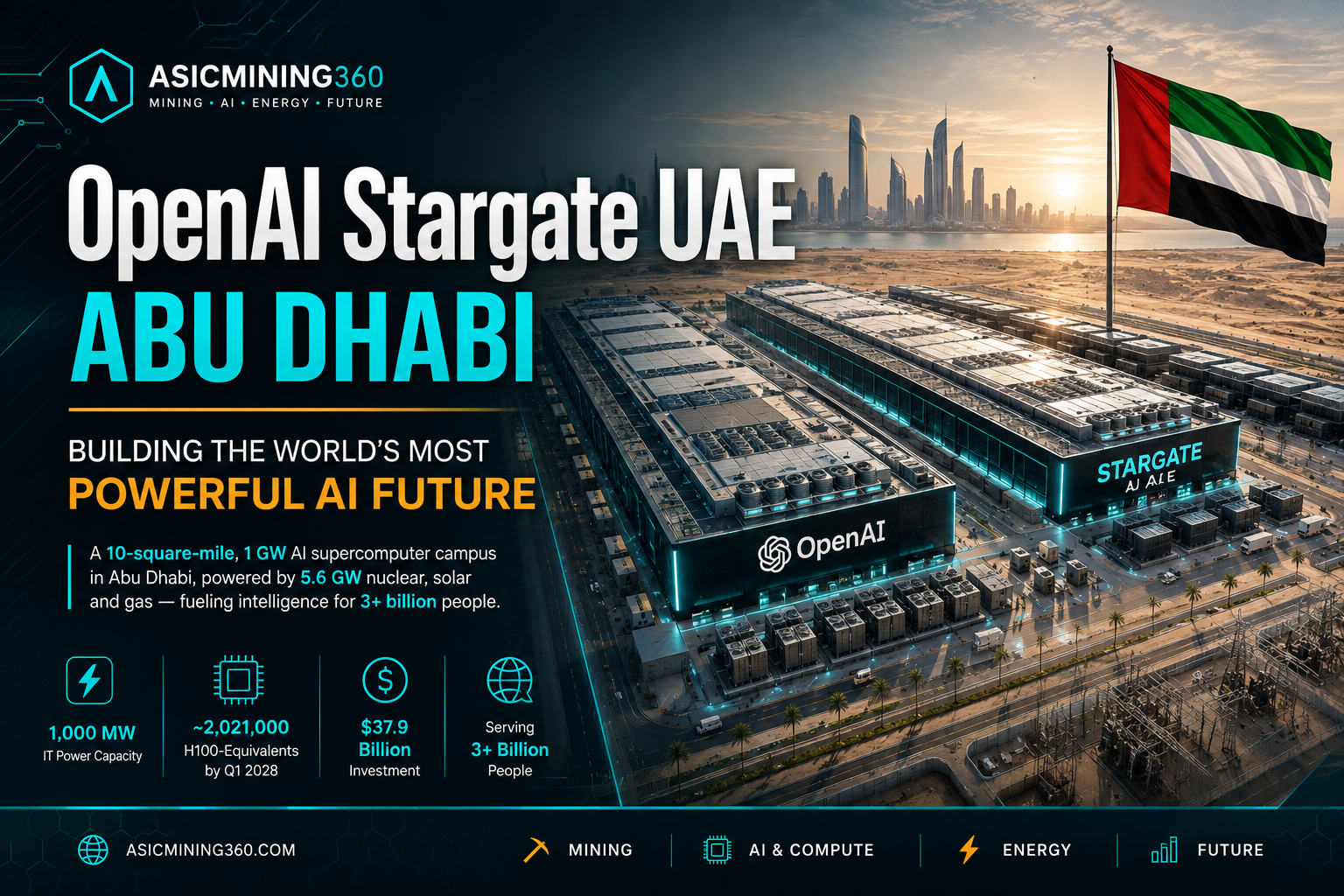
While several data center builds are underway across the Gulf, none compare in scale or strategic weight to OpenAI Stargate UAE. Spanning a 10-square-mile footprint within the newly established 5-gigawatt UAE–US AI Campus in Abu Dhabi, this facility represents the first Stargate-class computing cluster deployed outside American borders.
Technical Data Sheet: OpenAI Stargate UAE
| Project Metric / Component | Technical Specification |
|---|---|
| Project Name & Location | OpenAI Stargate UAE — Abu Dhabi, United Arab Emirates |
| Site Footprint | 10 square miles within the 5 GW UAE–US AI Campus |
| Primary Developer & Operator | Khazna Data Centers (a G42 company) |
| Key Partners & Tenants | OpenAI, Oracle, Nvidia, Cisco, SoftBank Group |
| Projected Capital Expenditure | $37.9 Billion |
| Design IT Power Capacity | 1,000 MW (1 GW IT load); first 200 MW scheduled for 2026 delivery |
| Target Compute (Q1 2028) | ~2,021,000 H100-equivalents |
| Planned Silicon Architecture | • 100,000 Nvidia B300 chips (253k H100-eq) • 200,000 Nvidia Rubin chips (1,769k H100-eq) |
| Labor & Site Excavation | 3,500 active site workers; 1.2M ft³ sand dune cleared (1.3M man-hours) |
| Export Infrastructure Target | Intelligence grid serving 3+ billion people within a 3,000 km radius |
How Analysts Verify Hyperscale Builds (Epoch AI Methodology)
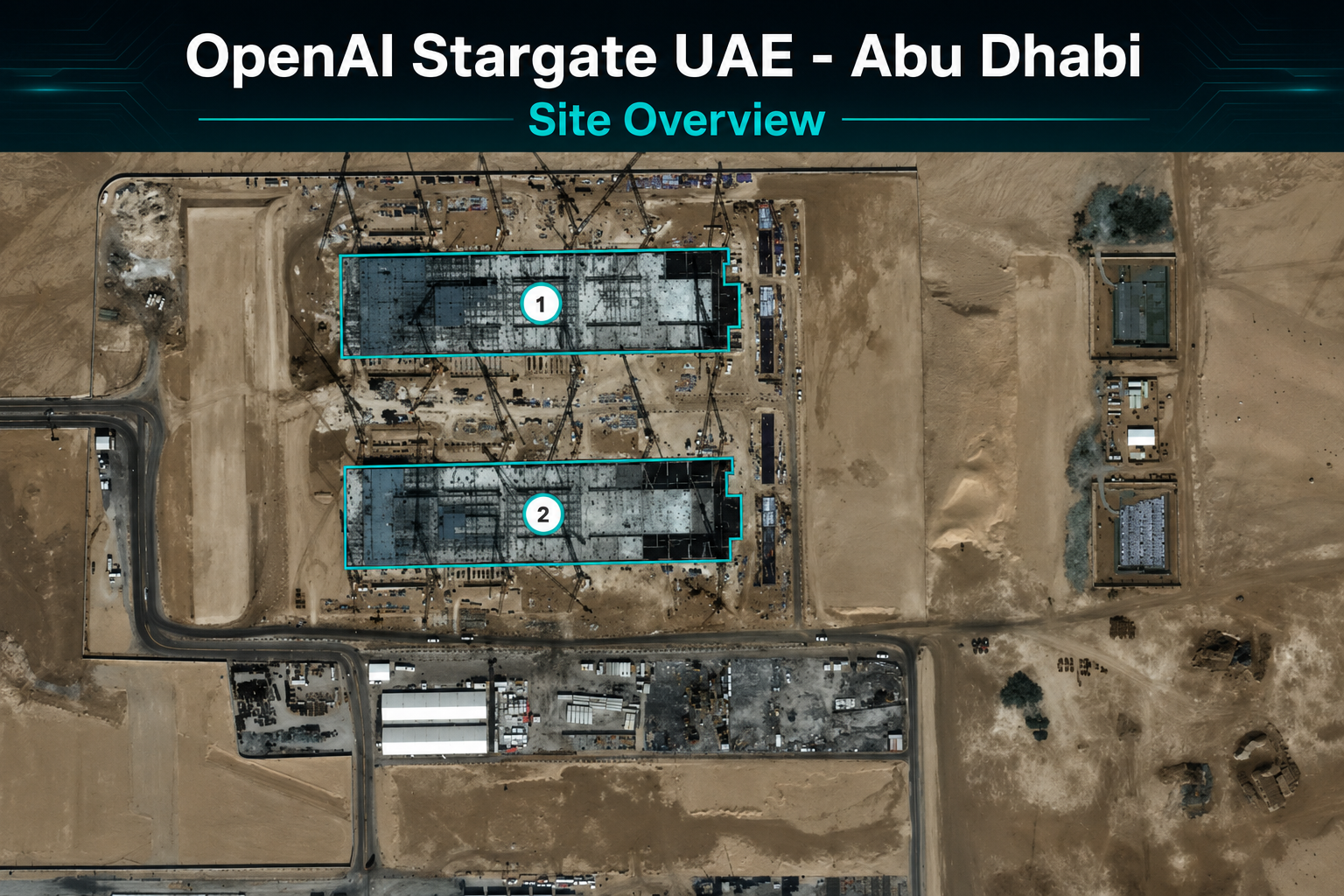
Facilities of this caliber cannot be hidden. Independent institutions like Epoch AI track and verify these mega-projects through multi-layered remote sensing pipelines. Using commercial high-resolution satellite imagery (Vantor, Airbus, Sentinel-2), analysts identify three distinct signatures that differentiate AI compute clusters from ordinary industrial distribution centers:
-
Massive External Heat Rejection Units: Modern AI chips throw off an absurd amount of heat. If you look at them from space, you can spot the massive cooling blocks sprawling across rooftops and perimeters—usually packed with thick rows of 24-fan air chillers or heavy-duty liquid heat exchangers.
-
Heavy Emergency Backup Generation: A data center can't afford to blink. That’s why you'll see long flanks of high-capacity diesel generators or local gas turbines hugging the buildings, standing ready to kick in the second the grid takes a hit.
-
Dedicated High-Voltage Substations: You can't run a city's worth of compute on standard wiring. Thick concrete transformer pads and heavy-duty transmission lines run straight from the national grid into the facility, giving away its gigawatt-scale appetite.
By counting fans, measuring heat-exchanger surface areas, and mapping out the floor plans, analysts can run cooling models that pin down the exact IT power footprint in megawatts. Cross-reference that with export quotas—roughly 100,000 top-tier Nvidia chips rolling in annually—and you get a surprisingly accurate picture of the true H100-equivalent compute humming away inside.
Power Dynamics: National Grid Breakdown and Energy Tariffs
Feeding a 1,000 MW IT load is no small feat—it takes a powerhouse of a grid just to keep the lights on. Back in 2024, the UAE pumped out 169 TWh of electricity, landing it at #27 globally while growing at a swift +4.9% year-over-year clip. But to truly grasp the scale of what Stargate is asking for: running that single 1 GW IT campus at full tilt will burn through roughly 10.5 TWh every single year (factoring in a tight 1.2 Power Usage Effectiveness ratio).
Put another way, a single collection of server racks in the desert is going to swallow up nearly 6.2% of the entire nation's annual electricity generation all by itself.
National Power Generation & Electricity Tariff Profile
| Grid Parameter / Tariff Category | Official Metric / Rate | Strategic Relevance to Data Centers |
|---|---|---|
| National Generation (2024) | 169 TWh (+4.9% YoY Growth, Ranked #27 Globally) | Provides a large power base capable of absorbing gigawatt-scale single-site loads. |
| Fossil Fuel Generation (Gas) | 71.53% of Total Grid Output | Delivers fast-ramping power generation to absorb rapid load shifts when GPU clusters initialize. |
| Nuclear Fission (Barakah) | 23.07% of Total Grid Output | Provides 5.6 GW of unbroken, zero-carbon 24/7 industrial baseload power (~40 TWh/yr). |
| Solar Generation (PV) | 5.40% of Total Grid Output | Offsets high daytime cooling loads; expanding rapidly via massive utility solar parks. |
| Residential Power Tariff | $0.080 / kWh | Standard domestic rate across utility zones. |
| National Average Tariff | $0.095 / kWh | Combined baseline across all consumer sectors. |
| Industrial / Commercial Standard | $0.110 / kWh | Baseline industrial rate (~$1.15B annual power bill for a 1 GW facility). |
| Negotiated Sovereign PPA (Target) | ~$0.042 – $0.056 / kWh | Subsidized bulk power rates reserved for strategic tech clusters, cutting power OpEx by over 50%. |
This dual-source generation structure is the key to Abu Dhabi's strategy. While natural gas provides flexible capacity to handle sudden power spikes during model training resets, nuclear and solar energy provide the clean energy credits required by Western tech giants like OpenAI and Microsoft to meet corporate ESG commitments.
The Geopolitical Powder Keg: Regional Conflict and Strategic Targeting
Despite these economic advantages, building the world's most concentrated AI infrastructure in the Middle East exposes billions of dollars in silicon to acute geopolitical risk. Hosting flagship American technologies makes these facilities high-value strategic targets in a volatile regional theater characterized by ongoing US-Iran confrontation and regional proxy warfare.
The threat is not theoretical. Recent military conflicts in the region have demonstrated that commercial cloud infrastructure is vulnerable to physical disruption. During escalations in Gulf tensions, drone and missile strikes hit critical infrastructure, including Amazon Web Services (AWS) facilities in Bahrain and the UAE. These attacks caused structural damage, electrical fires, and severe grid interruptions, forcing AWS to advise clients to re-route critical workloads out of the region.
A $37.9 billion facility like Stargate UAE presents an even larger target. In any broader regional conflict, facilities housing state-of-the-art semiconductors and proprietary AI models could become prime targets for asymmetric strike vectors. Furthermore, the UAE's assertive foreign policy—including active interventions and political entanglements across parts of East Africa and the Middle East—has created diplomatic frictions with several regional actors. These political rivalries increase the risk profile of Abu Dhabi’s technological assets, raising difficult questions for Western partners about physical security and long-term operational continuity.
Desert Engineering: Extreme Heat, Dust, and Single Points of Failure
Beyond the boardrooms and the shifting fault lines of regional politics, there is an even more unforgiving adversary waiting outside the data center doors: the desert itself.
-
The Thermal Wall: When summer temperatures in Abu Dhabi regularly push past 50°C (122°F), standard air-chilling systems essentially give up. Trying to cool racks densely packed with power-hungry Nvidia B300 and Rubin chips using ambient air is a losing battle. Facilities are forced into direct liquid cooling or complex closed-loop setups just to keep the silicon from melting down.
-
The Zero-Margin Rule: Out here, cooling isn't a background feature; it's a matter of life and death for the hardware. At 50°C, there is zero margin for error. If a primary pump hiccups or a water loop drops pressure, those high-density chips hit thermal limits in a matter of seconds. The resulting spike triggers emergency hard shutdowns, yanking the entire 1 GW cluster offline in a heartbeat.
-
Micro-Dust Infiltration: Then there's the sand. The desert air is full of fine, abrasive dust that acts like sandpaper on machinery. It chokes external cooling fins, ruins heat exchangers, and finds its way past normal vents. Keeping that microscopic grit out of delicate electronics requires multi-stage, positively pressurized air locks that treat a server hall more like a semiconductor cleanroom than an industrial warehouse.
The Verdict: Strategic Triumph or Fragile Mirage?
The United Arab Emirates has managed to crack the hardest part of the equation: it threw sovereign money at the problem, built a nuclear-backed grid, and mobilized work crews that move faster than concrete can dry, cementing Abu Dhabi as a heavyweight in the Middle East’s tech race.
Yet, the rest of the story remains unwritten. The ultimate test won't be won on architectural blueprints or spreadsheet models, but out there in the political crosswinds and the baking desert sands.
Will Stargate turn into the beating digital heart that powers billions across the Global South, or will it serve as an expensive reminder of what happens when you stack billions of dollars of fragile technology in a part of the world where the ground rarely stays still for long ? In the end, success won't be decided by algorithms; it will come down to whether Abu Dhabi can guard its skies with the exact same precision it uses to power its silicon.