

Introduction
Running a large language model on a desktop computer used to mean making a difficult compromise. You could choose a smaller model that fitted inside your GPU's memory, accept slower performance, or move the workload to a cloud server.
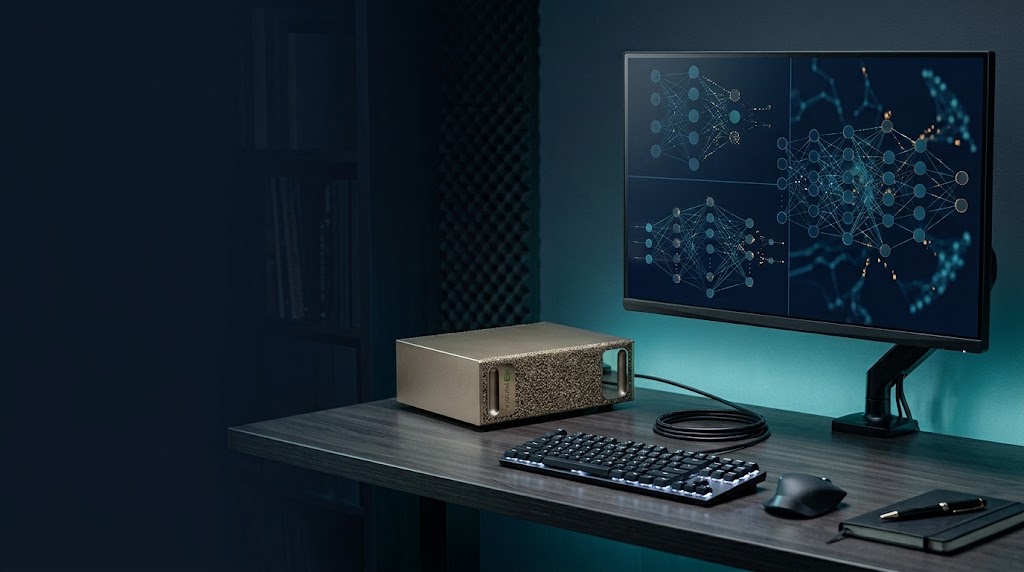
NVIDIA DGX Spark takes a different approach: instead of relying on a conventional desktop processor paired with a separate graphics card, it combines CPU and GPU resources around a shared memory architecture.
The headline figure is striking. NVIDIA says DGX Spark can run inference on AI models with up to 200 billion parameters using 128GB of unified memory. The machine is compact enough to sit on a desk, yet its intended workload would traditionally be associated with much larger computing systems.
But the interesting part isn't simply the number of parameters. It's how the machine organizes memory, why that matters for large models, and what the 128GB figure actually tells us about its capabilities.
1. Local LLM Inference: Why VRAM Constraints Limit 200B Parameter Models
A language model consists of billions of learned numerical values called parameters. During inference, the model uses these values to generate a response, one token at a time.
The larger the model, the more memory is generally needed to hold its weights. Consider a model with 200 billion parameters. If each parameter is stored using 16 bits, the weights alone require approximately 400GB of memory. At 8 bits per parameter, that falls to around 200GB. At 4 bits, the theoretical requirement falls to approximately 100GB.
These are simplified calculations based on the number of parameters and the bits used to represent each one. They exclude additional memory required by the runtime, temporary computations, and the model's context.
This explains why memory capacity matters so much. A conventional graphics card may have enough processing power to perform calculations on a large model, but if the model cannot fit into its available memory, the system needs workarounds or a smaller model.
DGX Spark is designed to make much larger models accessible on a local machine. Its 128GB pool provides room for workloads that would exceed the dedicated VRAM of many consumer graphics cards. However, the available memory is shared by the system, so not all 128GB can automatically be treated as free space for model weights.
2. NVIDIA GB10 Grace Blackwell Chip: LPDDR5X & NVLink-C2C Architecture
At the heart of DGX Spark is NVIDIA's GB10 Grace Blackwell superchip. It combines a 20-core Arm CPU with a Blackwell-generation GPU in a compact system measuring approximately 150 × 150 × 50.5 mm. The standard configuration includes 128GB of LPDDR5X unified memory.
The important distinction is how the two processors access memory.
In a traditional desktop with a discrete graphics card, the CPU typically uses system RAM while the GPU uses its own dedicated VRAM. Moving data between the two can require explicit transfers, and the capacity available to the GPU is constrained by its dedicated memory.
DGX Spark uses a unified memory architecture. The CPU and GPU can access the same physical memory pool, with NVIDIA's NVLink-C2C technology providing a high-bandwidth connection within the Grace Blackwell design. This reduces the need to maintain separate copies of data in CPU RAM and GPU memory.
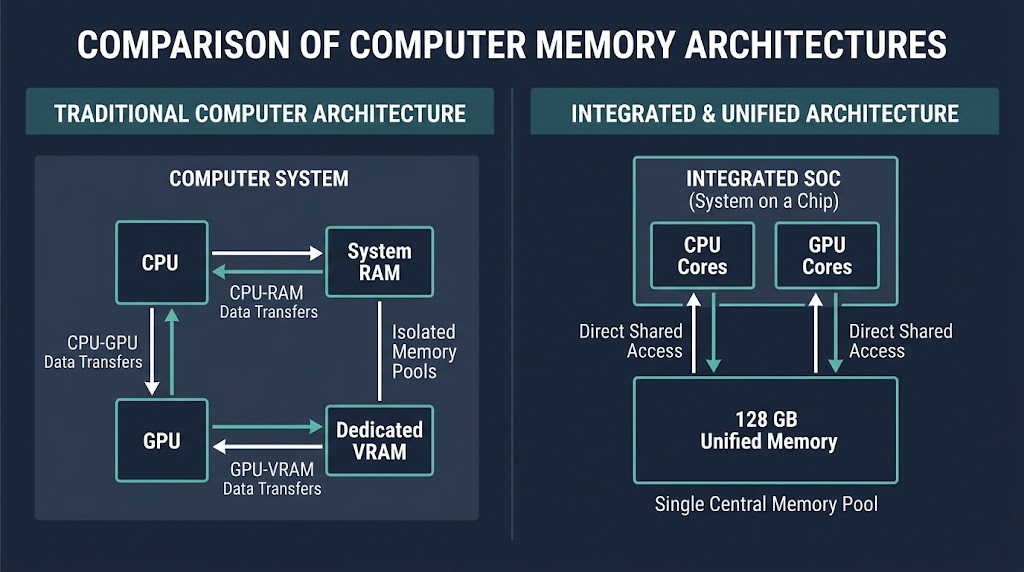
The practical advantage is straightforward: a developer can work with a much larger model without having to fit all its weights into a small, separate graphics-memory pool.
That doesn't mean data movement disappears completely, or that every operation runs at maximum speed. The processors still have different roles, memory access still has limits, and applications must be optimized for the architecture.
3. Quantization & Memory Footprint: Fitting 200B Parameters in 128GB
NVIDIA's claim that DGX Spark can run inference on models with up to 200 billion parameters becomes easier to understand when memory precision is taken into account.
At four bits per parameter, a 200B model has a theoretical weight footprint of about 100GB. That leaves roughly 28GB of the nominal 128GB pool before accounting for operating-system use, model metadata, the inference engine, context-related memory and other allocations.
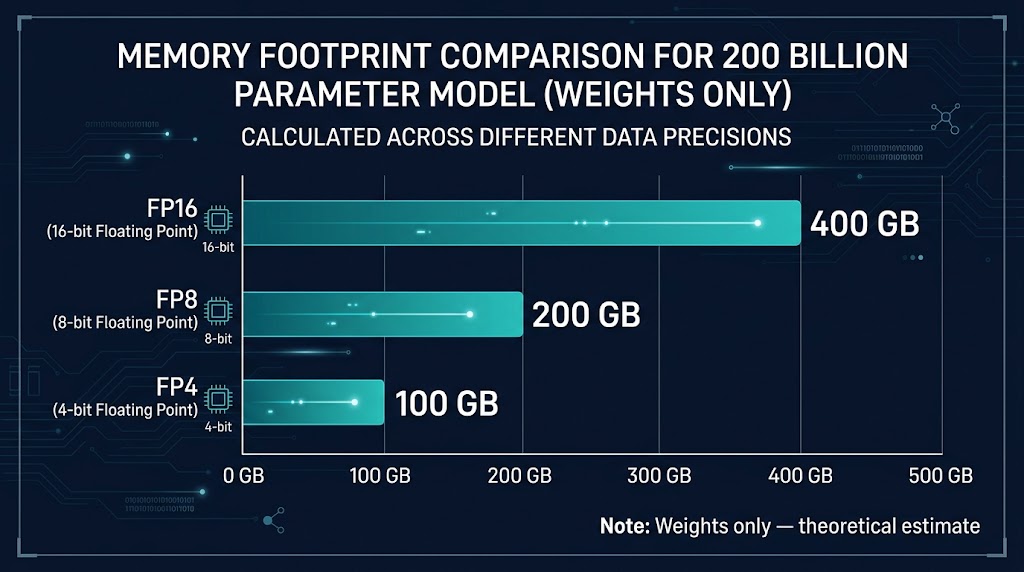
That is a much tighter fit than the headline number might suggest. Some models will fit under suitable quantization and runtime configurations; others may require a smaller context, more aggressive memory optimization or a different model format.
It is also important to distinguish inference from fine-tuning. NVIDIA lists inference for models up to 200B parameters, but its stated fine-tuning capability is up to 70B parameters. Those are different workloads with different memory demands.
The takeaway is that 128GB does not magically make every 200B model easy to run. It creates the memory capacity that makes the attempt possible, while precision, software support and workload requirements determine whether a particular configuration works in practice.
4. Local AI Development: Prototyping & RAG Pipelines on Desktop Hardware
The appeal of DGX Spark is less about replacing every AI server and more about changing where early-stage development can happen.
A developer can experiment with a large model, test a retrieval-augmented generation pipeline, evaluate local inference, or adapt a smaller model without renting a remote GPU instance for every experiment. Keeping the workload local may also help with data-control requirements, although security still depends on how the machine and its software are configured.
The same system can form part of a larger setup. NVIDIA supports connecting multiple DGX Spark systems for workloads involving larger models, though adding machines introduces networking, software and coordination requirements. It is not equivalent to simply adding their memory together and expecting every model to run without further configuration.
For a researcher or independent developer, this is the meaningful shift: some experiments that previously required access to a shared server can now begin on a desk.
5. Memory Bandwidth Limits: 273 GB/s Throughput vs. Inference Speed
There is one crucial distinction to keep in mind. Memory capacity determines how much model data can fit; memory bandwidth helps determine how quickly that data can be supplied to the processors.
DGX Spark has a specified memory bandwidth of 273GB/s. That figure is not the same as a guarantee of inference speed. Actual token generation depends on the model, quantization, context length, software implementation, compute requirements and how efficiently the workload uses the available bandwidth.
This is why the ability to load a 200B model should not be confused with the ability to serve many users quickly. A system can successfully run a large model and still be a poor choice for a high-throughput production service.
For that reason, DGX Spark makes the most sense when its large unified memory and NVIDIA software ecosystem solve a specific development problem. If the priority is maximum inference throughput per dollar, other hardware configurations deserve comparison before a purchase.
Summary: Redrawing Local AI Boundaries with NVIDIA DGX Spark
NVIDIA DGX Spark makes large-model experimentation more accessible by combining the GB10 Grace Blackwell architecture with 128GB of unified memory. That shared pool removes an important capacity barrier and gives developers room to explore models that would be difficult to accommodate on many conventional desktop GPUs.
But the 200B figure is a capability claim, not a universal promise of speed or compatibility. Model precision, runtime overhead, bandwidth and the intended workload still matter.
The real achievement is not that a desktop has somehow eliminated the constraints of AI computing. It is that a compact machine has moved the boundary of what developers can realistically experiment with locally.