Introduction
Running AI models locally has quickly grown from a niche hobby into a real alternative to cloud subscriptions and API locks. But picking the right machine isn't just about buying the most expensive rig or sticking with a brand you already know.
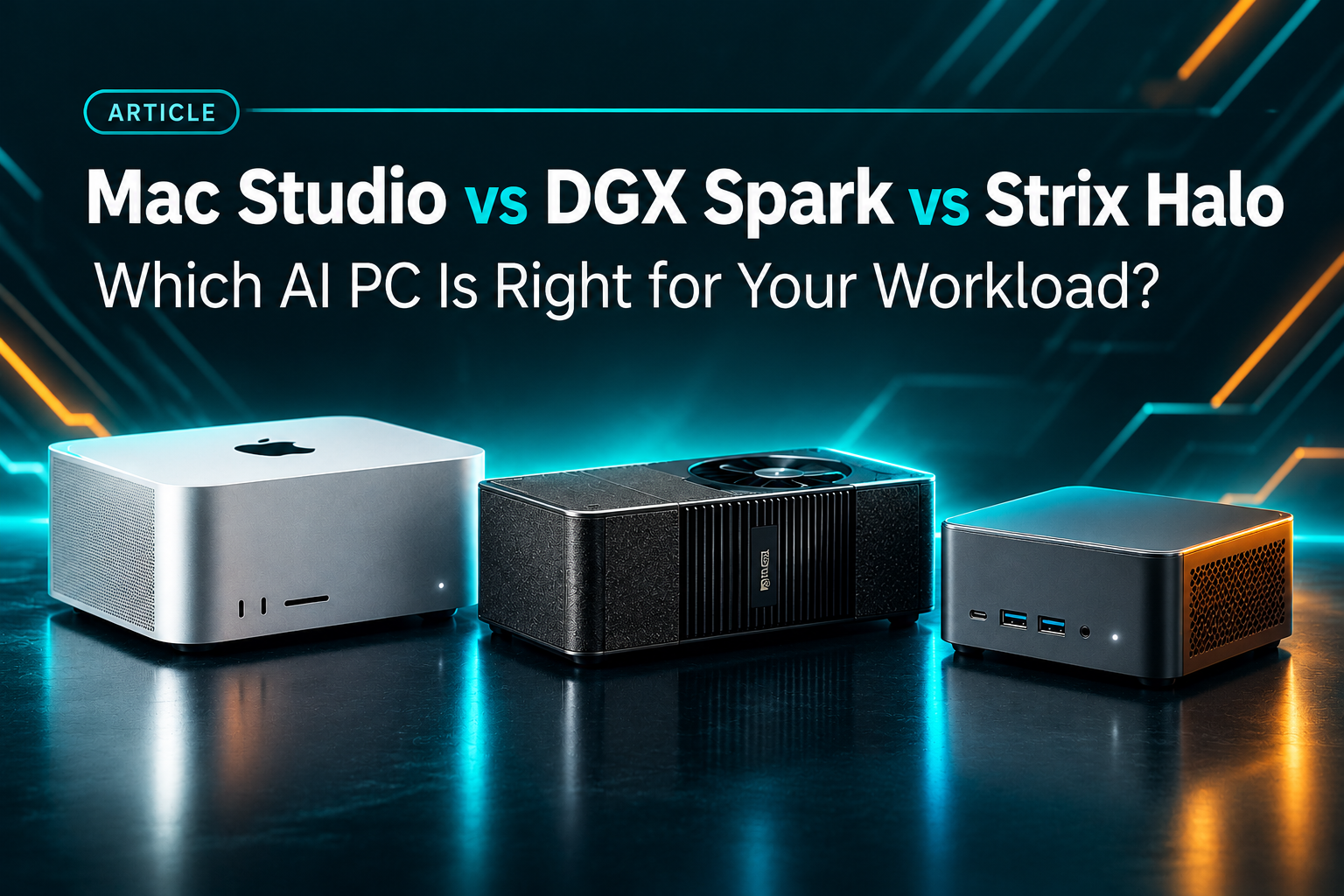
Three platforms dominate this space right now: Apple's Mac Studio, NVIDIA's DGX Spark, and mini PCs powered by AMD's Strix Halo. Each takes a completely different path when balancing memory capacity, raw bandwidth, software support, and price.
When you break down the actual numbers, the best choice simply comes down to what kind of AI workloads you plan to run.
1. Apple Mac Studio M5 Ultra: 1.2 TB/s Unified Memory Bandwidth
Apple's Mac Studio is designed for users who want substantial unified memory in a compact desktop computer. In the configurations described in the source, the M5 Max starts at $2,499 with 36 GB of memory, while a configuration with 128 GB reaches $5,099.
The M5 Ultra starts at $5,199 with 96 GB of memory and offers a reported memory bandwidth of approximately 1.2 TB/s. The source also describes a 256 GB configuration costing an additional $4,000, alongside a planned 512 GB configuration whose price had not yet been announced.
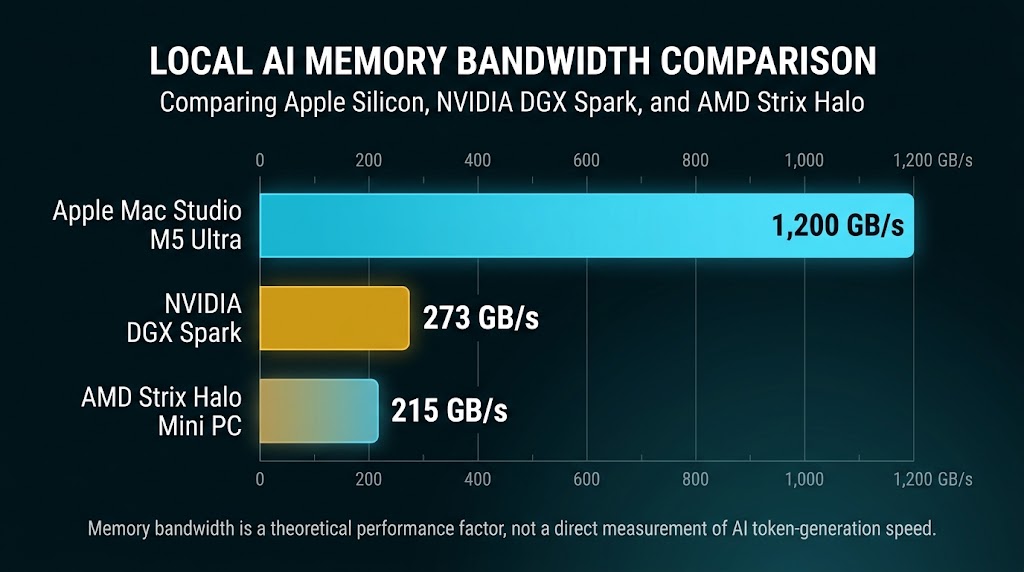
The main advantage is memory bandwidth. On paper, the raw throughput numbers tell a stark story: Apple's M5 Ultra leads the field with roughly 1,200 GB/s (1.2 TB/s) of unified memory bandwidth, compared to 273 GB/s on NVIDIA’s DGX Spark and ~215 GB/s on AMD Strix Halo platforms. That gives the M5 Ultra a theoretical 4.4x bandwidth multiplier over the DGX Spark and a 5.6x advantage over Strix Halo. However, hardware benchmarks don't scale linearly into token throughput. Real-world generation speed relies heavily on model architecture (dense vs. MoE), runtime execution framework, context overhead, and thread optimization—meaning a 4x leap in memory bus speed rarely yields a 4x jump in actual inference.
This can matter when running AI models that must repeatedly access large amounts of model data. Higher bandwidth also provides more theoretical headroom for inference workloads, although actual performance depends on the model architecture, software, and workload.
However, Apple's approach has limitations. Memory is soldered rather than upgradeable, so buyers must choose their capacity when purchasing the machine. The system also does not provide access to NVIDIA's CUDA ecosystem, which the source identifies as an important consideration for AI development.
Best suited to: Developers who prioritize high memory bandwidth, large unified-memory configurations, and a compact desktop environment for local AI.
2. NVIDIA DGX Spark: GB10 Grace Blackwell & CUDA Software Integration
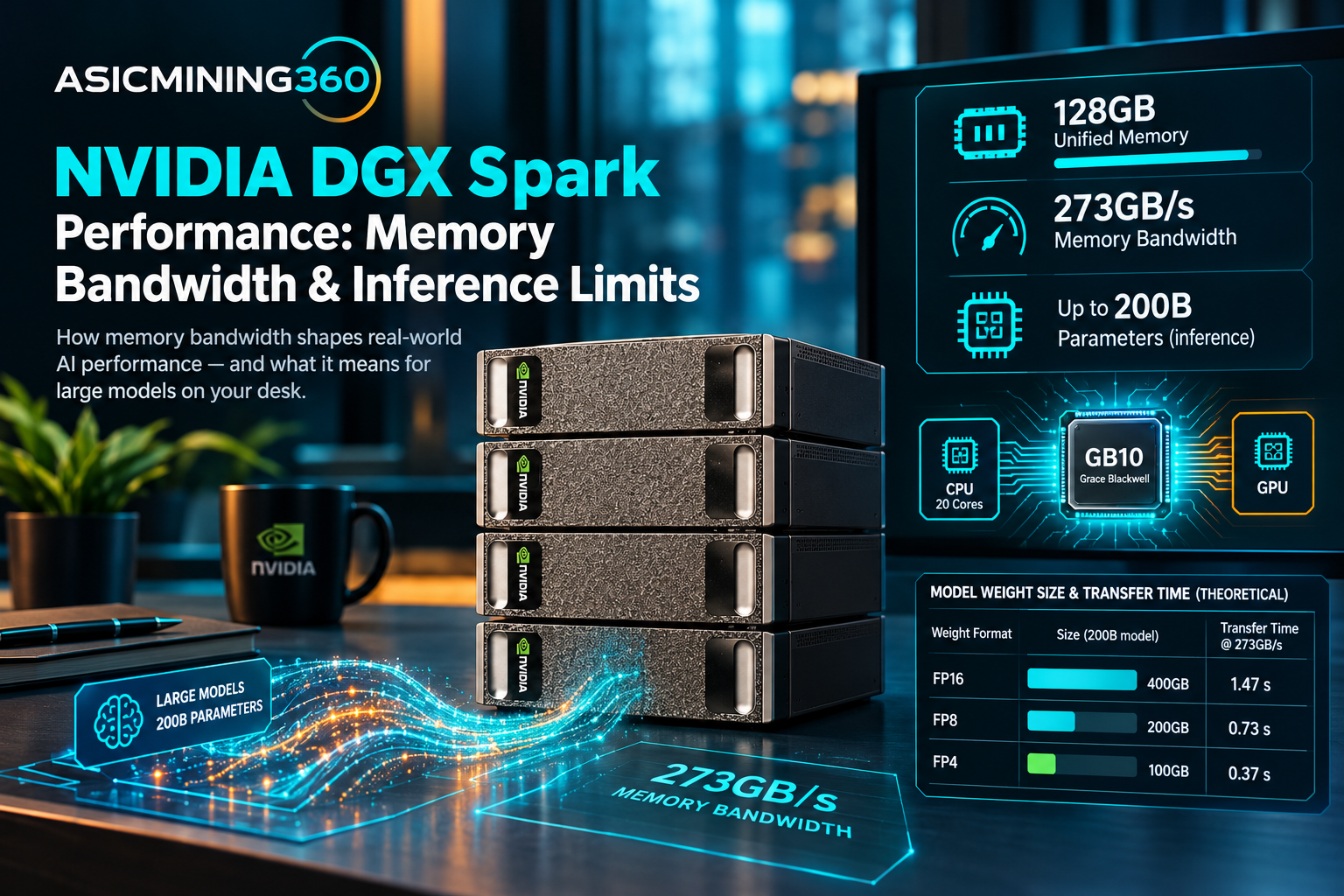
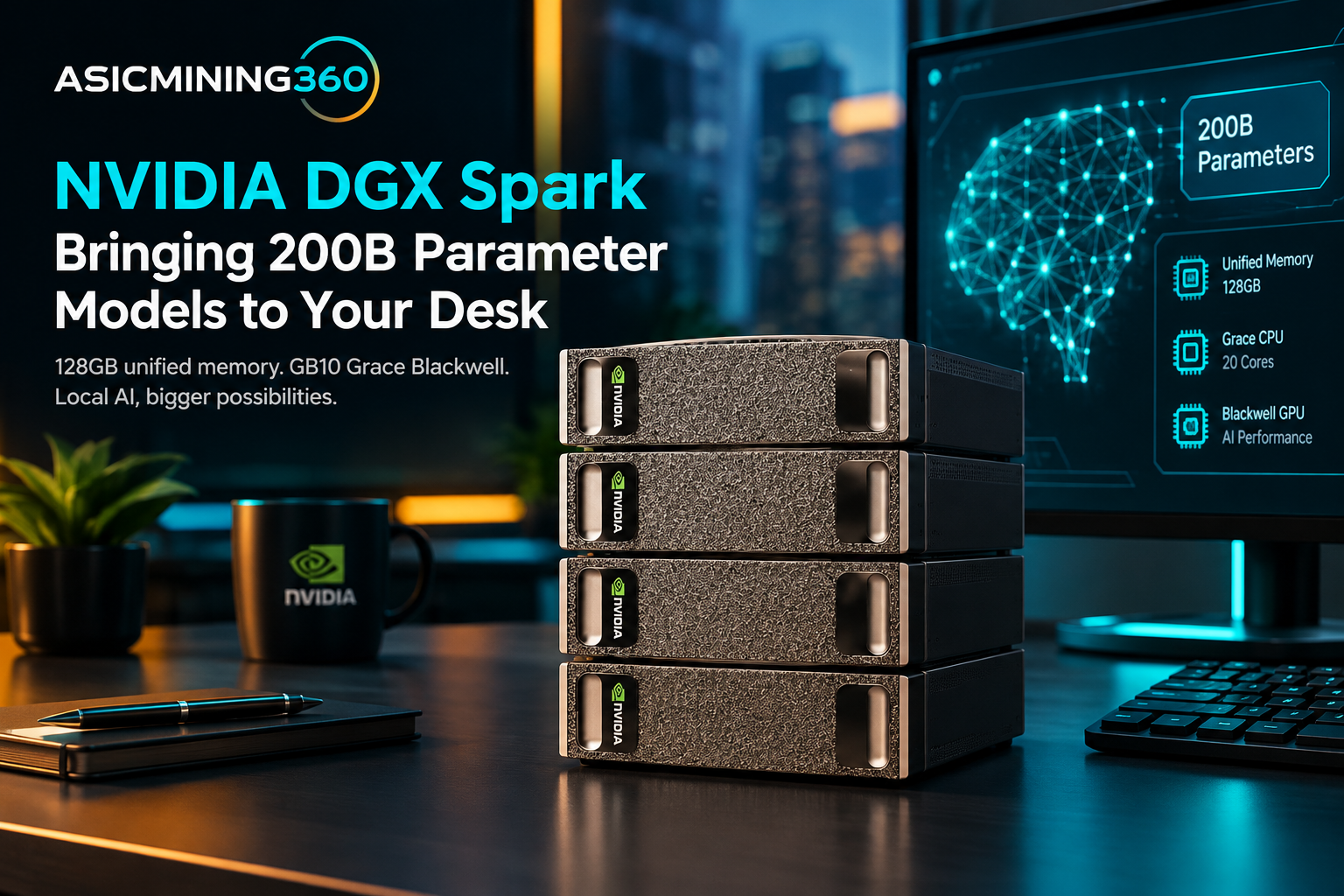
NVIDIA takes a different approach with the DGX Spark. The source describes a compact system offering 128 GB of memory for $4,699, with a reported memory bandwidth of 273 GB/s.
Compared with Apple's high-bandwidth configurations, that is a substantial difference on paper. However, bandwidth alone does not determine the final speed of every AI model.
The principal attraction of NVIDIA's system is its software ecosystem. CUDA is an important part of many AI development workflows, and the source identifies it as a key reason to consider NVIDIA hardware.
The system is also presented as an option for more demanding prompt processing and workloads involving multiple users. For teams already relying on NVIDIA-oriented software, this compatibility may matter more than achieving the highest possible memory bandwidth.
There are trade-offs. The reported bandwidth is considerably lower than Apple's 1.2 TB/s figure, while higher-end NVIDIA graphics hardware can become extremely expensive. The source cites the RTX Pro 6000, with 96 GB of memory, as an example of a product whose price reached $16,000.
Best suited to: Developers and teams whose existing workflows depend heavily on CUDA and who value compatibility with NVIDIA's software ecosystem.
3. AMD Strix Halo Mini PCs: Budget-Friendly Memory for Local LLM Agents
AMD's Strix Halo platform takes a completely different angle on local AI. Instead of shelling out top dollar for Apple's bandwidth or NVIDIA's brand tax, you get a solid, budget-friendly x86 machine with plenty of RAM.
The price tags speak for themselves: you can pick up a compact unit like the GMKtec starting around $1,700, or a modular Framework build for around $3,449—a fraction of what you'd spend on high-end Apple or NVIDIA hardware.
You do give up raw speed, though. The Strix Halo memory bus tops out around 215 GB/s, lagging behind the DGX Spark's 273 GB/s and sitting far below Apple's M5 Ultra at 1.2 TB/s. While lower bandwidth slows down heavy memory access, it doesn't mean your token generation speeds fall off a cliff in everyday use.
On the workbench, AMD offers big practical wins: a much better price-per-gigabyte for RAM, clean Linux support, and an open ecosystem. Just keep an eye on thermals—cramming this much performance into a mini PC means heat builds up fast, which can throttle clock speeds during back-to-back heavy workloads.
Best suited for: Buyers looking to maximize local RAM on a budget, who want a native Linux environment and are comfortable managing small-form-factor thermals in exchange for low entry costs.
4. Workstation Hardware Matrix: Memory Capacity, Bandwidth & Price
The following table summarizes the figures and trade-offs reported in the source material.
| Feature | Apple Mac Studio M5 Ultra | NVIDIA DGX Spark | AMD Strix Halo mini PCs |
|---|---|---|---|
| Memory capacity cited | 96 GB starting configuration; higher capacities described | 128 GB | Up to 128 GB in the scenarios described |
| Reported memory bandwidth | 1.2 TB/s | 273 GB/s | Approximately 215 GB/s |
| Price cited | From $5,199 | $4,699 | From $1,700 |
| Main advantage | High memory bandwidth | CUDA ecosystem | Lower entry price |
| Main limitation | Soldered memory; no CUDA | Lower bandwidth than the cited Apple configuration | Lower bandwidth and potential thermal limitations |
| Main use case | Bandwidth-focused local AI | NVIDIA-oriented development workflows | Cost-conscious local AI |
Prices and configurations are reproduced from the source material and are not independently verified. The systems may differ in other hardware and software characteristics, so these figures should not be treated as a complete benchmark.
5. Real-World Benchmarks: Dense Models vs MoE Architecture Execution
Doubling system memory bandwidth doesn't guarantee a 2x bump in real-world token generation.
Take a dense model like Qwen 2.5 72B. Quantized to 4-bit (INT4), the model weighs in at roughly 41 GB. In head-to-head testing across Apple and NVIDIA platforms, generation speeds landed consistently between 15 and 30 tokens per second—despite Apple's massive memory bandwidth advantage on paper. The takeaway is clear: raw bandwidth sets the theoretical ceiling for throughput, but software runtimes and memory access patterns dictate actual speed.
Model architecture plays an equally decisive role. Dense models force the system to evaluate every single parameter for every output token. Mixture of Experts (MoE) architectures, on the other hand, route tokens to specific sub-networks, activating only a fraction of total parameters per pass. That key structural difference explains how an MoE model like Mixtral/GPT-style 120B can hit around 60 tokens per second on the DGX Spark.
Ultimately, these figures prove why buying local hardware based on a single spec sheet metric is a trap. Performance hinges on your specific execution stack, active context window, quantization quality, and batch size. A machine finely tuned for a single developer's prompt loop will behave very differently under concurrent multi-user API demands.
6. Which System Should You Choose?
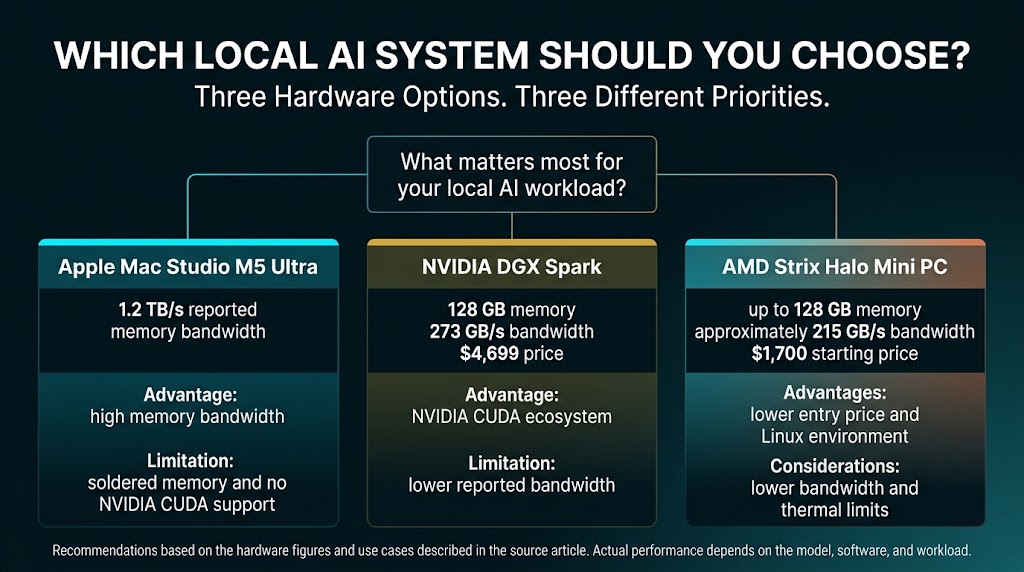
The three options serve different priorities.
- Choose Apple Mac Studio if high memory bandwidth is your main priority and its price, fixed memory configuration, and software limitations fit your needs.
- Choose NVIDIA DGX Spark if CUDA compatibility and the NVIDIA development ecosystem are central to your workflow.
- Consider AMD Strix Halo if you want a lower-cost route to substantial memory capacity and are willing to accept lower reported bandwidth and potential thermal constraints.
For a solo developer running a handful of local agents, AMD provides a remarkably cost-effective starting line. If your primary bottleneck is streaming heavy token outputs where raw memory bus speed dominates, Apple’s high-bandwidth unified memory justifies the premium. And for engineering teams whose workflows, fine-tuning scripts, and deployment pipelines rely strictly on CUDA, NVIDIA’s ecosystem remains the most practical choice.
There is no single "best" hardware platform on paper. The right local AI machine is simply the one that runs your specific target models at acceptable speeds, integrates cleanly into your software stack, and respects your budget and operational limits.
Conclusion
Local AI hardware selection should be driven by three architectural parameters: total addressable memory capacity, system memory bandwidth, and software stack integration.
Capacity establishes the upper bound for active model parameter size and context cache allocation. Bandwidth functions as the primary hardware constraint on token generation latency during autoregressive inference. Software compatibility dictates ecosystem support for underlying execution providers—such as CUDA, Metal/MLX, or ROCm/Vulkan.
Each silicon vendor balances these trade-offs differently across unified and discrete architectures. Determining optimal hardware requires profiling target model architectures against real deployment workloads to calculate cost per unit of compute performance.
Editorial note: This article is based exclusively on the supplied source text. Hardware specifications, prices, and performance figures have not been independently verified.