Introduction
NVIDIA **DGX **Spark has an impressive headline feature: it can run large AI models locally, including models with up to 200 billion parameters under suitable configurations. Yet the ability to load a model into memory doesn't necessarily mean the machine can generate answers quickly.
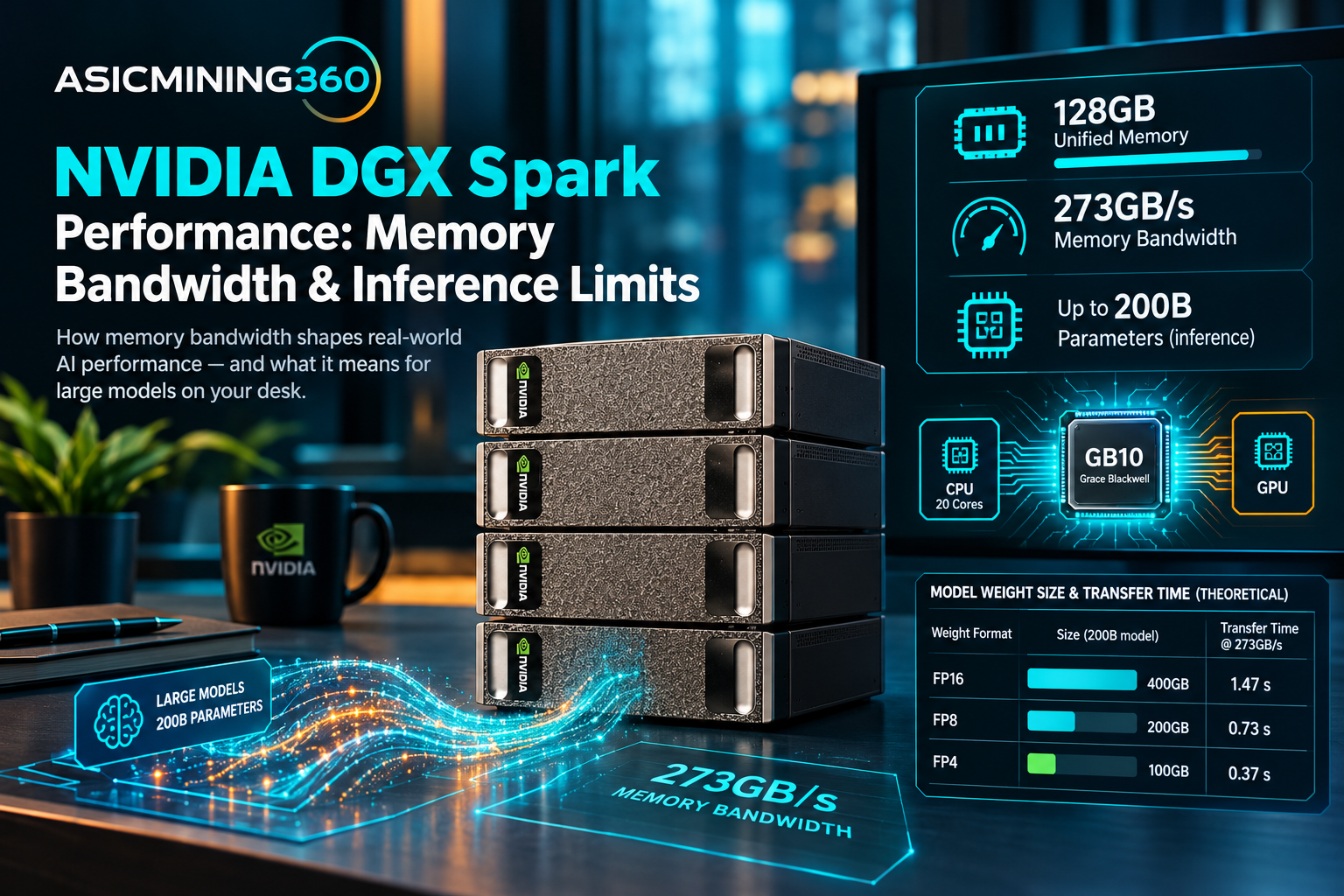
This is where memory bandwidth becomes important. DGX Spark combines CPU and GPU resources with 128GB of unified memory, but its memory bandwidth is rated at 273GB/s. That figure may sound substantial, and it is, but the amount of data an AI model needs to access during inference changes how we should interpret it.
The real question isn't simply whether a model fits. It's how quickly the system can deliver the information needed to generate each response.
1. AI Inference Bottlenecks: Why Memory Bandwidth Limits Token Generation
When a Large language model generates text, it produces a sequence of tokens. A token might represent a complete word, part of a word, punctuation, or another small unit of text.
During autoregressive generation, the model predicts the next token using its learned weights and the existing context. It then repeats the process to produce the following "TOKEN".
For a large model generating tokens for a single user, reading its weights can account for a substantial share of the work. If those weights occupy tens or hundreds of gigabytes, the system needs to move considerable amounts of data between memory and its processors.
Memory capacity tells us how much data can be stored. Memory bandwidth tells us how quickly data can be transferred.
These are two different limits. A machine might have enough memory to accommodate a large model but still take longer than expected to generate a response because supplying the model's weights becomes a bottleneck.
DGX Spark's unified memory helps make large models fit locally. Its 273GB/s bandwidth, however, places a separate constraint on how quickly data can be accessed.
2. 273 GB/s Bandwidth Analysis: Theoretical Transfer Times & Weights
A bandwidth rating of 273GB/s means that the memory system has a theoretical transfer rate of up to 273 gigabytes per second under the relevant conditions. It does not mean that every AI model can use that entire rate continuously.
To understand the implications, consider a simplified model of inference in which generating one token requires reading the model's weights once. If the effective weight size is 100GB, dividing that size by the rated bandwidth gives a theoretical data-transfer time of approximately 0.37 seconds.
The calculation is straightforward:
Transfer time = Data size ÷ Memory bandwidth
For a 100GB weight footprint:
100GB ÷ 273GB/s ≈ 0.37 seconds.
This is a useful way to understand the hardware's limits, but it is not a benchmark of DGX Spark. Real inference includes computation, runtime overhead, memory access patterns and other operations. The system may not sustain its theoretical peak bandwidth for the entire workload.
Still, the calculation illustrates an important point: moving a large model's weights is not instantaneous, even when they fit comfortably within the available memory.
3. Quantization & Precision: FP16, FP8, and FP4 Weight Transfer Impact
The number of parameters alone does not determine how much data needs to be read. The numerical precision used to represent those parameters also matters.
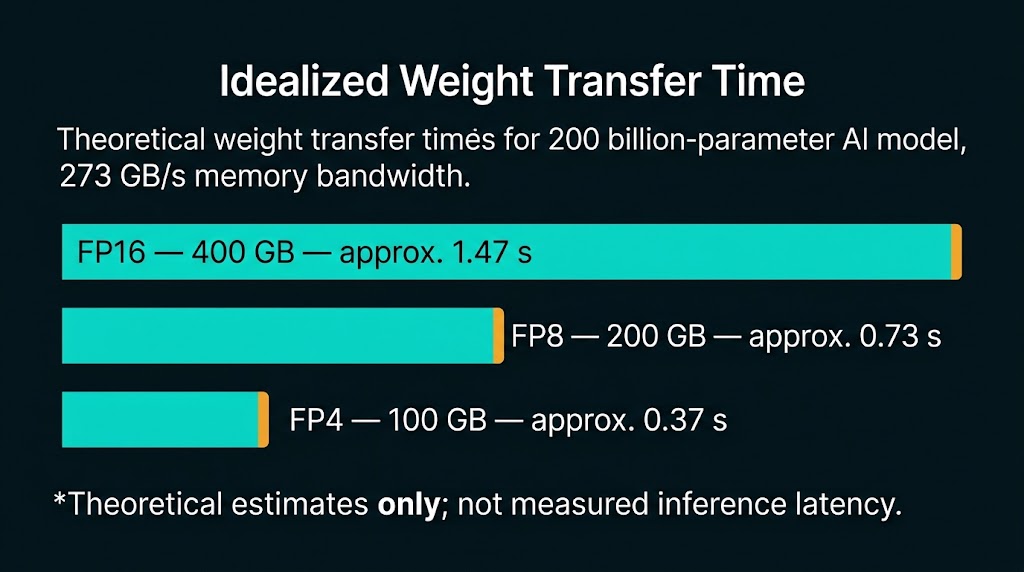
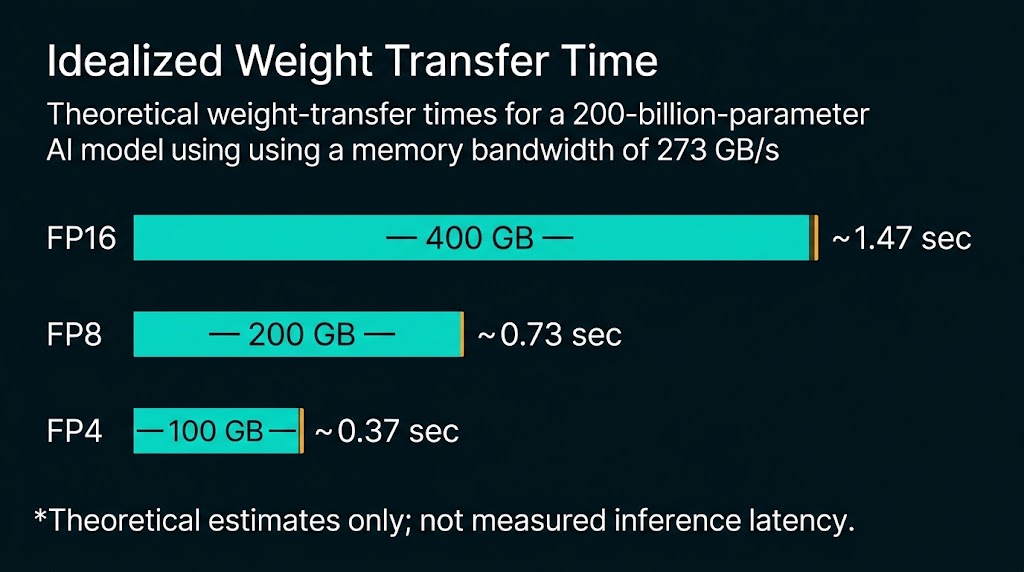
A 200-billion-parameter model stored at four bits per parameter has a theoretical weight size of around 100GB. At eight bits per parameter, the weights require around 200GB, while 16-bit weights require around 400GB.
Using 273GB/s as an idealized bandwidth ceiling, the resulting transfer times look like this:
| Weight format | Theoretical weight size | Idealized transfer time |
|---|---|---|
| FP16 | 400GB | 1.47 seconds |
| FP8 | 200GB | 0.73 seconds |
| FP4 | 100GB | 0.37 seconds |
These figures assume that the entire weight set must be read for each generated token and that the full rated bandwidth is available. They exclude other memory requirements and do not represent measured token-generation times.
For DGX Spark, the FP4 scenario is particularly relevant because a 100GB theoretical weight footprint can potentially fit inside its 128GB unified memory pool. The FP8 and FP16 examples illustrate the bandwidth implications of larger weight representations, but their weights alone exceed that pool.
Quantization is therefore important for two separate reasons: it reduces the memory required to store a model and can reduce the amount of data that needs to be transferred during inference. However, quantization formats, metadata, numerical accuracy and software support all affect the final result.
4. Token Generation Speed Ceilings: Bandwidth vs. Compute-Bound Workloads
The transfer-time estimates help explain why a large model can be slow even on specialized hardware.
Imagine a model whose weights occupy 100GB. In an idealized, bandwidth-bound scenario, reading that quantity of data at 273GB/s takes about 0.37 seconds. That corresponds to a rough ceiling of 2.7 tokens per second if each token requires one full weight read and the transfer is the only relevant cost.
This is not a prediction of the actual speed of every 200B model on DGX Spark. It is a simplified model showing how bandwidth can constrain single-stream generation.
Actual results depend on how efficiently the software accesses memory, the model's architecture, the amount of computation required, the context length and the quantization implementation. Some workloads are more compute-bound than bandwidth-bound.
There is another important distinction: inference changes when several requests are processed together. Batching can allow the system to reuse weight data across multiple sequences, improving overall throughput. That can increase the number of tokens served per second across all users, even if each individual request does not become proportionally faster.
Consequently, single-user generation speed and total system throughput should not be treated as interchangeable measurements.
5. Memory Capacity vs. Bandwidth: Trade-offs in Compact AI Workstations
Increasing memory capacity allows a system to accommodate larger models, longer contexts or more components of a workload without running out of space. But if the memory bandwidth remains unchanged, the system may still struggle to deliver high generation speeds for a large model.
This is the central trade-off behind compact AI workstations. DGX Spark makes large-model experimentation possible in a desktop-sized system, but its capacity should not be mistaken for unlimited performance.
For a developer testing a model, building an application prototype or evaluating a local inference pipeline, that compromise may be acceptable. The ability to work locally can reduce dependence on cloud infrastructure and make experimentation more convenient.
For a production service handling many simultaneous users, the priorities may be different. Consistent latency, aggregate throughput and operating costs become central, so a system with greater memory bandwidth or multiple accelerators may be a better fit.
The right choice depends on the workload rather than the largest parameter count advertised.
6. What About the Mac Studio and Other Alternatives?
Evaluating the DGX Spark requires looking at the broader unified-memory landscape, including top-tier Apple Mac Studio setups that trade off different capacity and bandwidth numbers.
Higher bandwidth helps tremendously with bandwidth-bound inference, but it doesn't make a system an automatic winner across the board. Available memory footprint, supported quantization formats, compute performance, software integration, and system pricing all weigh into the equation.
Deep CUDA integration and Blackwell's native low-precision acceleration give NVIDIA a strong edge for developers locked into that stack. However, alternative unified-memory hardware can be very compelling for specific workloads or frameworks.
To draw meaningful conclusions, you need apples-to-apples benchmarks running the same model, quantization, and context window under identical inference conditions. Spec-sheet bandwidth alone won't tell you which rig actually wins.
Engineering Verdict: Evaluating DGX Spark for Real-World AI Inference
NVIDIA DGX Spark demonstrates how far local AI computing has progressed, but its 128GB memory capacity and 273GB/s bandwidth address different parts of the problem.
The large memory pool makes it possible to accommodate models that would not fit on many conventional desktop GPUs. Bandwidth, meanwhile, influences how quickly the system can feed those models during inference.
That distinction matters when evaluating a machine for real work. A model that loads successfully may still generate tokens slowly, and a system that performs well for one user may behave differently under a larger batch of requests.
The most useful question is therefore not just how many parameters DGX Spark can run. It is whether its memory bandwidth, software support and real-world token-generation speed match the workload you actually intend to run.