
Introduction
The global expansion of Artificial Intelligence is changing the way the world thinks about technology infrastructure. AI is no longer only a question of better algorithms, faster chips, or more capable software. Behind every large AI model is a physical infrastructure that requires enormous computing capacity, reliable electricity, advanced cooling, high-speed connectivity, and secure facilities.
For this reason, one factor increasingly stands above the rest: the cost and availability of electricity
Training large AI models and operating cloud-computing infrastructure around the clock can consume enormous amounts of power. As AI workloads become more intensive, countries that can provide reliable electricity at competitive prices will have an important advantage in attracting data centers, cloud providers, semiconductor companies, and AI infrastructure investment.
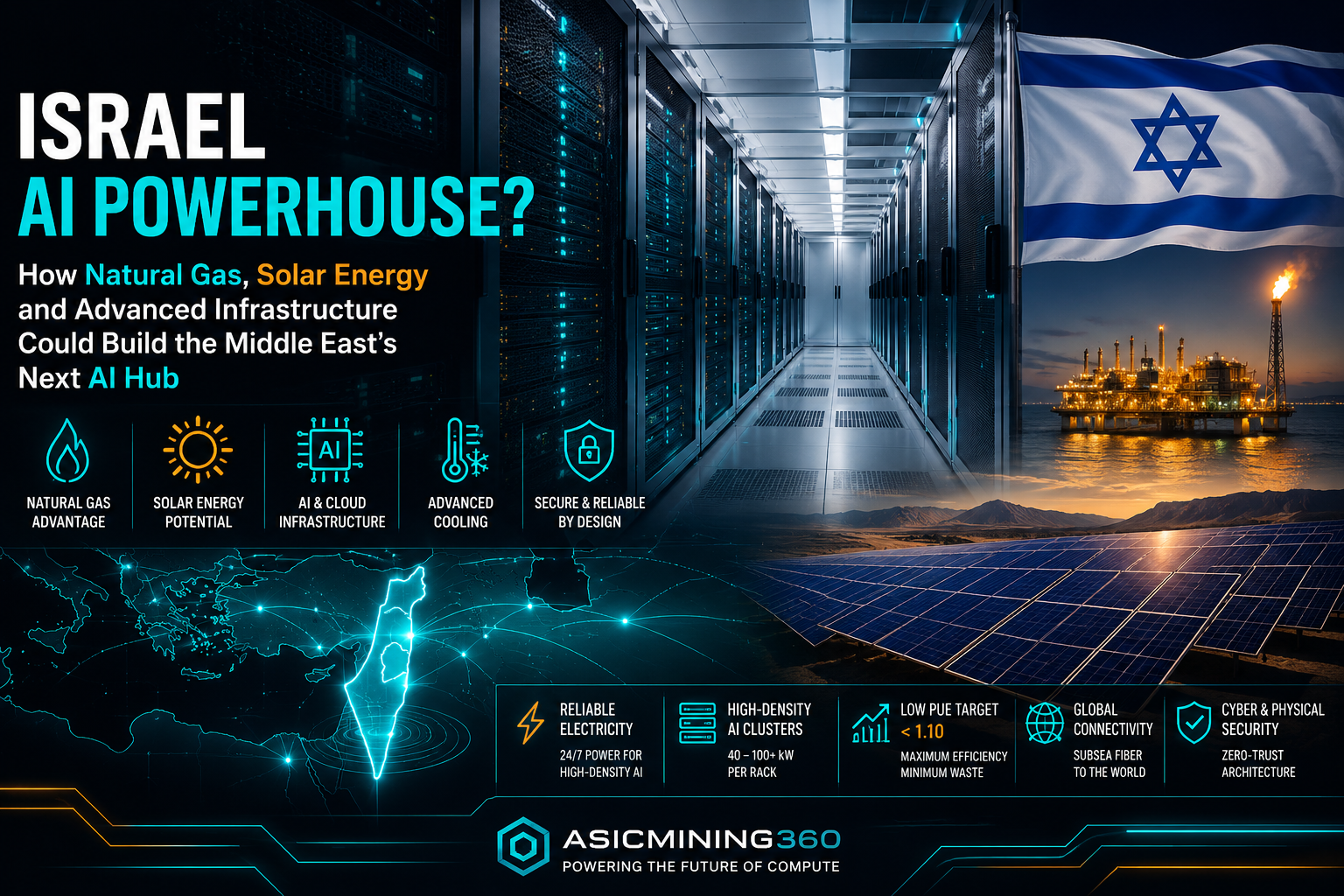
Within the Middle East, Israel occupies an unusual position. It has one of the region's most developed technology ecosystems, strong international relationships, an established semiconductor and cybersecurity sector, and direct access to a growing offshore natural gas industry. At the same time, its geography provides significant solar-energy potential, particularly across the Negev.
All of this naturally tees up the big question: can Israel actually muscle its way into becoming the Middle East's go-to hub for next-gen AI and cloud infrastructure?
Technology Meets Energy
Israel punches well above its weight in tech, and that edge stretches way past its local borders. The country has built a powerhouse ecosystem spanning cybersecurity, software development, cloud infrastructure, semiconductor design, and heavy-duty computing.
However, technology alone does not determine where hyperscale infrastructure is built.
Large AI data centers are fundamentally energy-intensive industrial facilities. Their economics depend heavily on the availability, reliability, and long-term price of electricity. A country may have excellent engineers and strong digital infrastructure, but if electricity is too expensive or the grid cannot provide sufficient capacity, large-scale AI infrastructure becomes difficult to develop.
This is where Israel's energy transformation becomes particularly relevant.
Over the past decade, Israel has moved from substantial dependence on imported fuels toward becoming a significant offshore natural gas producer and exporter. The development of fields such as Leviathan and Tamar has created a domestic source of fuel capable of supporting electricity generation and reducing dependence on imported energy.
That transition gives Israel something extremely important for AI infrastructure: a domestic energy base that can support continuous power generation.
Israel’s Offshore Natural Gas Advantage
Israel's offshore gas sector has become one of the most important components of its modern energy system.
Discovered offshore fields contain substantial recoverable resources, with commonly cited estimates placing total discovered reserves in the range of approximately 850–900 billion cubic meters (BCM). The largest resources are concentrated in several major fields.
| Offshore Field | Approximate Resource Estimate | Development Significance |
|---|---|---|
| Leviathan | ~500 BCM | Israel's largest offshore gas development and a major source of domestic supply and exports |
| Tamar | ~280–319 BCM | Major domestic gas supplier supporting electricity generation |
| Karish & Tanin | >50 BCM combined | Additional offshore production capacity |
| Dalit | ~8 BCM | Smaller discovered offshore resource |
| Total Discovered Resources | ~850–900 BCM | Long-term strategic energy resource base |
Production has seriously ramped up, too. Offshore natural gas fields pumped out around 27 BCM in 2024, with over half staying local to power the home front while the rest headed overseas to fuel exports—mostly to neighbors like Egypt and Jordan.
The infrastructure supporting this industry is equally important. Israel has developed hundreds of kilometers of transmission and distribution pipelines connecting offshore production with domestic energy infrastructure.
This matters for AI because a data center cannot simply depend on occasional electricity availability. AI clusters require power continuously. GPU and accelerator infrastructure must operate 24 hours a day, while cloud providers require predictable capacity and high levels of reliability.
Natural gas therefore provides an important baseload component that can complement renewable generation.
Solar Energy Adds a Second Layer
Natural gas is not Israel's only energy advantage.
The Negev Desert provides substantial solar-energy potential, with high levels of solar irradiation across large areas. Annual solar irradiation in favorable parts of the region can reach roughly 2,250 kWh per square meter, although actual energy production varies according to location, technology, orientation, and system efficiency.
This creates an opportunity to combine two different energy characteristics.
Natural gas can provide dispatchable generation when electricity demand is high or solar output is unavailable, while utility-scale solar can supply additional daytime electricity and reduce the carbon intensity of the overall energy mix.
For future AI campuses, this combination could become particularly valuable.
Rather than viewing gas and solar as competing technologies, Israel could potentially use them as complementary components of a larger energy architecture: gas for reliability, solar for additional generation, and advanced storage and grid management to improve flexibility.
Technical Datasheet: Next-Generation AI Data Center Infrastructure
The next wave of local data centers can't just be built for regular office workloads—they need to be purpose-built for heavy-duty AI crunching.
Let's face it: AI accelerators run blazing hot compared to old-school servers. As racks get packed tighter, traditional fans and air cooling just can't keep up anymore. That’s why advanced setups like direct-to-chip liquid cooling and full immersion baths are moving from nice-to-haves to absolute must-haves.
A potential technical blueprint would look like this:
| Parameter | Technical Specification | Operational Standard |
|---|---|---|
| PUE Target | < 1.10 Power Usage Effectiveness | Ultra-efficient facility design that minimizes non-compute energy consumption |
| Power Density | 40 kW – 100+ kW per Rack | Designed for high-density GPU and accelerator configurations |
| Baseload Energy Strategy | Dual-Source Grid Coupling | Domestic natural-gas generation combined with utility-scale solar |
| Thermal Management | Direct-to-Chip & Immersion Cooling | Single-phase and two-phase dielectric liquid cooling for high heat flux |
| Circular Heat Repurposing | Hydronic Thermal Export | Potential recovery of server heat for greenhouses and agricultural facilities |
| Network Connectivity | Subsea Fiber Trunking | High-capacity international connectivity linking Mediterranean landing points with global networks |
| Cyber & Physical Hardening | Zero-Trust Hardened Nodes | Strong physical security combined with modern cybersecurity and hardware isolation |
The PUE target is particularly important. A facility approaching a PUE of 1.10 would spend relatively little additional energy on cooling, power distribution, lighting, and other infrastructure compared with the energy delivered directly to IT equipment.
At the same time, liquid cooling could become increasingly important as AI racks move toward tens or even more than 100 kW of power density.
This is where Israel's technology sector could potentially complement its energy infrastructure. Advanced cooling, cybersecurity, semiconductor expertise, and high-density computing can all become components of a specialized AI data-center ecosystem.
Israel’s AI Infrastructure Deployment Matrix
The potential development of this ecosystem can be summarized through four major pillars:
| Core Pillar | Current Capability | Strategic Expansion Objective |
|---|---|---|
| Generation Capacity | Domestic offshore natural gas + solar farms | Multi-gigawatt dedicated generation for AI and cloud-computing corridors |
| Regional Integration | Gas pipeline exports to Egypt and Jordan | Potential expansion toward broader regional energy corridors |
| Cooling Efficiency | Advanced liquid and closed-loop cooling technologies | Large-scale immersion and direct-to-chip systems for high-density AI clusters |
| Supply Chain Resilience | Strong domestic technology ecosystem | Greater integration with global semiconductor, cloud, and hyperscale companies |
The Security Question
Energy is only one part of the equation.
Building a hyperscale data center isn't a casual bet—it's a multi-billion-dollar commitment designed to run for decades. Because the stakes are that high, investors look way past basic power bills. They dig deep into physical security, political stability, regional connectivity, insurance premiums, and the hard risk of sudden infrastructure breakdowns.
This makes the geopolitical environment surrounding Israel particularly important.
Since October 7, 2023, Israel has been involved in an extensive regional conflict involving Hamas, Hezbollah, Iran-linked groups, and other actors. The subsequent military campaigns dramatically changed the security environment across several parts of the region.
Israel has significantly weakened the military capabilities of Hamas and Hezbollah and has directly confronted Iranian military capabilities. The fall of the Assad government in Syria has also changed the regional strategic landscape.
From an infrastructure-investment perspective, however, military success does not automatically eliminate geopolitical risk.
For Israel to become a major regional AI hub, the long-term objective would be to translate military deterrence into predictable infrastructure security. Global cloud companies need confidence that power plants, fiber routes, data centers, and supply chains will remain operational over decades.
That distinction is critical.
The opportunity is therefore not simply about being militarily stronger. It is about creating an environment in which international technology companies can confidently commit billions of dollars to long-lived infrastructure.
The Saudi Arabia and Qatar Question
Local energy reserves give Israel a solid baseline, but taking the next big leap forward is going to rely heavily on regional economic teamwork.
The Abraham Accords proved that cross-border collaboration between Israel and its Arab neighbors isn't just a pipe dream. With countries like the UAE and Bahrain already locking in formal ties, the groundwork is laid for a much wider web of commercial partnerships across the region.
The larger strategic question concerns Saudi Arabia and Qatar.
Saudi Arabia is one of the world's largest oil producers and possesses enormous energy resources and investment capital. Qatar is one of the world's leading natural gas and LNG producers.
Closer economic and energy relationships with these countries could potentially change the economics of large-scale computing infrastructure.
Down the line, regional energy tie-ups could mean all sorts of ambitious projects—think shared gas trading networks, cross-border power grids, new pipelines, or joint generation plants. Of course, none of this is a walk in the park. Pulling off projects of that scale always hinges on delicate political deals, hard economics, tight security, and massive capital injections.
But if they became feasible, the implications could be significant.
Israel would bring its technology ecosystem, cybersecurity expertise, semiconductor capabilities, engineering talent, and data-center know-how. gulf partners could contribute energy resources, capital, and access to large regional markets.
The result could be a broader energy-to-compute ecosystem linking Gulf resources with Eastern Mediterranean technology infrastructure.
From Energy Security to AI Competitiveness
This is ultimately the most important connection.
The future competitiveness of AI infrastructure will depend on more than the price of GPUs. Operators will examine the total cost of compute.
That includes:
- electricity;
- grid connection costs;
- cooling;
- land;
- network connectivity;
- construction;
- taxation;
- financing;
- security;
- and long-term energy availability.
If Israel can combine domestic gas production, expanding solar generation, highly efficient cooling, strong fiber connectivity, and its existing technology ecosystem, it could create a compelling environment for specialized AI infrastructure.
Regional energy integration could strengthen that position further.
Instead of competing only as a small national market, Israel could potentially position itself as a technological node connecting European technology markets, Mediterranean infrastructure, and Gulf energy resources.
Israel’s Potential AI Data Center Future
The most realistic future is unlikely to involve Israel immediately becoming the largest data-center market in the world. The country has geographic, land, water, grid-capacity, security, and cost constraints that must be addressed.
Its opportunity is different.
Israel could specialize in high-value, high-density computing infrastructure where its technological capabilities provide an advantage. AI inference, specialized cloud services, cybersecurity workloads, semiconductor-related computing, and advanced research infrastructure could all become important components of this market.
If additional power-generation capacity is built around major computing clusters, the scale could eventually move from individual facilities toward multi-gigawatt AI corridors.
That would represent a major transformation: data centers would no longer be treated simply as buildings filled with servers. They would become integrated energy-and-compute facilities combining power generation, high-density computing, liquid cooling, fiber networks, cybersecurity, and potentially agricultural heat recovery.
Conclusion: A Potential Eastern Mediterranean AI Powerhouse
Artificial Intelligence is creating a new industrial race, and the countries that control the infrastructure behind computation will have an increasingly important role in the digital economy.
Israel enters this race with several unusual advantages: an advanced technology sector, substantial offshore natural gas resources, growing renewable-energy potential, international connectivity, semiconductor expertise, and an established cybersecurity ecosystem.
Its offshore gas discoveries have already transformed the country's energy position, moving it toward greater domestic energy security and allowing it to become a regional gas exporter. The Negev adds a significant solar resource, while advanced cooling and computing technologies could allow future facilities to operate at extremely high rack densities.
The next major opportunity may lie beyond Israel's borders.
Deeper economic and energy ties with Saudi Arabia and Qatar could unlock vital capital and massive energy resources, ultimately helping slash long-term power costs for massive data centers. Combined with Israel's technological capabilities, this could create a distinctive regional model in which Gulf energy resources and Israeli technology converge around AI and cloud computing.
The central question, therefore, is no longer whether Israel has the technological capabilities to participate in the AI revolution. It clearly does.
The bigger question is whether it can scale its electricity generation, data-center capacity, grid infrastructure, international connectivity, and regional economic relationships quickly enough to capture a significant share of the next wave of AI investment.
If those pieces come together, Israel could emerge as one of the most important AI and advanced-computing hubs in the Middle East, with the Eastern Mediterranean serving as a strategic bridge between global technology markets and the enormous energy resources of the Gulf.
FAQ
Q1: Can Israel actually pull off becoming a major tech and AI hub out there in the Middle East?
They definitely have the tech chops and cyber background for it, plus a massive backbone of natural gas right off their coast. But honestly, it all comes down to whether they can scale up their grid power and keep energy cheap enough to handle massive server loads without blinking.
Q2: Are those offshore gas fields actually big enough to keep power-hungry data centers running 24/7?
Pretty much. Fields like Leviathan and Tamar are pumping out tens of billions of cubic meters of gas every year. That gives them a rock-solid, domestic baseload supply so those GPU clusters don't have to worry about sudden blackouts or intermittent power drops.
Q3: Where does solar fit into all of this if they already have natural gas?
The Negev Desert gets slammed with serious sunlight—roughly 2,250 kWh per square meter every year. Solar handles the daytime load to keep things clean and take some pressure off the gas plants, giving them a nice mix of constant and renewable power.
Q4: What kind of heavy-duty specs are we talking about for these next-gen data centers?
They have to be built completely differently than old-school server rooms. We're looking at insane power densities hitting 40 to over 100 kW per rack, PUE ratings under 1.10 to cut down energy waste, and heavy reliance on direct-to-chip liquid cooling or immersion baths so the hardware doesn't melt.
Q5: Could regional ties with Gulf countries really change the game for them?
If regional partnerships and economic bridges with energy giants like Saudi Arabia or Qatar ever really clicked, it would completely flip the script. Merging massive Gulf energy resources and capital with Israeli tech and engineering could create a massive compute corridor connecting the Mediterranean to the Gulf.
Source
- Official Website: www.datacenter.com
- Direct PDF Document: Download Official Offshore Gas & Infrastructure Report (PDF)