Introduction
When we talk about the race to build AI data centers, the conversation usually revolves around electricity prices, advanced chips, computing power, and the billions of dollars being poured into new facilities. Water rarely gets the same attention, even though it can make a real difference when a country decides whether to build more data centers.
In our previous articles on ASICMINING360, we looked at countries that want to attract AI investment but face a difficult problem: they have plenty of energy, sometimes at very competitive prices, yet they do not have enough freshwater to support large-scale industrial development without additional costs. This is particularly relevant in parts of the Middle East and the Gulf, where data center localization and water availability are becoming increasingly important considerations for technology investment.
Desalination is an option, of course, but it is not a free solution. It requires infrastructure, electricity, and additional investment. When a data center operator is comparing locations, these costs can influence the final decision.
This time, I want to look at the problem from the other side.
What about countries that already have enormous freshwater resources? Countries where major rivers carry billions of cubic metres of water every year, much of which eventually flows into the sea. Could some of them turn that natural advantage into an opportunity to attract more AI data centers?
The Food and Agriculture Organization of the United Nations (FAO), through its AQUASTAT database, provides data on renewable water resources around the world. Using the figures presented below as a starting point, we can identify ten countries with particularly large water resources and look at how well positioned they are to compete for AI infrastructure investment.
There is one catch, though. Having plenty of water does not mean a country is ready to host large data centers. It also needs reliable electricity, a suitable power grid, good internet connectivity, access to technology, and the money to build and operate these facilities. A country can rank among the world's richest in water and still struggle to attract this type of investment.
That is why the comparison below looks at both water resources and each country's ability to put them to practical use.
Top 10 Countries With the Largest Renewable Water Resources
The figures in the table represent the preliminary annual water-resource estimates used for this comparison. The daily amounts are simple averages calculated from those annual figures. They should not be mistaken for water that is sitting unused and ready to be allocated to industry.
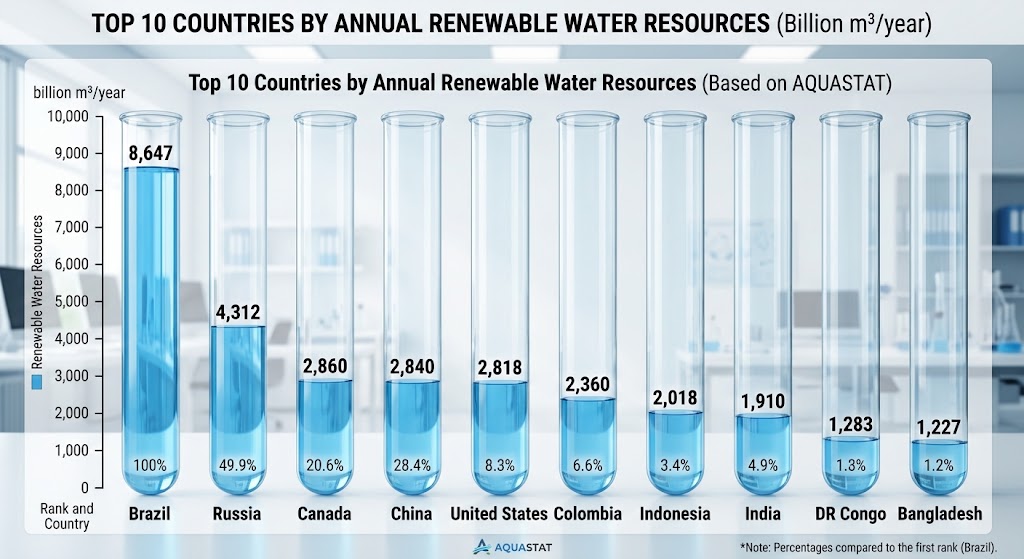
| Rank and country | Annual renewable water resources and daily average | Main source of water | Prospects for AI data center investment |
|---|---|---|---|
| 1. Brazil | 8,647 billion m³/year; around 23.69 billion m³/day | The Amazon Basin, major river systems, and abundant rainfall | Very high. Brazil has enormous water resources, substantial hydropower generation, and a large industrial economy. It has a strong starting position, although electricity prices, grid capacity, and the location of suitable sites will influence where new data centers make sense. |
| 2. Russia | 4,312 billion m³/year; around 11.81 billion m³/day | The Ob, Yenisei, and Lena rivers, as well as Lake Baikal | Medium. Russia has no shortage of water or natural energy resources. The bigger problem is attracting international technology companies under current sanctions and restrictions. Access to advanced chips, financing, and international partnerships can be more important than the country's natural advantages. |
| 3. Canada | 2,860 billion m³/year; around 7.84 billion m³/day | The Great Lakes, Mackenzie River, St. Lawrence system, and other freshwater networks | Very high. Canada is one of the more attractive candidates because it combines abundant freshwater with hydropower, a developed economy, and cold weather in many regions. Those conditions can help reduce cooling costs, although power availability and grid connections still need to be checked at the local level. |
| 4. China | 2,840 billion m³/year; around 7.78 billion m³/day | The Yangtze, Yellow River, and other major river basins | Very high. China has a large technology industry, extensive electricity-generation capacity, and an established data center market. The main complications are regional water shortages and restrictions on access to certain advanced computing technologies. |
| 5. United States | 2,818 billion m³/year; around 7.72 billion m³/day | The Mississippi–Missouri system, Great Lakes, and other major river basins | Very high. The United States has a major advantage in AI companies, cloud computing, financing, and access to technology. However, some of the areas attracting the most data center investment already face water pressure or electricity-grid constraints. National resources alone do not tell the whole story. |
| 6. Colombia | 2,360 billion m³/year; around 6.47 billion m³/day | The Magdalena and Orinoco river systems and tropical rainfall | Medium. Colombia has plentiful freshwater and a significant hydropower sector. It could attract more data center projects, but reliable electricity, connectivity, financing, and the availability of suitable industrial sites will determine how far it can go. |
| 7. Indonesia | 2,018 billion m³/year; around 5.53 billion m³/day | Tropical rainfall and river systems spread across the archipelago | Medium. Indonesia has a large domestic market and a growing digital economy. Its geography creates additional challenges, however, particularly when it comes to supplying electricity and connecting infrastructure across different islands. Energy costs and the electricity mix will also affect its competitiveness. |
| 8. India | 1,910 billion m³/year; around 5.23 billion m³/day | The Ganges, Brahmaputra, and other river systems, supported by monsoon rainfall | Medium. India has a strong technology sector and considerable potential for further data center investment. However, water stress, uneven electricity availability, and pressure on the power grid make it difficult to treat its large national water resources as a straightforward competitive advantage. |
| 9. Democratic Republic of the Congo | 1,283 billion m³/year; around 3.51 billion m³/day | The Congo River Basin and tropical rainfall | Low at present. The country has enormous water resources and major hydropower potential. The difficulty is building the infrastructure needed to use them reliably. Electricity supply, financing, connectivity, and supporting industrial infrastructure remain significant obstacles to large AI data center projects. |
| 10. Bangladesh | 1,227 billion m³/year; around 3.36 billion m³/day | The Ganges–Brahmaputra–Meghna river system and its delta | Low to medium. Bangladesh has a growing digital economy, but it also faces high population density, flood risks, pressure on utilities, and limited space for some large industrial developments. Reliable electricity and the cost of building suitable infrastructure will be important factors. |
Data Sources & Methodology
We built this comparative analysis using national renewable water estimates, leaning on the FAO AQUASTAT database for baseline hydrological metrics. To see how these water resources line up with actual power grids and digital infrastructure, we drew supplementary data from World Bank Open Data and Our World in Data.
A few practical boundaries to keep in mind when looking at the numbers:
-
Reporting Timelines: Figures reflect the specific reporting years and definitions used by each source database.
-
Daily Averages: Daily water numbers are simply annual totals divided by 365—they show overall national volume, not what is actually piped, treated, or available at a specific site.
-
Investment Ratings: Our qualitative assessments balance four real-world factors: local water abundance, available grid capacity, regional connectivity, and unhindered access to AI hardware.
Why Some of These Countries Could Still Struggle
Look at India, for instance. It has massive rivers, a booming tech sector, and huge interest in AI. But water availability is extremely uneven—key tech hubs are already struggling with severe local water shortages. On top of that, getting a large-scale power connection from the grid can take years. Having plenty of water on a national map simply doesn't make up for those local bottlenecks, especially when water scarcity and data center cooling challenges put additional pressure on local resources.
Indonesia runs into a different problem altogether: geography. It gets plenty of rain and has strong river systems, but distributing power across thousands of islands makes building large, centralized data center hubs a logistical headache.
Colombia has a solid hydroelectric base, but operators there still face basic ground-level hurdles: finding suitable industrial land, getting a stable grid hookup, and securing affordable project financing.
Russia is an entirely different story. It has all the water and energy it could ever need, but strict international sanctions and hardware restrictions mean major global tech investors simply can't operate there.
As for the Democratic Republic of the Congo, its raw hydropower potential is massive. But there's a huge gap between having a powerful river and actually having the physical power lines and substations needed to keep a data center running 24/7. Until that infrastructure gets built, its water wealth won't move the needle for AI investors.
Water Is Becoming More Important, but Electricity Still Matters
There is another point worth considering. Some cooling systems consume substantial amounts of water through evaporation, while other designs can reduce direct water use. Closed-loop liquid cooling, for example, can circulate coolant through equipment, although the full water and energy footprint depends on the system design and how heat is ultimately rejected.
That means a country does not necessarily need to provide enormous quantities of freshwater to host AI infrastructure. What matters is whether operators can cool their equipment efficiently without putting excessive pressure on local water supplies.
Electricity is just as important. A country may have abundant hydropower resources, but if the nearest grid cannot deliver enough power to a proposed site, a developer may have to wait for new transmission infrastructure or choose another location. The same applies to countries with large amounts of natural gas or other energy resources: generation capacity must translate into reliable power at a competitive price.
This is one reason the United States, Canada, China, and Brazil stand out in this comparison. Each has a combination of water resources, energy capabilities, and technological or industrial strengths. But even in these countries, the best locations will depend on local conditions rather than national averages.
Which Countries Would I Choose?
If I were choosing the strongest candidates from this list, I would start with the United States and Canada. Both have advanced technology ecosystems, access to investment capital, and the infrastructure needed to support large computing projects. Canada also benefits from extensive hydropower resources and cold weather in many regions.
China would remain a major contender because of its industrial capacity, domestic technology sector, and electricity-generation base. Brazil is another country worth watching: its water resources and hydropower potential are substantial, and it could become more attractive if grid capacity and digital infrastructure keep pace with demand.
India would be a more complicated choice. Its technology sector and market size are important advantages, but water stress and electricity constraints mean that some locations may be much more suitable than others. I would assess individual regions before placing the country in the same category as the strongest candidates.
Colombia and Indonesia have room to grow, while Russia's prospects depend heavily on geopolitical and technology-access constraints. The Democratic Republic of the Congo has considerable long-term potential, but it needs substantial infrastructure investment before its natural resources can translate into a similar level of competitiveness.
These are my assessments based on the combination of resources and investment readiness, not predictions of future investment totals. Actual project announcements, electricity contracts, grid capacity, and construction plans would be needed to establish a more precise ranking.
Final Thoughts
In our earlier articles, we looked at countries that may find it difficult to compete for AI data center investment because they have limited freshwater resources, even when energy is relatively cheap. This article looks at the other side of the same issue: countries that have large renewable water resources and could use them to their advantage.
The important thing is not simply to find the countries with the most water. It is to find those that can combine water availability with reliable electricity, competitive operating costs, modern infrastructure, and access to the technology needed to run large AI facilities.
A river that carries billions of cubic metres of water each year does not automatically translate into an economic advantage. But when a country can provide both water and dependable, competitively priced electricity, it has a useful starting point in the competition for data center investment.
For ASICMINING360, that is the key takeaway: water may become an increasingly important factor in deciding where AI infrastructure is built, but countries will gain a lasting advantage only when they can turn their natural resources into reliable, affordable infrastructure.