
Introduction
Solar cells have improved considerably over the past decade, and perovskites are one of the materials driving that progress. In early experiments, perovskite solar cells converted less than 4% of incoming sunlight into electricity. Laboratory efficiency has since climbed above 25%, making them a serious area of research in solar energy.
Part of the appeal is how these cells can be manufactured. Some production methods use relatively low temperatures, opening up possibilities for lightweight solar panels, flexible solar devices, and tandem cells that combine perovskites with other photovoltaic materials.
Still, efficiency figures tell only part of the story. The composition of the material, the arrangement of the cell's layers, and the movement of electrical charges all affect how well a device performs.
What Are Perovskite Solar Cells?
Perovskite refers to a crystal structure, not a single chemical compound. Many materials used in solar cells follow the general formula ABX₃, where A and B represent different cations and X is usually a halide ion.
In many high-performance perovskite cells, the B-site metal is lead. The A-site component can vary, with methylammonium, formamidinium, and cesium among the options researchers use to adjust the material's properties.
Changing the composition affects how the material absorbs light and how much energy its electrons need to move into an excited state. This energy difference is known as the band gap. For example, methylammonium lead iodide has a band gap of roughly 1.55 electron volts.
Because researchers can adjust these properties by changing the composition, perovskites can be developed for different types of solar cells, offering new possibilities alongside established solar panel technologies.
How Does a Perovskite Solar Cell Generate Electricity?
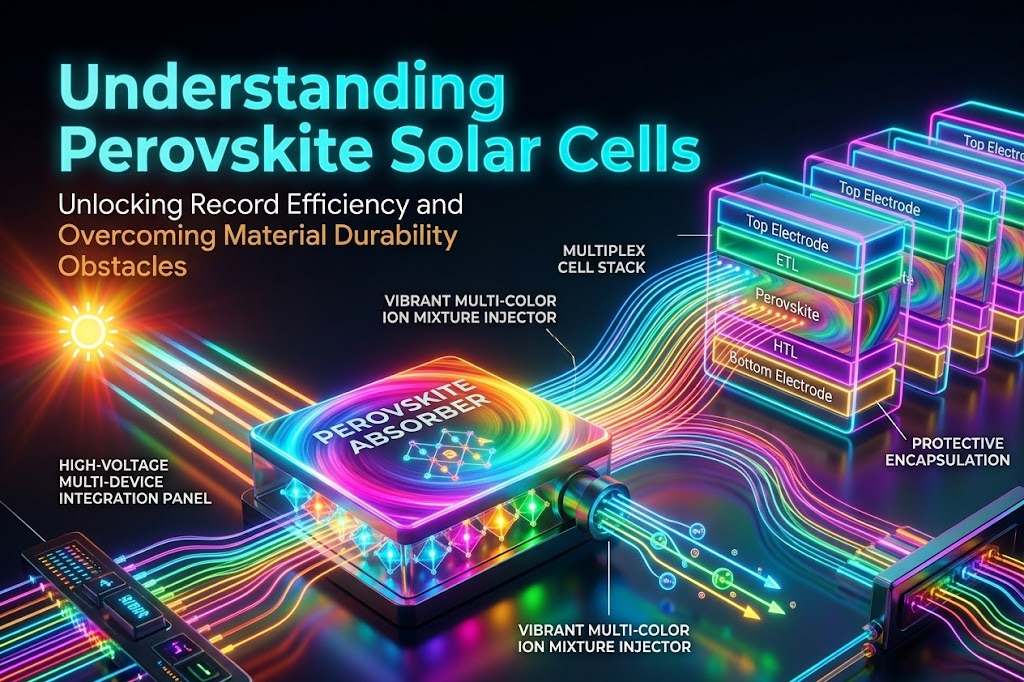
A typical perovskite solar cell consists of several thin layers. These usually include a transparent front electrode, an electron transport layer, a perovskite absorber, a hole transport layer, and a back electrode.
The process starts when sunlight reaches the perovskite absorber. Incoming photons transfer energy to the material, generating electrons and holes that can contribute to an electrical current. The transport layers help move these charges toward the appropriate electrodes, allowing current to flow through an external circuit.
The interfaces between the layers can make a significant difference. If the energy levels do not align well, or if defects trap charges, electrons and holes may recombine before they reach the electrodes. That reduces the amount of electricity the cell can produce. Careful layer design helps limit these losses and improve device performance.
Two widely used configurations are called n-i-p and p-i-n. The names describe the order of the charge transport layers relative to the perovskite absorber. Both configurations can use a planar structure, in which the layers sit on top of one another rather than relying on a more complex textured architecture. This arrangement can simplify fabrication.
Why Material Selection Matters
The absorber gets much of the attention, but the other layers also affect efficiency, manufacturing costs, and long-term reliability.
Electron transport layers commonly use titanium dioxide or tin oxide. On the other side of the absorber, hole transport layers may contain organic semiconductors such as Spiro-OMeTAD or PTAA. Some designs instead use inorganic or carbon-based materials.
Each choice comes with trade-offs. A material may transport charges efficiently but require a higher processing temperature, cost more to produce, or interact poorly with an adjacent layer. Researchers therefore need to consider how the complete device behaves rather than evaluating each component in isolation.
The electrodes present similar choices. Indium tin oxide and fluorine-doped tin oxide are common transparent front electrodes because they allow light to pass through while conducting electricity. Gold and silver are often used for the back electrode, although researchers are exploring less expensive alternatives.
The best combination depends on the intended application. A cell optimized for record laboratory efficiency may use different materials and fabrication methods from a flexible device or a solar module designed for large-scale production.
The Promise and Limitations of Perovskites
Perovskite solar cells have improved quickly enough to become an important part of photovoltaic research. Their adjustable band gaps also make them useful in tandem designs, where two different absorber materials capture different parts of the solar spectrum.
For example, a perovskite layer can be paired with silicon to capture more of the available sunlight than either material would typically capture alone. This approach offers a way to improve the efficiency of existing solar-cell technology.
In practical applications, combining solar power and energy storage can help make renewable electricity more useful for energy-intensive facilities such as mining farms and data centers.
The main obstacle is durability. A cell that performs well in a controlled laboratory may not maintain the same output after years outdoors. Heat, moisture, oxygen, and prolonged exposure to light can damage the material or its interfaces. Many high-performing perovskite compositions also contain lead, which raises questions about leakage prevention, recycling, and disposal at the end of a panel's service life.
Solving these problems requires more than improving the absorber. The electrodes, transport layers, protective coatings, and manufacturing process all affect how well the finished device holds up over time.
Conclusion
Perovskite solar cells combine strong light absorption with adjustable electronic properties and manufacturing methods that may be less energy-intensive than some conventional approaches. Their layered structure also gives researchers considerable control over charge transport and makes them suitable for tandem designs.
The remaining challenge is to turn laboratory performance into dependable commercial products. Manufacturers need to produce cells consistently, limit degradation under real-world conditions, and keep production costs competitive. Progress will depend on better fabrication methods, carefully engineered interfaces, and effective strategies for protecting the cells throughout their working life.