
The Impact of Generative AI on Hardware
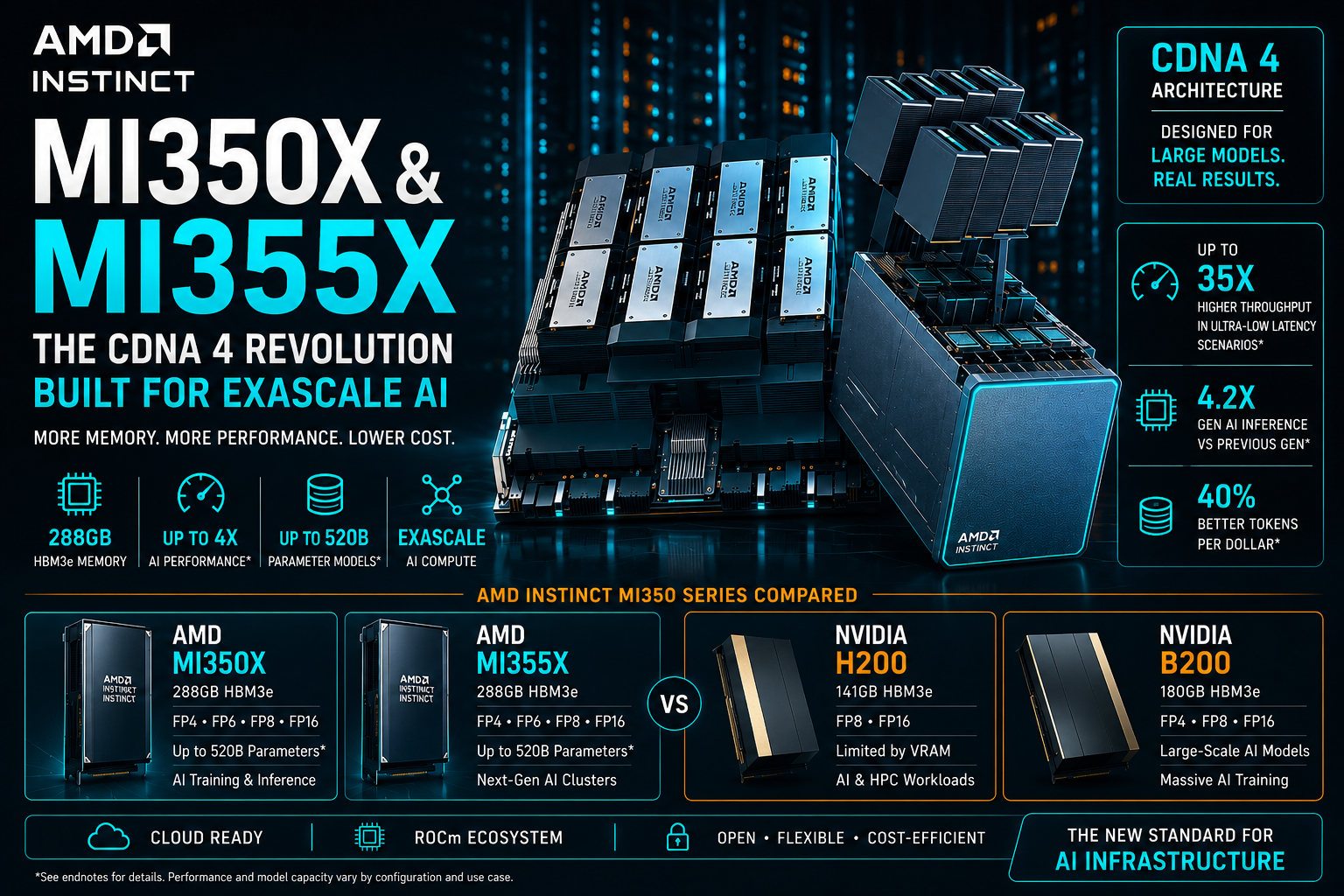
The generative AI boom didn't just change software; it pushed modern hardware to its absolute limits. Today’s large language models (LLMs) and real-time inference systems require unprecedented levels of compute and memory bandwidth that traditional GPUs can no longer sustain efficiently. Data centers are now facing a critical bottleneck. This is where the AMD Instinct MI350 series—particularly the MI350X and flagship MI355X accelerators—comes into play. Rather than offering a simple generational upgrade, AMD has designed this new class of accelerators as a fundamental architectural shift, purpose-built for large-scale AI training, inference, and high-performance computing (HPC) workloads.
AMD Instinct MI350 vs MI355X Architecture: Key Differences Explained
If you want to understand the raw power of these accelerators, you have to look at the new CDNA 4 architecture. AMD engineered this silicon from the ground up specifically to handle the brutal workloads defining the "Transformer" AI era, marking a massive leap forward from the older CDNA 3 framework.
The real engineering breakthrough here is the advanced chiplet design. Rather than relying on one massive, expensive die, we are looking at an incredibly dense array of transistors distributed across multiple smaller chiplets. AMD stitches these together using their cutting-edge 3D packaging technology. This modular strategy is brilliant: it lets them scale up performance aggressively while maintaining tight control over manufacturing efficiency and yields.
So, what separates the base models from the MI355X if they share the same underlying silicon DNA? It comes down to hardware limits. The MI355X is essentially the unleashed version of the chip. AMD configured it with higher thermal and power ceilings, allowing operators to push the hardware to its absolute limit in environments where maximizing throughput is the only metric that matters. Of course, all that compute power is useless if it's waiting on data. To solve the notorious memory bottleneck inherent in complex model training, AMD packed these accelerators with high-speed HBM3e memory, ensuring the data pipelines remain constantly fed.
AMD MI350 vs MI355X vs NVIDIA H200 & B200: AI GPU Performance Comparison
| Specification | AMD MI350X | AMD MI355X | NVIDIA H200 | NVIDIA B200 |
|---|---|---|---|---|
| Architecture | CDNA 4 | CDNA 4 | Hopper | Blackwell |
| Memory Type | HBM3e | HBM3e | HBM3e | HBM3e |
| Memory Capacity | 288 GB | 288 GB | 141 GB | 180 GB |
| AI Data Formats | FP4, FP6, FP8, FP16 | FP4, FP6, FP8, FP16 | FP8, FP16 | FP4, FP8, FP16 |
| Max AI Model Size | Up to 520B parameters* | Up to 520B parameters* | Limited by VRAM | Large-scale AI models |
| Target Workloads | AI Training & Inference | Next-gen AI Clusters | AI & HPC | Massive AI Training |
AMD MI350 Memory, HBM Capacity & Large Language Model (LLM) Performance
In the world of AI, memory is king. Modern LLMs are becoming so massive—often reaching hundreds of billions of parameters—that traditional GPUs simply run out of room. AMD addresses this with a massive 288 GB of HBM3e memory per GPU. This is a game-changer. According to performance roadmaps, a single MI350 series accelerator can host models with up to 520 billion parameters. For a data center operator, this means you don't have to jump through hoops to partition a single model across dozens of GPUs, which drastically simplifies infrastructure and boosts overall efficiency.
AMD MI350 AI Performance: Compute, Training & Inference Benchmarks
When it comes to raw speed, AMD is claiming a 4× generational leap in AI compute performance. But it’s not just about being faster; it’s about being smarter.
A major driver of this improvement is the support for new data formats like FP4 and FP6. By running models at a lower precision without sacrificing meaningful accuracy, these accelerators can process information much faster and with less memory overhead. This makes the MI350 series a powerhouse for large-scale inference.
However, it’s not a one-trick pony. With native support for high-precision formats, it’s just as capable in scientific research and engineering simulations as it is in generating text, making it a versatile asset for research labs and cloud providers alike.
AMD MI350X vs MI355X: CDNA 4 Architecture for AI Workloads
AMD Instinct Generational Comparison: MI300X vs MI325X vs MI350X Series
| Specification | AMD MI300X | AMD MI325X | AMD MI350X / MI355X |
|---|---|---|---|
| Architecture | CDNA 3 | CDNA 3 (Refined) | CDNA 4 |
| Memory Type | HBM3 | HBM3e | HBM3e (Next-Gen) |
| Memory Capacity | 192 GB | 256 GB | 288 GB |
| AI Precision Formats | FP8 / FP16 | FP8 / FP16 | FP4 / FP6 / FP8 / FP16 |
| Max AI Model Size | Up to ~200B parameters* | Up to ~350B parameters* | Up to ~520B parameters* |
| Target Workloads | GenAI & HPC | Large LLM Training | Exascale AI Training & Inference |
| Relative Performance | 1x (Baseline) | 1.3x – 1.6x | Up to 4x (FP4 workloads) |
*Actual model capacity depends on software optimization, parallelism strategy, and memory allocation.
AMD MI355X Server Specifications & AI Data Center Deployment
Stepping back to look at the full rack, the MI355X server platform is a beast of modern engineering. A fully kitted-out server can pump out roughly 1.6 exaflops of FP4 compute power. Combine that with over 2 terabytes of HBM3e memory across the system, and you have a machine capable of handling the world’s most demanding AI tasks. AMD also kept "real-world" logistics in mind:
- Cooling: It comes in both air-cooled and liquid-cooled flavors, depending on the density of the data center.
- Compatibility: It’s designed to fit into the same infrastructure used for the MI300 and MI325. This is a huge win for operators because it means they can upgrade their compute power without tearing down their entire facility.
AMD MI355X Benchmarks: LLM Inference & AI Model Performance
The benchmarks tell a compelling story. When tested against Llama 3.1, the MI355X platform showed up to 35× higher throughput in ultra-low latency scenarios—critical for real-time speech translation or instant code generation where every millisecond counts.
For more general generative AI tasks, like chatbots or document summarization, we’re seeing a 4.2× improvement over the previous generation. Even more impressive is the performance on models like DeepSeek, where the hardware delivers significantly more tokens per second, allowing it to handle more concurrent users simultaneously.
AMD MI350 Cost Efficiency: Tokens per Dollar & AI Infrastructure ROI
Raw performance is great, but efficiency defines the bottom line. This is where AMD is making its strongest push.
Using open-source frameworks like vLLM, the MI355X has shown it can churn out about 30% more tokens per second than some of its high-priced rivals. When you crunch the numbers on hardware cost versus output, AMD estimates a 40% advantage in "tokens-per-dollar." That kind of efficiency can save a cloud provider millions of dollars over the life of a cluster.
AI GPU Cost Comparison: AMD MI350 vs NVIDIA Tokens-per-Dollar Analysis
AI Inference Cost Comparison: Tokens per Dollar Across Data Center GPUs
| AI Accelerator | Estimated Price (USD) | Relative LLM Throughput | Tokens per Dollar Efficiency | Typical Use Case |
|---|---|---|---|---|
| AMD MI350X | $25,000 – $30,000 | Very High | Excellent | Enterprise LLM Inference |
| AMD MI355X | $30,000 – $35,000 | Extremely High | Very High | Exascale AI Clusters |
| NVIDIA H200 | $30,000 – $40,000 | High | Moderate | HPC & Legacy AI Tasks |
| NVIDIA B200 | $40,000 – $50,000 | Extremely High | High | Next-gen Model Training |
*Estimates based on market averages, performance benchmarks, and cloud inference workloads using optimized frameworks such as vLLM.
Where to Rent AMD MI350 & MI355X GPUs: Best Cloud AI Providers
The best part? You don't have to buy a $100,000 server to use this tech. Most developers and startups will access the MI350 series through the cloud. By renting GPU clusters, companies can tap into this massive "exaflop-level" power on an as-needed basis. This lowers the barrier to entry, allowing a small research team to train a world-class model without needing a massive capital investment.
Should You Choose AMD MI350 or MI355X for AI Workloads?
The AMD Instinct MI350 and MI355X represent a major milestone. By focusing on massive memory capacity, the CDNA 4 chiplet architecture, and aggressive cost efficiency, AMD has positioned itself as a primary architect of the AI future. As models continue to grow, the hardware backing them must evolve—and the MI350 series is more than ready for the challenge.
Frequently Asked Questions About AMD Instinct MI350 & MI355X GPUs
Q1: What is AMD Instinct MI350 used for?
It's built for the "heavy lifting" of the AI world: training massive LLMs, high-speed inference, and complex scientific simulations in data centers.
Q2: What is the difference between AMD MI350 and MI355X?
The MI355X is the higher-tier version of the series, tuned for maximum performance with higher power and thermal limits.
Q3: How much memory does the AMD MI350 GPU have?
It packs up to 288 GB of HBM3e memory, enough to fit enormous AI models that would choke standard GPUs.