
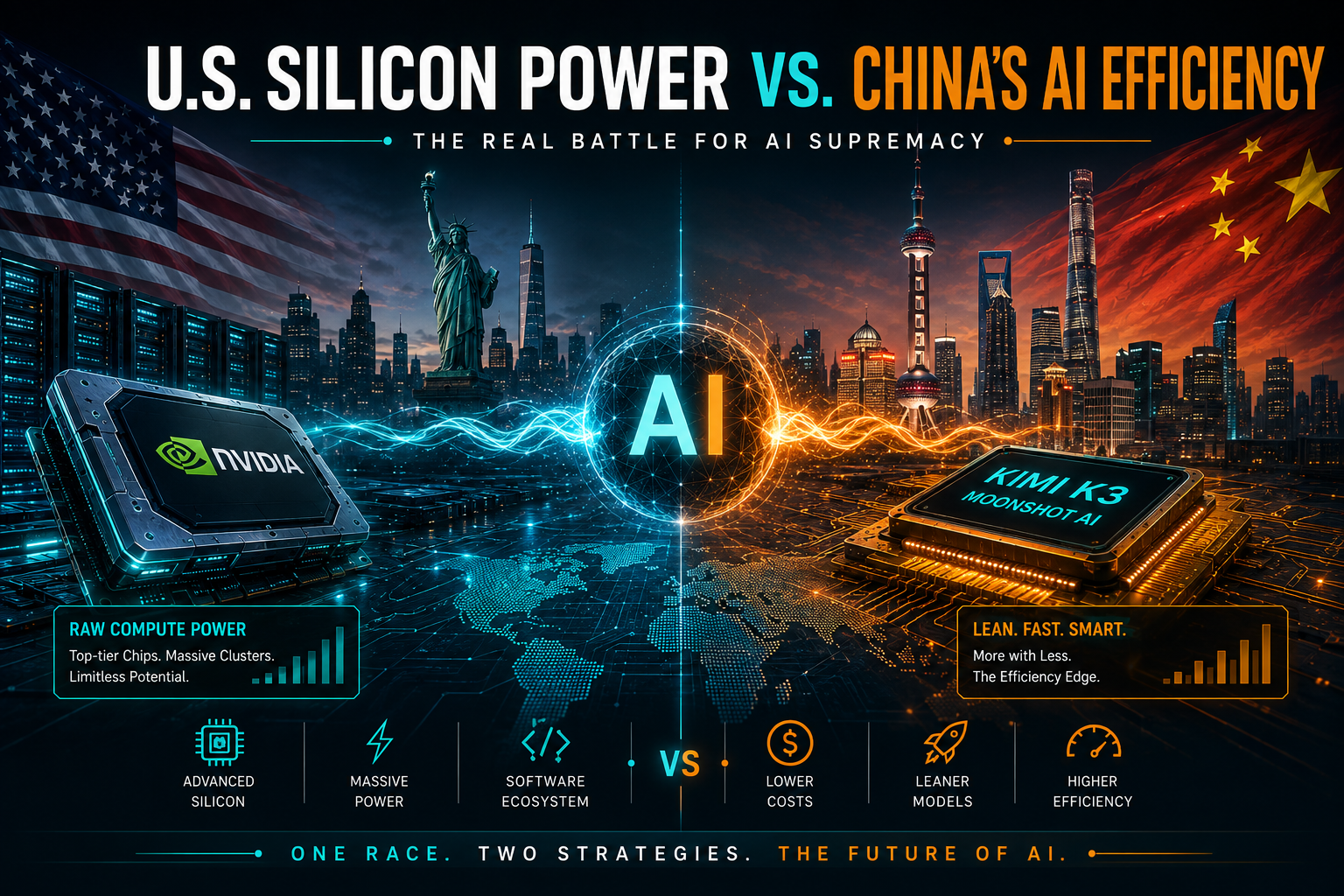
Introduction: The U.S.–China AI Race — Silicon or Efficiency?
The AI race between the United States and China is no longer just about who can build the smartest model. It has turned into a much wider economic and tech war—one fought over model costs, cutting-edge chips, data centers, power grids, semiconductor supply chains, and the deep pockets needed to keep it all running long-term.
Over the past few months, Chinese AI models have put real pressure on U.S. tech firms, mostly on price. Today's market demands top-tier performance at a fraction of the cost, forcing American AI labs to rethink their margins and push hard for better efficiency.
Still, the United States holds a massive card: absolute dominance in high-end silicon and the surrounding hardware-software stack, led by giants like NVIDIA and AMD. That advantage is backed by an advanced chipmaking supply chain—something trade restrictions have made extremely hard for China to access.
So the real question isn't just who has the cleverest AI model anymore. It's whether China can offset its hardware handicap through leaner, cheaper AI architecture—or if raw U.S. compute power will ultimately decide the winner.
America’s Silicon Advantage
America still dominates pure compute. Giants like NVIDIA and AMD don't just supply silicon—they control the entire stack, spanning software, networking, and data center design.
NVIDIA's real moat isn't just its hardware, but the ecosystem built around it. Training frontier models or running them at scale takes huge GPU clusters, massive facilities, and gigawatts of power—giving the U.S. a clear strategic lead in pure compute.
But that advantage comes with a staggering price tag.With compute costs through the roof, the price tag for data centers, power, and capacity is ballooning fast. That’s exactly where China’s focus on lean, low-cost AI starts paying off.
The Chinese Advantage: Lower-Cost AI
China isn't just racing to build the smartest AI; they're aggressively focused on making it cheaper and leaner. In the long run, this strategy might actually matter a lot more than chasing the absolute highest benchmark scores. If a model can deliver top-tier results while burning a fraction of the compute, it’s going to win over a lot of businesses and developers—even if it doesn't take the #1 spot on a leaderboard.
Take Moonshot AI's Kimi K3 as a prime example. Looking at our numbers, Kimi K3 Max posted an Intelligence Index of 60, putting it neck-and-neck with Grok 4.6 High (which scored 61). What's really striking is that both models hit the exact same Cost per Task at $0.84. This shows that Chinese labs aren't just competing on price anymore; they are going toe-to-toe with major competitors on pure performance without inflating the cost.
| Model | Company | Country | Intelligence Index | Cost per Task | Median Speed (tokens/s) | First Chunk (s) | Total Response (s) | Context Window |
|---|---|---|---|---|---|---|---|---|
| Claude Opus 5 (Max) | Anthropic | United States | 63 | $2.34 | 53 | 52.54 | 61.96 | 1M |
| GPT-5.6 Sol (Max) | OpenAI | United States | 61 | $1.23 | 71 | 137.55 | 144.61 | 1M |
| Grok 4.6 (High) | SpaceXAI | United States | 61 | $0.84 | 58 | 47.56 | 56.13 | 500K |
| Kimi K3 (Max) | Kimi / Moonshot AI | China | 60 | $0.84 | 39 | 2.83 | 67.59 | 1.05M |
In other words, the Chinese model reached a level very close to that of a competing model at essentially the same task cost.
Interestingly, Kimi K3 recorded only 2.83 seconds before the first part of the response appeared, while Grok 4.6 High took around 47.56 seconds. Meanwhile, Grok had the advantage in generation speed, recording 58 tokens per second compared to 39 tokens per second for Kimi K3.
These figures illustrate that the comparison cannot be reduced to a single metric. Instead, several factors determine the actual efficiency of an AI model.
| Model | Intelligence Index | Cost per Task | Time to First Response | Tokens per Second |
|---|---|---|---|---|
| Kimi K3 | 60 | $0.84 | 2.83 seconds | 39 |
| Grok 4.6 High | 61 | $0.84 | 47.56 seconds | 58 |
This comparison reveals an important aspect of China's strategy: a model does not have to rank first to become a serious competitor. If China can produce a model that closely matches the best U.S. models while maintaining competitive operating costs and greater flexibility, it can exert significant pressure on companies relying on expensive, closed models.
This is why Cost per Task is such an important metric. It addresses a more economically relevant question than a simple intelligence score:
How much does it cost to obtain the result?
Open Models: China’s Strategic Edge
Beyond pure cost-efficiency, Chinese AI labs are leaning heavily into open-weight models—a move that’s turning heads across the developer community. Rather than locking users into a proprietary API or a walled garden, open weights give engineering teams the freedom to download, modify, and host models on their own terms.
To be clear, "open" isn't a free lunch. Deploying a massive model still eats up serious power, hardware, and engineering resources. But by lowering the barrier to entry and handing control back to developers, China's open-source push directly serves its broader goal: driving global AI adoption by keeping expenses down.
The U.S. Problem: The Rising Cost of the AI Race
The biggest hurdle for the U.S. right now is simple: staying ahead in the AI race is getting absurdly expensive. Keeping up requires staggering amounts of capital—building massive data centers, hoarding high-end chips, locking down power grids, and constantly bankrolling the next generation of models.
All of this leaves the American AI playbook walking a financial high-wire. For these eye-watering investments to pay off, commercial demand for AI can't just grow—it has to keep surging to cover the bill.
The emergence of competing models that can deliver similar performance at lower costs becomes particularly sensitive. Lower service prices do not only impact the AI company itself; they can indirectly affect an entire chain of companies that benefit from ongoing growth in spending on data centers, processors, and computing infrastructure.
Thus, the progress of Chinese AI models is not merely a threat to U.S. AI laboratories; it poses an economic challenge to a much broader ecosystem that depends on sustained investment in data centers and AI processors.
Circular Financing and the Domino Effect Risk
Alongside rising costs, a more complex issue is emerging in the U.S. AI economy: Circular Financing.
The basic idea is that money and investments can circulate among a relatively small group of companies that depend on one another for growth, financing, and infrastructure purchases.
1. A company invests in an AI company.
2. That AI company needs data centers.
3. The data centers require processors.
4. Those processors are purchased from a company that may have already invested in or financed the involved infrastructure.
In this way, money can flow through a nearly closed circle rather than all revenues coming from completely independent economic demand.
NVIDIA exemplifies this phenomenon, as it does not benefit solely from selling AI processors. It has also become financially connected to several companies that require those processors, including OpenAI.
For instance, NVIDIA was considering providing guarantees worth up to $250 billion related to financing a massive data center project in Ohio. Such a guarantee could reassure lenders about the project's ability to secure the necessary financing, while the infrastructure itself would ultimately require vast quantities of AI processors.
This creates an interesting economic paradox: NVIDIA invests in a company needing computing power, supports the financing of infrastructure that the company requires, and that infrastructure then utilizes NVIDIA processors. Consequently, money that leaves NVIDIA can eventually return to the company in the form of chip sales.
The situation becomes even more complicated when we consider that OpenAI raised $122 billion in what was described as the largest funding round in Silicon Valley history, with a valuation approaching $1 trillion. However, the financial figures indicated that the company generated around $13 billion in revenue against $34 billion in spending in 2025, resulting in an operating loss of approximately $21 billion.
These figures do not necessarily imply that the financial model of AI companies is unsustainable. However, they highlight the enormous scale of the bet being placed on the future and demonstrate why a sudden slowdown in demand or revenue could become a much larger problem when companies are so deeply interconnected.
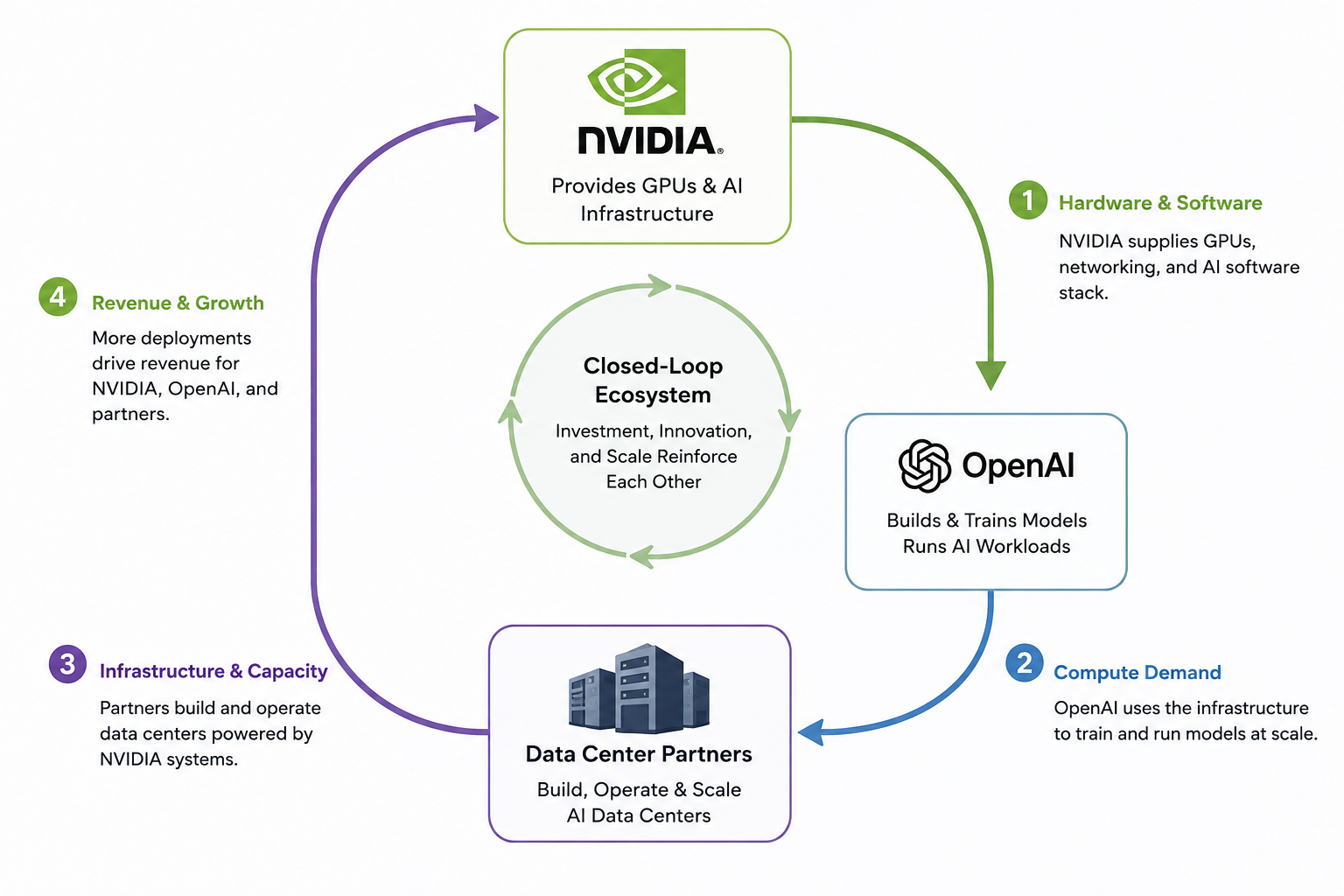
This is why the risk can be compared to dominoes. If demand for AI continues to rise, these financial relationships can accelerate growth. However, if a major company encounters a serious problem, demand slows, or revenues fall significantly below the investment level required, the shock could spread from one company to another due to the high degree of interdependence.
The Flywheel: NVIDIA and the OpenAI Feedback Loop
For Nvidia, OpenAI’s growth creates a powerful double payoff. First, as OpenAI’s valuation climbs, so does the value of NVIDIA’s equity stake. Second—and far more critically—every time OpenAI scales, it has to buy more NVIDIA GPUs, networking, and data center kit to power that expansion.
With over 90% of NVIDIA’s revenue tied directly to its data center segment, keeping OpenAI hungry for compute isn't just a passive investment—it actively fuels NVIDIA's main revenue engine.
China’s Bottleneck: The Silicon Wall
While American tech deals with eye-watering capital costs and tangled financing models, China faces a far more existential threat on the flip side: access to cutting-edge silicon.
Strict U.S. export restrictions have locked Chinese firms out of NVIDIA’s latest-generation accelerators. That constraint leaves Chinese labs with no choice but to innovate on efficiency, squeezing every last drop of performance out of underpowered hardware.
Yet, there is an inescapable reality here: Beijing can build clever algorithms and open-weight models all day long, but training and running frontier AI at scale still demands immense physical compute. As each new generation of processors widens the hardware gap, software optimization alone can only take you so far.
The Deeper Problem: Semiconductor Manufacturing Equipment
The Hardware Chokepoint: ASML and the Lithography Bottleneck
The AI rivalry goes way beyond just hoarding GPUs. China is also cut off from buying the world’s most advanced chipmaking equipment—putting Dutch tech giant ASML right at the center of the geopolitical crossfire.
ASML doesn't actually bake silicon itself. Instead, it builds the ultra-advanced lithography systems that allow foundries to print microscopic circuits. That makes it arguably the single most critical chokepoint in the entire global tech supply chain.
These aren't ordinary factory machines. A single standard EUV unit commands a price tag north of $150 million, while the next-gen High-NA EUV systems push $400 million apiece. They are mind-bogglingly complex engineering feats—packing hundreds of thousands of hyper-precise components—that literally make modern miniaturization possible.
By bumping the numerical aperture up to 0.55 NA, High-NA systems allow chipmakers to etch even denser, smaller transistors onto silicon. Missing out on this gear isn't just an inconvenience for China—it’s a massive barrier to keeping pace with leading-edge silicon.
Can China Close the Gap in Advanced Chipmaking Equipment?
Rumors frequently surface about China building homegrown alternatives to ASML’s EUV lithography machines, piecing together a domestic supply chain to break free from Western tech. But those claims require a heavy dose of reality.
It’s one thing to build a working prototype in a lab; it’s an entirely different beast to manufacture advanced silicon at commercial volume with the precision, uptime, and yield the industry demands.
Still, if Beijing eventually cracks the EUV code, the geopolitical tectonic plates will shift. Instead of scrambling to import high-end silicon, China could spin up its own foundries for advanced chips—effectively blunting the impact of U.S. export controls.
The Great Paradox: Efficiency Versus Computing Power
That’s the core tension driving the AI race today.
China is mastering algorithmic efficiency and undercutting costs, while the U.S. controls the silicon, the data centers, and the supply chains that make it all run.
The race can therefore be viewed as a confrontation between two different strategies:
- The United States is betting on enormous computing power.
- China is betting on efficiency and reducing the cost of access to AI.
Kimi K3 illustrates this idea clearly. It is not the strongest model in the comparison we have, as Grok 4.6 High is one point ahead in the Intelligence Index. However, Kimi achieves a very similar level with the same Cost per Task in our data while also delivering a remarkably low time to first response.
This helps explain why Chinese AI models have become a concern for U.S. companies, even when they do not outperform them across the board.
The market does not necessarily need a model that is dramatically more intelligent if it can obtain nearly the same level of performance at a competitive cost and with greater flexibility.
Who Has the Better Chance of Winning the AI Race: U.S. Technology or Chinese Efficiency?
Right now, the U.S. holds all the high cards: superior silicon, world-class data centers, unmatched software stacks, deep capital markets, and control over global tech supply chains. But playing that hand requires relentless spending, and every dollar burned needs a real-world payback to keep the momentum going.
China, on the other hand, is leaning hard into efficiency, lower costs, and open-weight models. Its main bottleneck remains hardware—restricted access to bleeding-edge chips and lithography equipment creates a gap that won't close overnight.
If Washington can keep pushing the envelope with NVIDIA and AMD while preserving its compute lead, America stays comfortably ahead. But if Beijing keeps squeezing more performance out of leaner models while slowly chipping away at its hardware deficit, this race gets uncomfortably tight.
In the end, victory won't just go to whoever builds the smartest AI. It will go to whoever can strike the right balance: pairing top-tier capability with manageable costs, scalable hardware, and economics that actually make sense.
America is doubling down on brute-force compute. China is betting on algorithmic thrift. While Washington works to protect its hardware moat, Beijing is trying to render that moat less relevant by making every single FLOP count.
The question that will define this tech war is simple: Can Chinese efficiency outrun the silicon shortage, or is America’s compute advantage just too big to bridge?
FAQ
Q1: What is the real conflict behind the current AI race between the U.S. and China?
It goes way beyond just who can build the smartest chatbot or model. It has turned into a massive economic showdown between two completely different strategies. The United States is throwing staggering amounts of money at brute-force computing power—hoarding top-tier chips, building massive data centers, and locking down the whole hardware stack. Meanwhile, China is leaning hard into algorithmic efficiency, lower costs, and open-weight models to see if they can get close to top-tier performance without needing endless billions of dollars.
Q2: Why are Chinese AI models starting to make American tech companies nervous?
It mostly comes down to price and practicality. Chinese labs are putting real pressure on the market by offering models that get remarkably close to Western heavyweights at a fraction of the cost. For businesses and everyday developers, you don't necessarily need the absolute #1 model on a leaderboard if you can get 95% of the performance for way less money and with much faster response times.
Q3: If the U.S. has the best chips, what is China's main disadvantage?
It boils down to a serious hardware bottleneck. Strict trade restrictions have locked Chinese tech firms out of buying the world's most advanced accelerators and cutting-edge chipmaking machines—specifically the ultra-complex lithography systems built by companies like ASML. While Chinese engineers are brilliant at squeezing every drop of performance out of underpowered hardware, training massive frontier AI at scale still requires immense physical compute.
Q4: What is "circular financing" and why are experts worried about it in the U.S. tech market?
Circular financing happens when a small, tightly knit group of companies ends up funding each other's growth in a bit of a closed loop. For example, a giant tech firm invests heavily in an AI lab, that lab uses the money to build massive data centers, and those data centers buy billions of dollars worth of processors right back from the original investor (or a partner). While it supercharges growth when times are good, it creates a domino effect risk. If demand suddenly cools down or revenues fall short, a shock to one major player could ripple through the whole chain.
Q5: Can China eventually build its own advanced chipmaking machines to bypass Western restrictions?
It’s an uphill battle. While people often hear rumors about homegrown prototypes being built in labs, there is a massive gap between making something work once and mass-producing microscopic, highly precise silicon at a commercial scale with the reliability the industry demands. Replicating equipment that packs hundreds of thousands of hyper-precise components is one of the toughest engineering challenges on the planet, so it’s a hurdle that won’t disappear overnight.
Q6: In the end, which strategy is going to win this tech war?
It really depends on whether efficiency can outpace raw power. If the U.S. can keep fueling its massive capital investments and the commercial demand keeps surging to cover those eye-watering bills, America's compute advantage will be tough to beat. But if China keeps making its models leaner and cheaper—making every single calculation count—they might just render the West's expensive hardware moat a lot less relevant.
Sources
- Artificial Analysis — AI model performance, intelligence scores, cost, speed, latency, and context-window data.
- OpenAI — OpenAI’s $122 billion funding round and company valuation.
- The Wall Street Journal — NVIDIA’s initial $250 billion financing guarantee discussions for OpenAI’s Ohio data center.
- Reuters — Updates on the NVIDIA–OpenAI–SB Energy financing structure and the Ohio data-center project.
- ASML — EUV and High-NA EUV lithography technology.
- NVIDIA / SEC — NVIDIA’s Data Center business and financial information.
- CompaniesMarketCap — ASML market-capitalization data.