Introduction: Kimi K3 vs OpenAI and Anthropic
In mid-July of this year, Chinese AI startup Moonshot AI sent shockwaves through the global tech industry with the launch of its open-weight model, Kimi K3.
According to mainstream news outlets, TV broadcasts, and viral media reports, this extraordinary model—boasting a staggering 2.8 trillion parameters—has achieved unprecedented contextual understanding and accuracy. Media headlines framed it as a historic milestone: an open-weights release capable of directly challenging, and occasionally outperforming, closed-source giants like OpenAI, Anthropic, and Google’s Gemini.
At the center of this storm is Yang Zhilin, born in 1992—a brilliant engineer who embodies a growing trend of reverse migration from West to East. After earning his Ph.D. in the United States and working alongside top-tier researchers at major tech firms, Yang turned down lucrative American offers to return to Beijing and build a global AI powerhouse.
Kimi K3’s debut instantly rattled Wall Street, pulling down key chip stocks as investors braced for a race to the bottom on pricing. The concern wasn't subtle: a highly capable, fraction-of-the-cost rival out of China could undercut the lucrative subscription fees driving Silicon Valley’s biggest players. With annual recurring revenue crossing $300 million, word spread that Moonshot AI was reshaping its legal setup to pave the way for a Hong Kong listing targeting a valuation north of $30 billion.
However, a closer look beyond the media hype reveals a far more nuanced reality.
While mainstream headlines paint a picture of absolute dominance, technical deep-dives and sober industry reports offer a much more grounded perspective. At the end of the day, this isn't about giving away free handouts or cheap features—it's about whether their core engineering can actually hold its own:
-
Open-Source Limits: Despite impressive benchmarks in specific tasks, Kimi K3’s overall performance still trails premier closed-source models like Anthropic's Claude 3.5 or OpenAI's flagship architectures.
-
Valuation & IPO Timeline: While recent funding rounds pushed Moonshot AI's valuation toward the $30 billion mark (with projections hinting at $50 billion), formal timelines for a Hong Kong listing remain unconfirmed.
-
Parameter Efficiency: The headline figure of 2.8 trillion parameters does not imply that every parameter is activated per query; rather, it relies on sparse routing architectures (such as Mixture-of-Experts) to maintain computational efficiency.
In the following analysis, we put Moonshot AI through a series of head-to-head benchmarks to see how it holds up against the competition. Is Kimi K3 a real threat to Silicon Valley’s top players, or is this just another wave of market overreaction? Looking back at previous headline-grabbers like DeepSeek, the pattern is clear: initial panic gave way to reality when those models struggled to match the sustained, production-grade output of US AI leaders. We’ll examine whether Kimi K3 is headed down that same path or if it actually has what it takes to shift the balance.
AI Model Comparison: Kimi K3 vs GPT-5 vs Claude Performance Benchmarks
1. AI Models Comparative Benchmark (Top Model Per Creator)
| Model | Creator | Intelligence Index | Context Window | Cost per Task (USD) | Speed (Tokens/s) | Latency First Chunk (s) | Total Response Time (s) |
|---|---|---|---|---|---|---|---|
| Claude Opus 5 (max) | Anthropic | 63 | 1M | $2.34 | 55 | 51.13 | 60.15 |
| GPT-5.6 Sol (max) | OpenAI | 61 | 1M | $1.23 | 63 | 120.03 | 127.93 |
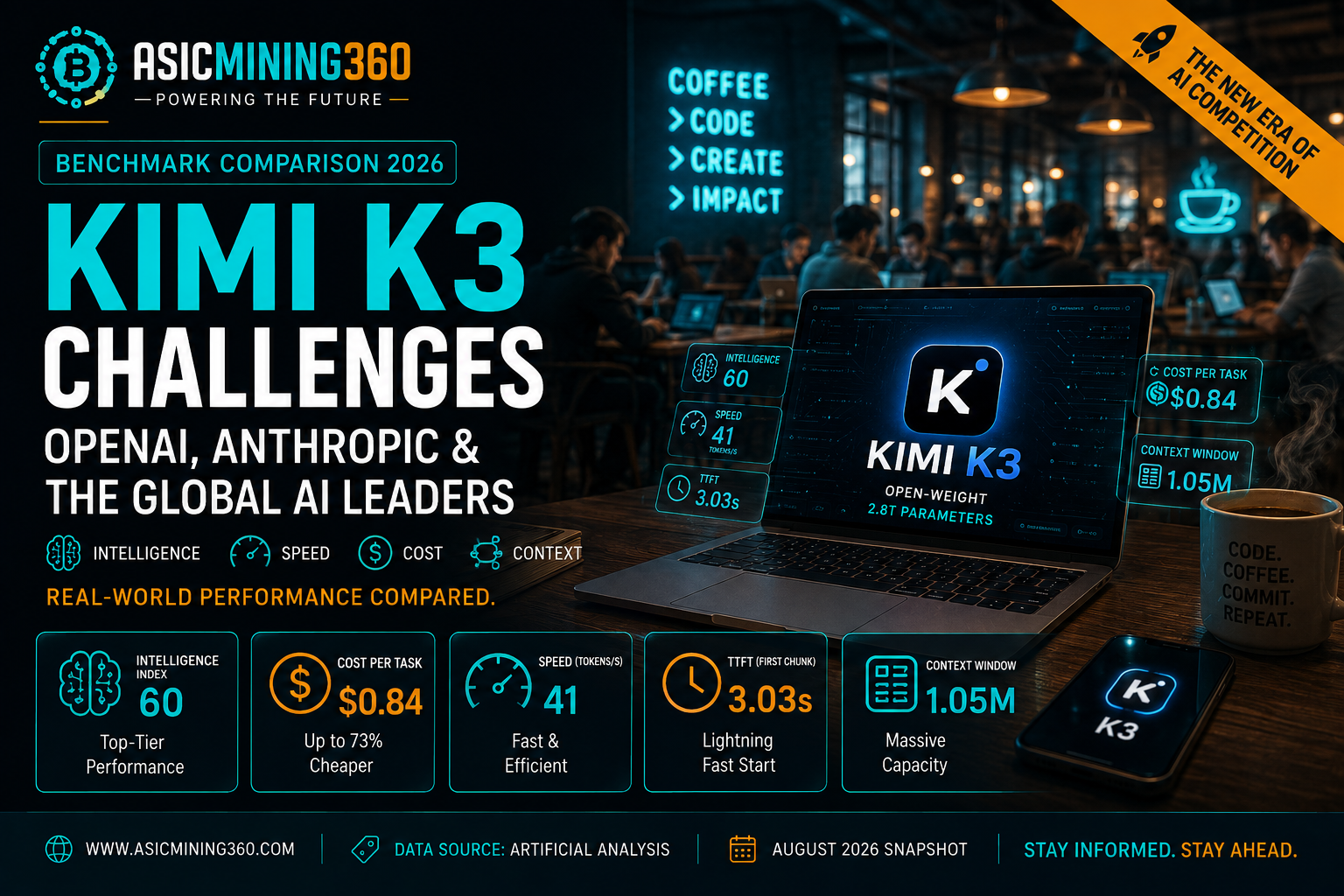
| Kimi K3 (max) | Kimi (Moonshot AI) | 60 | 1.05M | $0.84 | 41 | 3.03 | 64.60 |
| Qwen3.8 Max | Alibaba | 58 | 1M | $1.13 | 78 | 2.62 | 34.82 |
| Muse Spark 1.2 (xhigh) | Meta | 57 | 1.05M | $0.40 | — | — | — |
| Grok 4.5 (high) | SpaceXAI | 56 | 500k | $0.36 | 61 | 7.86 | 16.08 |
| GLM-5.2 (max) | Z AI | 53 | 1M | $0.31 | 115 | 1.48 | 23.29 |
| DeepSeek V4 Flash 0731 (max) | DeepSeek | 52 | 1M | $0.03 | 115 | 1.15 | 22.84 |
| Gemini 3.6 Flash | 52 | 1M | $0.56 | 224 | 19.41 | 21.64 | |
| MiniMax-M3 | MiniMax | 45 | 1M | $0.14 | 138 | 1.77 | 19.92 |
| Motif 3 (Beta) | Motif Technologies | 45 | 262k | — | — | — | — |
2. Benchmark Metrics & Evaluation Methodology
| Metric / Benchmark | What It Measures | Methodology & Engineering Details |
|---|---|---|
| Intelligence Index | Overall model intelligence across reasoning, knowledge, coding, scientific problem-solving, and agentic tasks. | Artificial Analysis Intelligence Index v4.1 combines nine evaluations: GDPval-AA v2, τ³-Banking, Terminal-Bench v2.1, SciCode, Humanity's Last Exam, GPQA Diamond, CritPt, AA-Omniscience, and AA-LCR. Higher scores indicate stronger overall performance. |
| Context Window | The maximum number of combined input and output tokens a model can process within a single request. | Reported in tokens. Artificial Analysis defines the context window as the maximum combined input and output capacity, with the effective output limit varying by model. For example, Kimi K3 supports a context window of approximately 1M tokens. |
| Cost per Task | The estimated cost of completing one task from the Artificial Analysis Intelligence Index. | Calculated as a weighted average across Intelligence Index tasks, incorporating applicable input, cache-hit, cache-write, reasoning, and answer-token pricing. Lower cost indicates greater cost efficiency. |
| Speed (Median Tokens/s) | The rate at which a model generates output after the first response chunk is received. | Measured in output tokens per second. Artificial Analysis reports the median (P50) performance over recent measurements to reflect sustained model performance. |
| Latency First Chunk (TTFT) | The time required to receive the first token after an API request is submitted. | Measured in seconds from API request submission to the first received token. For reasoning models, this can include the model's reasoning or "thinking" time before an answer is produced. |
| Total Response Time | The end-to-end time required to receive a standardized 500-token response. | Calculated from time to first token, applicable reasoning/thinking time, and the time required to generate 500 output tokens at the measured output speed. Lower values indicate faster end-to-end response performance. |
Kimi K3 Benchmark Results: Performance, Pricing & Cost Comparison
Stacked against Silicon Valley’s top frontier models, Kimi K3 (max) signals a clear turning point in the market. Rather than simply fighting for a spot at the table, Moonshot AI is forcing a real economic shift—delivering top-tier capabilities at a price point that makes the competition look unsustainable.
- Cost per Task & Economic Efficiency
The Data
Kimi K3 (max): Sets the baseline budget at $0.84 per task.
OpenAI’s GPT-5.6 Sol (max): Sits in the middle at $1.23 per task—a 46.4% jump over Kimi.
Anthropic’s Claude Opus 5 (max): Tops the chart at $2.34 per task, carrying a heavy 178.6% markup (nearly 2.8x Kimi’s price).
Analytical Take
The price difference here is impossible to ignore. If you're running automated flows at scale, small price shifts quickly stack up. Paying nearly triple for Claude Opus 5—or a 50% premium for GPT-5.6 Sol—is a tough check to sign. Kimi K3 puts direct pressure on major Western providers, making those high enterprise margins a lot harder to defend.
- Raw Intelligence & Problem-Solving (Intelligence Index)
The Data
Claude Opus 5 (max): Leads the benchmark at 63 points.
GPT-5.6 Sol (max): Comes in second with 61 points.
Kimi K3 (max): Takes third with 60 points.
Analytical Take
A tiny 3-point gap separates the top closed model from Kimi K3. In real-world work, Moonshot AI delivers roughly 95% of the reasoning power you get from top US frontier models. When performance is this close, spending 178% more money for that last 5% of capability just doesn't add up on a balance sheet.
- Speed & Initial Latency (TTFT & Response Time)
The Data
Kimi K3 (max): Starts output almost instantly, hitting a Time-to-First-Token (TTFT) of just 3.03 seconds.
GPT-5.6 Sol (max): Lags behind with a heavy initial wait of 120.03 seconds, while Claude Opus 5 (max) takes 51.13 seconds.
Completion Time: Even with an output pace of 41 tokens/second, Kimi K3 wraps up its run in 64.60 seconds. That puts it neck-and-neck with Claude Opus 5 (60.15 seconds) and practically twice as fast as GPT-5.6 Sol (127.93 seconds).
Analytical Take
Kimi K3's fast start shows smart tuning behind the scenes. By putting text on screen right away, Moonshot AI removes the feeling of waiting on a frozen screen. It proves that keeping API costs low doesn't mean building a sluggish app.
Data Methodology & Source Acknowledgment
The benchmarking metrics and performance data presented in this article were compiled using evaluations from Artificial Analysis. To deliver a clear, high-impact comparison, the raw dataset was refined to highlight only the top-performing flagship model from each leading AI developer, setting aside secondary or lighter architecture variants.
Kimi K3 vs OpenAI & Anthropic FAQs
Q1: What is the current ranking of Qwen-3 among the world's most powerful AI models?
On global benchmarks like the Artificial Analysis Intelligence Index, Kimi K3 (max) ranks #3 overall with an Intelligence Index score of 60. It sits directly behind Anthropic’s Claude Opus 5 (max) at #1 (63 points) and OpenAI’s GPT-5.6 Sol (max) at #2 (61 points). This makes Kimi K3 the highest-ranking open-weights model on the global leaderboard.
Q2: Does Qwen-3 beat OpenAI models like GPT-4o and GPT-5.6o?
Yes and no—it depends on the metric:
Over older models (like GPT-4o): Kimi K3 easily outperforms legacy flagships across coding, long-context understanding, and multi-step reasoning.
Over OpenAI’s newest flagship (GPT-5.6 Sol): GPT-5.6 holds a slight 1-point edge in pure reasoning (61 vs. 60). However, Kimi K3 beats GPT-5.6 on speed and cost: it gets its first response out in just 3.03 seconds (compared to GPT-5.6's 120-second wait) and costs 30% less per task ($0.84 vs. $1.23).
Q3: Who is the development team behind Qwen-3, and where is the company's headquarters located?
Kimi K3 was developed by Moonshot AI, a Beijing-headquartered artificial intelligence lab founded in March 2023. The company was founded by Yang Zhilin (born in 1992), a Chinese AI researcher who earned his Ph.D. in the United States and worked at top US labs before returning to China to launch Moonshot AI.
Q4: Why is Kimi K3's $0.84 price causing all this controversy and global attention?
Because it disrupts the traditional pricing model for high-end AI. Up until now, using a top-three global model meant paying premium API fees (like Anthropic’s $2.34 per task). Kimi K3 brings near-top-tier performance down to $0.84 per task, making enterprise-scale automation and AI deployment drastically cheaper for startups and developers.
Q5: How can a massive model like Qwen-3, with 2.8 trillion parameters, operate with such speed, performance, efficiency, and low cost?
It all comes down to smart engineering. Instead of activating all 2.8 trillion parameters for every single prompt—which would be painfully slow and massively expensive—Kimi K3 relies on a Mixture-of-Experts (MoE) architecture. Think of it like a team of specialized advisors: for any given query, it only routes the work to the specific "experts" it needs (about 104 billion active parameters). Combined with its custom Kimi Delta Attention mechanism, this design allows the model to retain massive reasoning power while delivering fast response speeds (41 tokens/sec) and keeping operational costs exceptionally low.