
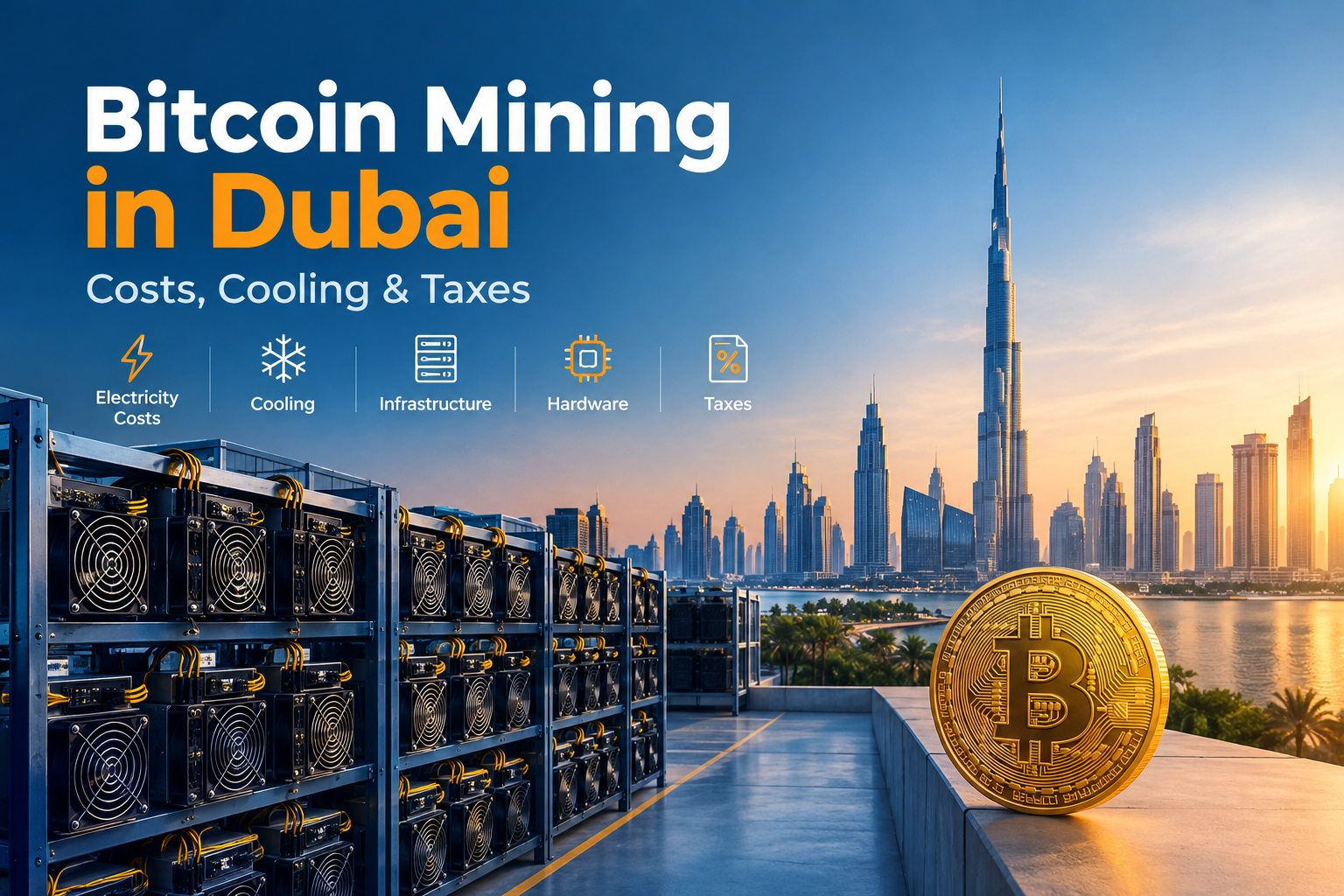
Introduction
Dubai has a reputation for being friendly to the crypto industry, so it is easy to see why someone looking at Bitcoin mining might think it is a natural place to set up a farm.
But mining Bitcoin in Dubai is not simply a matter of buying a few ASICs, finding a warehouse, and plugging everything in.
The machines run around the clock. They consume a lot of electricity, produce a huge amount of heat, and need an environment that can keep them operating reliably. In Dubai, the heat is not a small detail. It can become one of the biggest operational problems you have to solve.
Before moving hardware to the UAE, it is worth looking at the economics from the ground up.
1. Electricity Comes First
For a Bitcoin mining operation, electricity is usually the number that matters most.
An ASIC can generate revenue 24 hours a day, but it also consumes power 24 hours a day. A small difference in the electricity rate can therefore have a noticeable effect on the farm's monthly operating costs.
And the Bitcoin price is only part of the equation.
Mining difficulty can change, network conditions can shift, and the amount of Bitcoin earned by a machine can fall even while the machine itself continues consuming roughly the same amount of electricity.
That is why a mining operation that looks profitable on a spreadsheet can quickly become much less attractive when power costs rise.
Before shipping equipment to Dubai, calculate the expected electricity cost using the actual power consumption of the ASICs you intend to run. Do not base the decision only on the machine's advertised daily revenue.
2. Dubai's Heat Makes Cooling a Serious Issue
Electricity is not the only major operating expense.
ASIC miners turn a large portion of the electricity they consume into heat. In a cooler climate, that heat is already a challenge. In Dubai's summer conditions, it becomes much harder to manage.
A mining facility needs proper airflow and heat removal. Depending on the size and design of the operation, that can mean industrial ventilation, air-conditioning, or a more specialized cooling setup.
This creates an uncomfortable relationship between mining and cooling:
The more machines you install, the more heat you have to remove.
And cooling itself consumes electricity.
That means you cannot simply calculate the power draw of the ASICs and stop there. The real energy requirement also includes the infrastructure keeping those machines within an acceptable operating environment.
Poor cooling can also lead to more downtime, hardware failures, and shorter equipment life.
3. The Facility Matters More Than It Looks
A serious mining farm needs more than floor space.
You need a location with sufficient electrical capacity, suitable ventilation, reliable connectivity, and an infrastructure setup that can handle continuous operation.
This is one reason why a commercial mining facility is very different from running a few machines at home.
The electrical system needs to be designed around a continuous heavy load. Airflow needs to be planned rather than improvised. Maintenance access matters. So does the ability to keep the operation running when individual machines or components fail.
The cheapest warehouse is not necessarily the cheapest mining location.
A facility that saves money on rent but requires expensive electrical work or cooling upgrades can end up costing considerably more.
4. Hardware Costs Do Not End When the ASICs Arrive
ASIC miners are productive equipment, but they are not permanent assets.
Fans fail. Power supplies can develop problems. Hashboards can require repair. Older machines also become less competitive as newer hardware enters the market.
That means depreciation should be part of the original calculation.
If the business only looks at today's Bitcoin price and today's mining revenue, it can give a misleading picture of profitability.
A better approach is to ask a more uncomfortable question:
What happens if Bitcoin revenue falls while my electricity, rent, cooling, and maintenance costs stay roughly the same?
If the answer is that the farm immediately becomes unprofitable, the operation may be relying too heavily on favorable market conditions.
5. Commercial Mining Is a Business
There is another distinction worth making.
Holding Bitcoin personally is not the same thing as operating a commercial mining farm.
A mining business has revenue, operating expenses, equipment, employees or contractors, premises, electricity bills, and ongoing compliance requirements.
The original article makes this distinction clearly: commercial mining should not be treated like passive ownership of Bitcoin, and the UAE's corporate tax framework can become relevant to business activity.
So if you are planning a serious operation, do not build your financial model around the idea that Dubai's lack of personal income tax automatically means the mining business itself has no tax obligations.
The business structure matters.
6. Licensing and Infrastructure Need to Be Sorted Out Early
Commercial mining also involves practical paperwork.
You need the appropriate business setup, a suitable commercial location, and an electrical infrastructure capable of supporting the planned load.
This should be dealt with before the hardware arrives.
There is little value in importing a large number of ASICs and then discovering that the premises cannot provide the required electrical capacity or that the intended business activity does not fit the licensing arrangement.
The same applies to banking and accounting.
Keep records of hardware purchases, electricity costs, mining-pool payouts, wallet transactions, repairs, and other major expenses. These records are useful for understanding whether the farm is actually profitable, but they can also become important when explaining the source of funds to financial institutions.
7. Is Dubai Actually a Good Place to Mine Bitcoin?
That depends on the numbers.
Dubai offers a strong business environment and a well-developed crypto ecosystem, but those advantages do not automatically overcome expensive electricity or cooling requirements.
For a miner, the calculation is fairly simple in principle:
Mining revenue − electricity − cooling − facility costs − maintenance − hardware depreciation − taxes = actual profit
If the result is healthy under conservative assumptions, Dubai may make sense.
If the model only works when Bitcoin prices remain high and mining difficulty stays favorable, the location may not be as attractive as it first appears.
This is particularly important for large farms. At small scale, a bad assumption might cost you some money. At industrial scale, the same mistake can become a serious operating loss.
Final Thoughts
Bitcoin mining in Dubai can work, but the country's crypto-friendly reputation should not be confused with cheap mining.
The real questions are much more practical.
How much will the electricity actually cost? How will you remove the heat during the hottest months? Can the facility support the electrical load? How much will the hardware depreciate? And what taxes and compliance costs apply to the business structure you choose?
Those numbers should be answered before the ASICs are shipped.
Dubai may offer attractive opportunities for crypto businesses, but a mining farm still has to obey the basic economics of mining. If the power, cooling, infrastructure, and hardware costs do not make sense, a favorable crypto environment alone will not turn an expensive operation into a profitable one.
Sources
- UAE Federal Tax Authority (FTA) — UAE Tax Residency Rules.