Introduction
The next challenge for artificial intelligence and cryptocurrency mining may not be chips, cooling, or even land. It may be electricity.
AI data centers are becoming some of the most power-intensive facilities ever built, while large Bitcoin mining farms already operate hundreds or thousands of ASIC miners around the clock. Both industries need reliable electricity, but they also face a second problem: power demand is becoming less compatible with an aging and increasingly constrained grid.
This is where a different approach to energy storage is attracting attention.
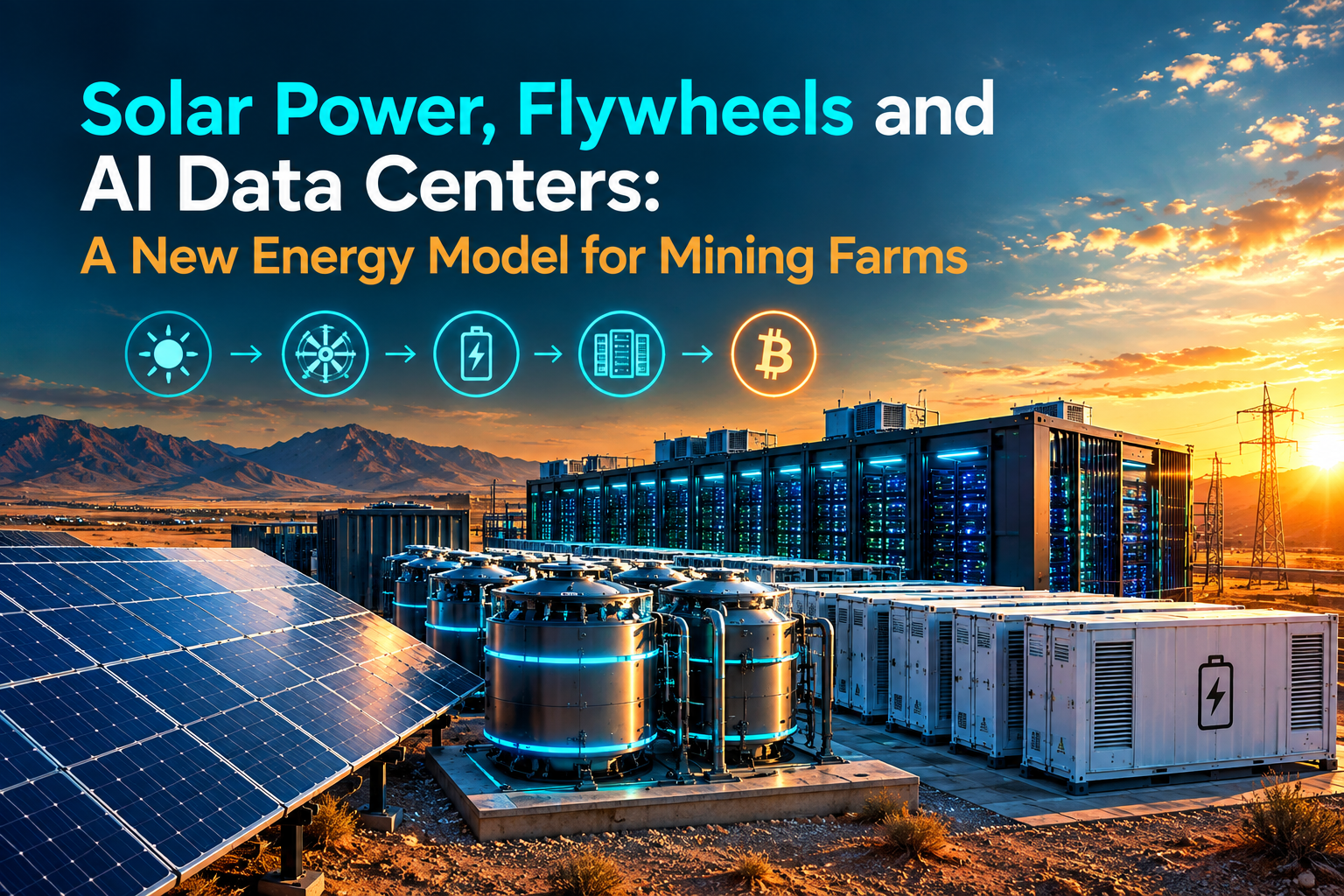
Instead of relying entirely on conventional lithium batteries, data centers and mining farms could combine solar generation, high-power flywheel storage, and longer-duration LFP batteries. The result would be an energy system capable of producing electricity locally, absorbing rapid changes in demand, and storing surplus solar generation for later use.
Why Solar Alone Is Not Enough
Solar power is particularly attractive for large computing facilities because many data centers and mining operations can be located in regions with strong solar resources.
Algeria is a good example. Much of the country's southern territory receives very high solar irradiation, with Tamanrasset standing out as one of the country's strongest solar-resource areas. Studies of the region have reported annual direct normal irradiation of around 2,600–2,800 kWh/m², making Tamanrasset particularly interesting for large-scale solar generation. Other southern areas, including Adrar, Ouargla, and Béchar, also have significant solar potential.
Saudi Arabia offers another interesting environment. Areas around Tabuk, Riyadh, NEOM, and the Red Sea region combine large available land areas with significant solar resources. Tabuk is particularly notable for its high direct normal irradiation, making it one of the most interesting regions to consider when solar availability is a central part of a computing-energy strategy. Saudi Arabia is also investing heavily in AI infrastructure. In NEOM's Oxagon, HUMAIN and DataVolt are developing an AI-ready data-center project whose first phase is planned at 360 MW, including 100 MW under active development, with renewable energy and advanced cooling among the project's design elements.
But solar has an obvious limitation.
The sun does not produce electricity continuously.
A mining farm cannot simply shut down every evening, and an AI data center cannot afford unpredictable interruptions. Solar therefore needs to be combined with storage and intelligent power management.
The Flywheel Difference
A flywheel stores electricity in a completely different way from a chemical battery.
Electricity is used to accelerate a rotor to a very high rotational speed. The rotor stores energy as kinetic energy. When electricity is required, the same system operates in reverse and converts rotational energy back into electrical power.
Modern systems use technologies such as vacuum enclosures and low-friction or magnetic bearing systems to reduce losses.
The important advantage is not necessarily storing energy for an entire night. It is handling very fast and repeated power events.
For example, Torus describes its Spin system as a high-power flywheel platform designed for millisecond response, a 10C discharge rate, 25,000 cycles, and a six-minute full discharge cycle. Its stated purpose includes managing rapid load changes, voltage events, and peak demand.
That characteristic makes flywheels particularly interesting for computing infrastructure.
Why AI Data Centers Could Use Flywheels
AI workloads can create substantial variations in electrical demand. Thousands of GPUs operating together can produce large and rapidly changing power requirements.
For a conventional backup system, the battery is expected to perform several jobs simultaneously:
- provide backup electricity;
- absorb short power disturbances;
- support peak loads;
- respond to sudden demand changes;
- and potentially store renewable electricity for hours.
These are very different jobs.
A hybrid system separates them.
The flywheel handles short, high-power events, while an LFP battery handles longer-duration energy storage.
Solar panels then provide the primary renewable generation whenever conditions allow.
The architecture becomes:
Solar → AI Data Center → Flywheel for rapid events → LFP battery for longer backup → Grid as an additional source
This approach can reduce the number of high-intensity cycles imposed on the chemical battery while giving the facility a much faster response mechanism.
Bitcoin Mining Farms Have a Similar Problem
Bitcoin mining may appear to be a simpler electrical load because ASIC miners generally operate continuously. In practice, however, a large mining farm can have significant power-management requirements.
Thousands of ASICs can represent a large electrical load concentrated in one location. Starting equipment, changing operating conditions, curtailment events, and grid fluctuations can all affect the economics of the operation.
This is particularly important when mining is connected to renewable generation.
Imagine a solar-powered mining farm in southern Algeria, particularly around Tamanrasset.
During the middle of the day, photovoltaic production can exceed the electricity required by the ASIC fleet. Instead of simply curtailing the excess, part of that electricity could be directed toward storage.
The flywheel would not necessarily be responsible for storing several hours of energy. Its role would be different: rapid power stabilization and high-frequency cycling.
An LFP battery could then store the larger energy surplus for later use.
The mining operation effectively becomes an energy-management system rather than simply a collection of ASIC machines.
Saudi Arabia: From Solar Resources to Compute Infrastructure
Saudi Arabia is particularly interesting because its energy strategy is increasingly connected with digital infrastructure.
Riyadh is developing a growing technology and data-center ecosystem, while NEOM is positioning the Oxagon industrial area as a location for large-scale sustainable computing infrastructure.
The DataVolt project is designed around renewable energy, advanced cooling, and high-density computing. Its first 360 MW phase illustrates the scale at which electricity and computing are becoming inseparable.
For projects of this size, energy storage does not have to perform only the traditional role of "backup battery."
It can become part of the facility's power architecture.
A possible configuration could combine:
Large solar field + grid connection + flywheel storage + LFP battery bank + AI computing load
The flywheel responds to fast electrical events, the battery supports longer periods, and the solar installation supplies a significant portion of the daytime demand.
For a mining operation, the same architecture could be adapted to allow more flexible operation based on electricity prices and solar availability.
Algeria: Solar Energy Meets Flexible Computing
Algeria presents a different opportunity.
The country's enormous southern territory and strong solar potential could theoretically support energy-intensive industries close to large renewable-generation sites.
Tamanrasset deserves particular attention in this context because of its exceptionally strong direct solar resource. Other southern locations such as Adrar, Ouargla, and Béchar could also be considered when evaluating large-scale solar and computing projects.
The concept would be straightforward:
Solar generation → energy storage → computing infrastructure
The computing load could include Bitcoin mining, AI inference, high-performance computing, or a combination of several workloads.
The advantage of mining is that some operations can be more flexible than conventional commercial loads. When solar output falls or the grid becomes constrained, mining capacity can potentially be reduced. When electricity is abundant and inexpensive, more machines can operate.
That flexibility could become increasingly valuable as renewable generation grows.
China Is Already Connecting Renewable Power With Computing
China provides perhaps the clearest real-world example of the relationship between renewable electricity and computing infrastructure.
In Ningxia, a large renewable-energy project has been connected directly with a cloud-computing base in Zhongwei. The project includes 500 MW of solar capacity, with additional wind capacity planned, and is designed to coordinate electricity availability with computing demand.
China is also developing computing capacity in renewable-rich western regions.
Two areas are particularly relevant when looking at the country's solar geography: the Tibet Autonomous Region, especially areas around Lhasa, Shigatse, Shannan, and Ali, and Qinghai, particularly the Qaidam Basin. The broader Qinghai–Tibet Plateau is recognized as one of China's richest solar-resource zones, while both Tibet and Qinghai have already attracted large-scale photovoltaic development.
Research from 2026 shows that AI adoption could drive a massive surge in China's data center power demand by "2030". Moving computing workloads to regions rich in renewable energy can help cut emissions, but the actual payoff depends on how well those workloads sync up with real-time green power generation.
This is an important concept for both AI and mining.
The future may not simply involve building a data center and then finding electricity for it.
Instead, operators may increasingly ask:
Where is the cheapest and cleanest electricity available, and can computing capacity be placed there?
Flywheel vs. Battery: They Solve Different Problems
It would be misleading to present flywheels as a complete replacement for batteries.
They are better understood as complementary technologies.
| Feature | Flywheel Storage | LFP Battery |
|---|---|---|
| Energy storage mechanism | Kinetic | Chemical |
| Very fast response | Excellent | Very good |
| Frequent cycling | Excellent | Good |
| Long-duration storage | Limited | Strong |
| Degradation | Very low compared with chemical storage | Gradual capacity degradation |
| High-power events | Excellent | Good |
| Multi-hour backup | Not the primary role | Well suited |
| Best application | Power quality and rapid response | Energy shifting and backup |
This distinction matters for AI data centers and mining farms.
A flywheel does not need to replace a battery. It can protect the battery from some of the rapid, repetitive events that are not ideal for long-duration chemical storage.
The Real Opportunity Is the Hybrid System
The most interesting development is therefore not "flywheel versus lithium."
It is the combination of technologies.
A modern site architecture pairs solar panels as the primary power engine, LFP batteries for multi-hour storage, and flywheels for immediate, split-second stabilization.
An AI data center could use the same principle at a much larger scale.
When solar generation peaks, excess power tops off the batteries to widen profit Margins. If a power flicker hits, the flywheel responds instantly. And during grid strain, energy management systems simply dial back mining hardware or shift compute workloads as needed.
This ties power generation, energy storage, and compute together in a much smarter way.
The data center or mining farm is no longer simply consuming electricity.
It becomes part of the energy system.
What This Could Mean for the Future
The biggest change may come from combining flexible computing with renewable energy.
AI data centers need enormous amounts of electricity. Bitcoin mining also consumes large quantities of power, but mining has one characteristic that many traditional industries do not: its workload can potentially be curtailed or shifted according to energy conditions.
That creates an unusual opportunity.
A solar farm can produce electricity when the sun is available.
A battery can move some of that energy through time.
A flywheel can handle rapid fluctuations.
And a flexible computing load can adapt its consumption to the availability and cost of electricity.
Together, these technologies could create a new type of infrastructure in places such as Tamanrasset in southern Algeria, Tabuk in Saudi Arabia, Tibet and Qinghai in western China, and other regions with abundant renewable resources.
The real innovation is therefore not a new battery or a new mining machine.
It is the architecture that connects them.
For the next generation of AI data centers and Bitcoin mining farms, the competitive advantage may increasingly come from controlling energy, storage, and computing as one integrated system rather than treating electricity as a simple operating expense.