
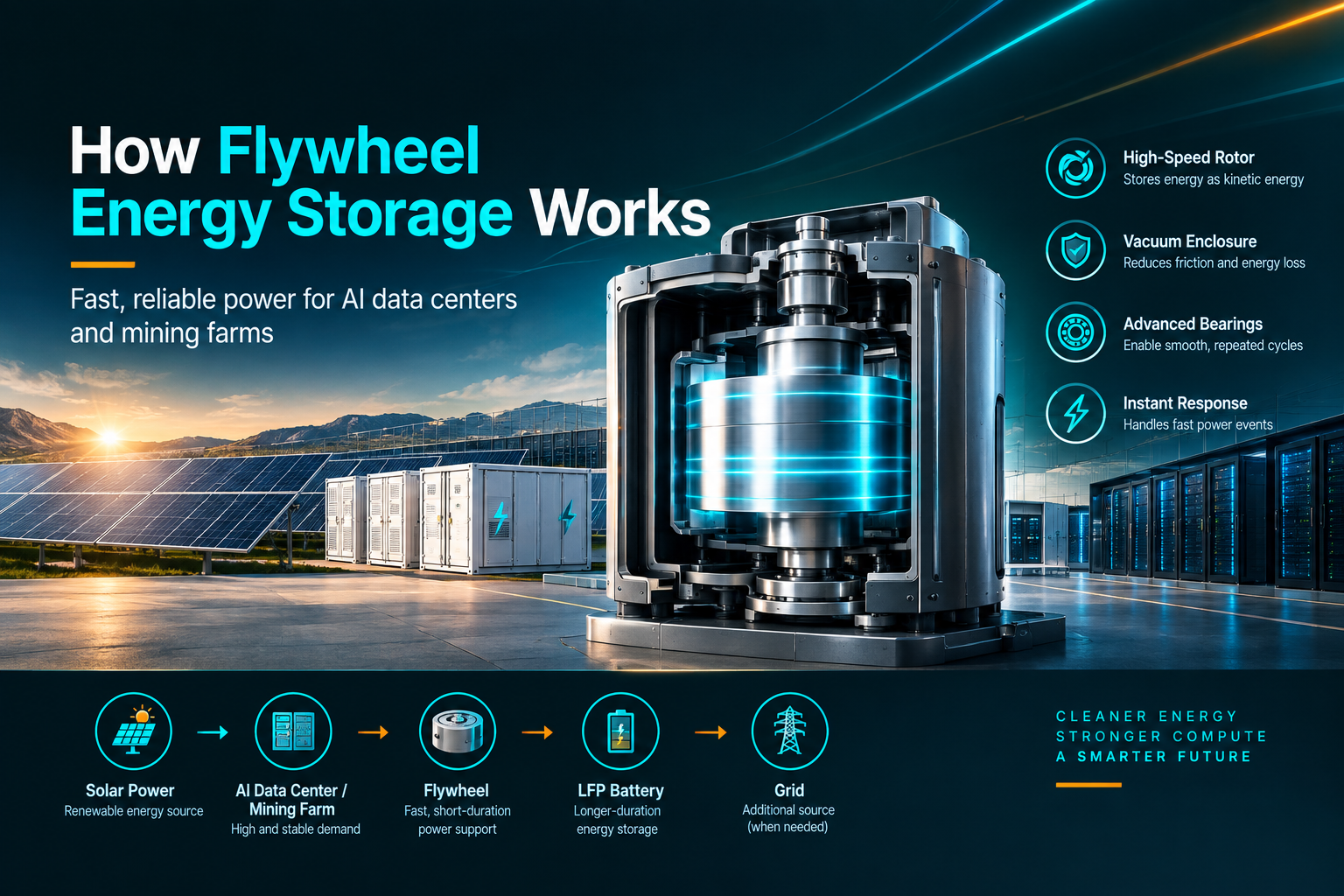
Introduction
As electricity demand continues to rise, especially from AI data centers, industrial facilities, and large computing operations, energy storage is becoming more than a backup solution. It is becoming part of the power infrastructure itself.
One technology attracting attention is flywheel energy storage.
Unlike a conventional lithium battery, a flywheel does not store electricity through a chemical reaction. It stores energy mechanically.
At its core, electricity spins a rotor at high speed to store power as motion, reversing the process when energy is needed.
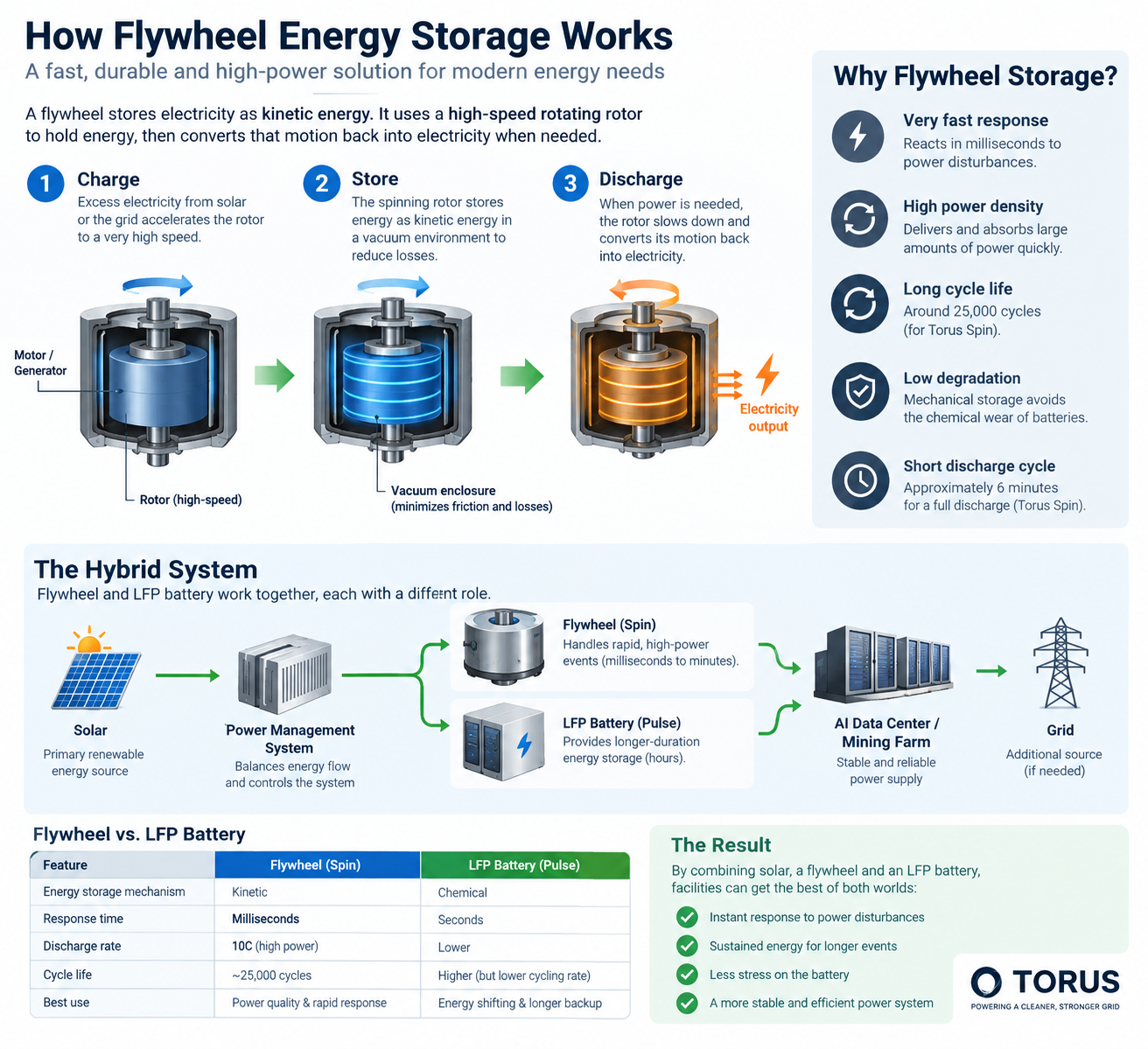
Modern flywheels minimize energy loss by spinning inside a vacuum enclosure with advanced, low-friction bearings. This allows the system to repeatedly charge and discharge without relying on the chemical processes found inside conventional batteries.
The biggest advantage is therefore not necessarily how many hours the system can store electricity.
It is how quickly it can deliver power.
Torus, for example, describes its Spin flywheel system as a high-power storage platform capable of responding in milliseconds. The system has a 10C discharge rating and is designed for approximately 25,000 cycles. Torus also describes a full discharge cycle of around six minutes, making the technology more suitable for high-power, short-duration events than for storing energy throughout an entire night.
This difference becomes important when dealing with modern electrical loads.
An AI data center can experience rapid changes in power demand as large numbers of GPUs operate together. Industrial equipment can also create sudden power spikes, voltage disturbances, or repeated changes in electrical load.
A conventional battery can handle these events, but repeatedly using chemical cells for very fast, high-power cycling can contribute to battery degradation.
This is where the flywheel can play a different role.
Instead of asking one battery system to perform every task, a hybrid architecture can divide the workload.
Flywheels tackle fast power bursts while LFP batteries cover long-term energy—a hybrid setup Torus calls "Spin" (for high-power spikes) and "Pulse" (for sustained delivery).
The result is a storage system with two different response characteristics.
The flywheel can react almost immediately to a sudden electrical disturbance. The battery can then provide sustained power when the event lasts longer. This can reduce the number of aggressive high-power cycles imposed on the chemical battery.
Another important characteristic is cycle life. Torus currently specifies a 25,000-cycle lifespan for Spin, while its Pulse LFP battery is designed for longer-duration storage and a lower cycling rate.
This makes flywheel technology particularly interesting for facilities where power quality and rapid response are more important than storing enormous amounts of energy for many hours.
The technology does not replace batteries.
It solves a different problem.
For AI data centers, industrial facilities, renewable-energy systems, and potentially large Bitcoin mining operations, the more interesting model may therefore be flywheel plus battery, rather than flywheel versus battery.
Solar or another generation source can provide the electricity, the LFP battery can shift energy through time, and the flywheel can react to the fast electrical events that happen in milliseconds.
That is where the technology becomes more than a simple storage device.
It becomes part of the power-management architecture itself.