
Introduction to Modular Battery Energy Storage Systems (BESS) for Crypto Mining & AI
Electricity is no longer just a utility bill for crypto miners, GPU farms, and AI compute operators—it is the main operating cost. In many regions, demand charges, peak pricing windows, and grid instability now matter as much as the raw price per kilowatt-hour. This is why solar alone is no longer enough.
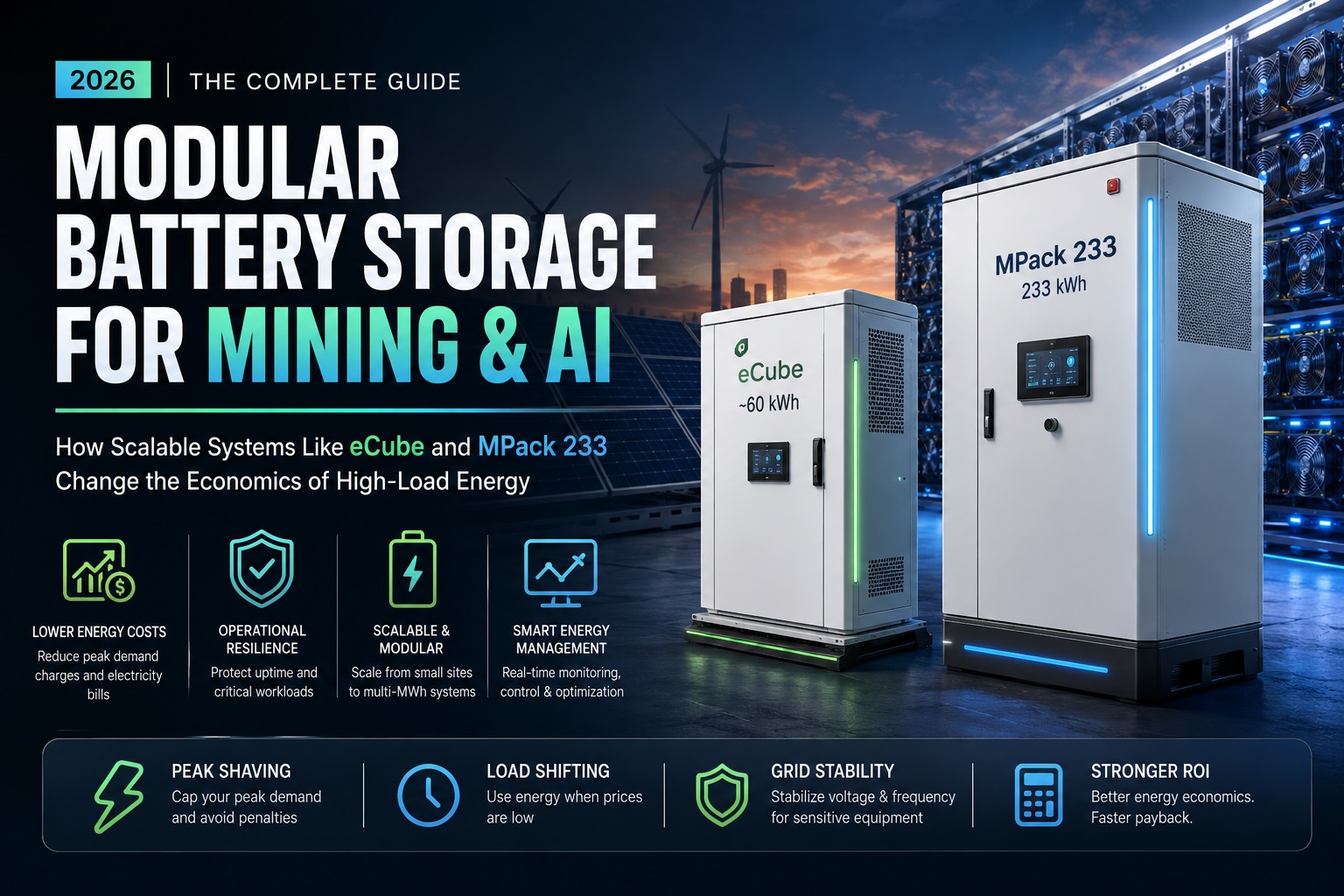
At recent industry events, a new class of commercial and industrial battery systems has gained attention: modular, reconfigurable storage platforms that can scale from small commercial sites to multi-megawatt installations. Two examples from this category—often discussed together—are a 60 kWh-class modular system (commonly known as eCube) and a larger 233 kWh platform with integrated power electronics (often referred to as MPack 233).
This article explains how these systems work and how they can reduce energy costs, stabilize operations, and improve ROI in mining and AI workloads.
Why Battery Energy Storage Systems Are Essential for Crypto Mining and AI Data Centers
For ASIC and GPU operators, energy costs are not just about how much power you use, but when you use it.
Many commercial sites are billed using:
-
Time-of-use pricing (electricity is more expensive during peak hours)
-
Demand charges (you pay extra based on your highest short-term power spike)
-
Grid penalties for unstable or reactive loads
Mining farms and AI clusters often have spiky load profiles. When new rigs spin up, when cooling systems ramp, or when batch jobs hit peak utilization, demand can jump sharply. Even if your average consumption is reasonable, those short peaks can dominate your monthly bill.
This is where battery storage becomes a financial tool, not just a backup system:
-
It can shave peaks by supplying short bursts of power instead of pulling them from the grid.
-
It can shift consumption to cheaper hours.
-
It can stabilize voltage and frequency for sensitive electronics.
-
And, in some cases, it can provide real operational resilience during outages.
Solar → Battery → Peak Shaving → Reduced Grid Dependency
eCube 60 kWh Modular Battery Storage: Features, Benefits & Use Cases
One of the most practical ideas in modern storage design is modularity. Instead of forcing operators to buy a single massive battery block, some systems are built from smaller, repeatable units. A typical example in this category is a ~60–61 kWh storage cabinet built from 12 individual battery modules, each around 5 kWh. Together, they form a compact but flexible building block for commercial projects.
Optimizing Electrical Architecture: Reconfigurable Voltage: One System, Two Worlds
What makes this type of system especially interesting is its rewirable internal architecture.
In one configuration, the modules are arranged in mixed series/parallel groups to operate in a lower DC voltage range (roughly a few hundred volts). This matches the requirements of mid-size three-phase inverters commonly used in light commercial setups. In another configuration, all 12 modules are placed in series, pushing the DC voltage much higher—suitable for larger three-phase inverters and 480V-class systems. In practice, this means:
-
The same battery cabinet can be adapted to different electrical standards and inverter sizes simply by changing internal wiring.
-
For operators and installers, this reduces inventory complexity and makes future upgrades easier.
Enhancing Hardware Compatibility: Pairing With Inverters and Standards
These systems are typically certified to work with popular commercial inverters in the 30 kW to 60 kW range, and they are designed to meet modern safety standards (such as UL 9540 in many markets). Newer certification updates aim to make them even more inverter-agnostic, which is important for sites that want flexibility in system design.
From a mining or AI perspective, this matters because:
-
You are not locked into a single inverter ecosystem.
-
You can expand or reconfigure your power architecture as your compute load grows.
-
You can standardize on one battery platform across different sites.
How Modular Battery Storage Scales from 60 kWh to Utility-Scale Energy Systems
A single ~60 kWh unit is useful, but the real power of this approach appears when systems are combined. These modular cabinets can typically be:
-
Paralleled on the DC side (multiple batteries feeding one inverter)
-
Or paralleled on the AC side (multiple inverter + battery pairs working together)
In practical terms:
-
One inverter can often support several battery cabinets.
-
Multiple inverters can then be combined into a larger system.
At scale, this architecture can reach multi-megawatt-hour storage capacities.
For large mining farms or AI data halls, this opens up a different strategy:
-
Use storage not just for backup, but as an active grid-interaction tool.
-
Cap your peak demand even as your total compute power grows.
-
Design your power system in phases, expanding storage alongside compute instead of overbuilding from day one.
Battery Energy Management Systems (BMS): Monitoring, Control & Performance Optimization
Modern storage systems are not just boxes of batteries. They usually include a built-in Energy Management System (EMS) with:
-
Local display and controls
-
Monitoring of battery health and temperature
-
Charge/discharge scheduling
-
Diagnostics and alarms
For high-load operations, this is critical:
-
You can fine-tune peak shaving behavior.
-
You can prioritize backup reserves for critical loads (networking, cooling, control systems).
-
You can monitor cell-level temperatures and performance, which helps protect long-term battery life.
In a mining or AI facility, where uptime and predictability matter, this level of control is often more valuable than raw capacity alone.
Battery Energy Storage Safety Standards and Fire Protection for Industrial Installations
Fire safety is one of the biggest concerns with any large battery system—especially in indoor or semi-enclosed environments like warehouses or data centers. Modern commercial systems typically integrate multiple layers of protection:
-
Water ingress sensors to shut down the system in case of flooding
-
Smoke and heat detectors inside the cabinet
-
Temperature monitoring at the individual cell level
-
Internal fire suppression systems (often aerosol-based)
-
Pressure relief or blast panels designed to vent safely upward instead of outward
For operators, this means two things:
-
These systems are designed to meet strict commercial safety requirements.
-
Proper installation, spacing, and ventilation are still essential parts of the overall risk management strategy.
- Site Load: 500 kW continuous ASIC mining operation
- Peak Demand Reduction: 10% – 25% (depending on load variability and EMS strategy)
- Electricity Tariff: $0.10 – $0.15 per kWh (regional average range)
- Demand Charge: $10 – $20 per kW (applicable in demand-based billing systems)
- Primary Value Driver: Peak shaving + load shifting during high-cost periods
- Estimated Payback Period: Typically 18 – 36 months depending on usage pattern and tariff structure
Note: Results vary significantly based on regional electricity pricing, load profile stability, and system sizing strategy.
MPack 233 Battery Energy Storage System: High-Capacity Solution for Mining & AI Infrastructure
While modular 60 kWh cabinets are ideal building blocks, some projects benefit from larger, more integrated units. This is where systems in the ~233 kWh class come in.
These platforms usually differ in three key ways:
1) Integrated Inverter (PCS)
Instead of relying on an external inverter, these systems often include a built-in power conversion system in the 100–150 kW range. This allows the unit to operate as:
-
An AC-coupled storage system (easy to add to existing solar or grid setups)
-
Or part of a DC-coupled architecture using additional cabinets
For retrofit projects—very common in mining and industrial sites—AC coupling is a big advantage. You can place the battery between the grid and the load without redesigning the entire solar or electrical system.
2) Higher-Voltage, Multi-Module Architecture
Internally, these systems are built from several large modules connected in series to reach higher DC voltages, suitable for three-phase commercial and industrial environments. This improves efficiency and reduces current-related losses at higher power levels.
3) Liquid Thermal Management
Instead of air conditioning, many large systems use liquid cooling with conduction plates and circulating coolant. This allows:
-
Stable operation in very hot climates
-
Reliable performance in very cold regions (with active heating)
-
More uniform cell temperatures, which helps extend battery lifespan
For mining farms in places like Texas, the Middle East, or Southern Europe—and for AI facilities that run 24/7—thermal management is not a luxury. It is a core part of system reliability.
Best Applications of Battery Energy Storage Systems for Crypto Mining, AI & Industrial Facilities
These larger systems are often deployed in sites such as:
-
Data centers and AI compute clusters
-
Hospitals and critical infrastructure
-
EV fast-charging hubs (which create extreme demand spikes)
-
Industrial facilities with heavy motors and cooling systems
-
Large commercial sites with volatile load profiles
For miners and AI operators, the main economic drivers are:
-
Peak demand reduction (often the fastest payback component)
-
Operational resilience (protecting uptime and hardware)
-
Energy arbitrage (charging when power is cheap, discharging when it is expensive)
-
Grid compliance and stability (avoiding penalties and curtailments)
Future-Proofing Power Infrastructure: Designing for Growth: From Single Units to Arrays
High-capacity systems can also be paralleled into arrays, often using dedicated combiner cabinets and higher-level EMS software. This allows:
-
Centralized control over multiple storage units
-
Coordinated peak shaving and load management
-
Integration with site-level or utility-level control systems
For growing mining or AI operations, this means you can:
-
Start with a few hundred kWh
-
Expand toward megawatt-hour-scale storage as your compute footprint grows
-
Keep the same control and operational philosophy across all stages
Strategic Planning for Energy Investors: Practical Advice for Investors and Operators
Before investing in battery storage for mining or AI, consider these points:
-
Model your load profile first. The value of storage depends heavily on how spiky your demand is and how your utility bills demand charges.
-
Don’t oversize blindly. Often, a well-sized system aimed at peak shaving delivers better ROI than a massive backup-only battery.
-
Think in phases. Modular systems let you scale storage alongside compute growth.
-
Plan for integration. Make sure the EMS, inverter strategy, and grid interface match your long-term expansion plans.
-
Account for thermal and safety requirements. These are not optional in high-density compute environments.
Comparative Analysis of eCube and MPack 233: Battery Storage Comparison for Mining and AI Workloads
| Specification | eCube (~60 kWh) | MPack 233 (~233 kWh) |
|---|---|---|
| Target Use | Small / Medium commercial, mining & AI edge sites | Medium / Large commercial & industrial, mining farms, AI data halls |
| Energy Capacity | ~60–61 kWh | ~233 kWh |
| Scalability | Yes, multiple units can be combined | Yes, multiple units can be paralleled |
| Voltage Flexibility | Reconfigurable (208V / 480V systems) | High-voltage industrial design |
| Inverter | External (30K / 60K class) | Built-in inverter (~125 kW) |
| Cooling System | Air / AC cooling | Liquid cooling |
| Main Benefit | Peak shaving + backup for spiky loads | Peak shaving + resiliency for heavy loads |
| Typical Applications | Shops, small mining or AI clusters | Mining farms, EV fast charging, large compute sites |
| Retrofit Friendly | Yes | Yes (AC-coupled, easy to add to existing systems) |
- High upfront CAPEX
- Battery degradation over time
- Requires proper EMS tuning
- Not effective for flat-rate electricity markets
Maximizing Profitability in High-Energy Markets: Conclusion
For ASIC miners, GPU farms, and AI compute operators, modern battery storage is no longer just about keeping the lights on. It is a financial optimization tool, a risk management layer, and a scalability enabler.
Modular systems in the ~60 kWh class provide flexible building blocks that can adapt to different voltages and inverter sizes, while larger ~233 kWh platforms with integrated power electronics and liquid cooling offer turnkey solutions for heavier commercial and industrial loads.
Used correctly, these systems can:
-
Cut peak demand costs
-
Stabilize operations
-
Improve energy predictability
-
And make high-energy compute businesses more resilient and more competitive in an increasingly volatile power market.
FAQs: Keeping it Real with Energy Storage
Q1: Is the ROI actually realistic for mid-sized operations?
It mostly depends on your utility’s billing structure. For those on a flat-rate plan, the payback period is steady but longer. However, for operations facing heavy demand charges (penalties for peak usage spikes), the ROI is much faster. Using batteries for "peak shaving" allows you to pull from stored energy instead of the grid during high-load cycles, effectively cutting the most expensive part of the monthly bill.
Q2: eCube (Modular) vs. MPack 233 (All-in-One): Which is the better fit?
It comes down to your infrastructure goals:
-
The eCube (60 kWh): Best for those who need flexibility. Its modular design allows for voltage adjustments and easier scaling if you plan to reconfigure your setup later.
-
The MPack 233: The ideal "set it and forget it" solution. Since it’s AC-coupled with a built-in inverter, it requires less external hardware. The integrated liquid cooling also makes it the superior choice for facilities that struggle with high ambient temperatures.
Q3: What are the actual fire risks in high-density environments?
While any high-density energy system requires respect, industrial-grade units like the eCube and MPack are built with multiple redundant safety layers that go far beyond standard consumer electronics. These include:
-
Active Suppression: Internal aerosol fire suppression and dedicated smoke detectors within the cabinets.
-
Directional Venting: Pressure relief panels designed to vent upwards, protecting surrounding equipment.
-
Cell-Level Monitoring: Constant temperature tracking at the individual cell level, which automatically triggers a system shutdown well before thermal runaway becomes a risk.