The Growing Shift: Converting ASIC Mining Facilities into AI Data Centers
At asicmining360.com, we have repeatedly pointed out the growing connection between cryptocurrency mining and artificial intelligence. At first, the two industries may look completely different. One is built around Bitcoin and digital money, while the other is changing computing, science, and technology.
But look a little closer and the similarities become obvious.
Electricity is at the heart of both businesses. The cost and availability of power can make or break a Bitcoin mining operation, and the same is increasingly true for AI data centers.
The hardware is different, but the idea is similar. Bitcoin miners use large numbers of specialized machines, while AI companies rely on huge numbers of GPUs and other powerful chips. Both generate a lot of heat and need serious cooling systems. Both also need buildings, electricity infrastructure, networking, monitoring, and software to keep thousands of machines working together.
And both are looking toward the future, although in very different ways. Bitcoin is part of the development of digital money and a new financial system, while AI is becoming one of the most important technologies in modern science and business.
This connection is no longer just an interesting comparison.
Some Bitcoin mining companies are now taking the next step: using the infrastructure they built for mining to enter the AI data-center business.
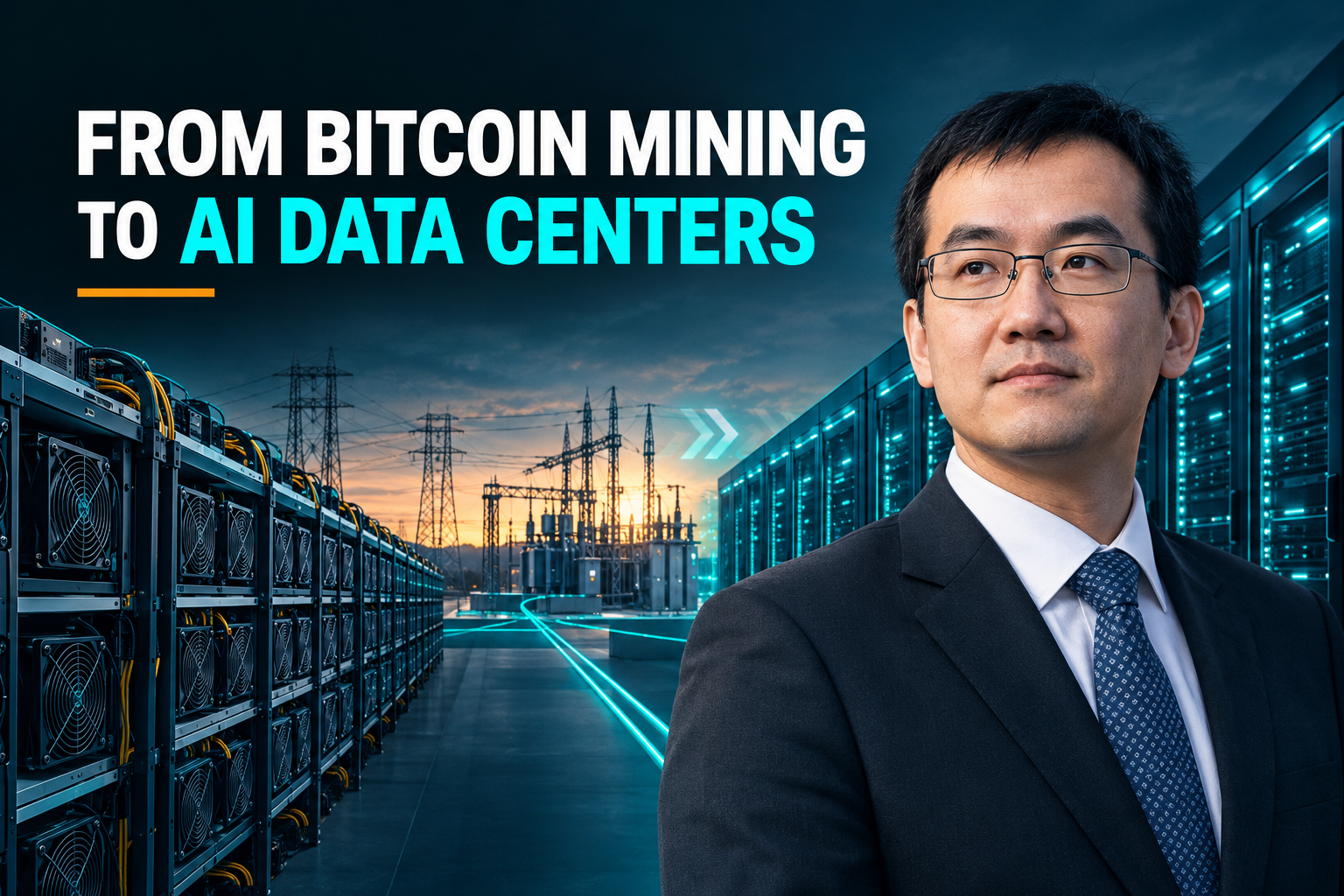
One of the clearest examples is Bitdeer, led by Jihan Wu.
Jihan Wu’s Transition: From Early Bitcoin Adoption to AI Cloud Computing
Jihan Wu was born in 1986 in Chongqing, China, and studied economics and psychology at Peking University.
After university, he worked as a financial analyst. His career changed direction in 2011 when he discovered Bitcoin.
Wu reportedly raised about 100,000 yuan from family and friends and used it to buy around 900 Bitcoin. He also became involved in China's early Bitcoin community and helped build one of the country's first Bitcoin community websites.
He later became known for translating Satoshi Nakamoto's Bitcoin white paper into Chinese.
But Wu was not satisfied with simply owning Bitcoin. He became interested in the machines needed to produce it.
In 2012, he invested in a Bitcoin mining hardware startup. The company later ran into technical problems, and Wu also lost money on another mining hardware investment.
Going through all of that made one thing crystal clear to him: the entire future of Bitcoin mining was going to come down to top-tier hardware and serious engineering.
That eventually led him to Micree Zhan.
Bitmain’s Legacy and the Evolution of Industrial-Scale ASIC Bitcoin Mining
When Wu and microelectronics engineer Micree Zhan founded Bitmain in 2013, they essentially struck gold. They released their first major rig, the Antminer S1, that same year, and demand just went through the roof.
The crypto market hit a massive slump after the Mt. Gox disaster in 2014, but as Bitcoin eventually recovered, the mining industry fired right back up. Bitmain caught this wave perfectly with the Antminer S5, which turned out to be one of their biggest hits.
By 2017, the company was virtually untouched in the hardware market, raking in around $2.5 billion in revenue.
But Wu was never just a background CEO. He was heavily invested in the politics of the network itself, right in the middle of the intense community arguments over Bitcoin's block size and transaction speeds. That exact standoff is what eventually led to the hard fork and the birth of Bitcoin Cash in 2017.
But after years in the Bitcoin industry, Wu's interests began moving beyond mining itself.
In 2019, he stepped down as Bitmain's co-CEO and founded Matrixport, a Singapore-based cryptocurrency financial-services company.
His next move would take him even further away from traditional Bitcoin mining.
Why Existing Crypto Mining Infrastructure is Perfect for High-Performance AI Computing
The important thing to understand is that a large Bitcoin mining farm is already a serious industrial computing facility.
It needs electricity, substations, transmission connections, buildings, cooling, networking, permits, maintenance teams, and people who know how to operate thousands of machines.
AI data centers need many of the same things.
The biggest difference is the hardware.
Bitcoin miners use ASICs designed specifically for cryptocurrency mining. AI data centers rely heavily on GPUs and other high-performance chips.
But the physical infrastructure around those machines can overlap.
This gives established mining companies an interesting advantage.
Building a large AI data center from scratch can take years. Getting a new electricity connection, building substations, obtaining permits, preparing land, and developing the necessary transmission infrastructure are not things that can always be done quickly.
Bitcoin miners have already spent years doing exactly that.
So instead of starting with an empty piece of land, an AI company may be able to start with a site that already has much of the difficult work completed.
And in the AI race, time can be almost as valuable as electricity.
How Bitdeer is Repurposing 3 Gigawatts of Power for Global AI Projects
This is where Jihan Wu's current strategy becomes particularly interesting.
Wu has said that Bitdeer has around three gigawatts of power capacity and power-related opportunities worldwide, with roughly two gigawatts in the United States.
His argument is that Bitcoin miners have already built much of the infrastructure that AI data centers need.
Transmission lines, substations, permits, buildings, local workers, and grid connections can take years to develop.
In places such as Texas, getting new electricity capacity connected to the grid can involve lengthy studies and approvals.
Bitcoin miners that have already gone through this process may therefore have a valuable head start.
Wu has said that the fastest Bitdeer sites could be converted into AI data centers in about one year, while more complicated projects could take two or three years.
He has also suggested that, over time, Bitdeer's U.S. power capacity could increasingly be used for AI data centers.
But there is an important detail here: Bitdeer does not necessarily have to stop mining Bitcoin while this happens.
Using Bitcoin Mining as a Transitional Bridge for Future AI Data Center Demands
This may be one of the smartest parts of the strategy.
Imagine a company developing a huge power project for an AI data center. The electricity is available, but the AI customer is not ready yet.
The project could sit unused while waiting for construction, equipment, or contracts.
Bitcoin mining offers another option.
The company can use that electricity to mine Bitcoin while the AI project is being developed.
Once an AI customer is ready, part of the power capacity can potentially be moved toward AI computing.
Wu has described this as a practical way of reducing uncertainty for power developers.
If a company is building a large power plant, it wants to know that someone will actually buy the electricity.
A Bitcoin mining operation can provide that demand immediately, while an AI data center can become the longer-term customer.
In this sense, Bitcoin mining can act as a bridge between new power generation and future AI demand.
Why Bitdeer Continues ASIC Bitcoin Mining Operations During the Generative AI Boom
Even with all the massive hype around AI right now, Wu has zero plans to walk away from Bitcoin mining. He’s been in the game since the very beginning and is still completely convinced that Bitcoin is here to stay.
There is also a practical reason.
AI data centers require enormous amounts of money and their development can take years. Demand can change, projects can be delayed, and investors are increasingly asking whether the massive spending on AI infrastructure will eventually produce enough profit.
Bitcoin mining can provide another source of income while the AI side develops.
Wu has argued that this is particularly useful when building new power capacity.
If a power developer knows that Bitcoin miners will consume the electricity even if an AI project is delayed, it may be easier to justify the investment.
That makes Bitcoin mining more than just a business on its own.
It can also become a way to support the development of future AI infrastructure.
Bitdeer AI Cloud Services: Affordable GPU Computing Power for Tech Startups
Bitdeer's move into AI is not limited to changing its mining sites.
The company has also developed Bitdeer AI, a cloud-based computing service aimed at companies, startups, researchers, and other users that need access to powerful AI hardware.
The idea is fairly simple.
Many smaller companies want to use AI but cannot afford to build their own data center full of expensive GPUs.
Instead, they can rent access to computing power.
One example mentioned by Bitdeer is Imagine App, an AI platform that can generate creative content, including video. According to Bitdeer, the company used access to NVIDIA H100 GPUs through Bitdeer's infrastructure.
This is another natural step for a company that already understands large-scale computing.
The business is no longer only about owning Bitcoin mining machines. It is becoming about providing access to powerful computing itself.
The AI Investment Question
There is, however, a major issue that cannot be ignored.
AI infrastructure is extremely expensive.
Companies are spending huge amounts on GPUs, data centers, electricity, cooling systems, networks, and new power generation.
That is very different from the traditional software model, where a company could sometimes grow rapidly without building enormous physical infrastructure.
AI needs physical assets.
And those assets eventually cost money to maintain and replace.
Wu has acknowledged this difference and has raised the question of whether the returns from all this spending will justify the investment.
That does not necessarily mean the AI boom is going away.
It simply means that the industry needs to prove that the demand for AI computing will be strong enough to support the enormous amount of infrastructure being built.
For a company like Bitdeer, keeping Bitcoin mining alongside AI provides a degree of flexibility.
The Real Asset May Be the Power
Perhaps the biggest lesson from this transition is that the most valuable asset for a mining company may no longer be the mining machine itself.
It may be the power infrastructure behind it.
Cheap and reliable electricity, land, substations, transmission connections, permits, and industrial buildings can all become valuable when demand for computing rises.
A Bitcoin mining site built several years ago for ASIC machines could eventually become an AI data center filled with GPUs.
The machines change.
The purpose changes.
But the electricity infrastructure remains.
This is why the line between Bitcoin mining companies and AI infrastructure companies is becoming increasingly difficult to draw.
Bitcoin Mining and AI Are Closer Than They Look
Bitcoin mining and AI are obviously not the same business.
But they share a surprisingly large foundation.
Both need enormous amounts of electricity.
Both depend on specialized computing hardware.
Both produce significant heat and require cooling.
Both need large industrial facilities.
Both rely on software to coordinate large numbers of machines.
And both are increasingly limited not by the availability of chips alone, but by something much more basic: where can we get enough electricity to run all these machines?
That question may become one of the defining issues of the next decade.
Bitcoin miners discovered the importance of cheap power years ago.
AI companies are now discovering the same thing.
And companies that already control power, land, grid connections, and computing infrastructure may have an opportunity to serve both markets.
The Future of Hybrid Computing: Blending Blockchain Power with AI Facilities
The movement of Bitcoin miners into AI data centers is not simply a story about one industry replacing another.
It is about infrastructure.
Bitcoin mining companies spent years finding cheap electricity, securing land, building substations, connecting to the grid, installing cooling systems, and learning how to operate thousands of machines at the same time.
The AI industry now needs many of those same things.
Jihan Wu's career illustrates this transition particularly well. He started by investing in Bitcoin, moved into mining hardware with Bitmain, entered cryptocurrency financial services through Matrixport, and is now building a business that combines Bitcoin mining, power infrastructure, and AI computing through Bitdeer.
The reason is relatively simple.
The machines may change, but electricity remains the foundation.
Bitcoin mining turns electricity into a digital financial asset.
AI turns electricity into computing power, models, applications, and new digital services.
For companies that already control the infrastructure needed to supply that electricity, the opportunity may be much bigger than Bitcoin mining alone.
The future may therefore produce a new kind of computing company: one that can mine Bitcoin when that makes economic sense, provide AI computing when demand is stronger, and use the same underlying power infrastructure for both.
That is the real connection between Bitcoin mining and AI—and it may become increasingly important as the world enters an era where access to electricity is becoming just as important as access to chips.