
Introduction
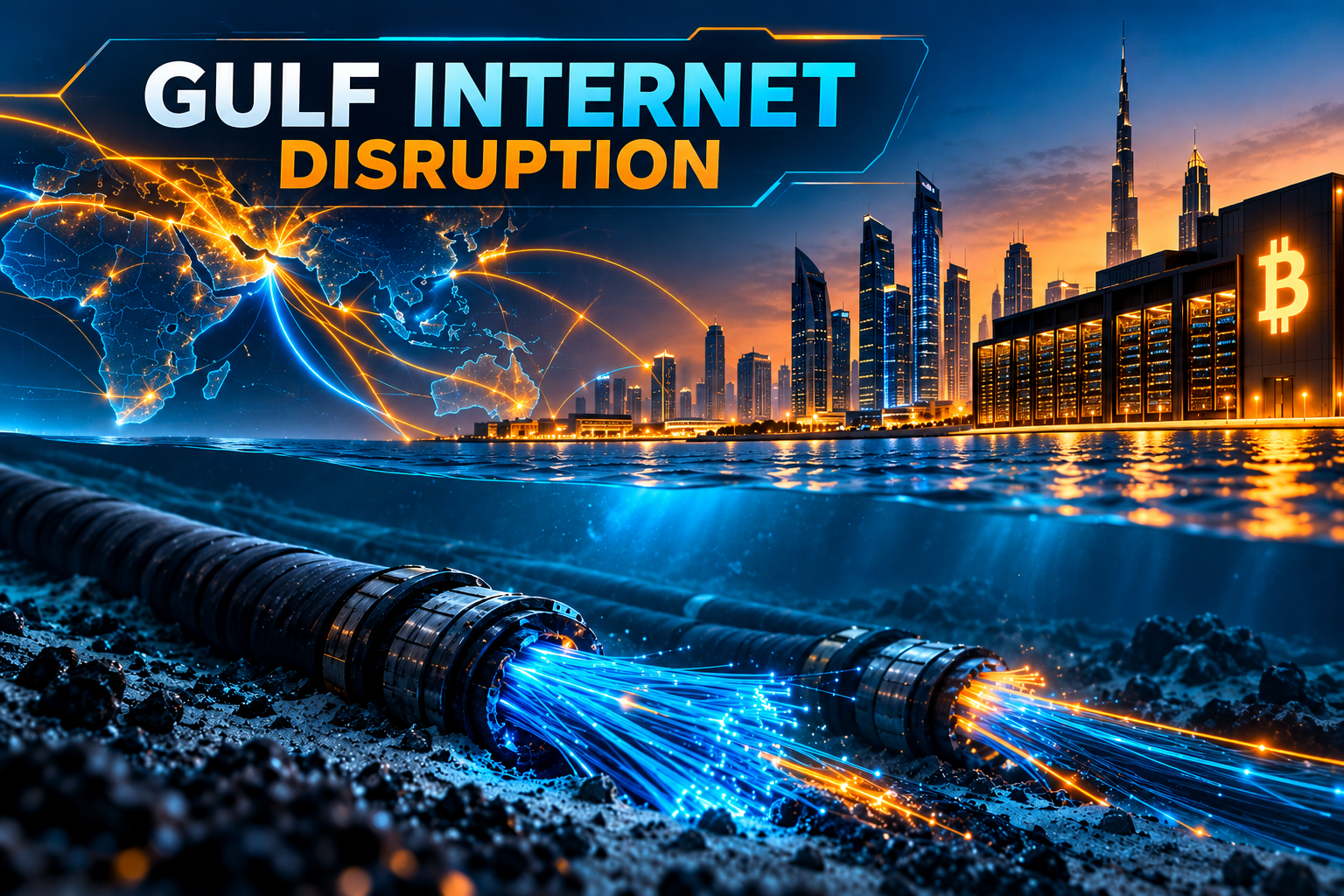
What actually happens if a cluster of major undersea internet cables in the Middle East gets severed overnight? Would regional data centers go completely dark? Could cloud platforms and AI training pipelines grind to a halt? And where does that leave the thousands of Bitcoin mining rigs humming across the region?
These aren't just theoretical security drills. The conversation gained fresh urgency following reports of renewed geopolitical threats targeting subsea fiber optics and critical Gulf infrastructure.
Over the last few years, the Gulf has quietly positioned itself as a major hub for enterprise data centers, AI clusters, and high-density crypto mining. But while these facilities have stable power grids, they rely heavily on underwater fiber to communicate with the rest of the world. A simultaneous cut across multiple lines would trigger fallout far worse than just sluggish loading screens.
For Bitcoin, the scenario introduces a fascinating dynamic: if hash rate across Iran, the UAE, or neighboring operations drops offline, do miners in the rest of the world actually profit?
The short answer is yes—but with a few major caveats. Severing an internet link doesn't instantly turn off an ASIC rig, just as a disconnected data center still has functional power. The real outcome depends on scale, duration, and how fast operators can failover to secondary bandwidth.
And for global miners, the gap between a 6-hour connectivity hiccup and a 3-week physical outage is night and day.
1. Subsea Fiber Architecture: Gulf Chokepoints & Terrestrial Failover Limits
Most people don't realize that nearly all international internet traffic relies on undersea cables. They’re the invisible pipelines supporting financial settlements, enterprise cloud storage, cross-border corporate communication, and continuous data transfers between continents.
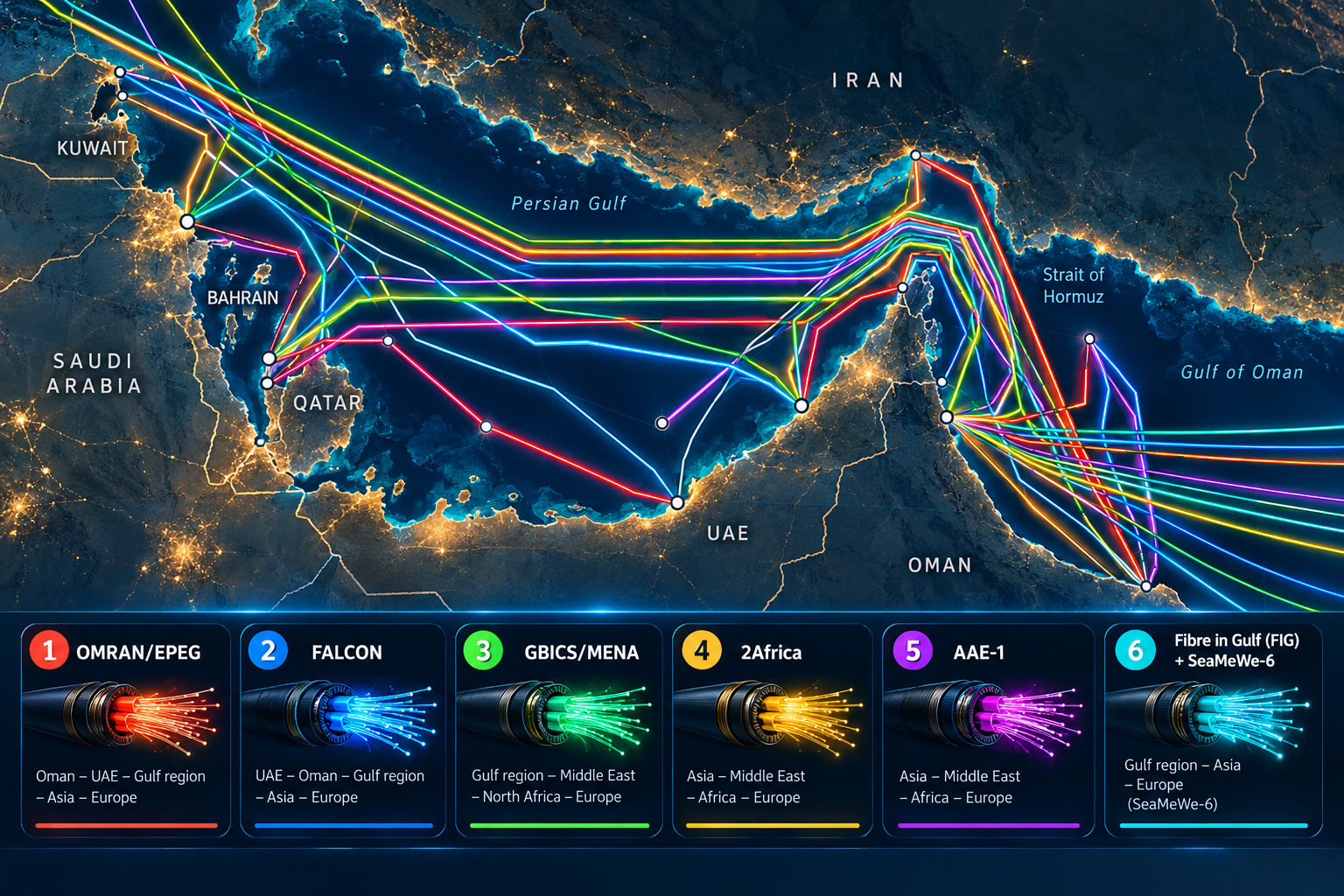
In the Gulf, key subsea networks—such as AAE-1, FALCON, and GBI—provide the primary links to international internet exchanges. If multiple systems in this group go down simultaneously, the region loses a massive chunk of its outbound throughput.
Still, it’s crucial to draw a line between the Strait of Hormuz and the Red Sea. A multi-cable break in the Red Sea disrupts global transit between Europe and Asia. A break in Hormuz, by contrast, is mostly a regional headache—concentrated heavily on Gulf-based endpoints rather than international backbones.
Gulf nations also have key redundancies in place. The UAE lands critical fiber outside the Persian Gulf choke point along the Fujairah coastline, Saudi Arabia relies heavily on its Red Sea landing stations, and overland terrestrial networks can help route data across land borders.
But backup routes have limits. They rarely have enough spare headroom to absorb 100% of the diverted traffic without severe congestion and latency spikes.
Ultimately, the risk here isn't a global internet blackout. It’s a targeted, high-impact regional connectivity squeeze that forces Gulf data centers, AI workloads, and online platforms to operate under tight bandwidth constraints.
2. Multi-Cable Severance Risks: Latency Spikes & Deep-Sea Repair Delays
When a single submarine cable goes down, network operators can usually reroute traffic behind the scenes without much drama. If there’s enough headroom on backup lines, everyday users barely notice a dip in performance.
The real trouble starts when multiple subsea cables in the same corridor snap at once. Backup capacity gets overwhelmed fast, latency spikes through the roof, and critical online services start dropping requests or failing altogether.
This isn't just a worst-case scenario on paper. Back in March 2024, a single subsea event off the coast of Côte d'Ivoire severed four major cables simultaneously, crippling internet access across 13 African nations. Entire economies faced severe network degradation, and bringing those lines back online took weeks of offshore repair work.
That outage proved a sobering point: breaking just a handful of physical lines on the ocean floor can instantly disrupt millions of users and enterprises.
In a high-risk zone like the Strait of Hormuz, fixing damaged cables gets exponentially harder. Specialist repair ships can't just sail in—they face strict naval security blocks, skyrocketing insurance premiums, and naval hazard zones before they can even drop specialized equipment into the water.
Ultimately, the duration of an outage comes down to two things: how much traffic can be diverted through overland or satellite routes, and how long repair crews are forced to wait on the sidelines before fixing the broken glass.
3. Gulf Data Center Resilience: Application Layer Failures vs. Uptime
Data centers are the physical engines powering modern digital life—housing the server racks, storage arrays, and high-speed switches behind enterprise cloud services and AI development. Across the Gulf, billions of dollars have poured into building out these facilities to position the region as a major computing hub.
But data centers don't depend on subsea fiber cables the same way they rely on power grids and cooling loops.
If undersea lines are cut, a facility’s servers don't suddenly freeze up. As long as electricity, chilled water, and local networks stay active, the hardware keeps spinning. The real breakdown happens at the application layer, where local workloads rely on external data streams, remote authentication hubs, or cross-border payment gateways. If those international API endpoints drop offline, an application can stall or crash—even while its host server is running at 100% health.
Hyperscale cloud providers engineer around this using multi-region redundancy and distributed traffic management. In theory, critical workloads can failover to other regions, while mirrored databases keep services alive. In practice, no redundancy model is bulletproof when an entire regional bandwidth corridor shrinks overnight.
The economic fallout from these disruptions isn't theoretical: failed financial settlements, dropped enterprise sessions, lost operational productivity, and soaring bills for emergency satellite or terrestrial bandwidth.
The ultimate nightmare scenario, however, isn't just a severed subsea cable. It’s a compound failure where network blackouts hit at the exact same time a facility suffers physical damage or local power and cooling failures—moving the crisis from high latency to total loss of regional compute capacity.
4. AI Workload Vulnerabilities: Local Inference vs. Remote Dataset Latency
Artificial intelligence adds another layer to the region's digital infrastructure. Modern AI data centers can contain expensive accelerators, high-speed networking equipment and large storage systems designed to handle demanding computing workloads.
Not every AI application needs a continuous international connection. If a model and its required data are available locally, some inference tasks can continue even when external connectivity is limited.
Other services are more dependent on remote systems. They may need to access cloud-based models, external datasets, distributed storage or computing resources in another country. An outage can interrupt these connections or delay the transfer of large amounts of data.
This creates an important distinction: a cable failure can make an AI service inaccessible without damaging the hardware that runs it.
Direct physical damage to an AI data center would be a different matter. Replacing advanced accelerators, specialized networking equipment and supporting infrastructure can be expensive, and some components may have long procurement lead times.
Even then, the overall impact would depend on how much computing capacity was concentrated at the affected facility and whether the operator could move workloads elsewhere.
For the Gulf's growing AI sector, reliable electricity, cooling, connectivity and physical security are all important. Protecting just one of these elements is not enough to guarantee that a facility can continue operating normally.
5. ASIC Mining Telemetry: Mining Pool Disconnections vs. Offline Hashing
Bitcoin mining works differently from cloud computing.
ASIC miners perform hashing calculations to help find valid blocks on the Bitcoin network. As long as a machine has electricity and remains operational, it can continue hashing without a constant stream of data from the internet.
However, most industrial miners use mining pools to receive work and submit shares. If a cable outage breaks the connection to a pool, the machines may continue running while the operator's ability to earn normal pool rewards is disrupted.
The consequences depend on the circumstances. A farm with an alternative internet provider or an independent network route may keep operating. A farm that loses all useful connectivity could become unproductive even if its hardware is still powered on.
There are therefore three different scenarios:
- Connectivity problems: The machines remain operational, but connections to mining pools become unreliable.
- Loss of effective mining capacity: Miners can no longer contribute useful work because of prolonged communication problems or other operational failures.
- Physical shutdown: Power, cooling or equipment failures force the mining facility to stop operating.
These outcomes should not be treated as equivalent. A disconnected mining farm does not automatically mean that every ASIC inside it has stopped hashing.
It is also difficult to determine exactly how much Bitcoin mining capacity operates in Iran and the wider Gulf region. Public estimates rely on incomplete information, and not all mining activity is necessarily reported or independently verified.
For that reason, it would be premature to predict how much global hashrate would disappear in a Hormuz-related disruption.
6. Network Hash Rate Impact: 2016-Block Difficulty Epoch Adjustments
Technically, yes—surviving miners could profit, but only if an outage pulls a large enough slice of global hash rate out of active block production for an extended period.
Bitcoin's protocol self-calibrates every 2,016 blocks to keep block generation at roughly ten minutes. If a major mining region drops off the map, average block times temporarily stretch out. When the next difficulty epoch hits, the target lowers—making it easier for operational farms to find valid blocks.
If your rigs stay online while competing hash rate vanishes, your projected daily BTC payout per TH/s goes up.
The catch is timing and mechanics. Bitcoin’s difficulty code doesn't react instantly to a severed fiber optic line. The outcome depends entirely on whether those ASICs are actually locked out of the network and how long they stay isolated.
An internet cut isolates a farm from its pool, but it doesn't power down the hardware. Mining engineers can often route around local breaks using satellite backhauls or backup terrestrial lines to restore block header transmission within hours.
Furthermore, difficulty is only one side of the profitability equation. Realized margins still depend heavily on Bitcoin's market price, power costs, network transaction fees, and hardware efficiency. A geopolitical crisis big enough to sever undersea fiber could also send power prices soaring or trigger broader market volatility.
Ultimately, miners outside an outage zone stand to gain if competing hash rate takes a sustained hit, but calculating that upside ahead of time is pure guesswork until we know the true extent of the damage and repair timelines.
7. Why the Impact Would Differ Across Industries
While AI hubs, cloud platforms, and Bitcoin mining facilities all sit under the same digital infrastructure umbrella, their failure modes couldn't be more different when international connectivity breaks.
Enterprise cloud platforms are inherently distributed. Modern software stack architectures constantly pass telemetry between application layers, identity management systems, and multi-region databases. Cut that inter-system pipeline, and the service becomes unusable—even if the underlying local bare-metal servers are sitting at 100% health.
AI infrastructure occupies a middle ground. Large language model training runs or localized batch workloads can technically keep crunching data locally during a blackout. However, real-time inference APIs, remote dataset streams, and distributed multi-node GPU clusters suffer immediate operational halts when subsea links drop.
Bitcoin mining operates under a completely different paradigm. An ASIC rig doesn't need a heavy broadband pipe to execute SHA-256 calculations, but it does require a ultra-low-latency channel to fetch new block headers and submit valid proof-of-work shares back to its pool.
Recognizing these technical distinctions is crucial when calculating economic fallout. A subsea cable break can freeze cloud platforms, stall AI pipelines, or cause an ASIC farm to throw high stale-share ratios without causing a single cent of physical hardware damage.
The true threat isn't a single isolated fiber cut. It's a compound failure—where simultaneous cable severances overlap with choked backup bandwidth, extended maritime repair delays, and localized power grid instabilities.
Infrastructure Verdict: Subsea Redundancy & Modern Compute Resilience
Most people have heard of the Strait of Hormuz because of the oil tankers that pass through it. What gets less attention are the internet cables running along the seabed in the surrounding region. If several of these cables were cut during a conflict, the problems could spread quickly. Some businesses might lose access to their cloud services, AI data centers could have trouble serving customers abroad, and Bitcoin mining farms might find themselves unable to reach their mining pools.
That doesn't mean everything would shut down overnight. Many large data centers have more than one internet connection, and some of their equipment can keep working even when outside connections are lost. The real trouble starts when too many cables go down at the same time and there aren't enough alternative routes to carry the traffic.
For Bitcoin miners, things work a little differently. ASICs machines don't need a particularly fast internet connection, but they do need to stay connected to a mining pool or the Bitcoin network. Otherwise, they can keep running and consuming electricity without getting paid for the work they do. If a large number of miners remain disconnected, blocks may take longer to find until Bitcoin adjusts its mining difficulty. After that adjustment, miners who are still online could earn more Bitcoin for the same amount of computing power.
A few hours without internet might be little more than an inconvenience for companies with backup connections. But several weeks would be another story. Mining farms could lose revenue, cloud providers might struggle to serve their customers, and data center operators could face some difficult decisions.
The Gulf has invested heavily in building data centers, expanding AI services, and attracting cryptocurrency mining Businesses. But having the latest servers and thousands of mining machines is only part of the job. Keeping them connected to the rest of the world matters just as much.
Sources and Further Reading
- Reuters — Report on Iran's reported plans to target Gulf undersea cables
- TeleGeography — Submarine Cable Infrastructure and the Strait of Hormuz
- Internet Society — 2024 West Africa Submarine Cable Outage Report
- Bitcoin Developer Guide — Block Chain and Difficulty Adjustment
- CoinShares — Bitcoin in Iran
Note: The potential outages and mining impacts discussed above are scenarios, not confirmed outcomes. Reliable estimates of the mining capacity that could be affected are not publicly available.