
Introduction
We’ve reached a point in 2026 where Bitcoin mining is no longer a niche experiment. It has evolved into a frontline for global economics—a place where the Fed’s balance sheets meet the hard limits of the electrical grid. Today, a Federal Reserve announcement isn't just a news cycle; it’s an immediate, tangible hit to the profitability of every ASIC rig on the planet.
The shift from the Powell era to Kevin Warsh’s leadership has ushered in a much colder climate for the industry. We’re looking at tighter liquidity and a market that has effectively lost its patience for inefficiency. This transition does more than just move the price of Bitcoin; it forces a total rewrite of the mining playbook—impacting everything from electricity arbitrage and hashprice stability to the very survival of smaller firms.
In this landscape, the old question—"Is this profitable?"—is officially obsolete. The real question now is far more brutal: In a world where liquidity is drying up but mining difficulty only continues to climb, do you have what it takes to survive the squeeze?
2026 Macroeconomic Forces: Federal Reserve Policy, Monetary Tightening, and the War of the Kevins
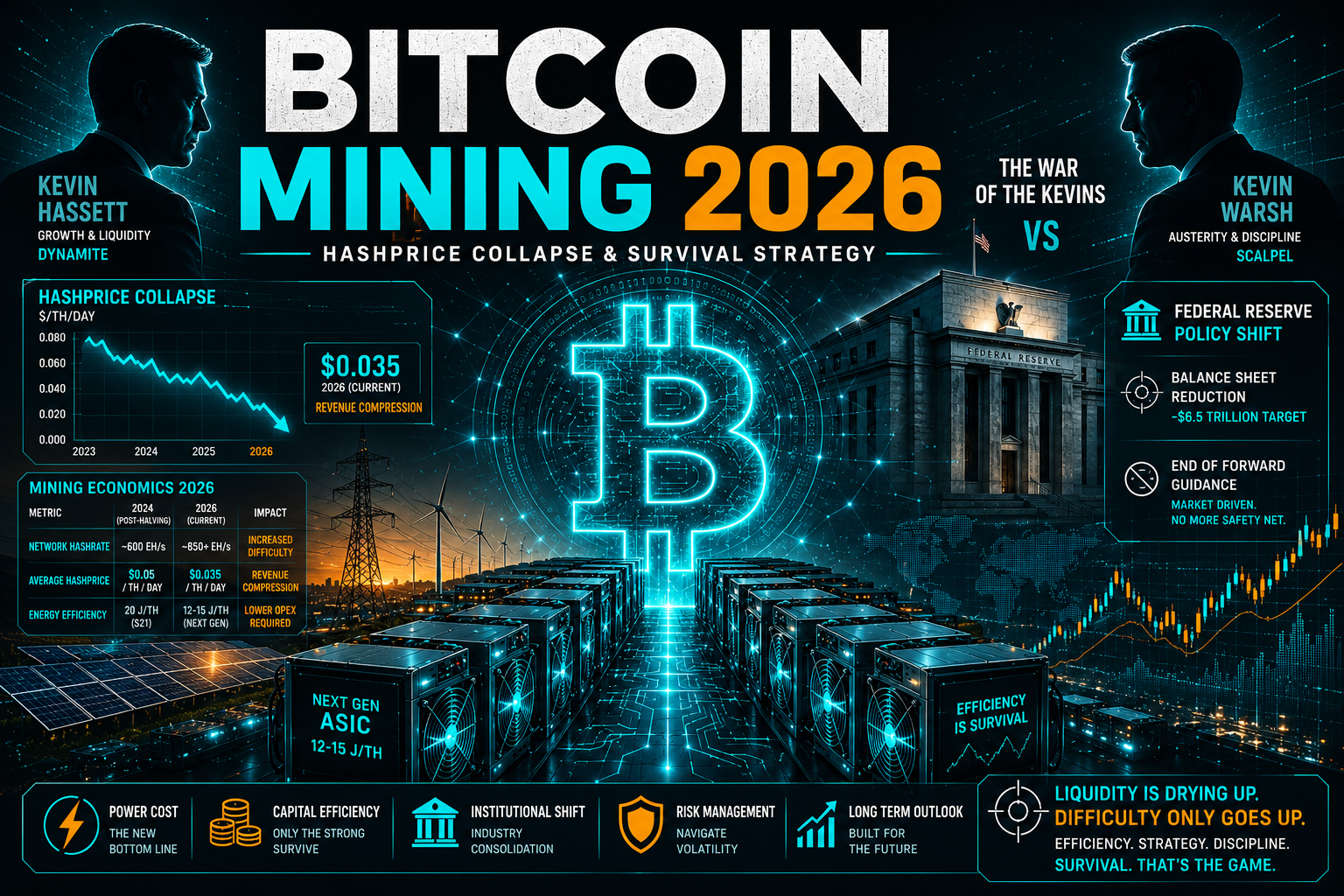
The transition from Powell to Warsh represents more than a change in leadership; it is a debate over the very nature of the U.S. Dollar. The selection process—the so-called "War of the Kevins"—pitted Kevin Hassett’s "dynamite" approach against Kevin Warsh’s "scalpel."
Kevin Hassett vs Kevin Warsh: Competing Visions for U.S. Monetary Policy
Kevin Hassett viewed Bitcoin and stablecoins as tools of American hegemony. His strategy leaned toward aggressive growth, lower real rates, and implicit currency debasement to favor U.S. exports. For Bitcoin, Hassett represented a "high-beta" tailwind fueled by M2 expansion.
How Federal Reserve Balance Sheet Reduction Impacts Bitcoin Liquidity
The victor, Warsh, views Bitcoin as a "thermometer of confidence" that disciplines central banks. However, his mandate is monetary austerity. By targeting a reduction in the Fed’s $6.5 trillion balance sheet and eliminating forward guidance, Warsh aims to restore market-driven price discovery.
The Analyst’s Take: While Warsh is "pro-Bitcoin" philosophically, his policy of sucking tighter global financial conditions are structurally bearish for BTC’s nominal price in the short term. Since 2014, the correlation between Bitcoin and global M2 growth has held at approximately 0.43, meaning liquidity alone explains over 50% of price action.
Bitcoin Mining Economics in 2026: Hashprice Compression, Difficulty Surge, and Revenue Decline
In 2026, the primary metric for any serious mining operation is Hashprice—the expected value of 1 TH/s of hashing power per day. Following the 2024 halving, we saw a brutal compression of hashprice as the block reward dropped to 3.125 BTC. In 2026, with the network difficulty at all-time highs, the "breakeven" has shifted significantly.
| Metric | 2024 (Post-Halving) | 2026 (Current) | Impact |
|---|---|---|---|
| Network Hashrate | ~600 EH/s | ~850+ EH/s | Increased Difficulty |
| Average Hashprice | $0.05 / TH / day | $0.035 / TH / day | Revenue Compression |
| Energy Efficiency | 20 J/TH (S21) | 12–15 J/TH (Next Generation) | Lower Operational Expenditure Required |
Profitability in 2026 is no longer about "number go up"; it is about operational efficiency (OpEx). High-cost miners (electricity > $0.07/kWh) are being flushed out, leading to a consolidation of the hashrate into the hands of publicly traded entities with access to low-cost debt and industrial-scale energy contracts.
Mining Investment Strategy in 2026: ASIC Hardware vs Spot Bitcoin vs Public Mining Stocks
For investors entering the space in 2026, the "Build vs. Buy" debate has evolved.
-
Scenario A: Purchasing Hardware (ASICs): This is a Long Volatility / Short USD play. Purchasing hardware today involves high Capital Expenditure (CapEx). If Bitcoin’s price drops toward the $40k–$50k range, hardware prices will deflate, offering a better entry point for those with sub-$0.04/kWh power.
-
Scenario B: Investing in Public Miners: Public miners act as a leveraged play on Bitcoin. In 2026, we look for companies with "fortress balance sheets"—those that held their 2024–2025 BTC production rather than selling into the dip.
-
Scenario C: Institutional ETF Flows: The advent of the BlackRock and Fidelity ETFs has "financialized" Bitcoin. We are now in a 30–50% volatility regime. For a capital allocator, spot BTC provides the cleanest exposure without the operational "headaches" of maintenance.
Bitcoin Mining Risks in 2026: Regulation, Energy Policy, and Hashrate Centralization
The Warsh era brings a specific type of risk: The removal of the "Fed Put." When the Fed stops telegraphing its moves, bond volatility rises. Because Bitcoin is a "pure" liquidity play, it is the first to feel the "tremors" of a tightening credit market.
-
Regulatory Capture: With the U.S. moving toward a strategic Bitcoin reserve framework, mining is being reclassified as "critical infrastructure." This brings the threat of "Green Mandates" or specific taxation on energy consumption.
-
Hashrate Centralization: The "arms race" for hardware creates a massive barrier to entry. Beginners should avoid "Cloud Mining" schemes, which remain high-risk in a compressed hashprice environment.
Long-Term Outlook for Bitcoin Mining: Energy Monetization and Digital Monetary Infrastructure
Despite the immediate "Warsh Chill" on liquidity, the structural case for Bitcoin mining remains robust. As Warsh himself noted, Bitcoin is a disciplinarian. It informs policymakers when they have over-extended.
In a world of persistent fiscal deficits, the debasement of the currency is a mathematical certainty, even if a hawk like Warsh attempts to slow the bleed. Mining is essentially a process of converting "undervalued energy" into "globally recognized collateral."
"Mining is the bridge between the physical world (energy/silicon) and the digital monetary world. In 2026, the most successful miners are those who treat their BTC not as a speculative windfall, but as a Tier-1 reserve asset."
2026 Bitcoin Mining Strategy: Survival, Efficiency, and Institutional Consolidation
The nomination of Kevin Warsh signifies a more "mature" but "volatile" phase for Bitcoin. While his intent is to strengthen the Dollar—which acts as a headwind for BTC price—the underlying demand for a non-sovereign, hard-capped asset continues to grow.
For the 2026 Investor:
-
Prioritize Efficiency: Only engage in physical mining if your all-in power cost is below $0.045/kWh.
-
Monitor M2: Watch the Fed’s balance sheet. If Warsh successfully reduces it by $1 trillion, expect "sideways-to-down" price action, providing a long-term accumulation window.
-
Embrace Volatility: A 30–40% drawdown is standard market behavior. For the institutional miner, these "stress tests" are where the competition is eliminated.
Final Verdict: Why Bitcoin Mining in 2026 Has Become a Survival Game Driven by Efficiency and Operational Power
Look at 2026 as the great shakeout. We’ve moved past the 'profit race' into a survival game where efficiency is the only currency that matters. Under the new monetary regime, liquidity is drying up, and miners are the ones feeling the heat through crushed hashprices and relentless difficulty spikes. The math is simple now: if you don’t have institutional scale and rock-bottom energy costs, you're on borrowed time. At the end of the day, 2026 isn't about hitting the jackpot—it’s about losing the least while the entire system recalibrates.
💡 Frequently Asked Questions (2026 Edition)
Q1: Is Bitcoin mining still profitable in 2026 with the current "Hashprice Collapse"?
The short answer: Only if you are an efficiency hawk. With the hashprice hitting a low of $0.035/TH/day, the era of "easy money" is officially over. Profitability now depends entirely on two factors: securing electricity below $0.045/kWh and utilizing next-gen hardware (12–15 J/TH). For retail miners with high overheads, the margins have practically evaporated, leaving the floor to industrial-scale operations that can weather the "squeeze."
Q2: How does the "War of the Kevins" and Kevin Warsh’s Fed policy affect BTC price?
It’s a tug-of-war between philosophy and liquidity. While Kevin Warsh views Bitcoin as a "confidence thermometer," his commitment to monetary austerity and balance sheet reduction is a double-edged sword. By sucking liquidity out of the system to save the Dollar, he creates a short-term "chill" that keeps BTC prices sideways or bearish. In 2026, Bitcoin is acting less like a speculative bubble and more like a disciplined asset reacting to the Fed's tightening grip.
Q3: What is the "breakeven" electricity cost for miners in the 2026 market?
The threshold has moved significantly lower. Post-2024 halving and amidst the 2026 difficulty surge, the "danger zone" is anything above $0.07/kWh. If your power costs are in this range, you are likely mining at a loss. To remain competitive in a landscape of 850+ EH/s network hashrate, successful firms are now pivoting toward energy arbitrage and direct integration with renewable grids to keep costs at or below the $0.04 mark.
Q4: Should I buy ASIC hardware or invest in Bitcoin ETFs in 2026?
It depends on your appetite for operational risk.
- ASIC Hardware: This is a high-conviction play. You are betting on your ability to manage hardware better than the market. It’s ideal if you have access to ultra-cheap power and want "virgin" BTC without counterparty risk.