Introduction
The H200 is no longer NVIDIA’s newest data center GPU. Blackwell and Blackwell Ultra have raised the bar, but the H200 still has a clear use: it gives AI teams 141GB of high-bandwidth memory, which can make room for models and workflows that strain smaller cards.
That extra memory is its main selling point. It does not make every task faster, and benchmark results show only modest gains over the H100 on some workloads. The choice comes down to what you need to run, how often you will use the GPU, and what each finished task will cost.
Independent benchmarks help show where the H200 fits. Its prospects in China add another factor, since sales there depend on export rules and purchasing decisions by Chinese companies.
NVIDIA H200 GPU Specifications: 141GB HBM3e Memory and AI Workloads
The H200 is part of NVIDIA’s Hopper generation. It uses HBM3e memory, with 141GB of capacity and 4.8TB/s of bandwidth. The H100 SXM has 80GB of HBM3 memory and about 3.35TB/s of bandwidth.
That larger memory pool can accommodate bigger model weights, longer context caches, or more supporting components. In some cases, a model that fits on one H200 would need to be split across several smaller GPUs. Keeping it on one card can make deployment simpler.
But memory capacity is not the same as speed. If a workload already fits comfortably on an H100 or a consumer GPU, the H200’s extra memory may not be worth the higher rental or purchase price. It matters most when memory is the part holding the workload back.
NVIDIA H200 AI Benchmarks: LLM Inference, Image Generation and 3D Performance
GPU Battle’s H200 database lists 208 workload results: 152 measured on its test systems and 56 estimated. The measured tests cover language models, image and video generation, 3D creation, audio, and AI training and serving.
| AI workload | H200 measured performance |
|---|---|
| Llama 3.1 8B | 268.31 tokens/sec |
| Qwen3 32B | 76.58 tokens/sec |
| Llama 3.3 70B | 42.66 tokens/sec |
| Stable Diffusion XL | 37.16 images/min |
| FLUX.1 dev | 9.51 images/min |
| Wan 2.2 5B (720p) | 1.41 frames/sec |
| TRELLIS.2 Image-to-3D | 90.1 assets/hour |
Source: GPU Battle, NVIDIA H200 benchmark database, accessed October 29, 2026. These are results for individual tests, not guaranteed production speeds.
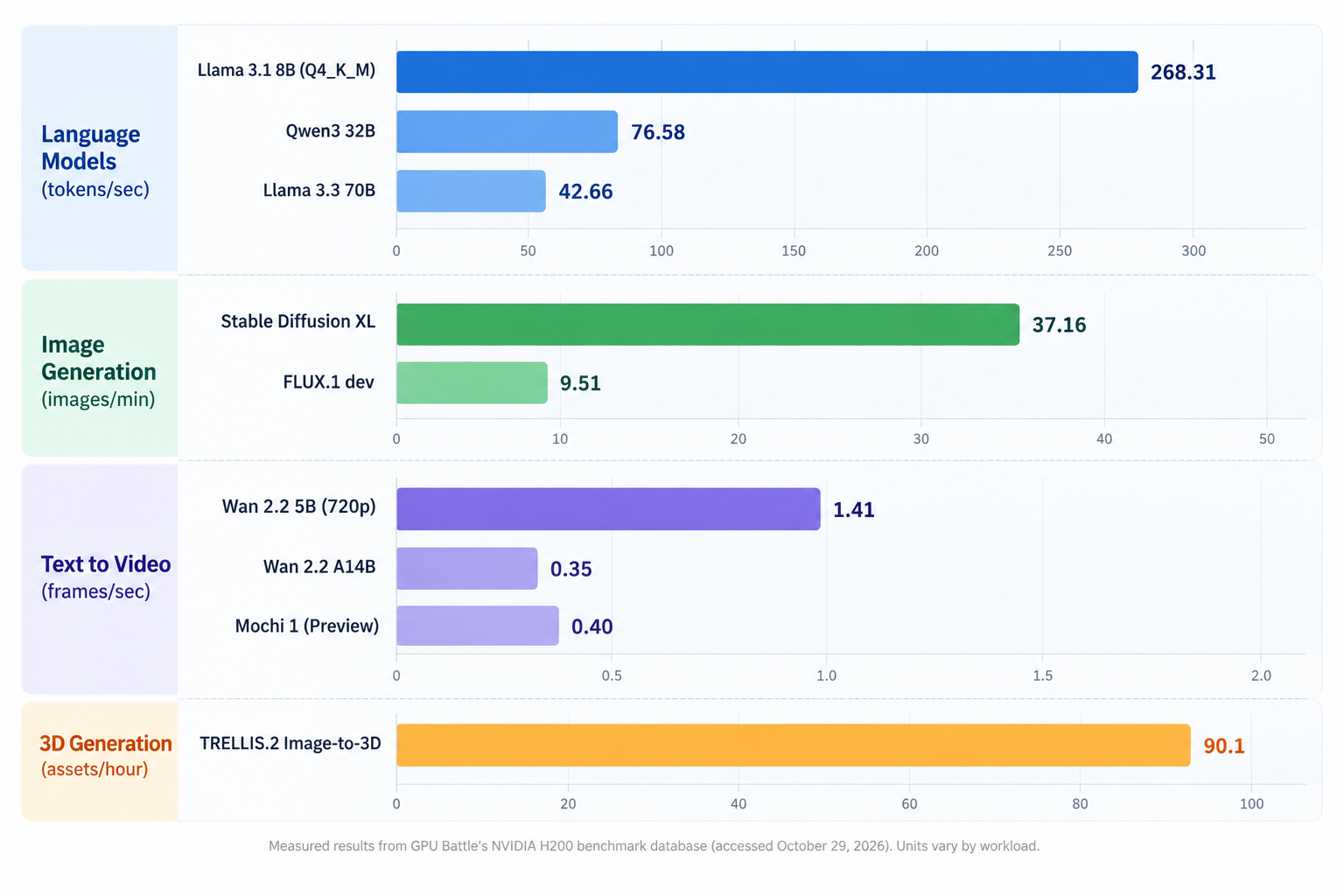
The numbers use different units because the jobs are different. Tokens per second, images per minute, and video frames per second cannot be combined into one fair score. Even two image models may run at very different rates because their design and generation settings differ.
For cloud customers, the useful comparison is how quickly a GPU completes the work they actually need to run.
NVIDIA H200 vs H100 for LLM Inference: Llama 3.1, Llama 3.3 70B and Qwen3
In GPU Battle’s test, the H200 produced about 268 tokens per second with Llama 3.1 8B. The H100 scored about 262, a difference of roughly 2.5%. For Llama 3.3 70B, the H200 reached 42.66 tokens per second, compared with about 41 on the H100.
If a model fits in 80GB and already runs fast enough, those gains may not justify paying more for an H200. The larger memory pool becomes useful with bigger models, longer contexts, more KV-cache capacity, or several models kept available at once.
A company might, for example, keep separate models ready for coding, document analysis, and response checking. Whether they fit depends on quantization, context length, concurrent requests, and serving software. The H200’s advantage is that it can make these larger setups possible on one GPU; it does not make every model dramatically faster.
NVIDIA H200 Benchmarks for Stable Diffusion XL, FLUX.1, Wan 2.2 and 3D Generation
GPU Battle measured 37.16 images per minute on Stable Diffusion XL and about 9.51 on FLUX.1 dev. The gap reflects the models’ different compute demands, rather than a change in the GPU.
Video generation is heavier still. Wan 2.2 5B at 720p reached 1.41 frames per second in the test, while the larger Wan 2.2 A14B text-to-video workload reached about 0.35. These rates can help estimate GPU time for a clip, but total production time also depends on resolution, frame count, setup, and work outside the generation step.
In TRELLIS.2 image-to-3D, the H200 produced 90.1 assets per hour—about 40 seconds per asset in a warmed-up test. That could help studios estimate batch capacity for game assets or product previews. The H100 reached 87.9 assets per hour in the same test, so the H200’s lead was only around 2.5%.
That result makes the trade-off clear: more memory can open up larger workflows, but it does not always mean much more output.
NVIDIA H200 Cloud Rental Cost in 2026: Is $3.59 per Hour Worth It?
GPU Battle listed an H200 rental rate of $3.59 per hour on October 29, 2026, based on the cloud offers it tracks. At that rate, the GPU time would cost:
| Rental period | GPU rental cost |
|---|---|
| 1 hour | $3.59 |
| 8 hours | $28.72 |
| 24 hours | $86.16 |
| 30 days, continuous | $2,584.80 |
This assumes the rate stays available. Storage, networking, startup time, extra services, and idle time can raise the bill.
It is more useful to look at cost per completed job. At 90.1 TRELLIS.2 assets per hour, the benchmark rate works out to roughly $0.04 of GPU rental per asset. Stable Diffusion XL’s 37.16 images per minute is about 2,230 images an hour, or approximately $0.0016 of GPU rental per image.
Those are rough capacity estimates. They assume sustained benchmark throughput and leave out the rest of the production pipeline. A cheaper GPU that completes the same work at a lower total cost may be the better choice, even if it is slower per hour.
NVIDIA H100 vs H200 vs B300: GPU Memory, Performance and AI Use Cases
| GPU | Memory capacity | Main consideration |
|---|---|---|
| NVIDIA H100 SXM | 80GB | Works for tasks that fit in its memory |
| NVIDIA H200 SXM | 141GB | More room for large models and memory-heavy work |
| NVIDIA B300 | Up to 288GB in DGX configurations | Newer architecture and more capacity for demanding deployments |
The H100 remains a sensible option when the workload fits and its rental rate is lower. The H200 is a step up for teams that need more memory but do not need to move to a newer system. The B300 targets larger deployments and offers more capacity, though individual applications will not necessarily run proportionally faster.
Model choice, precision, software, batching, and memory use all affect results. Compare the same workload on each GPU before deciding; advertised specifications alone do not settle the question.
NVIDIA H200 China Export Restrictions in 2026: Licenses, Shipments and Market Impact
The H200’s commercial prospects are also tied to the debate over access to advanced AI chips. U.S. export restrictions complicated NVIDIA’s sales of its most capable accelerators in China, while Chinese companies turned more attention to domestic alternatives.
In 2026, Washington began granting licenses for some Chinese customers to buy H200s under specific conditions. Reuters reported in May that about ten companies, including Alibaba, Tencent, and ByteDance, had received approvals, though shipments had not started at that point.
The picture shifted later in the year. In July, a senior U.S. official confirmed that a small number of shipments had begun. NVIDIA later reported limited shipments to China and said Chinese government restrictions prevented sales of all products covered by its licenses.
That uncertainty makes long-term planning harder for Chinese buyers: future orders and deliveries may depend on changing rules. It also gives Beijing a reason to support local chipmakers. NVIDIA, meanwhile, has to navigate U.S. export controls while trying to keep a foothold in the market.
Who Should Rent an NVIDIA H200 GPU for AI Inference and Large Language Models?
The H200 is best suited to users who can put its 141GB memory to work. That may include teams serving 70-billion-parameter models, running several AI services, testing larger inference workloads, or generating demanding visual content.
Renting can give smaller companies access to data center hardware without the expense of buying and maintaining a server. Still, an H100 or a capable consumer GPU may deliver similar practical results for smaller models at a lower cost. Larger, more demanding deployments may justify a B300 or another newer accelerator.
Before choosing, check the workload’s memory needs, measured throughput, expected usage, and total cost of operation.
Final Assessment
The H200 remains capable even as newer GPUs take the lead. Its 141GB of HBM3e memory makes it a good fit for workloads that are hard to run on smaller cards, and the benchmark results show it handling language, image, video, and 3D tasks well.
Its speed advantage over the H100 is modest in several tests. For those workloads, the H200’s value comes from fitting a larger configuration on one GPU, rather than producing a dramatic jump in output. Its sales in China also remain subject to policy and market uncertainty.
For companies renting GPUs in 2026, the practical question is which card finishes the job at the lowest total cost. A well-used, affordable GPU can be a better investment than a faster one whose extra capacity sits idle.