Cooling Challenges in Space-Based Data Centers
On Earth, cooling computers is relatively straightforward. Fans move air across hot components, carrying heat away from the processor and allowing the system to maintain a safe operating temperature. Once the same idea is taken into space, however, that familiar cooling mechanism disappears.
This is one of the major engineering challenges facing the future of space-based data centers.
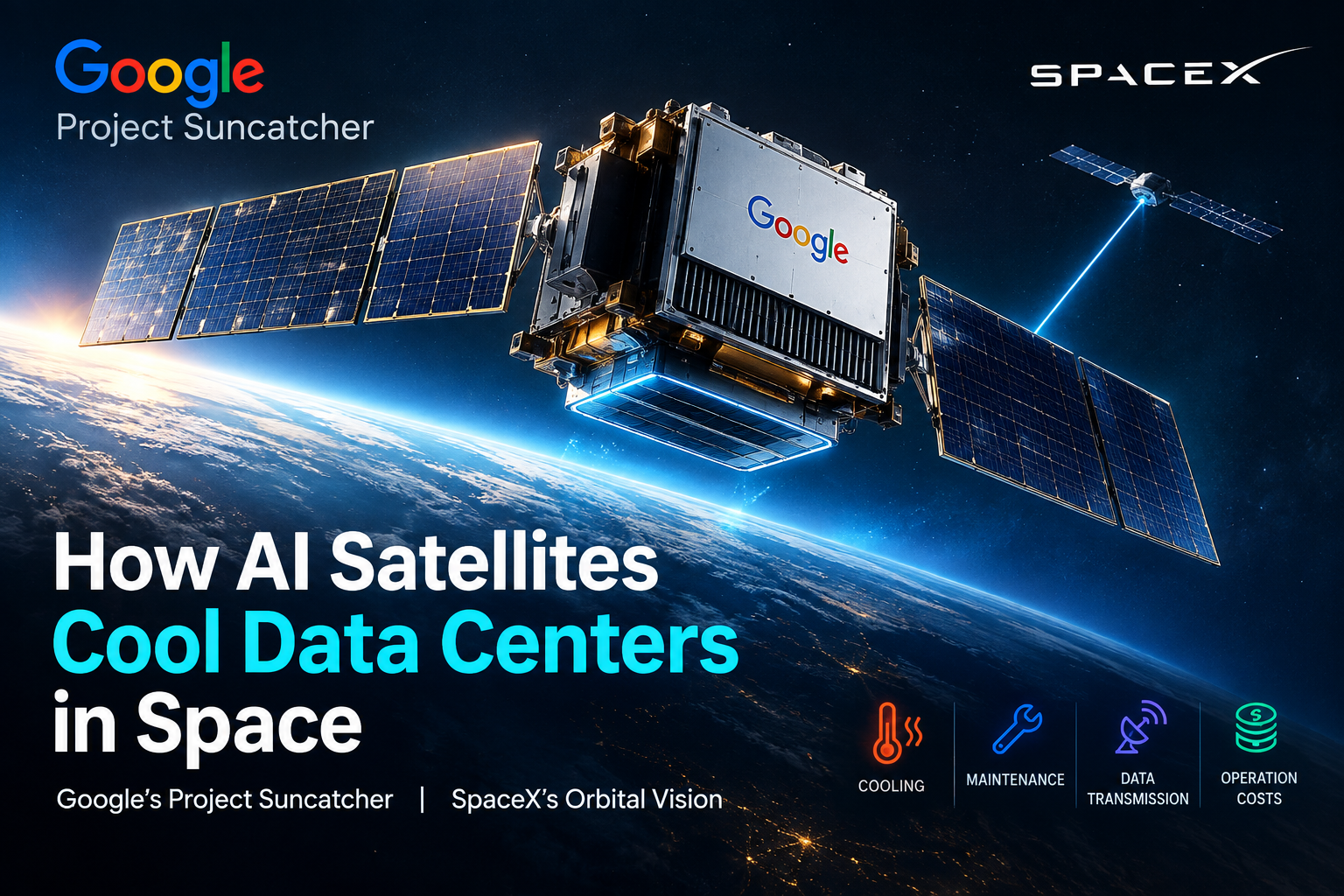
Google is already exploring the concept through Project Suncatcher, which the company announced on November 4, 2025. The project is designed to investigate whether large-scale computing infrastructure could operate in orbit, using solar-powered satellites equipped with Google's Tensor Processing Units (TPUs) and connected through high-speed optical communication links.
But putting a powerful AI processor inside a satellite creates a problem that does not exist in quite the same way on Earth:
How do you get rid of the heat?
In space, there is no surrounding air for a fan to push through the hardware. A conventional cooling fan therefore has little practical use in a vacuum. It cannot simply move hot air away from the processor and replace it with cooler air.
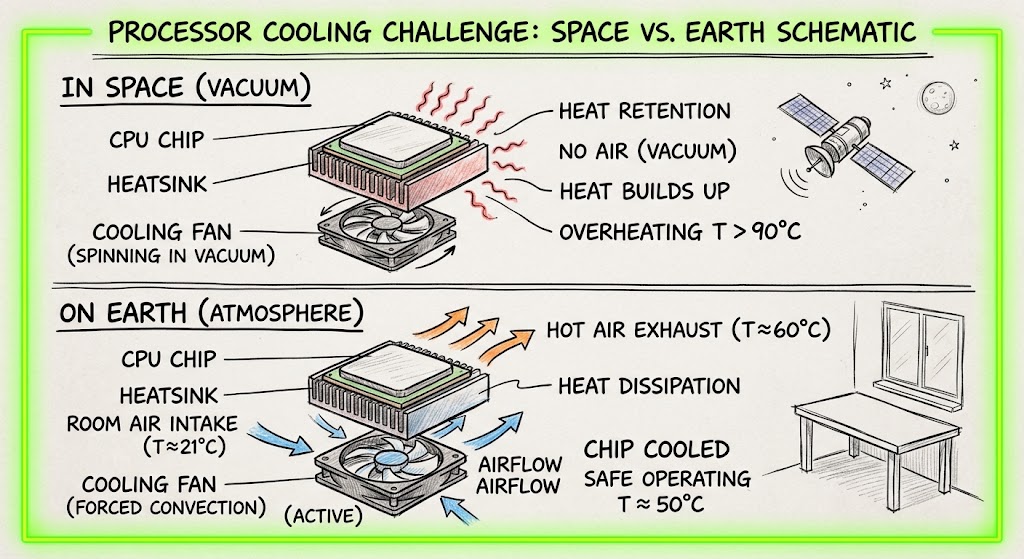
Instead, spacecraft have to move heat away from the processor and then dispose of it through thermal radiation.
The process begins at the processor itself. A thermal interface material connects the TPU to the thermal management system, allowing heat to transfer efficiently from the chip into dedicated aluminum and copper heat pipes, which route it toward specialized cooling hardware. From there, the heat spreads across high-surface-area radiators where the heat is radiated directly into the vacuum of space.
These panels do not need cold air.
They radiate thermal energy directly into space in the form of electromagnetic radiation, primarily infrared radiation. In this way, heat trapped inside the electronics is converted into radiation that can leave the spacecraft and travel into the surrounding environment.
The problem is that this process is neither as fast nor as simple as it might sound.
A radiator needs enough surface area to release the required amount of heat. Its design and orientation also matter because the spacecraft itself is exposed to sunlight and other sources of thermal energy. When high-power AI processors are involved, managing every watt of heat becomes a fundamental part of the spacecraft's design.
That is one reason the testing behind Google's Project Suncatcher matters. The goal is not simply to demonstrate that TPU processors can operate in space. Google also needs to understand whether a system built around Heat Pipes + Radiators can realistically handle the thermal output produced by AI processors in orbit. According to reporting from Ars Technica, the TPUs on the experimental satellite are expected to operate for roughly 15 minutes before being shut down to allow the system to cool, making thermal management one of the key issues the orbital tests are intended to examine.
But cooling is only part of the problem.
There is also maintenance.
On Earth, if a server fails inside a data center, a technician can reach it within hours or even minutes. A processor, power supply, cooling component, or server can be replaced relatively quickly. In orbit, a satellite is effectively a remote, difficult-to-access piece of hardware.
That becomes particularly important in AI computing because processors are evolving so quickly. A chip installed in a satellite today could become considerably less efficient than a newer generation only a few years later. On Earth, data centers can gradually replace and upgrade their servers. Replacing hardware in orbit, however, means sending new equipment into space.
This is where the idea of a constellation becomes important.
Instead of funneling all your resources into one giant, monolithic orbital data center, spreading that compute load across a constellation of smaller satellites creates a much tougher, more fault-tolerant network. If a single unit kicks the bucket, the rest of the cluster keeps right on ticking.
Sure, you still have to deal with the logistics and price tag of launching replacement hardware when things fail, but ditching the single point of failure makes the whole architecture vastly more resilient.
This brings us to another, even more ambitious project associated with Elon Musk and SpaceX.
On October 31, 2025, Musk responded on X to a discussion about building data centers in space. He said that expanding Starlink V3 satellites, which feature high-speed laser links, could provide the basis for orbital data centers, adding that SpaceX would pursue the idea.
The concept later became more clearly defined through what SpaceX has described as the SpaceX Orbital Data Center System—a vision for a massive network of orbital computing units that could communicate with one another through high-speed optical links and use the broader Starlink network to connect with Earth. Reports in 2026 described SpaceX plans involving numbers potentially reaching one million orbital units.
The basic idea behind these projects is similar: instead of keeping all AI computing infrastructure on Earth, part of the processing capacity could be placed in orbit, where solar energy is readily available for long periods and computing systems could process data before sending the results back to Earth.
But data transmission itself creates another challenge—and another cost.
An orbital data center does not operate in isolation. The information still has to reach users and ground-based infrastructure. That means the constellation needs high-bandwidth links between satellites, as well as connections between satellites and ground stations.
Google's Project Suncatcher is built around Free-Space Optical Links, using laser-based communication between satellites. The technology has the potential to provide very high bandwidth without relying solely on conventional radio-frequency links. Google has also planned further satellite testing to study high-bandwidth optical communication between orbital platforms.
And this is where the economics become more complicated.
Space offers an enormous supply of solar energy and, in theory, a promising environment for expanding computing capacity. But it also introduces costs that a conventional terrestrial data center does not face: launches, spacecraft manufacturing, radiator systems, radiation protection, communications, orbital control, hardware replacement, and maintenance from the ground.
Industry analysis has identified launch costs as one of the major obstacles to turning orbital data centers into large-scale commercial infrastructure. Hardware replacement is another important consideration, particularly in AI because processor generations are advancing so rapidly.
So the real question is not simply:
Can an AI processor operate in space?
Google is already testing that possibility.
The harder question is:
Can an entire data center be built in space and operated at a lower cost—or with greater scalability—than a data center on Earth?
That answer is still unresolved.
Project Suncatcher remains an engineering research and testing effort, rather than a commercial space data center already operating at scale. SpaceX's concept likewise depends on advances in launch capacity, optical communications, satellite manufacturing, and the economics of producing and deploying very large constellations.
But the direction of travel is becoming increasingly clear. As demand for AI computing continues to grow, technology and space companies are beginning to look at orbit not simply as a place to deploy satellites, but as a possible location for the computing infrastructure itself.
In that future, a data center may no longer mean a building packed with servers on the ground. It could instead mean a constellation of satellites collecting solar energy, processing data, exchanging information through laser links, and sending the results back to Earth.
The biggest challenge is turning that vision into a practical industry. Three problems will have to be addressed at the same time: managing heat in a vacuum, maintaining and upgrading hardware in orbit, and bringing launch and communications costs down far enough to make space-based computing economically competitive with terrestrial data centers.
Could Bitcoin Mining Move Into Space?
And what about Bitcoin mining? As mining difficulty and electricity costs continue to rise on Earth, could solving the cooling challenge make space-based Bitcoin mining an option worth exploring for companies looking for cheaper energy and more efficient infrastructure?
Source: Ars Technica — “Google’s first Suncatcher orbital data center test launches October 1”
Source for the approximately 15-minute TPU operating window and the required shutdown period for cooling.
Read the full source: Ars Technica