Introduction
Let’s face it: smart tech and computers have completely flipped our daily world upside down. Whether it’s those chat tools that write essays for you, giant cloud setups, or complex science labs running massive number-crunching tests, it all relies on one main hero: the GPU.
And when you look at who’s actually running the show, NVIDIA is pretty much leading the pack. They've totally captured the market by building seriously powerful chips, pairing them with the right software, and supplying the heavy-duty hardware that makes modern data centers tick.
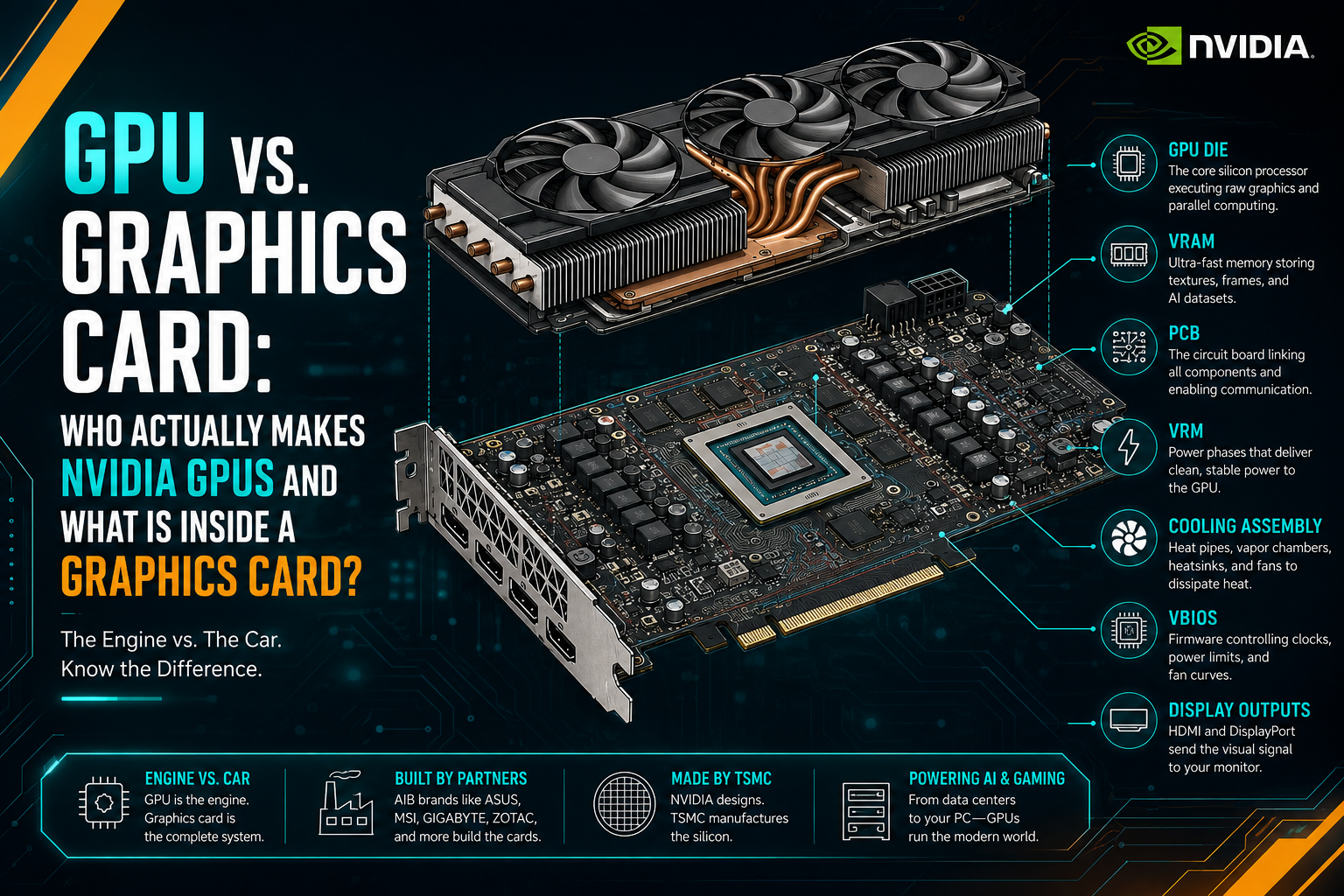
However, people constantly confuse two fundamental terms: a GPU is not the same thing as a graphics card. They get used interchangeably in everyday tech talk, but the GPU is merely the processing chip itself. The graphics card is the entire physical board that houses that chip alongside memory, power modules, fans, and display ports.
GPU vs. Graphics Card: The Engine vs. The Car
The easiest way to picture the difference is to think of a vehicle: the GPU is the engine, while the graphics card is the complete car—including the transmission, cooling radiator, electrical wiring, chassis, and exhaust.
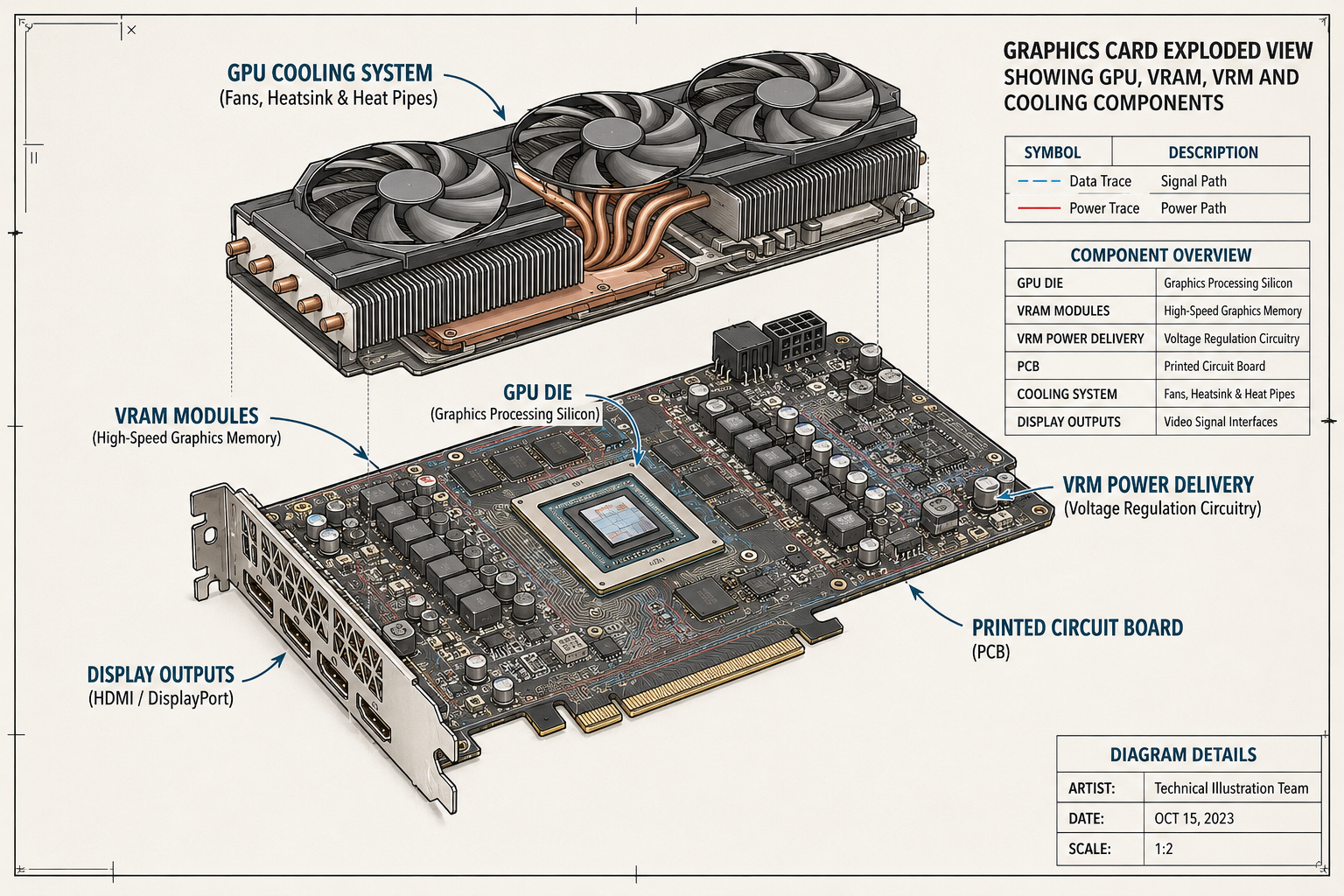
A modern GPU die is a microscopic silicon wafer packed with billions of transistors grouped into specialized cores (like Tensor Cores for AI and RT Cores for ray tracing). But on its own, a bare GPU chip can't render a single pixel onto your monitor. It requires an entire supporting ecosystem on the card to function:
| Component | Primary Function Inside the Graphics Card |
|---|---|
| GPU Die | The core silicon processor responsible for graphics rendering and parallel computing workloads. |
| VRAM (Video Memory) | High-speed onboard memory that stores textures, frame buffers, and other data for fast GPU access. |
| PCB (Printed Circuit Board) | The circuit board that electrically connects the GPU, memory, power delivery, and other components. |
| VRM (Voltage Regulator Module) | Converts and regulates power from the PSU into the precise voltages required by the GPU and memory. |
| Cooling Assembly | Uses heatsinks, heat pipes or vapor chambers, and fans to dissipate heat generated by the GPU and other components. |
| VBIOS (Video BIOS) | Embedded firmware that initializes the graphics card and manages hardware-level settings and operating parameters. |
| Display Outputs | Physical interfaces such as HDMI and DisplayPort that send processed video signals to connected displays. |
This distinction is why buying an "RTX 5090" from a brand like GIGABYTE means you are purchasing a complete graphics card built around an NVIDIA GPU, rather than raw silicon directly from NVIDIA.
Who Actually Builds Your NVIDIA Graphics Card?
NVIDIA designs the overarching chip architectures and software ecosystems, but it doesn't physically assemble every consumer gaming card on store shelves. For its GeForce lineup, NVIDIA relies on Add-In Board (AIB) partners. Companies like ASUS, MSI, GIGABYTE, ZOTAC, PNY, and Colorful buy raw GPU chips from NVIDIA and engineer custom graphics cards around them.
Here’s the wild thing: even if two different brands grab the exact same NVIDIA chip, the final card you pull out of the box can feel like a totally different beast. That’s because manufacturers put their own spin on everything surrounding that chip:
-
The Power Setup: They redesign the internal circuit boards and power delivery systems to feed the chip cleaner electricity, which is a lifesaver if you're trying to push things to the limit.
-
The Cooling Gear: Some brands go all-out with massive chunks of copper, high-tech vapor chambers, and custom fan designs just to keep the whole thing from melting under pressure.
-
The Noise Level: How they program the fans changes everything—some cards stay whisper-quiet no matter what you throw at them, while others roar like a mini jet engine when you're really pushing them.
-
Out-of-the-Box Speed Bumps: Most of them will crank up the speeds just a bit right out of the factory, giving you a free performance kick without you having to mess with any settings yourself.
Who Fabricates the NVIDIA Silicon Chip?
NVIDIA doesn't actually forge its own physical silicon chips either. NVIDIA is a fabless semiconductor company—meaning it handles digital design, research, and software development, but leaves physical manufacturing to specialized chip foundries.
NVIDIA’s primary manufacturing foundry is TSMC (Taiwan Semiconductor Manufacturing Company). TSMC takes NVIDIA's digital blueprints and prints them onto silicon wafers using ultra-precise photolithography and etching processes. (Notably, production for next-gen architectures like Blackwell also spans TSMC's advanced fab facilities in Phoenix, Arizona).
Further upstream, Dutch tech powerhouse ASML builds the extreme ultraviolet (EUV) lithography machines that foundries like TSMC require to etch microscopic circuit patterns onto silicon wafers in the first place.
What About AI Data Centers?
In enterprise environments, hardware looks totally different from consumer gaming rigs. Data centers rarely use standard PCIe graphics cards with consumer fan shrouds. Instead, enterprise AI workloads rely on heavy-duty accelerators—such as NVIDIA H100, H200, or B200 SXM modules—integrated directly onto custom server boards, tied together with high-speed NVLink interconnects, and cooled via complex liquid-cooling systems. In this space, NVIDIA supplies fully co-engineered, rack-scale computing platforms.
Major Manufacturers of NVIDIA GeForce Cards
When shopping for a consumer graphics card, your choice of AIB partner shapes your daily experience with noise, thermals, and aesthetics:
| Manufacturer | Where It's Based | What They're Known For |
|---|---|---|
| ASUS | Taiwan | Known for premium build quality, advanced cooling solutions, and popular product lines such as ROG Strix and TUF Gaming. |
| MSI | Taiwan | Offers a wide range of graphics cards with a strong focus on cooling, acoustics, and product lines such as Gaming X and SUPRIM. |
| GIGABYTE | Taiwan | Provides products across multiple price tiers, including AORUS models and cards featuring WINDFORCE cooling technology. |
| ZOTAC | Hong Kong | Known for compact graphics card designs, including small-form-factor models, alongside mainstream and high-performance options. |
| PNY | United States | Offers both consumer and professional graphics solutions, with a strong presence in enterprise and workstation markets. |
| Palit | Hong Kong | One of the world's major graphics card manufacturers, offering GeForce models across different performance and price categories. |
| Gainward | Europe / Palit Group | A GeForce graphics card brand operating under the Palit Microsystems group and particularly well known in European markets. |
| Colorful | China | Known for distinctive graphics card designs, specialized cooling solutions, and a strong presence in Asian markets. |
Understanding the Difference Matters
Separating the GPU die from the surrounding graphics card architecture is essential for making smart buying decisions. In upcoming hardware deep-dives, we will look beyond theoretical specs to compare real-world cards from both NVIDIA and AMD analyzing power phases, thermals, acoustic profiles, and benchmark numbers to pinpoint which custom build delivers the best overall performance and value.
Sources
- Branch Education YouTube Channel — Educational reference on how GPUs and graphics cards work.
- NVIDIA Official Website — Official information on NVIDIA GPUs, graphics cards, and AI hardware.