Introduction
AI inference is becoming one of the biggest workloads in modern data centers. As language models become larger and more capable, running them efficiently is no longer simply a question of installing a powerful GPU and launching a model. Memory capacity, GPU-to-GPU communication, cooling, power delivery, and software optimization all become critical.
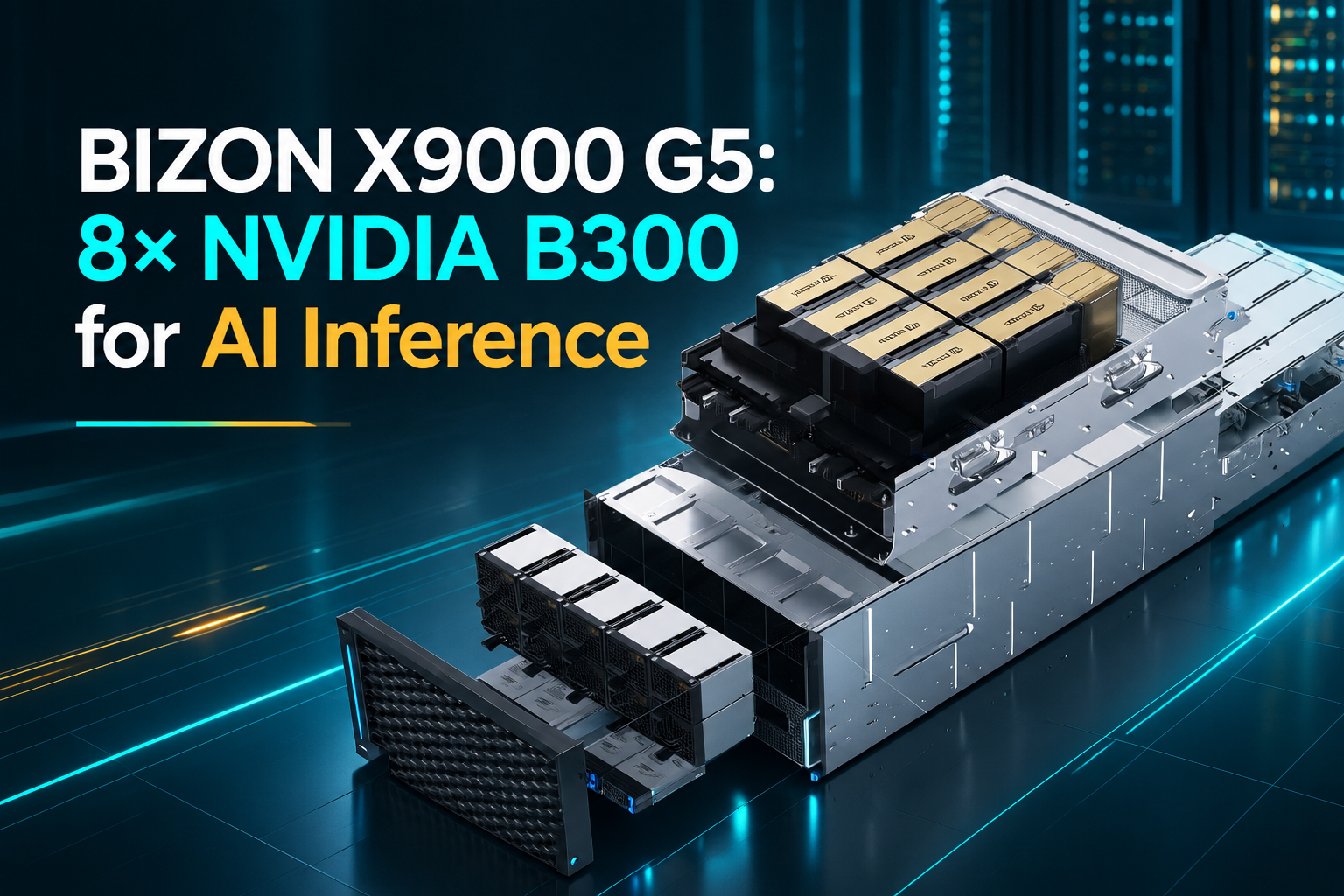
The BIZON X9000 G5 is designed for exactly this type of environment. Built around NVIDIA's HGX B300 platform, the system combines eight high-end Blackwell GPUs in a single 5U chassis, creating a machine aimed at large-scale AI inference rather than conventional workstation use.
We looked at the system from the perspective of what matters to an AI company: how much model capacity it can handle, how it behaves under concurrent workloads, how demanding the cooling system is, and whether a single server can realistically replace several smaller GPU machines.
BIZON X9000 G5 Specs: 5U Chassis with 8x NVIDIA B300 (2,240GB VRAM)
At first glance, the X9000 G5 looks more like a small data-center rack than a traditional GPU workstation.
The system uses a 5U chassis because there is simply a lot of hardware inside. Eight NVIDIA B300 GPUs sit at the heart of the machine, supported by powerful CPUs, large system memory, NVMe storage, high-speed networking, and a substantial cooling system.
One published configuration used two 128-core Intel Xeon processors and 2TB of system memory. That amount of RAM might appear excessive for a normal server, but large AI workloads can consume enormous amounts of memory once model weights, KV cache, operating-system requirements, and supporting services are taken into account.
The B300 GPUs are particularly important because each accelerator provides approximately 280GB of GPU memory in the configuration discussed in testing.
With eight accelerators working together, the available GPU memory becomes large enough for models that would be difficult or impossible to operate on conventional high-end workstations.
NVIDIA HGX B300 Interconnects: Tensor Parallelism for Multi-GPU Inference
For AI inference, having eight GPUs is not simply about getting eight times the performance.
Large language models often need to be distributed across multiple accelerators. Tensor parallelism allows the workload to be divided between GPUs, while high-speed GPU interconnects allow those accelerators to communicate efficiently.
This is where an HGX platform becomes considerably more interesting than a collection of consumer GPUs.
A server such as the X9000 can host a large model inside one tightly integrated system while allowing multiple users to access it simultaneously.
This is particularly useful for companies running internal AI assistants, coding tools, document-processing systems, research models, or commercial inference APIs.
Instead of giving every employee or application its own GPU, the company can operate a centralized model and share its capacity.
Concurrency Benchmarks: Tokens Per Second Performance Across 1 to 64 Users
The most interesting way to evaluate a server like this is not to run a single prompt and report the fastest possible number.
A real inference server may have dozens of users sending requests at the same time.
For that reason, published testing of the X9000 increased the workload progressively, beginning with a single user and then moving toward dozens of concurrent users.
With one user, the tested system produced roughly 100 tokens per second in the workload used by the test. GPU utilization reached very high levels while the system was actively generating responses.
As more users were added, total throughput increased, although the number of tokens available to each individual user naturally declined.
At around 32 simultaneous users, the published test reported approximately 2,059 tokens per second of aggregate throughput, or roughly 64 tokens per second per user.
At 64 users, aggregate throughput increased to approximately 3,000 tokens per second, while individual-user throughput dropped to around 48 tokens per second.
These numbers are more useful than a single peak benchmark because they demonstrate how the server behaves as demand increases.
Single-User Latency vs. Concurrent User Throughput in Enterprise AI
This distinction is important when evaluating AI hardware.
A machine producing extremely high tokens-per-second numbers for one user might not necessarily be the best solution for an enterprise.
Imagine a company with 50 employees using an internal AI assistant throughout the day. The important question is not simply:
"How fast can one person generate text?"
The better question is:
"How many people can use the system at the same time while maintaining an acceptable response rate?"
That is where a system such as the X9000 starts to make sense.
At higher concurrency, individual performance falls, but total throughput rises. The server is effectively sharing its enormous computing resources between many requests.
For an inference provider, this can be much more valuable than maximizing single-user performance.
Deploying 100B+ MoE Models: Llama, Qwen & DeepSeek on 280GB VRAM GPUs
The B300 platform becomes particularly interesting when running large models such as Llama, Qwen, DeepSeek, and other mixture-of-experts or high-parameter models.
Modern open models can require hundreds of gigabytes of memory depending on their size, precision, quantization method, and context requirements.
Once a model becomes too large for one GPU, the deployment becomes a multi-GPU problem.
The eight-B300 configuration provides the memory and interconnect required for this type of workload.
It also gives operators more flexibility. A company does not have to restrict itself to smaller quantized models simply because its hardware cannot hold a larger model.
Of course, having enough VRAM does not automatically guarantee good performance. The software stack remains extremely important.
vLLM Framework Optimization: PagedAttention, Batching & GPU Utilization
Modern AI servers are heavily dependent on inference software.
Frameworks such as vLLM can distribute model execution across multiple GPUs and optimize request scheduling, batching, memory management, and token generation.
This becomes increasingly important as concurrency rises.
A poorly configured software stack can leave expensive GPUs underutilized, while a properly optimized deployment can extract considerably more performance from the same hardware.
This is also why benchmark results should always be read alongside information about the model, quantization, context length, batch size, concurrency, software version, and GPU configuration.
A B300 server does not have one universal tokens-per-second figure.
Its performance depends on what you ask it to do.
5U Airflow Architecture & B300 Thermal Management (50°C to 75°C Under Load)
Eight high-performance GPUs generate an enormous amount of heat.
The X9000 therefore uses a large 5U chassis with substantial heatsinks and a high-airflow cooling design. The physical layout separates the GPU area from the CPU and memory section, while large fans move air through the system.
Published testing showed GPU temperatures in the low-50°C range during lighter portions of the workload, with longer and heavier runs reaching the mid-70°C range.
Those results are encouraging, but they should not be interpreted as a guarantee for every installation.
Ambient temperature matters enormously.
A server operating inside a properly cooled data center has a completely different thermal environment from one installed in a hot equipment room during summer.
For operators in warmer climates, cooling capacity should therefore be considered part of the total cost of ownership rather than an afterthought.
BIZON X9000 G5 Power Draw & TCO Analysis: 600W Per GPU Scaling
Power is another major consideration.
During the published inference testing, GPU power consumption was reported at roughly 596W under one of the workloads, with consumption increasing as the number of concurrent users increased.
For an eight-GPU server, even relatively small changes in per-GPU consumption become significant at the rack level.
Operators should therefore consider not only the purchase price of the server but also electricity, cooling, rack capacity, power distribution, and networking.
For a company operating AI inference continuously, electricity can become a substantial operating expense.
The good news is that high utilization can also improve the economics of the hardware. If the GPUs spend most of their time serving paying customers or productive internal workloads, the cost of the infrastructure can be spread across a much larger amount of useful compute.
Enterprise Deployment Scenarios: Private LLM APIs & Internal AI Assistants
The X9000 G5 is clearly not aimed at someone who wants to experiment with AI occasionally.
It is designed for organizations that need serious inference capacity in a compact form factor.
Its combination of eight B300 GPUs, large GPU memory, powerful CPUs, extensive system RAM, high-speed interconnects, and enterprise-class cooling makes it a very different proposition from a conventional desktop AI workstation.
The most impressive aspect is not necessarily the peak benchmark number.
It is the ability to run large models while simultaneously serving multiple users.
That makes the platform particularly interesting for AI startups, model developers, research organizations, private inference platforms, and companies that want to keep sensitive AI workloads inside their own infrastructure.
Final Verdict: Evaluating BIZON X9000 G5 for Large-Scale AI Inference
The BIZON X9000 G5 demonstrates how quickly AI infrastructure is moving beyond the traditional concept of a GPU server.
With eight NVIDIA B300 accelerators inside a single 5U system, the machine provides the memory, networking, and compute resources required for demanding inference workloads.
Published testing shows that the platform can maintain substantial throughput as concurrency increases, while independent B300 testing demonstrates how much performance can vary depending on the model and software configuration.
That is perhaps the most important lesson.
There is no single benchmark that tells the whole story of an AI server.
For buyers, the better approach is to test the models they actually intend to deploy, measure performance at realistic concurrency levels, and account for power and cooling alongside raw tokens per second.
For large-scale inference, however, the X9000 G5 is an impressive example of what an eight-B300 architecture can deliver from a single server.