Introduction
Bitcoin mining looks very different when BTC is trading above $80,000. The higher price can make mining revenue look attractive, but it does not automatically turn every ASIC into a profitable machine.
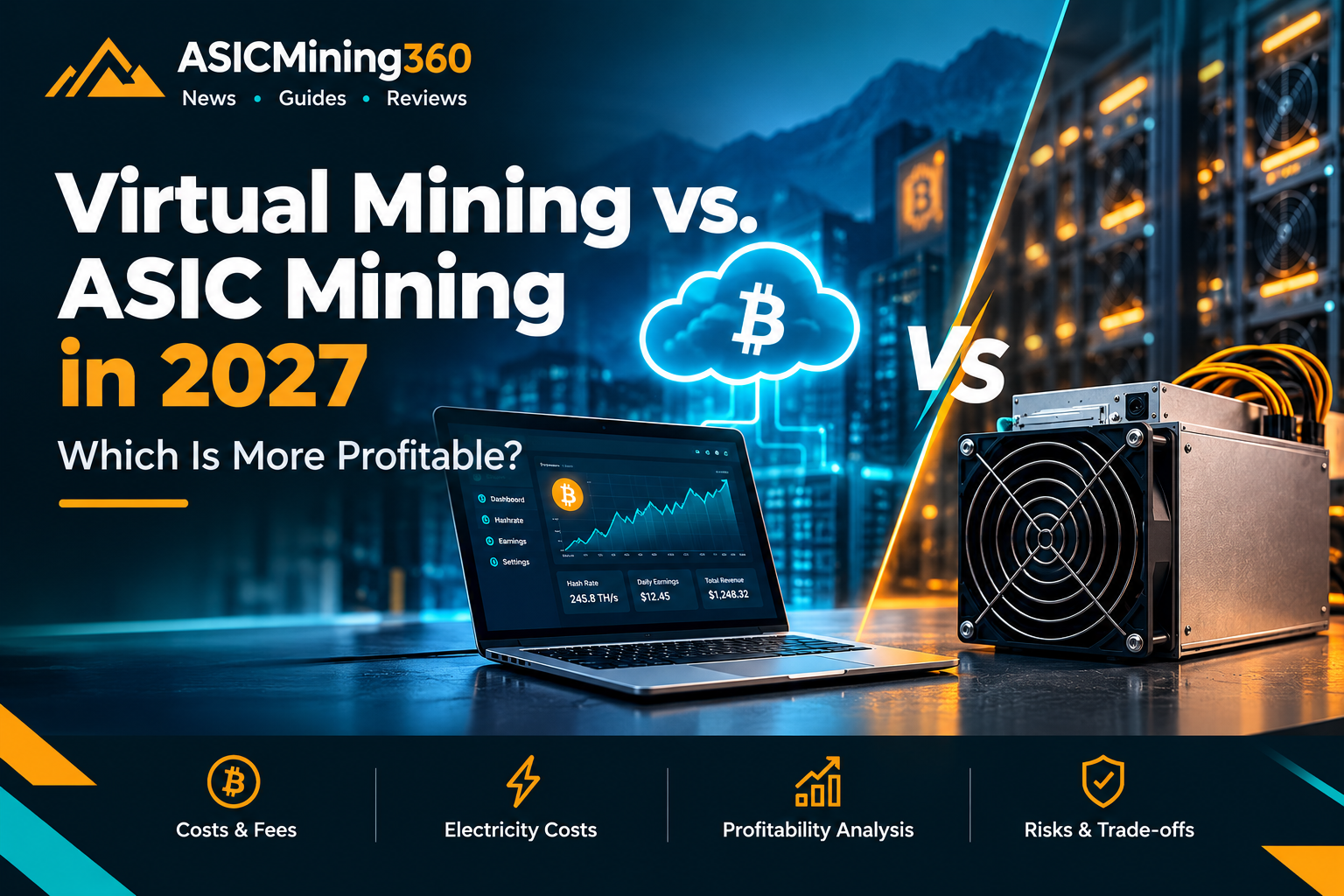
Looking ahead to 2027, there’s another route gaining serious traction. Instead of dealing with the heavy logistics and Capex of buying, racking, and maintaining physical rigs, operators can tap directly into cloud mining or hashrate leasing platforms. It’s a streamlined way to gain exposure to network compute power without ever having to unbox an ASIC or worry about cooling infrastructure.
So which option makes more sense?
The answer depends on much more than the Bitcoin price. Electricity costs, hardware efficiency, mining difficulty, fees, and the risks attached to the platform can all change the final result.
Cloud Hashrate Contracts vs. Physical ASIC Hosting: Structural Differences
With traditional bare-metal mining, the control—and the operational burden—is entirely on you. You buy the physical hardware, rack it, and point its hash rate directly at the network. But total ownership means managing every single layer of the stack: securing competitive power tariffs, taming thermal output, handling routine hardware repairs, and configuring your Stratum connections to a mining pool.
Virtual mining works differently. Instead of having an ASIC sitting next to you, you purchase or rent a certain amount of mining capacity through a platform. The actual machines are operated elsewhere, while your account receives the mining output associated with the amount of hash rate you control.
Some platforms also use mining NFTs to represent this position. The important point is that the user is not necessarily buying a physical ASIC. The economic value comes from the mining power and the terms attached to it.
That makes virtual mining much simpler from a technical perspective, but it introduces a different set of risks.
Impact of $80K+ BTC & 132.7T Network Difficulty on Daily Mining Hashprice
Bitcoin was trading around the mid-$80,000 range in early October 2026, after moving through a much stronger period earlier in the year.
That is obviously helpful for miners. When the value of the BTC produced by a machine rises, the same amount of hash rate can generate more revenue in dollar terms.
But there is a catch.
Mining economics are never static. The network ruthlessly recalibrates its difficulty every 2,016 blocks (roughly two weeks). This means every time a massive fleet of next-gen ASICs comes online, the competition for that fixed block reward gets even tighter. Case in point: by October 7, 2026, network difficulty had pushed to a staggering 132.72 trillion (T), driven by a global hash rate breaking the 1 Zettahash (1 ZH/s) barrier. It’s a relentless arms race.
This is why a high Bitcoin price should never be used on its own to calculate mining profitability.
Physical ASIC Hardware Ownership: CAPEX, Power Tariffs ($/kWh), and OPEX Risks
The biggest advantage of owning an ASIC is control.
You decide which machine to buy, where to operate it, which pool to use, and how much you are willing to spend on electricity. If you find a location with very cheap power, a modern and efficient ASIC can become an interesting long-term asset.
The downside is that all the operating costs are yours.
Electricity is usually the biggest one. Then there is cooling, hardware maintenance, downtime, pool fees, networking equipment, and eventually hardware depreciation.
An ASIC that looks profitable at $0.05 or $0.06 per kWh can look completely different at $0.10 or $0.15.
This is why miners should focus on efficiency as much as raw hash rate. A machine producing more terahashes is not necessarily the better machine if it consumes significantly more electricity to produce them.
Virtual Mining & Hashrate NFTs: Platform Fees, Counterparty Risk, and Hidden Costs
Virtual mining removes much of the technical work.
There is no noisy machine running in your home, no need to build a cooling system, and no need to worry about replacing a failed fan or power supply. The infrastructure is handled remotely.
For someone who wants exposure to mining without operating hardware, that can be a meaningful advantage.
But convenience comes at a cost.
Virtual mining platforms may charge for electricity, hosting, maintenance, or other services. Depending on the model, these costs can be deducted from mining revenue or paid separately.
There is also another issue that is easy to overlook: platform risk.
With a physical ASIC, you own a machine that can potentially be sold. With a virtual mining contract or mining NFT, the value depends much more heavily on the platform, its rules, the underlying agreement, and the ability to withdraw the resulting funds.
That difference matters.
2027 Financial Modeling: $6,000 Capital Allocation (ASIC Setup vs. Virtual Contract)
Imagine a miner has $6,000 available in 2027.
One option is to spend the money on an ASIC setup. The final result will depend heavily on the machine's efficiency and the electricity rate available at the mining location.
The other option is to allocate the same capital to a virtual mining service.
It may be tempting to compare the advertised monthly revenue from each option and simply choose the higher number. That would be a mistake.
For ASIC mining, the calculation should look roughly like this:
Mining revenue − electricity − pool fees − maintenance − other operating costs = net mining profit
For virtual mining, the calculation is different:
Mining revenue − platform fees − electricity/hosting charges − other applicable costs = net result
The number that matters is not the gross revenue. It is what remains after all costs.
Current hashprice data illustrates why this distinction matters. Looking at the network metrics around October 6, 2026, hashprice was hovering right at $40.78 per PH/s a day. But that gross revenue figure only tells half the story. Even if you were running the most efficient next-gen ASICs, you still had to carve a massive chunk out of that daily yield just to cover power bills and facility Opex before seeing a single cent of actual net profit.
And those conditions can change quickly.
When Physical ASICs Dominate: Sub-$0.05/kWh Power Tariffs & Efficiency (J/TH)
ASIC mining becomes more attractive when you have three things:
Cheap electricity.
This is probably the most important advantage. Industrial-scale miners can operate at electricity costs that are difficult for residential miners to match.
Efficient hardware.
Newer ASICs generally produce more hash rate for each unit of electricity consumed. That matters more as competition increases.
Long-term access to infrastructure.
At the end of the day, if you’ve already secured low-cost power, dialed-in cooling, a solid facility, and have the technical chops to manage the floor, bare-metal hardware ownership is usually the way to go. Why pay a host or cloud provider a premium on infrastructure you're fully equipped to run yourself?
The downside is that the initial investment is less flexible. If mining conditions deteriorate, you still own the machines.
When Virtual Mining Fits: Hands-Off Exposure Without Facility Infrastructure
Virtual mining has a different appeal.
It can make sense for someone who wants to participate in mining without dealing with hardware, electricity contracts, cooling, noise, or maintenance.
It can also be easier to scale. Instead of buying another physical machine, the user may simply increase the amount of hash rate assigned to the account.
But the trade-off is important: you are giving up some control.
Before putting money into a virtual mining platform, you should understand exactly what you are buying, how the hash rate is priced, what fees are charged, how withdrawals work, and what happens if mining becomes unprofitable.
A platform promising a certain return is not the same thing as a guaranteed mining profit.
Final Verdict: Cost per Terahash & Net Margin Comparison for 2027
There probably will not be one answer that works for everyone.
For a miner with cheap electricity, efficient hardware, and the ability to manage infrastructure, a physical ASIC is likely to remain the more attractive option. You have direct ownership and more control over the economics.
For someone who values simplicity and does not have access to cheap electricity or suitable mining infrastructure, virtual mining can be easier to access.
But easier does not automatically mean more profitable.
The best way to compare the two is to ignore the headline return and calculate the actual cost of producing each unit of mining power. Look at electricity, efficiency, fees, downtime, hardware value, and platform risk together.
Bitcoin being above $80,000 certainly creates a better revenue environment than a weak market. But by 2027, the miners that survive will still be the ones that control their costs.
And that is the real comparison between virtual mining and ASIC mining: not which one looks easier, but which one leaves you with more after everything has been paid.