Introduction: Electricity Is No Longer a Cost Line — It Is the Battlefield
In Bitcoin mining, machines get the attention, hashrate gets the headlines, and hardware launches dominate the conversation. But behind every profitable operation lies a quieter force that decides who survives and who disappears: electricity. In 2026, mining is no longer won by simply buying efficient ASICs or chasing the latest generation of hardware. It is won by securing access to cheap, stable, and scalable power before your competitors do. A miner paying $0.04 per kWh and a miner paying $0.09 per kWh may be running similar equipment, but they are not playing the same game. One is building cash flow, resilience, and long-term expansion potential. The other is operating on borrowed time.
That is the brutal reality of modern mining economics. Electricity is not just another operating expense—it is the foundation of mining ROI, the shield against difficulty compression, and the single variable that can turn a powerful fleet into either a high-margin asset or an expensive liability. From hydro-rich regions in Asia to subsidized power markets in the Middle East, from overlooked industrial zones in the United States to structurally cheaper grids across parts of Africa and Central Asia, the geography of electricity is now the geography of mining power itself.
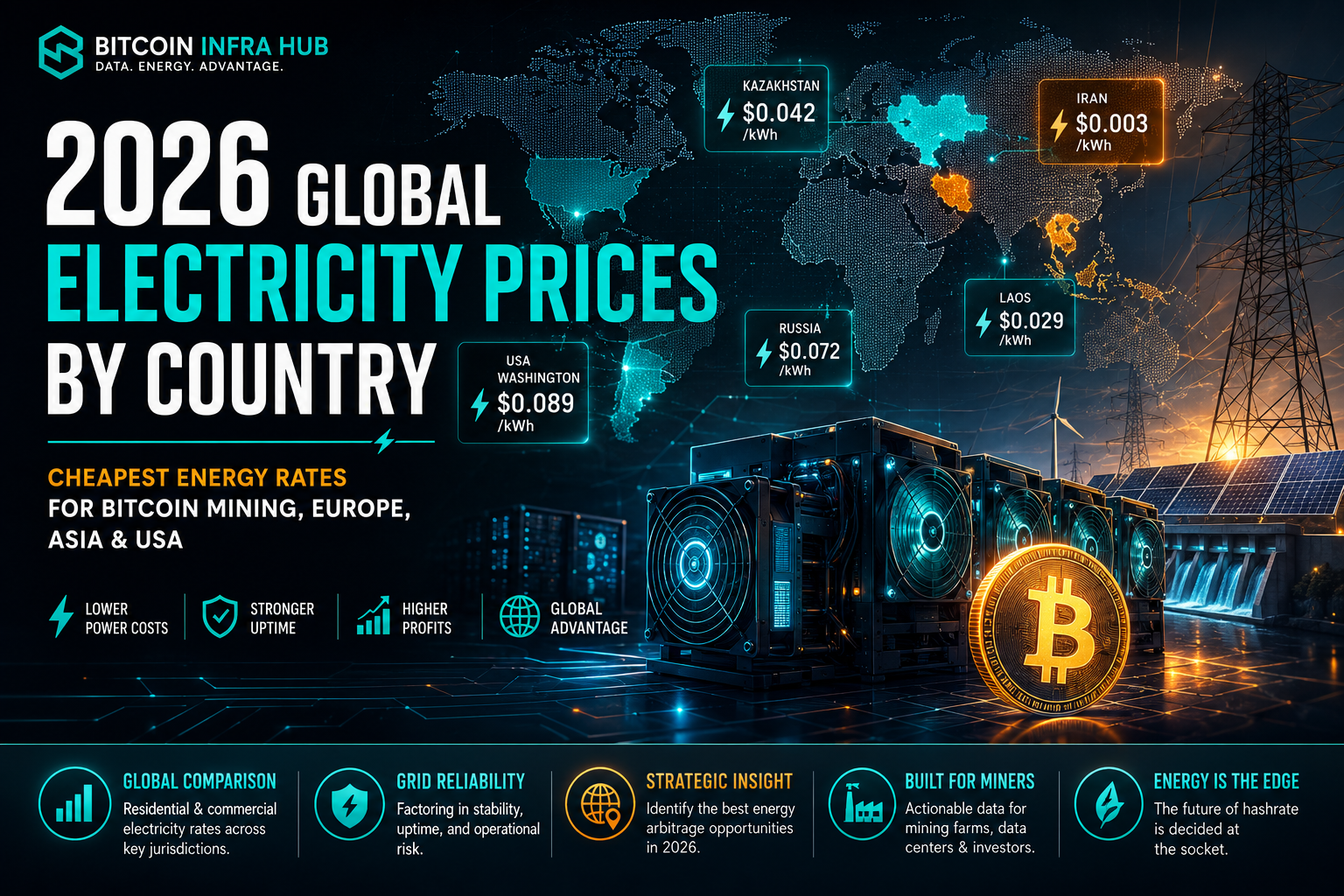
This global electricity index is designed to show exactly where that advantage lives in 2026. By comparing residential and commercial power rates across key jurisdictions—while also factoring in grid strength and operational stability—it reveals where miners, infrastructure operators, and data-center strategists can still find real energy arbitrage in an increasingly competitive world. Because in the end, the future of hashrate is not decided inside the machine. It is decided at the socket.
Data sourced from utility tariffs, provider billing samples, regulatory documents, and direct verification where available.
The cheapest electricity is not always the best mining destination. Smart operators evaluate power cost alongside grid reliability, regulatory stability, industrial access, and uptime risk.
⚡ 2026 Global Electricity Index
Cheapest Electricity Rates for Bitcoin Mining, Data Centers & Industrial Power Strategy
Conclusion: In 2026, the Winner Is Not the Miner — It’s the Energy Strategy
Let’s strip away the noise. In 2026, Bitcoin mining is no longer about who owns the most machines—it’s about who controls the cheapest, most reliable electrons. Hashrate can be bought. Hardware can be replaced. But a bad energy decision will silently destroy your operation, month after month, until margins disappear and expansion becomes impossible.
The difference between a profitable farm and a failing one often comes down to a few cents per kWh. That’s it. A tiny number on paper—but in reality, it’s the line between scaling confidently and slowly bleeding capital. The miners who understand this don’t chase trends—they chase energy advantage. They position themselves in regions where power is not just cheap, but stable, predictable, and built to support industrial-scale demand.
This is exactly why we’re seeing a shift in the global mining landscape. It’s no longer about chasing the latest hype; it’s about finding those rare spots where the infrastructure and policy actually make sense. People want places where the power stays on, the risks are manageable, and the grid feels like a partner rather than an obstacle.
Because in the end, mining is not a hardware business. It’s not even a technology business.
It’s an energy business.
And in that game, the winners are already decided—long before the first machine is ever turned on.
FAQ: Cheapest Electricity Rates 2026 for Bitcoin Mining & Data Centers
Q1: Which country actually has the cheapest electricity for Bitcoin mining in 2026?
If we’re looking strictly at the "sticker price," Iran, Ethiopia, and Sudan remain the floor of the market, with rates often dipping below $0.01 per kWh. However, there is a massive "but" here. These regions often face significant grid instability or "fluctuating" status. For miners who prioritize uptime over everything else, countries like Bhutan or Algeria offer a more "goldilocks" scenario—extremely low costs (around $0.02–$0.04) paired with much more reliable industrial infrastructure.
Q2: Why shouldn't I just move my rigs to the cheapest location on the list?
Because a cheap rate is useless if your machines are off. In the mining world, uptime is king. Locations with "Weak" or "Fluctuating" grid status often suffer from rolling blackouts or sudden regulatory shifts. Smart money in 2026 is moving toward jurisdictions where the price is slightly higher (like Kazakhstan or specific U.S. states) but the political and electrical environment is predictable. You'd rather pay $0.05 for 99% uptime than $0.01 for 50% uptime.
Q3: How do U.S. electricity rates compare for industrial mining?
The U.S. is a bit of a patchwork quilt. While residential rates are climbing, states like Washington, Idaho, and Texas remain global contenders for commercial mining. This is largely due to hydropower in the Pacific Northwest and curtailed wind/solar in the South. In 2026, the U.S. advantage isn't just the price; it’s the legal protection and the ability to plug directly into "behind-the-meter" renewable projects.
Q4: Is residential or commercial pricing more important for miners?
For the hobbyist with two or three machines at home, residential rates are the only metric that matters. But for any serious operation, commercial and industrial tariffs are the real battlefield. In many countries, the gap between what a homeowner pays and what a high-voltage data center pays can be as much as 50-70%. If you're scaling, you're looking for countries that offer specific "Industrial Zones" with subsidized power.
Q5: What role does renewable energy play in 2026 electricity costs?
Renewables are no longer just for green washing—they are the primary driver of cheap power. In 2026, the cheapest electricity globally often comes from excess capacity. Whether it's hydro in Laos, geothermal in Iceland, or solar in North Africa, miners are acting as the buyer of last resort for energy that would otherwise go to waste. This synergy is what keeps rates low even as global energy demand spikes.
Q6: Are electricity prices expected to stay stable throughout 2026?
In a word: No. Energy is tied to geopolitics. While hydro-reliant regions stay relatively flat, any country relying on natural gas or imported coal is subject to massive price swings. The winners of 2026 are those who have locked in long-term Power Purchase Agreements (PPAs) or are operating in countries with high domestic energy sovereignty.