

Introduction
Not long ago, a news report surfaced regarding a cooling system failure at a major data center. The summary of that event is as follows:
Lessons from the CyrusOne Cooling System Failure: How Physical Infrastructure Fragility Can Freeze Global Markets
A cooling failure almost triggered a global financial catastrophe involving trillions of dollars. In a quiet area of West and Central Chicago, USA, sits a modest data center that some of the world’s largest markets rely on. This facility operates 24/7, processing hundreds of thousands of transactions per second, including derivatives, oil, gold, commodities, indices, forex, and bonds. The center is owned by a private investment firm, CyrusOne, but is operated for the CME Group (Chicago Mercantile Exchange).
In the middle of the night, the server cooling system failed. Temperatures began to soar, and the servers started to struggle. As they overheated, trading for all contracts—derivatives, forex, commodities, and indices—came to a complete halt. The CME was forced to suspend trading, and global markets froze for hours. Imagine a market that is supposed to run 24/7 suddenly going dark as if the power was cut.
Prices were not updating, and traders across Asia and Europe found themselves stranded, with open positions they could not close, not understanding what was happening.
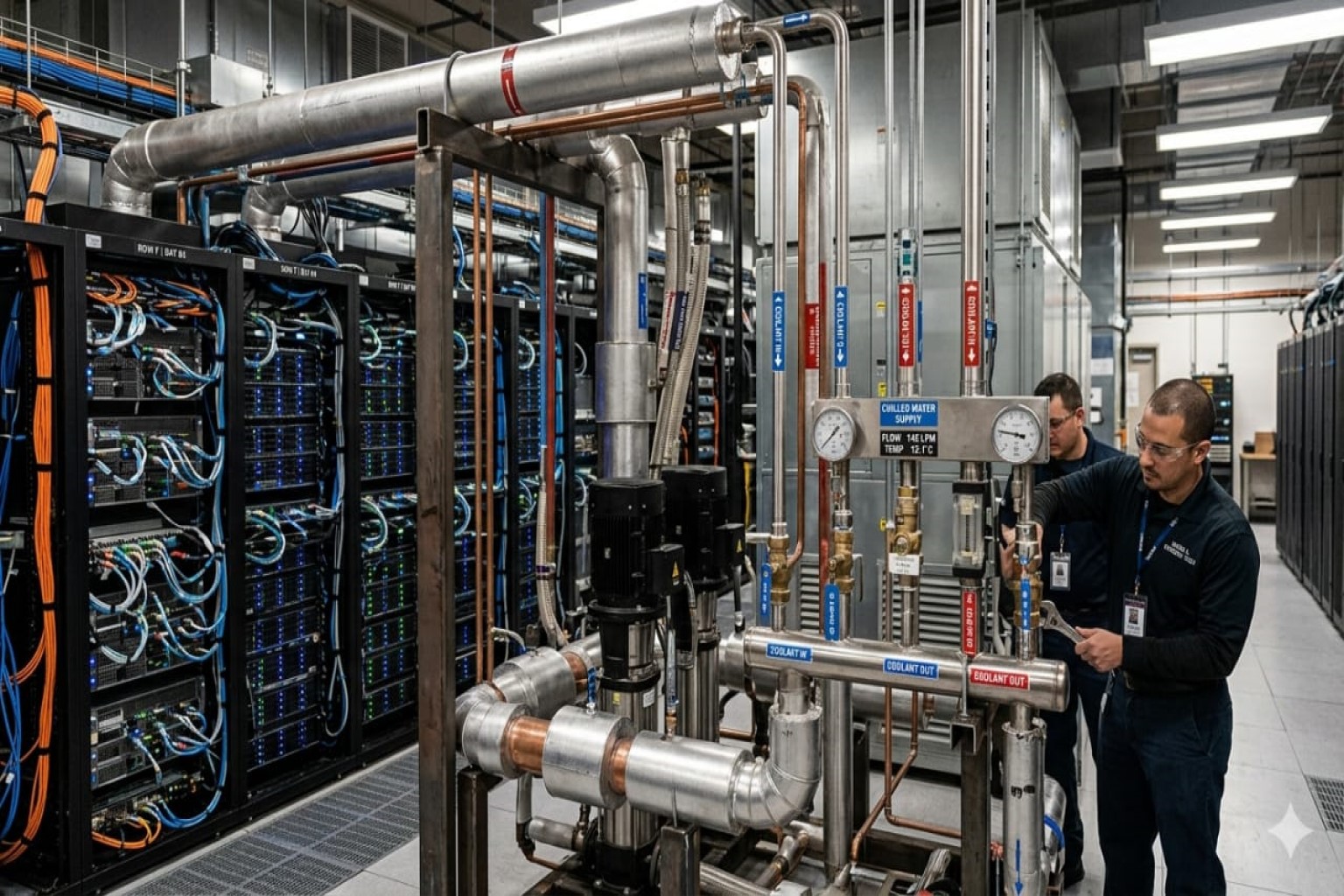
The strange irony is that the cause was not a virus, a cyberattack, or a software bug. It was a physical failure: weak cooling pipes. Amidst the high-tech world we imagine, simple pipes were enough to threaten a derivatives market with trillions of dollars in daily volume. Once resolved, CyrusOne restored cooling and added redundant systems, but the crisis highlighted a critical point: digital infrastructure is physical. It relies on cooling, power, and physical hardware. Centralization in a single provider creates a global "single point of failure."
Analyzing High-Hashrate Regions: Potential Scenarios That Threaten Global Bitcoin Mining Operations
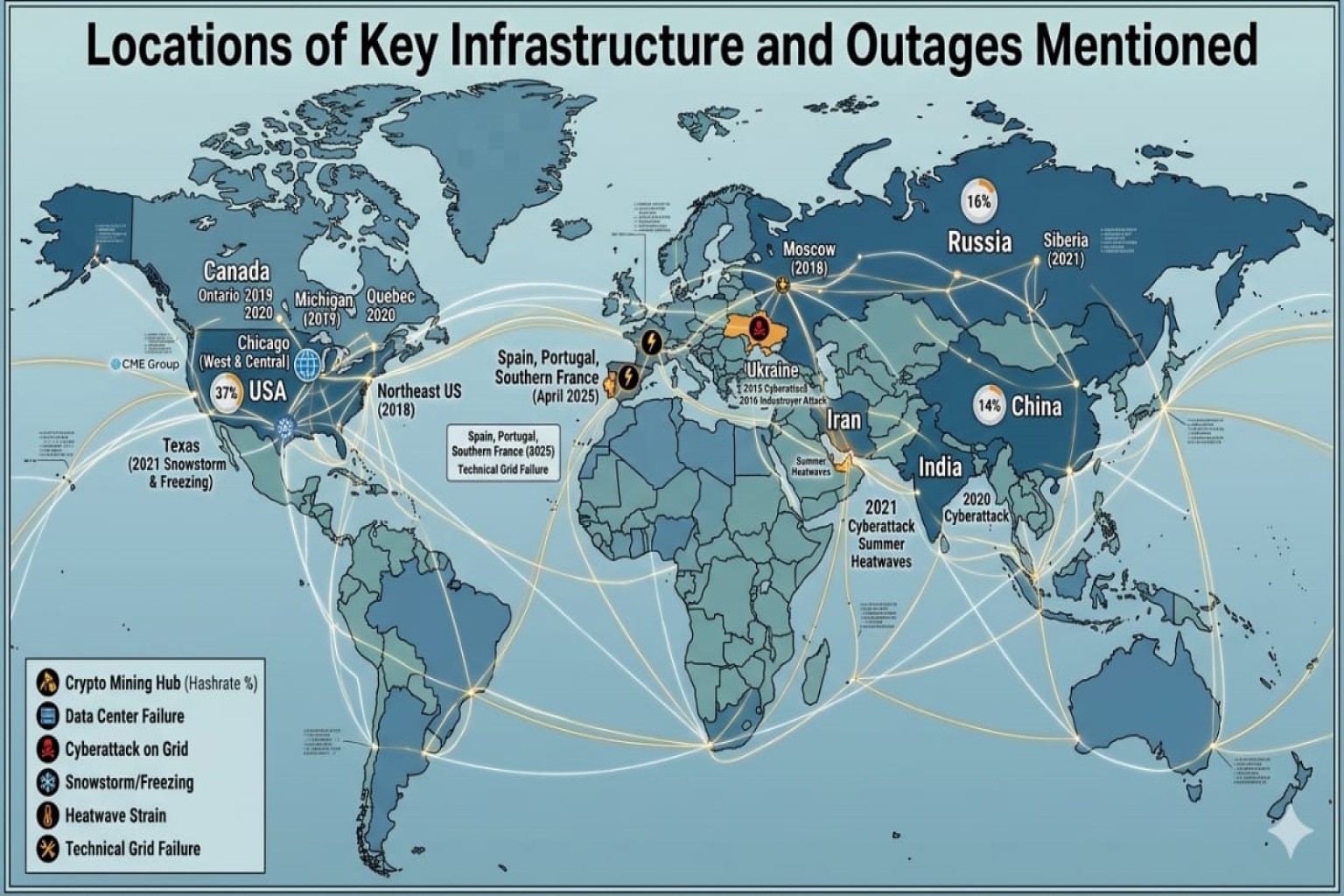
As a specialist in the mining field, several scenarios come to mind that could strike countries with high hashrate concentrations. This would directly impact Network Difficulty (making it easier due to thousands of mining devices going offline). For example, Bitcoin's hashrate is heavily concentrated in the USA (37%—concentrated in 3 states), Russia (16%), and China (14%).
1. The Growing Threat of Cyberattacks on Power Grids and Their Consequences for Centralized Mining Hubs
Today’s cyberattacks target critical infrastructure directly, most notably power grids, where attackers can disable electricity without physical destruction.
Examples: The 2015 Ukraine attack (230,000 people lost power) and the 2016 Industroyer attack. India (2020) and Iran (2021) also faced attacks that partially disabled power and fuel networks. These events confirm that relying on centralized, connected systems makes infrastructure vulnerable to a global shock via a single digital strike on mining hubs like Texas or Ohio.
2. How Extreme Snowstorms and Freezing Weather Disrupt Electrical Grids and Water-Cooled Mining Rigs
Snowstorms impact the grid in two ways: increased consumption and physical damage (downed poles or frozen components at power plants). Additionally, water-cooled mining rigs can fail due to freezing.
Texas 2021: 4.5 million people lost power for days due to frozen lines and plants.
Northeast US 2018: 1.3 million homes without power for up to 2 days.
Michigan 2019: 500,000 people without power for 1–3 days.
Canada: In Ontario (2019), 600,000 people (4% of the population) lost power, while in Quebec (2020), 250,000 people (3% of the province) were without electricity for several days.
Russia: Outages in Moscow (2018) and Siberia (2021) affected hundreds of thousands for up to two days.
3. The Impact of Summer Heatwaves and Electrical Grid Strain on Air-Cooled Crypto Mining Equipment
This phenomenon is less impactful as it primarily affects air-cooled equipment. However, it strains the electrical grid due to the continuous use of air conditioning, as seen in the Gulf region (UAE and Iran), despite their lower hashrate share compared to major players like Russia, Canada, the US, or China.
4. Technical Grid Failures and Infrastructure Vulnerabilities: Examining Recent Global Power Outage Case Studies
In April 2025, Spain, Portugal, and Southern France experienced partial blackouts due to a major technical flaw in the grid. In Spain, the outage lasted a day and a half, halting transport and communications. Investigations confirmed it was a technical fragility issue rather than a cyberattack, with power restored gradually over 6–10 hours on average.
How Large-Scale Miner Outages Affect Bitcoin Network Difficulty, Transaction Latency, and Mining Profitability
If any of the above occurs in a region representing at least 7% of the total hashrate, we can expect the following outcomes:
-
Lower Total Hashrate: Mining becomes temporarily easier, though block production may slow down slightly, which is logical.
-
Transaction Latency: Financial transfers on the network become slower to process.
-
Increased Profitability for Survivors: Profits for the remaining miners rise due to decreased competition.
-
Price Volatility: The market may experience price swings as it reacts to perceived production drops or network instability, especially following the official trading of Bitcoin in US markets.
-
Highlighting Centralization: Such failures expose the risks of relying on large centralized farms and increase calls for geographical distribution.
-
Automatic Difficulty Adjustment: Bitcoin automatically adjusts mining difficulty every 2,016 blocks (roughly every two weeks, depending on network speed). If a large number of miners go offline, block production slows temporarily until the next adjustment reduces difficulty and helps restore normal block times.
These scenarios are potential risks, but they will not have a significant impact on the market and mining unless they occur on a very large scale. We are simply analyzing realistic scenarios.
Frequently Asked Questions (FAQ)
Q1. How can a physical failure in a single data center freeze global financial markets?
This occurs due to centralization, creating what is known as a "single point of failure." Even though markets are digital, they run on physical hardware that requires constant power and cooling. When a critical facility like the CME Group data center experiences a cooling system failure, all connected trading for derivatives, forex, and commodities halts globally, regardless of how advanced the software is.
Q2. What happens to Bitcoin mining difficulty and profitability when thousands of miners go offline?
When a large number of ASIC miners go offline (due to power outages or technical failures), the total network hashrate drops. This initially slows down transaction processing. However, the Bitcoin network is designed to automatically adjust its mining difficulty (typically within a few days of a major event). This adjustment makes it easier and more profitable for the remaining miners to secure the network.
Q3. What are the most significant risks to high-hashrate mining regions like the USA, Russia, and China?
The biggest threats include cyberattacks on power grids, extreme weather events (such as Texas snowstorms or intense heatwaves), and technical infrastructure failures. Because mining hashrate is heavily concentrated in specific geographic zones, a regional power grid collapse can lead to a significant temporary drop in global mining power, highlighting the urgent need for geographical distribution of mining farms.