
Introduction
Europe’s energy crisis has changed the way the continent looks at natural gas. Before the war in Ukraine, Germany in particular benefited from large volumes of relatively cheap Russian gas, which helped support some of its most energy-intensive industries. The disruption of Russian supplies, followed by the destruction of Nord Stream 1 and 2, changed that equation dramatically.
For European industry, the problem was not simply finding another supplier. Replacing Russian pipeline gas with more expensive alternatives increased energy costs and put additional pressure on industries that depend heavily on gas and electricity. Germany, as Europe’s largest industrial economy, has been particularly exposed to this shift, with some energy-intensive sectors facing a much more difficult competitive environment.
That is one reason why Africa has become increasingly important in Europe’s search for alternative energy supplies. Algeria, Libya and Nigeria all have significant gas resources and geographical access to the European market, although the distance between Nigeria and Europe creates a very different infrastructure challenge.
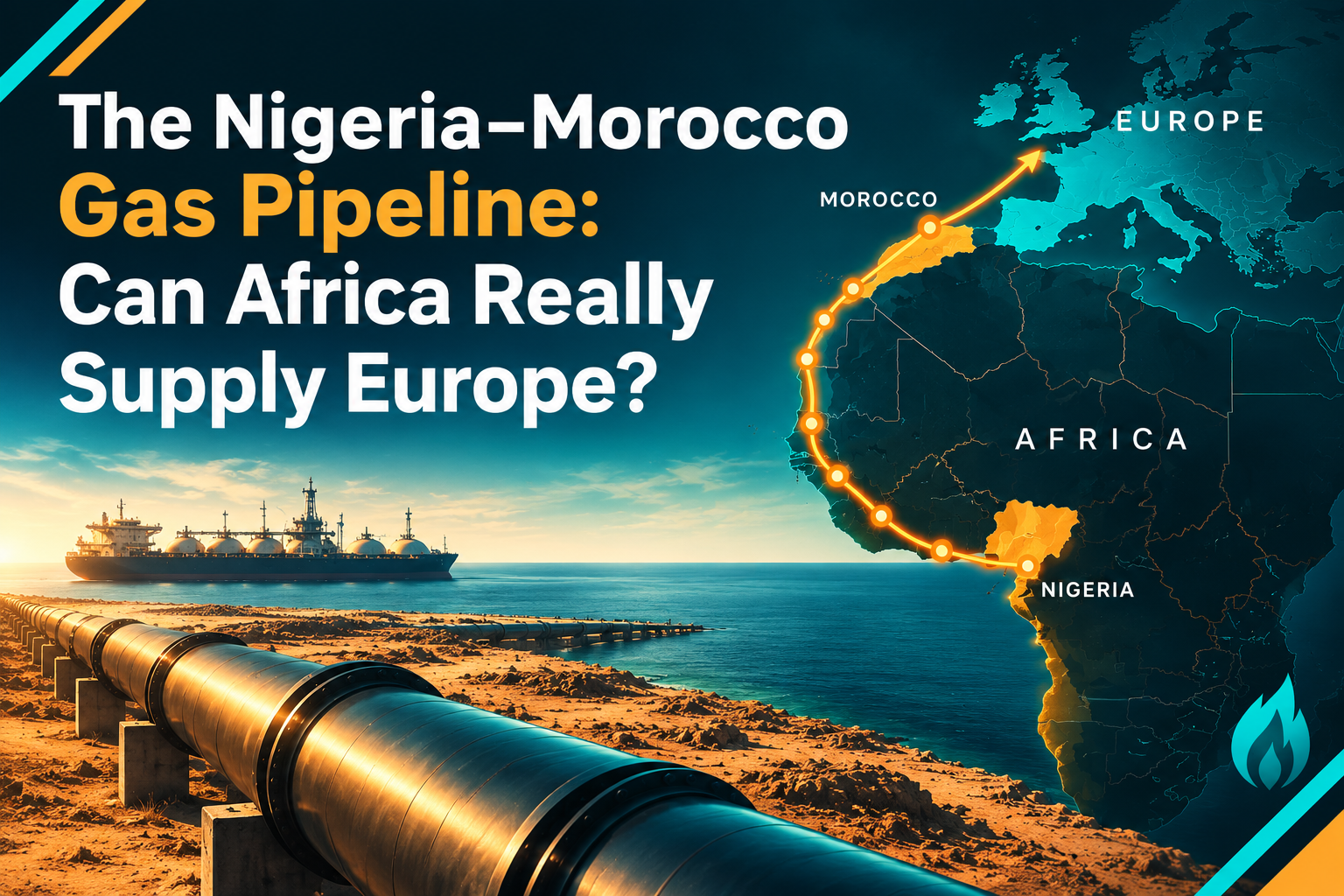
Nigeria has therefore become central to one of the most ambitious gas pipeline proposals in Africa: the Nigeria–Morocco, or Atlantic, gas pipeline. The idea is to transport Nigerian gas along the West African coast, passing through a large number of countries before reaching Morocco and eventually connecting with European markets.
On paper, the project offers an attractive vision. Nigeria has the gas, Europe needs additional supplies, and a major pipeline could potentially connect the two. In practice, however, the economics become much more complicated once the number of countries involved is taken into account.
For illustration, this article models what would happen if 5% of the remaining gas were allocated at each of 14 successive stages along the route. This is a hypothetical calculation designed to examine the potential cumulative effect of such allocations and does not represent the project's actual commercial agreements. Algerian President Abdelmadjid Tebboune has raised concerns over the economic implications of such a route, arguing that if the countries along the pipeline receive a share of the gas, the amount ultimately available for Europe could become substantially smaller.
This is where the numbers become interesting.
Assume, purely as a hypothetical calculation, that the pipeline initially carries 30 billion cubic meters of gas and that each participating country receives 5% of the gas remaining at that stage.
The important point is that the calculation should not simply subtract 5% of the original 30 billion cubic meters fourteen times. If the arrangement were structured as a percentage of the remaining volume, each deduction would be made after the previous country's share had already been removed.
Starting with 30 billion cubic meters, the first 5% deduction would leave:
30 × 0.95 = 28.5 billion cubic meters
After the second country:
28.5 × 0.95 = 27.075 billion cubic meters
The same process continues from one country to the next. After 14 successive deductions of 5%, the remaining volume would be:
30 × 0.95¹⁴ ≈ 14.63 billion cubic meters
In other words, under this hypothetical model, less than half of the original 30 billion cubic meters would remain after fourteen successive 5% deductions.
That does not mean this is how the actual project would operate. The commercial agreements, transit fees, ownership structures and gas-sharing arrangements between the participating countries are much more complicated than a simple 5% deduction. The calculation is useful mainly because it illustrates the concern being raised: when a pipeline crosses many countries, even relatively small claims on the gas can have a significant cumulative effect.
This issue has also attracted criticism from Jeffrey Porter, a U.S. analyst specializing in North African oil and gas. Porter has questioned the economic model behind the Atlantic pipeline, arguing that pipelines ultimately have to generate sufficient revenue to recover their enormous capital costs.
His argument is straightforward. Gas producers need to be paid for the gas they sell, while pipeline investors need customers who pay enough to recover the cost of building and operating the infrastructure. If several countries are compensated through gas rather than cash, the amount of gas available for commercial sale could decline while the cost of constructing the pipeline remains essentially unchanged.
According to estimates associated with the project, the pipeline could require investment on the order of $25 billion. At that scale, investors would need a credible long-term revenue model, secure customers and predictable volumes.
This is where the debate over the Atlantic pipeline becomes more than a question of engineering. Building a pipeline across thousands of kilometers is technically difficult, but financing it and ensuring that it remains commercially viable over several decades may be an even greater challenge.
And that raises an important question for Europe: if the original pipeline capacity is around 30 billion cubic meters, how much gas could realistically reach the European market after accounting for the commercial and transit arrangements of all the countries along the route?
The answer depends on the final agreements. But even a simple hypothetical calculation shows why the economics of a 14-country pipeline deserve closer examination.

What Happens to 30 Billion Cubic Meters?
To see how those cuts stack up over time, let’s imagine the pipeline starts off with 30 billion cubic meters (bcm) of Nigerian gas, taking a hypothetical 5% allocation at every leg of the journey.
The calculation below assumes that 5% of the gas remaining at each stage is allocated before the remaining volume continues along the route. This is a mathematical scenario rather than a confirmed commercial arrangement.
Hypothetical Gas Volume After Successive 5% Allocations
| Stage | Location | Gas Remaining |
|---|---|---|
| Starting point | Nigeria | 30.000 bcm |
| 1 | Benin | 28.500 bcm |
| 2 | Togo | 27.075 bcm |
| 3 | Ghana | 25.721 bcm |
| 4 | Côte d’Ivoire | 24.435 bcm |
| 5 | Liberia | 23.213 bcm |
| 6 | Sierra Leone | 22.052 bcm |
| 7 | Guinea | 20.949 bcm |
| 8 | Guinea-Bissau | 19.902 bcm |
| 9 | The Gambia | 18.907 bcm |
| 10 | Senegal | 17.962 bcm |
| 11 | Mauritania | 17.064 bcm |
| 12 | Western Sahara | 16.211 bcm |
| 13 | Morocco | 15.400 bcm |
| 14 | Additional 5% allocation scenario | 14.630 bcm |
*Western Sahara is shown here as a geographical stage in the hypothetical calculation and not as a statement about its international legal status.
The key mathematical point is that each 5% deduction is taken from the remaining volume, rather than from the original 30 bcm.
Therefore:
30 × 0.95¹⁴ = 14.63 bcm
After fourteen successive 5% deductions, approximately 14.63 billion cubic meters would remain.
This is significantly different from simply subtracting 5% of the original 30 bcm fourteen times. The repeated percentage reduction compounds at every stage, which is why the final volume falls to less than half of the starting amount.
The calculation is purely illustrative. The actual African Atlantic Gas Pipeline is officially described as a project running from Nigeria to Morocco through the Atlantic coastal countries, with connections intended to serve other West African and Sahelian markets. The official project documentation does not establish a rule under which every country automatically receives 5% of the gas.
Nevertheless, the exercise highlights the economic question at the centre of the debate. If a pipeline is designed around an initial capacity of around 30 bcm per year, but substantial volumes are consumed or allocated along the route, the amount ultimately available for Morocco and European markets becomes an important part of the project's economics.
The difference between 30 bcm at the starting point and 14.63 bcm after fourteen successive deductions is therefore not merely a mathematical curiosity. For a project requiring tens of billions of dollars in infrastructure investment, the final commercially available volume could have a major bearing on revenues, financing and the ability to recover the capital invested.
Could More Nigerian Gas Improve Europe’s Data Center Competitiveness?
The debate over Nigerian gas also raises a broader question for Europe: could a more stable supply of natural gas eventually help European countries remain competitive in energy-intensive industries such as large-scale data centers and cryptocurrency mining?
The Trans-Saharan Gas Pipeline offers a very different model from the Atlantic route. Instead of crossing a long chain of coastal countries, the project is designed to connect Nigeria to Algeria through Niger, with a planned capacity of up to 30 billion cubic meters of gas per year. The gas would reach Hassi R’Mel and could then be integrated into Algeria’s existing gas network and export infrastructure toward Europe.
That does not mean European electricity prices would automatically fall, or that all of the gas would reach European power plants. Gas would still have to compete with other fuels and electricity sources, while transmission costs, taxes, market conditions and European energy policy would continue to influence the final price. However, additional pipeline capacity could improve supply diversification and reduce some exposure to individual supply routes.
This matters for industries where electricity is a major operating cost. The IEA notes that electricity prices for energy-intensive industries in the EU remained more than twice U.S. levels in 2025, creating a significant competitive disadvantage.
For data centers and large-scale Bitcoin mining facilities, therefore, the question is not simply whether Europe has enough electricity. It is whether it can provide reliable, competitively priced power at the scale required by these facilities. A stronger gas supply network, combined with renewables, nuclear power, storage and grid investment, could improve that equation.
Europe may not be out of the competition. But its ability to attract the next generation of very large computing and energy-intensive facilities will increasingly depend on how successfully it solves the cost and availability of electricity.