
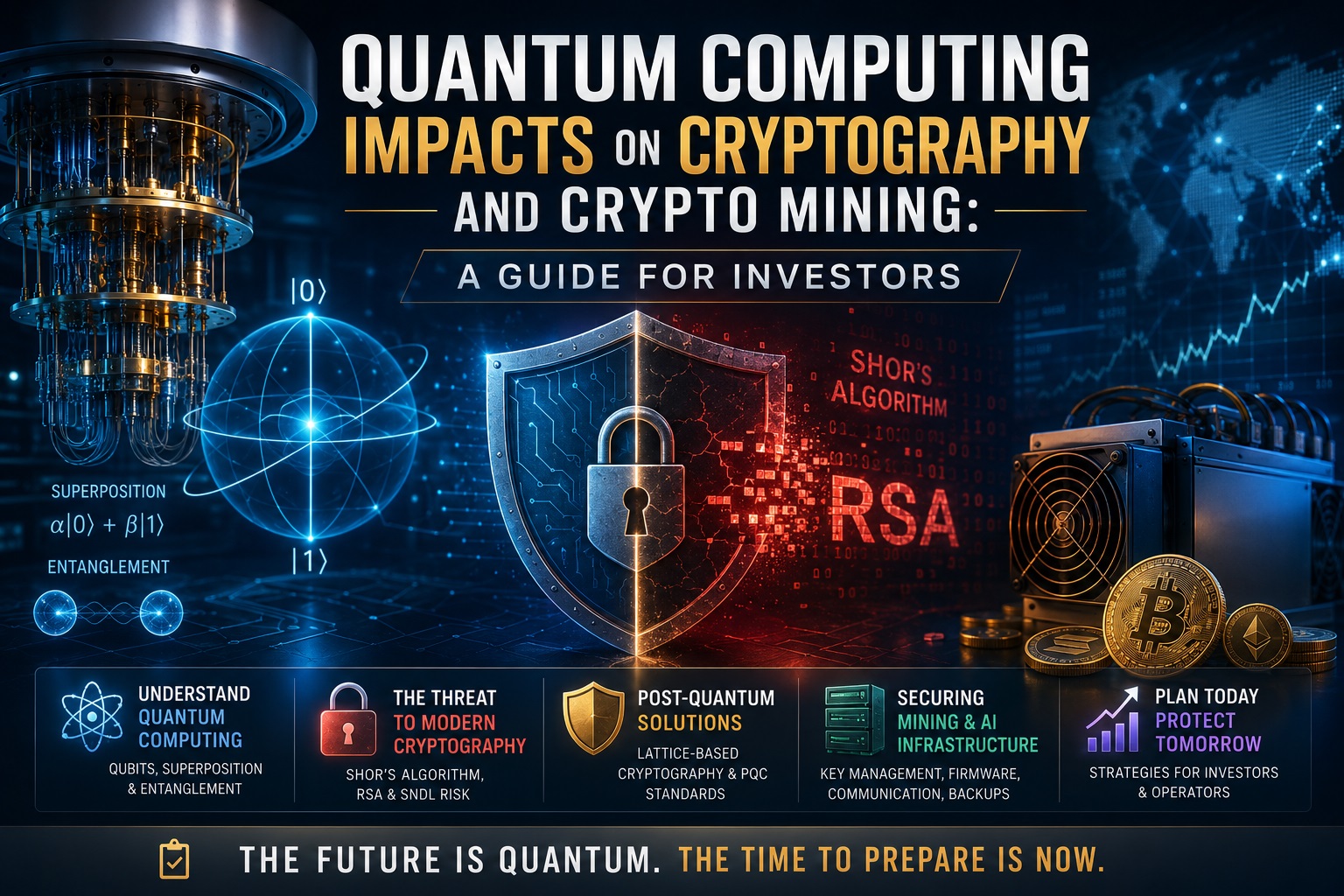
What Is Quantum Computing and Why Does It Matter for Cryptography?
When people in crypto hear new hardware, they usually think about faster GPUs, more efficient ASICs, or better cooling systems. But there is another class of machines quietly progressing in the background: quantum computers. These devices do not replace GPUs or ASICs for mining or AI workloads, and they are not designed for high-throughput tasks like hashing or model training. Instead, they are built for a small set of very specific problems that classical hardware struggles with.
The Technical Mechanics of Qubits and Parallel States
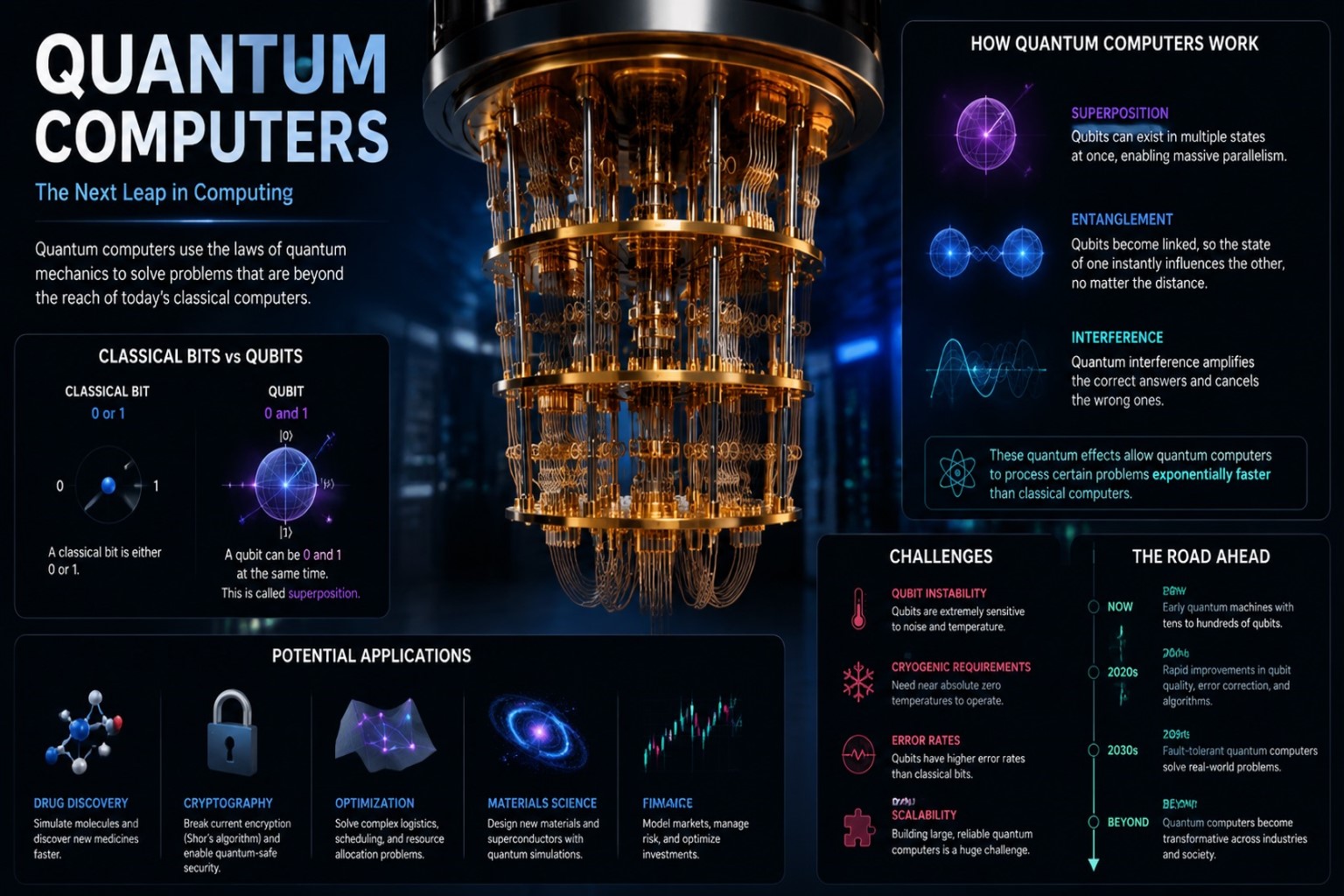
A classical computer—whether it’s a CPU, GPU, or ASIC—works with bits that are either 0 or 1. A quantum computer uses qubits, which can exist in a combination of 0 and 1 at the same time. This property, called superposition, allows a quantum processor to explore many possible states in parallel. Add to that another feature called entanglement, and you get a machine that can represent and manipulate an enormous number of states with relatively few qubits.
In theory, a few hundred high-quality qubits can represent more combinations than there are particles in the observable universe. In practice, today’s quantum hardware is still fragile, noisy, and expensive to operate. Error correction requires many physical qubits to create one reliable logical qubit, which is why useful, large-scale quantum computers are still years away.
So why should the crypto mining and AI compute industry care? Because even if quantum machines are not useful for mining, they directly target the cryptography that secures wallets, exchanges, blockchains, and infrastructure.
How Quantum Computing Threatens Modern Cryptography and Encryption
Modern crypto systems rely on two main types of cryptography:
-
Symmetric cryptography, where the same secret key is used to encrypt and decrypt data.
-
Asymmetric (public-key) cryptography, where a public key is used to encrypt or verify, and a private key is used to decrypt or sign.
Public-key systems are what make it possible to send funds, sign transactions, and secure connections without first sharing a secret in person. One of the most famous of these systems is RSA, which is based on a simple idea: multiplying two very large prime numbers is easy, but factoring their product back into those primes is extremely hard for classical computers.
With today’s key sizes, even the best classical algorithms running on supercomputers would need timescales far longer than human history to break a properly implemented RSA key. That is why this method has protected the internet, financial systems, and crypto infrastructure for decades.
Quantum computers change this assumption.
Store Now, Decrypt Later (SNDL): The Biggest Quantum Security Risk
A growing concern in cybersecurity is something called Store Now, Decrypt Later (SNDL). Attackers—whether criminals, corporations, or state actors—can already intercept and store encrypted data today: passwords, private communications, financial records, research, and more. They may not be able to read it now, but they are betting that in 10 to 20 years, quantum computers will be powerful enough to break today’s public-key encryption quickly.
This strategy makes sense because some information stays valuable for a long time: industrial secrets, medical research, identity data, and government intelligence. Even in the crypto world, old transaction histories, wallet backups, and encrypted keys could become sensitive if the underlying cryptography is broken.
Security agencies have been warning about this for years, and governments have started to react. In the United States and other regions, public institutions are already being pushed to migrate toward post-quantum cryptography—encryption methods designed to resist quantum attacks.
Classical Computing vs Quantum Computing: Key Differences Explained
To understand the risk, it helps to see why quantum machines can outperform classical ones for certain tasks.
With classical bits, two bits can represent four states: 00, 01, 10, and 11—but only one at a time. A calculation must be repeated for each input. With two qubits, a quantum computer can represent all four states at once in a superposition. With three qubits, eight states. With 20 qubits, over a million states simultaneously.
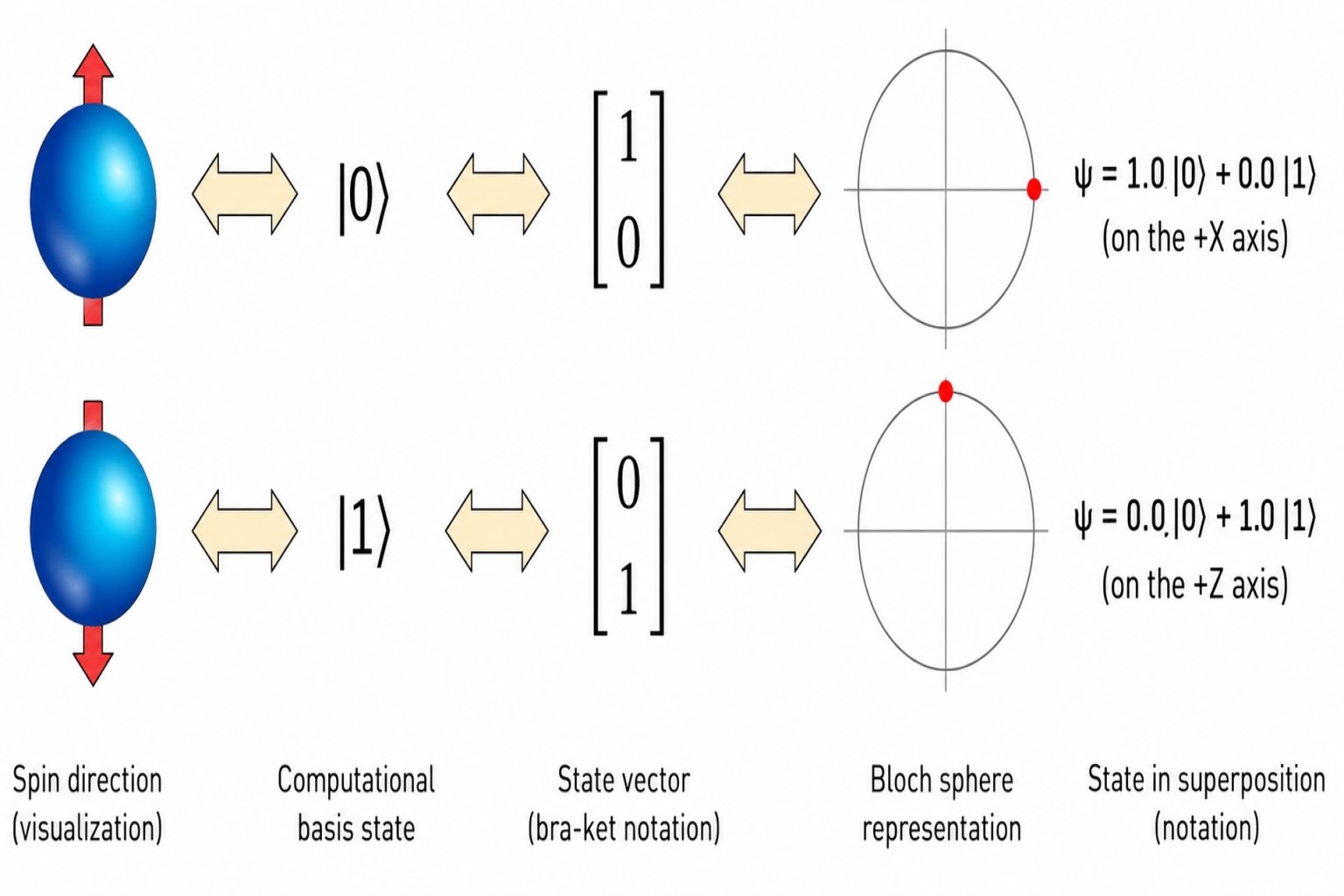
However, there is a catch: when you measure a quantum system, you only get one result. All the other information disappears. That means quantum computers are not magically faster at everything. They only become useful when an algorithm can shape the computation so that the final measurement reveals the specific answer you want.
For most problems, we do not know how to do this. But for a few critical tasks—especially those related to cryptography—we do.
How Shor's Algorithm Could Break RSA Encryption and Blockchain Security
In the 1990s, mathematician Peter Shor discovered a quantum algorithm that can factor large numbers exponentially faster than any known classical method. The core trick is to turn the factoring problem into a period-finding problem, which quantum computers can solve efficiently using a tool called the quantum Fourier transform.
At a high level, the process works like this:
-
You pick a random number that is smaller than the target number you want to factor.
-
You look at how powers of that number behave when divided by the target—specifically, how the remainders repeat in a cycle.
-
This repeating pattern has a period. Finding that period is the hard part for classical computers.
-
A quantum computer can create a superposition of many exponents at once, process them in parallel, and then use the quantum Fourier transform to extract the period.
Once you know this period, some simple classical math (including the greatest common divisor algorithm) often reveals the original prime factors.
The important point is not the math details, but the consequence: a sufficiently large and stable quantum computer can break RSA and similar systems in practical time.
Can Quantum Computers Break Bitcoin and Blockchain Security?
Early estimates suggested it might take hundreds of millions or even billions of physical qubits to break widely used RSA keys. As research in error correction and quantum architectures improved, those numbers dropped significantly. Some more recent projections suggest that tens of millions of physical qubits could be enough, depending on the design and error rates.
Today’s quantum computers are still far below that scale. The largest machines have on the order of hundreds or a few thousand qubits, and those qubits are noisy and short-lived. But progress has been steady, and in many areas, it looks more like engineering scaling than pure science fiction.
For long-term investors and infrastructure operators, this means the risk is not immediate—but it is also not imaginary.
Post-Quantum Cryptography: How Blockchain and Crypto Are Preparing
Because this threat has been known for years, cryptographers started working on alternatives that do not rely on factoring or similar problems. In 2016, the U.S. National Institute of Standards and Technology (NIST) launched a global competition to evaluate new, quantum-resistant algorithms. After years of analysis and attacks, a small set of candidates was selected in 2022 to become part of future standards.
Many of these new systems are based on lattice mathematics. Without going too deep into formulas, a lattice can be thought of as a grid formed by combining basic vectors in many integer ways. Some problems in high-dimensional lattices—like finding the closest lattice point to a given target—are believed to be extremely hard for both classical and quantum computers.
The key idea is simple: instead of relying on problems that quantum computers are known to solve efficiently, use problems that no efficient quantum algorithm is known for.
How Bitcoin Miners and AI Data Centers Can Prepare for Quantum Computing
For miners, hosting providers, and AI compute operators, quantum computers will not replace GPUs or ASICs for revenue-generating workloads. But they do change the security assumptions around:
-
Wallet key storage
-
Exchange and pool authentication
-
Firmware signing and update systems
-
Encrypted backups and long-term data storage
-
Secure communication between data centers
In the crypto ecosystem, signatures and key management are especially critical. If a future quantum attacker could derive private keys from public keys, any address that has ever revealed its public key could be at risk. This is one reason some blockchain communities are already discussing quantum-resistant signature schemes.
From an investment and operations perspective, the practical steps are:
-
Track which cryptographic standards your software and hardware depend on.
-
Prefer systems that have a migration path to post-quantum algorithms.
-
Avoid assuming that encrypted forever really means forever.
-
Treat long-term secrets (backups, keys, archives) as potential SNDL targets.
| Key Term | Simplified Definition |
|---|---|
| Qubit | The basic unit of quantum information that exists in multiple states simultaneously via superposition. |
| Shor’s Algorithm | A quantum algorithm capable of factoring large integers exponentially faster than classical computers. |
| SNDL Threat | "Store Now, Decrypt Later" – The practice of harvesting encrypted data today to crack it with future quantum tech. |
| Post-Quantum (PQC) | Cryptographic methods designed to be secure against the processing power of quantum computers. |
| Lattice-based Cryptography | A type of encryption using complex geometric structures that is currently believed to be quantum-resistant. |
The Future of Quantum Computing, Cryptocurrency & Digital Security
Quantum computers are not a threat to mining hardware efficiency, but they are a direct challenge to the cryptographic foundations of the crypto and digital infrastructure world. The risk is not about what attackers can do today, but about what they can prepare for tomorrow by storing encrypted data now.
The good news is that the industry is not standing still. Post-quantum cryptography is moving from research to standards, and software stacks will gradually adapt. For miners, AI operators, and investors, the smart move is not panic—but planning: understanding the transition, choosing flexible systems, and staying ahead of a slow but very real shift in the security landscape.
Quantum Computing & Cryptocurrency FAQs
Q1: Will quantum computers make my current Bitcoin mining rigs obsolete?
Not exactly. Quantum computers are brilliant at solving specific mathematical puzzles, but they aren't designed to compete with the raw hashing power of ASICs used in mining. Your hardware's efficiency for mining remains safe; the real shift is in how we secure the wallets and the network itself.
Q2: What exactly is the Store Now, Decrypt Later threat I keep hearing about?
It’s a bit like someone stealing a locked safe today because they know they’ll have the key in ten years. Hackers are collecting encrypted data right now, betting that future quantum computers will be powerful enough to crack it later. This is why long-term data privacy is becoming a big concern today.
Q3: Is there a way to make blockchains quantum-proof before it's too late?
Yes, and the work has already started! Developers are creating Post-Quantum Cryptography (PQC). These are new encryption methods based on complex math problems that even a quantum computer can't solve easily. Most blockchains will likely upgrade to these new standards as the technology matures.
Q4: How long do we actually have before quantum computers become a real danger?
While quantum tech is moving fast, we’re likely still a decade or more away from a machine stable and large enough to break standard encryption. It’s an engineering challenge more than a scientific one at this point, but it's enough of a reality that security experts are already changing the rules of the game.