
Introduction
Bitcoin self-custody gives you control over your own coins instead of leaving them with a bank or another centralized service. The trade-off is that you also have to look after the private keys yourself. A hardware wallet can keep those keys away from many online threats, but using only one device still means putting a lot of responsibility in one place.
A multi-vendor Bitcoin multisig setup spreads that responsibility between several hardware wallets instead of putting everything in one device. Ideally, those devices come from different manufacturers, so a problem with one company does not automatically affect the others.
Three separate keys are used in the wallet, and two of them must sign a transaction before the funds can be spent. So, if one device is lost or compromised, that alone isn't enough to move the Bitcoin.
What Is a 2-of-3 Bitcoin Multisig Wallet?
Multisig simply means that a Bitcoin transaction needs signatures from more than one key before it can go through.
In a 2-of-3 wallet, there are three signing keys in total. You can think of them as three people holding separate keys to the same safe, with any two able to authorize a withdrawal.
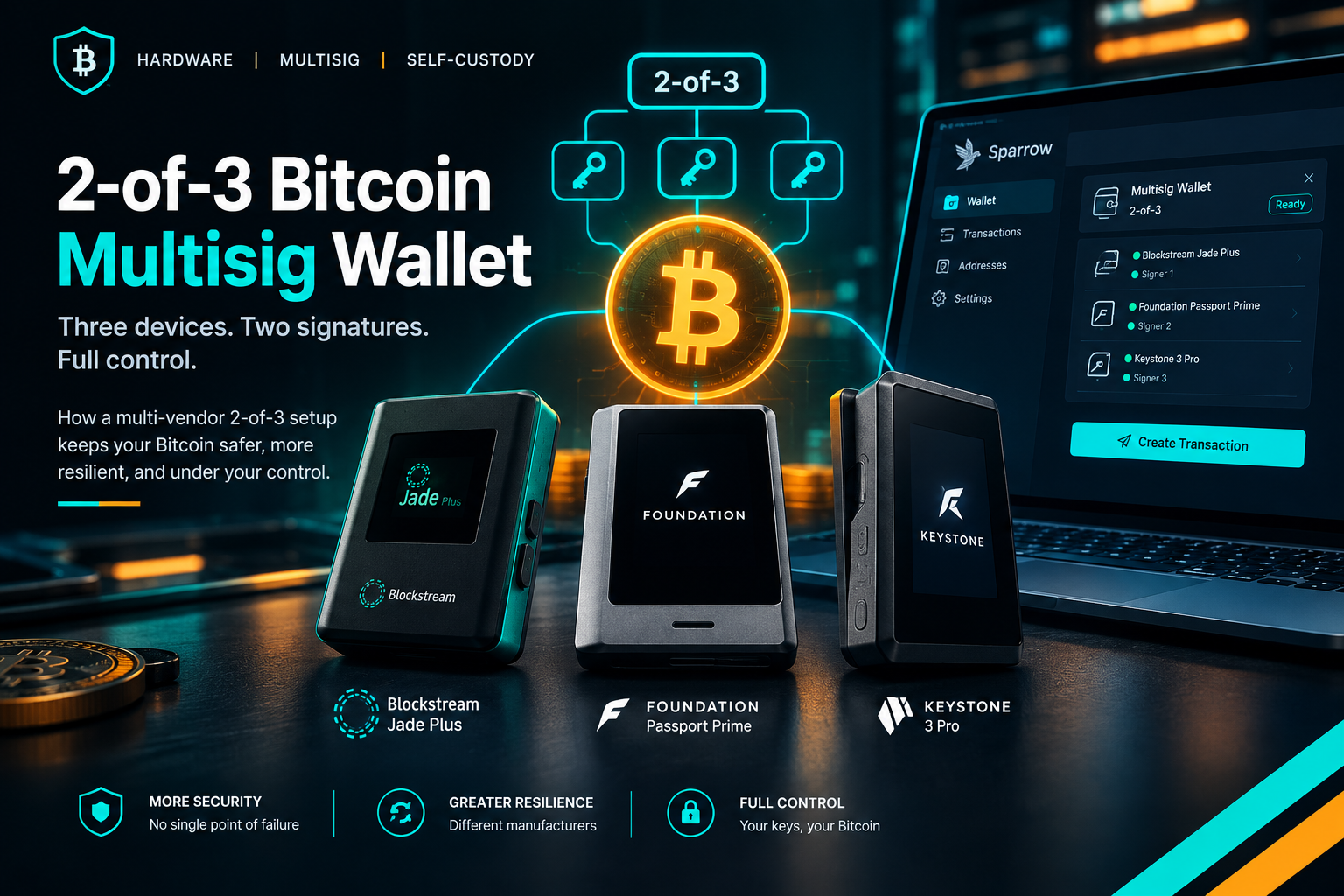
The important part is that these are three independent keys, not three copies of one key. Each hardware wallet holds its own signing key, and the wallet is configured so that any two of the three can authorize a transaction.
For example, a setup could use:
- A Blockstream Jade Plus
- A Foundation Passport Prime
- A Keystone 3 Pro
These devices can be used with a desktop wallet such as Sparrow. Sparrow brings the three signers together and manages the wallet and transaction process. The private keys themselves stay on the hardware wallets and are never handed over to the computer.
Why Use Three Different Hardware Wallets?
Using hardware wallets from different manufacturers can help avoid relying entirely on one company's products and software.
With a normal single-device wallet, the same hardware is responsible for creating the key, keeping it safe, and signing transactions. A serious flaw in the device, its firmware, or related software could therefore affect the wallet directly.
A 2-of-3 wallet gives you another option.
Suppose one of the three devices is compromised. The attacker would have that device's key, but that key alone cannot authorize a transaction. A second signer would still be needed to reach the 2-of-3 requirement.
There is also a practical reason for choosing different manufacturers. If a problem is specific to one company's firmware or hardware implementation, the other two devices are not necessarily exposed to the same issue.
This does not mean that multisig makes the wallet immune to attacks. It simply prevents the compromise of one signer from being enough to spend the funds.
Multisig Provides Redundancy, Not Just More Security
Security isn't the only reason people choose a 2-of-3 setup. It can also make the wallet easier to recover from the loss of one device.
With a single hardware wallet, losing the device can become a serious problem if the seed backup is missing or cannot be used. Without another way to recover the key, the Bitcoin could remain out of reach.
A 2-of-3 wallet gives you some room for that kind of failure. If one signer is lost, the other two can still sign a transaction and satisfy the wallet's rules.
That doesn't mean you should make three copies of the same seed. The three signers are meant to have separate keys. Each one is its own part of the wallet, and any two can be used together when it is time to spend the funds.
This distinction also matters when deciding where to keep the backups. If all three devices and their recovery information are stored in the same place, a fire, theft, or other physical event could affect the entire setup.
What Happens If One Hardware Wallet Has a Vulnerability?
A real-world hardware-wallet incident helps show why using different devices can matter.
The original example discussed in the source material involves a vulnerability associated with insufficiently random seed generation in the Coldcard MK3. According to the account cited in that material, approximately 1,500 BTC were stolen from affected wallets.
The broader point is more important than the particular device involved.
If a vulnerable device is used as only one signer in a properly configured 2-of-3 wallet, gaining control of that device does not provide enough authority to spend the Bitcoin.
The other two keys are still needed.
This is where the separation between the signers becomes useful. A problem with one device does not automatically give an attacker everything required to take control of the wallet.
There are limits, of course. If two of the three signing keys are compromised, the attacker can meet the 2-of-3 requirement. Multisig can reduce the impact of a single compromised signer, but it cannot protect funds when enough signing authority has been obtained.
A Real-World Multi-Vendor Example
A practical setup could consist of three different hardware wallets:
- Blockstream Jade Plus
- Foundation Passport Prime
- Keystone 3 Pro
Each device keeps its own signing key, while Sparrow brings the three keys together into one multisig wallet.
The computer does not need to receive the private keys. Instead, the hardware wallets can provide public information, including extended public keys (xpubs). Sparrow can use that information to build the wallet and generate its receiving addresses.
The resulting wallet can also be represented by a wallet descriptor.
Why the Wallet Descriptor Matters
Having two out of three hardware wallets does not automatically mean that the wallet can be recovered without any additional information.
The signing keys are essential, but the wallet also needs to know how those keys fit together.
That includes information such as:
- Which keys belong to the wallet
- How the keys are ordered
- Which derivation paths are being used
- What the spending policy is
- Which fingerprints identify the participating keys
The wallet descriptor contains the information needed to recreate the wallet's structure. It tells the software which keys are involved, how they are arranged, and what rules must be followed before a transaction can be spent.
It is not a private key, but it is still an important part of the recovery process.
Without the descriptor or equivalent configuration information, you may still have the underlying signing keys but have trouble rebuilding the exact wallet or finding all of its addresses.
This is why a proper multisig backup plan needs to cover more than the hardware wallets and seed phrases. You also need to preserve the information that tells you how those keys work together.
Multisig Is More Complicated Than Single-Signature Self-Custody
The extra protection comes with a price: multisig is more complicated.
A standard single-signature wallet is relatively easy to understand. One seed controls the wallet, and the recovery process is usually straightforward.
A multisig setup adds several more pieces:
- Multiple hardware wallets
- Multiple recovery seeds or signing keys
- A quorum such as 2-of-3
- Wallet descriptors
- Extended public keys
- Derivation paths
- Master fingerprints
- Backup procedures
- A recovery plan
None of these is especially difficult on its own. The challenge is making sure that all of them are still understandable and usable years later.
For that reason, multisig is not automatically the right choice for every Bitcoin holder.
A poorly documented multisig wallet can create serious recovery problems. Someone might have all three hardware wallets but forget which key belongs to which signer. Another person might carefully preserve the seeds but lose the wallet descriptor. Someone else might keep every backup in the same location, which removes much of the redundancy the setup was supposed to provide.
The cryptography is only one part of the picture. How the wallet is set up, documented, stored, and tested matters too.
Test the Wallet Before Holding Significant Bitcoin
Creating a multisig wallet successfully in software does not mean the setup has been fully tested.
Before moving a significant amount of Bitcoin into it, it makes sense to try the whole process with a small amount first.
You can send a small transaction to the new wallet and check that the receiving addresses appear as expected. After that, create a spending transaction and sign it with two of the three hardware wallets.
This gives you a chance to check a few important things:
- The wallet generates the expected addresses
- All three devices recognize the same multisig setup
- Change addresses are handled correctly
- Each signer can produce a valid signature
- Two signatures are enough to complete a transaction
- The wallet configuration has been backed up correctly
A small test can uncover a configuration mistake before a large amount of Bitcoin is sitting behind the wallet.
For self-custody, it is important to know not only that the wallet exists, but that you can actually use and recover it when needed.
Different Vendors Can Reduce Common-Mode Risk
Using three different hardware wallets is not simply about owning three products from three companies. It is also about avoiding situations where all three signers depend on the same underlying technology.
This is sometimes called common-mode failure.
If several signing devices share the same software, manufacturer, hardware design, or implementation, one flaw could potentially affect more than one signer.
Different vendors do not eliminate that possibility. They can, however, reduce the number of things the three devices have in common.
For example, if a vulnerability is specific to one manufacturer's firmware, the other two devices may not be affected by the same problem.
The same idea applies to physical storage.
Three different hardware wallets don't provide much redundancy if all three recovery backups are kept in the same drawer. A single theft, fire, or other event could affect everything at once.
For that reason, diversification has to be considered on both sides: how the keys are managed digitally and where the backups are kept physically.
Multisig Does Not Replace Good Backup Practices
A 2-of-3 wallet still needs a carefully planned backup strategy.
You should know what happens if:
- One hardware wallet stops working
- One recovery seed is lost
- A backup location becomes inaccessible
- The wallet descriptor is unavailable
- Replacement hardware is needed
- One signer is physically destroyed
The purpose of 2-of-3 multisig is to let the wallet continue working even after one signing key is lost.
But that only helps if the other two keys are available and you have enough information to rebuild the wallet.
In other words, having redundancy on paper is not enough. The remaining pieces have to be somewhere you can actually access and use.
The Weakest Link May Be Operational, Not Technical
It is easy to look at multisig and think that requiring several signatures automatically makes a wallet safer.
The reality is a little more complicated.
You are no longer protecting just one key and one recovery phrase. You now have several independent keys, multiple devices, wallet configuration information, and a recovery process to keep track of.
That can protect against certain failures, but it also gives you more things that can go wrong.
A good multisig setup should therefore account for ordinary problems as well as technical attacks.
What happens if one device disappears?
What happens if one manufacturer stops supporting a product?
What happens if you need to recover the wallet several years from now?
What happens if you forget how the wallet was originally configured?
These are not hypothetical details that can simply be ignored. They are part of managing a self-custody wallet over the long term.
Multi-Vendor Multisig as a Long-Term Self-Custody Strategy
For Bitcoin holders who want to avoid putting all their signing authority in one hardware-wallet ecosystem, a 2-of-3 multi-vendor setup offers a way to spread that responsibility across different devices.
A combination such as the Jade Plus, Passport Prime, and Keystone 3 Pro illustrates the idea well. Each device holds a separate signing key, while Sparrow coordinates the multisig wallet.
The important part is that no single device holds enough authority to spend the funds on its own.
If one device is compromised, the attacker still needs another signer. If one device is lost, the other two can still be used. And if a problem affects one manufacturer, the other two devices are not automatically affected by the same issue.
At the same time, multisig requires more organization than a standard single-signature wallet. Wallet descriptors, fingerprints, derivation paths, backups, and recovery procedures all need to be recorded and kept somewhere safe.
The goal is not to build the most complicated setup possible. It is to build one that you understand, can maintain over time, and can recover when you actually need it.
Multi-vendor multisig is ultimately about spreading signing authority. Instead of putting everything in the hands of one device and one manufacturer, the wallet requires multiple independent signers to come together before the Bitcoin can be spent.