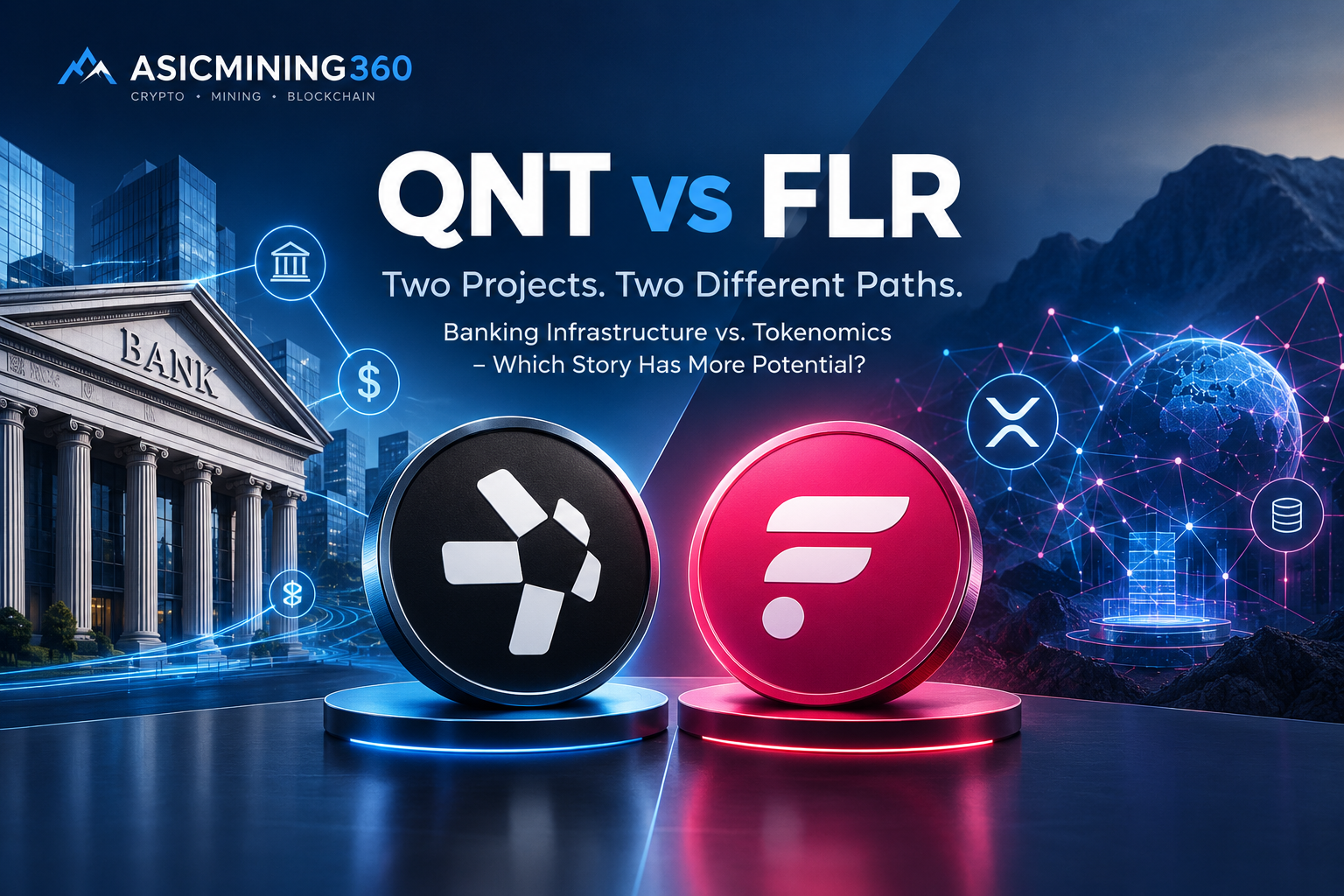
The recent attention around Quant (QNT) and Flare (FLR) comes from two very different stories. One is suddenly being associated with the future of bank settlement and tokenized deposits. The other has spent much of the year quietly changing the economic mechanics of its network.
At first glance, the two tokens might seem to have little in common. But there is an interesting question underneath both stories: how directly is the success of the network actually connected to the token?
That question matters because a strong partnership, a growing network, or an ambitious roadmap does not automatically translate into demand for a cryptocurrency.
Quant and the banking infrastructure story
The development places Quant within a much broader banking infrastructure trend as traditional financial institutions continue exploring digital assets. The project is intended to support the clearing and settlement of tokenized deposits and connect that infrastructure with existing U.S. payment systems, including RTP and the Clearing House's large-value payment infrastructure.
The scale is what makes the announcement particularly interesting.
The Clearing House processes enormous amounts of payment activity, so the idea of tokenized deposits moving through infrastructure connected to major banks naturally creates a much larger narrative than a typical blockchain partnership. Reporting around the initiative has also pointed to participation from major financial institutions.
But there is an important distinction between Quant being selected to provide infrastructure and QNT becoming the asset through which all of that financial activity must pass.
Those are not the same thing.
The terms of the arrangement have not been fully disclosed publicly. That leaves an important question unanswered: what role, if any, will QNT itself play inside this particular banking network?
Quant's established business model has involved its Overledger technology, with licenses and usage connected to QNT. But a new institutional arrangement can have its own commercial structure. Banks could potentially pay for infrastructure through ordinary corporate arrangements rather than creating direct demand for the token.
That uncertainty is particularly important because QNT has a relatively limited supply. With fewer tokens available compared with many large crypto projects, significant new demand could have a substantial effect on price. But the reverse is also true: a wave of speculative buying can create sharp corrections when expectations get ahead of confirmed information.
This is why the banking announcement should be viewed as an important development for Quant's technology, while the implications for QNT itself remain a separate question.
The expected availability in the first half of 2027 also means that investors are looking at a project that is still moving toward production. The selection is real, but the full system has not yet been operating at scale.
Flare has taken a different route
Flare's story is almost the opposite.
Instead of relying primarily on a major external announcement, the project has spent the year changing the economics of FLR itself.
One of the most significant developments came through FIP.16, which received overwhelming community support and introduced several changes to the token's monetary structure.
Annual inflation was reduced from 5% to 3%, while the annual issuance cap was reduced from 5 billion FLR to 3 billion. At the same time, Flare increased base gas fees substantially, creating a mechanism through which network activity can result in more FLR being burned.
The Flare Drop program also reached the end of its planned distribution period in January. That matters because the program had represented a recurring source of additional tokens entering the market.
Taken together, these changes create a different supply picture from the one FLR holders were dealing with previously.
There is also FIRE, or the Flare Income Reinvestment Entity. The idea is to collect revenue generated within the ecosystem and direct it toward FLR market purchases and burns.
On paper, that creates a feedback mechanism: greater network activity can generate more revenue, which can potentially lead to additional purchases and reductions in token supply.
But there is an important caveat.
A mechanism can exist without generating significant economic value.
As of the beginning of September, FIRE's accumulated revenue was still very small compared with the scale of the FLR token economy. The larger potential comes from mechanisms such as MEV, or maximal extractable value. If Flare succeeds in capturing a meaningful portion of this activity, FIRE could eventually have a much larger revenue base.
For now, however, that remains a potential rather than an established source of large-scale demand.
Staking tells another part of the story
Flare has also seen considerable growth in the amount of FLR committed to network security.
The staked or delegated amount reached roughly 21 billion FLR, compared with around 16 billion in July. Earlier figures also showed hundreds of validators and thousands of delegators participating in the network.
That does not automatically mean the token must rise in price. Staked assets can eventually become liquid again, and participation numbers alone do not guarantee sustainable economic demand.
Nevertheless, staking does reduce the amount of immediately available supply while tokens remain committed to securing the network.
The more interesting development may be the changing composition of that participation. The proportion of FLR directly staked rather than delegated increased during the summer, suggesting greater participation from holders who are actively involved in network security.
Again, the numbers are useful because they describe what is happening underneath the price chart rather than simply reflecting market sentiment.
XRP gives Flare another source of demand
Flare's other major narrative revolves around XRP.
Through its F-assets infrastructure, XRP can be represented within the Flare ecosystem as FXRP, allowing XRP liquidity to interact with decentralized applications and financial products.
That ecosystem has continued to attract institutional infrastructure. Partnerships involving firms such as Hex Trust have expanded access to Flare staking and FXRP minting, while FXRP has also gained access to additional trading and lending infrastructure.
Another notable development was the approval of FXRP as collateral in a Morpho-based lending vault holding RLUSD.
These developments do not prove that Flare will become a major destination for XRP liquidity. They do, however, show how the project is attempting to build an actual use case around one of the largest existing crypto communities.
The challenge is that much of this thesis depends on continued demand for XRP-based DeFi.
If that demand grows, Flare has a larger addressable ecosystem. If it remains limited, many of the token's new economic mechanisms could continue operating without generating enough activity to have a major market impact.
Two different kinds of uncertainty
This is ultimately what makes QNT and FLR interesting to compare within the broader crypto infrastructure landscape.
Quant's biggest uncertainty is the relationship between its technology and its token.
The technology can succeed. The banking infrastructure can be deployed. Major institutions can use the system. None of those facts alone establish how much value must flow toward QNT.
Flare's uncertainty is almost the reverse.
The relationship between network activity and FLR is much more explicitly built into the protocol. Fees can burn FLR. Staking locks tokens. Issuance has been reduced. FIRE is designed to create token purchases and burns.
The question is therefore less about whether the mechanism exists and more about whether enough economic activity will eventually pass through it.
That distinction is easy to overlook during a crypto rally.
A token can have excellent technology and weak token demand. Another can have sophisticated tokenomics and insufficient users. Neither infrastructure nor tokenomics creates value by itself.
The road ahead
Both projects also have significant developments still ahead.
For Quant, the important milestone is the transition from selection to actual production infrastructure. The targeted availability in the first half of 2027 will be much more informative than headlines surrounding the initial announcement.
For Flare, the next test is whether its new economic structure can translate into sustained network activity. Confidential computing, further F-assets development and native Bitcoin-related functionality could expand the ecosystem, but roadmap targets should not be treated as completed products.
That is particularly important in crypto, where delays are common and announcements can move prices long before the underlying technology reaches meaningful scale.
In the end, QNT and FLR represent two different ways of approaching the same problem.
Quant is trying to become part of the financial plumbing. Flare is trying to make its own network economics increasingly connected to actual usage.
The most important thing is not which narrative sounds more exciting. It is whether the published facts eventually connect network activity to sustainable demand for the token.
For QNT, that connection still depends heavily on commercial terms that the public cannot fully inspect. For FLR, much of the mechanism is already visible, but the network still needs considerably more activity for those mechanisms to become economically significant.
That leaves both projects with something to prove — but they have very different questions to answer.