Introduction
Bitcoin mining has come a long way from a bunch of rigs humming in a garage or small warehouse. Today’s major mining farms operate more like industrial power plants—drawing hundreds of megawatts, housing tens of thousands of ASICs, and running on dedicated substations with advanced cooling setups.
As companies scramble for cheap energy and heavy-duty infrastructure, these mega-facilities are taking center stage. In fact, many are now being built from the ground up to handle both Bitcoin mining and AI high-performance computing.
Here are five of the biggest Bitcoin mining sites leading the pack in power capacity and sheer scale.
1. Riot Platforms – Rockdale, Texas
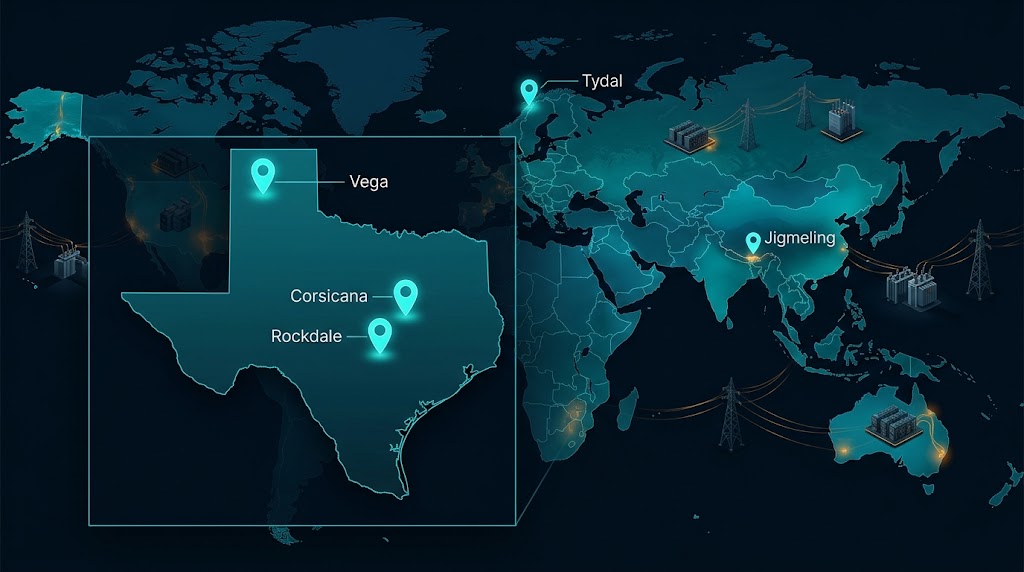
When you talk about US-based Bitcoin mining, Riot’s Rockdale facility is easily one of the most iconic names in the space. Located right in the heart of Texas, this massive operation has been humming along and scaling up since 2020.
The facility has 700 MW of developed power capacity across seven buildings. Riot uses both immersion cooling and air cooling, allowing different parts of the site to operate with different mining and computing configurations.
The Rockdale site is also becoming more flexible. Riot says its existing infrastructure can support Bitcoin mining as well as other data center operations.
Technical Overview
| Specification | Details |
|---|---|
| Location | Rockdale, Texas |
| Country | United States |
| Operator | Riot Platforms |
| Developed power capacity | 700 MW |
| Buildings | 7 |
| Construction started | 2019 |
| Operations began | 2020 |
| Hashrate | Not publicly disclosed for the site |
| Cooling | Immersion cooling + air cooling |
| Main use | Bitcoin mining and data center operations |
| Power market | ERCOT |
Rockdale's biggest advantage is its scale. A 700 MW site provides enormous electrical capacity and allows Riot to deploy large numbers of mining machines while maintaining flexibility for future computing applications.
2. Riot Platforms – Corsicana, Texas
Riot's Corsicana facility is another massive project in Texas. The site was designed with up to 1 GW of approved power capacity, making it one of the largest single-site developments in the Bitcoin mining industry.
The first phase was developed with 400 MW for Bitcoin mining, while Riot has been evaluating other uses for part of the remaining capacity, including AI and high-performance computing.
The site began construction in 2023 and became operational in 2024. Riot's current information shows 1 GW of total approved capacity, with the company developing the site for large-scale data center applications as well as mining.
Technical Overview
| Specification | Details |
|---|---|
| Location | Corsicana, Texas |
| Country | United States |
| Operator | Riot Platforms |
| Total approved capacity | Up to 1 GW |
| Initially developed for Bitcoin mining | 400 MW |
| Currently energized | 288 MW |
| Construction started | 2023 |
| Operations began | 2024 |
| Hashrate | Not publicly disclosed for the site |
| Grid connection | 345 kV |
| Main use | Bitcoin mining, AI/HPC development |
Riot previously described Corsicana as potentially the world's largest Bitcoin mining facility by developed capacity when fully built. However, the company later shifted part of its development strategy toward AI and HPC, so the full 1 GW should not be described as current Bitcoin mining consumption.
3. Bitdeer – Jigmeling, Bhutan
Jigmeling is one of the most interesting large-scale Bitcoin mining projects outside North America.
Located in Bhutan, the project was developed by Bitdeer with a planned electrical capacity of 500 MW. The project was completed and became an online crypto site, with energization taking place in phases as mining equipment was delivered.
The project uses hydro-cooling technology, which is particularly relevant for high-density ASIC mining.
Technical Overview
| Specification | Details |
|---|---|
| Location | Jigmeling, Bhutan |
| Country | Bhutan |
| Operator | Bitdeer |
| Power capacity | 500 MW |
| Status | Online |
| Hashrate | Not publicly disclosed for the site |
| Cooling | Hydro cooling |
| Main mining hardware | Bitdeer SEALMINER series |
| Grid infrastructure | 132 kV and 220 kV substations |
| Energization | Phased deployment |
Bitdeer reported that the project had completed construction and that its mining infrastructure was being energized according to the delivery schedule of SEALMINER machines.
The combination of very large power capacity and hydro-based cooling makes Jigmeling one of the most notable Bitcoin mining projects in Asia.
4. Bitdeer – Tydal, Norway
Tydal is another large Bitdeer mining site, but it is very different from the Texas facilities.
The project is located in Norway and uses hydro cooling. Bitdeer completed a major 175 MW hydro-cooled expansion, bringing the site's total electrical capacity to around 225 MW in its infrastructure reporting.
Norway also gives the project access to a power system dominated by renewable electricity, making the site particularly interesting from an energy perspective.
Technical Overview
| Specification | Details |
|---|---|
| Location | Tydal, Norway |
| Country | Norway |
| Operator | Bitdeer |
| Total site capacity | Up to 225 MW |
| Major expansion | 175 MW |
| Status | Online |
| Hashrate | Not publicly disclosed for the site |
| Cooling | Hydro cooling |
| Mining hardware | Bitdeer SEALMINER series |
| Power source | Norwegian grid |
| Current strategy | Crypto mining with planned infrastructure conversion |
Bitdeer has also been evaluating the future use of its Tydal infrastructure for other data center applications. This shows how large mining facilities are increasingly being designed with flexibility in mind.
5. Hut 8 – Vega, Texas
Hut 8's Vega facility is smaller in power capacity than the giant Riot and Bitdeer campuses, but it stands out because of its very high computing density.
Vega has 205 MW of nameplate power capacity and is designed to support up to approximately 15 EH/s of Bitcoin mining hashrate.
The facility can host up to 17,280 BITMAIN U3S21EXPH ASIC miners. Each machine can deliver up to 860 TH/s at approximately 13 J/TH.
Unlike traditional air-cooled mining farms, Vega uses direct-to-chip liquid cooling. Hut 8 says the facility uses 96 custom cooling modules circulating a glycol-water solution through a closed-loop system.
Technical Overview
| Specification | Details |
|---|---|
| Location | Texas |
| Country | United States |
| Operator | Hut 8 |
| Power capacity | 205 MW |
| Maximum hashrate | ~15 EH/s |
| ASIC miners | Up to 17,280 BITMAIN U3S21EXPH |
| ASIC hashrate | Up to 860 TH/s each |
| ASIC efficiency | 13 J/TH |
| Cooling | Direct-to-chip liquid cooling |
| Facility size | 162,000 sq. ft. |
| Initial energization | June 2025 |
Hut 8 describes Vega as one of the largest single-building Bitcoin mining facilities by nameplate hashrate. Its combination of high-density ASIC deployment and liquid cooling makes it particularly different from older large mining farms.
Comparing the Five Mining Farms
| Mining Farm | Country | Power Capacity | Hashrate | Cooling |
|---|---|---|---|---|
| Riot Rockdale | USA | 700 MW | Not disclosed | Immersion + Air |
| Riot Corsicana | USA | Up to 1 GW approved | Not disclosed | Not fully disclosed |
| Bitdeer Jigmeling | Bhutan | 500 MW | Not disclosed | Hydro |
| Bitdeer Tydal | Norway | Up to 225 MW | Not disclosed | Hydro |
| Hut 8 Vega | USA | 205 MW | ~15 EH/s | Direct-to-chip liquid |
Final Thoughts
The scale of modern Bitcoin mining farms is changing rapidly. Facilities such as Rockdale and Jigmeling are built around hundreds of megawatts of power, while projects such as Vega show how modern ASIC mining is moving toward much higher computing density and advanced liquid cooling.
Another important trend is the growing connection between Bitcoin mining and AI data centers. Large mining sites already have valuable assets such as power connections, substations, fiber, land, cooling systems, and large industrial buildings. This is why some mining companies are now designing their infrastructure to support more than Bitcoin mining alone.
For miners, the biggest question is no longer simply how many ASICs a farm can install. Power availability, energy cost, cooling efficiency, grid infrastructure, and the ability to adapt the site may be just as important.