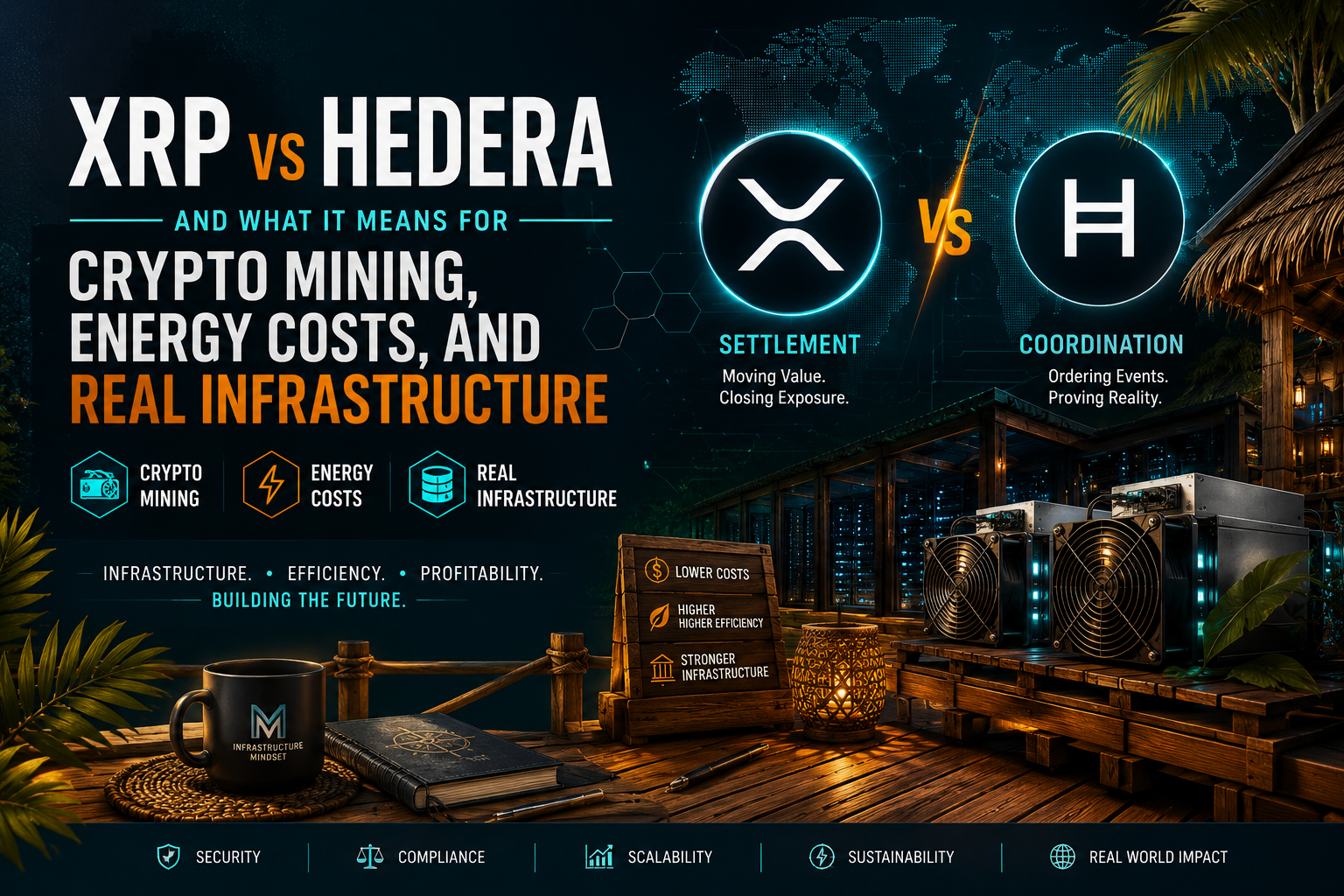
The crypto industry loves simple battles: one coin versus another, one chain to “win,” one standard to rule everything. You see this clearly in debates like XRP vs Hedera (HBAR), where the conversation is often reduced to price action, partnerships, or headlines about “institutional adoption.” But that framing misses a much bigger and more practical reality—especially if you care about crypto mining, infrastructure costs, electricity prices, and long-term profitability.
Institutions do not build systems the way retail investors build portfolios. They don’t pick one token and bet everything on it. They assemble stacks: different layers for custody, settlement, compliance, coordination, and risk management. That difference matters, not just for investors, but also for miners, data center operators, and anyone trying to understand where real demand for blockchain infrastructure actually comes from.
In this article, we’ll break down the real structural difference between Ripple/XRP and Hedera, explain how this relates to infrastructure thinking, and connect it to the world of crypto mining economics—from ASIC vs GPU decisions to electricity costs, cooling, and efficiency. The goal is not hype. It’s to help you understand how these systems fit into the broader picture of energy, cost, and real-world deployment.
Understanding the Bigger Picture: Tokens vs Infrastructure
Retail Thinking vs Institutional Thinking
The difference between retail and institutional thinking is not about preference—it is about how real systems are designed, deployed, and scaled.
Retail vs Institutional Thinking
| Aspect | Retail Perspective | Institutional Perspective |
|---|---|---|
| Focus | Price, speed, hype | Risk, compliance, integration |
| Decision Model | Single asset bet | Layered infrastructure stack |
| Key Question | Which coin wins? | What problem does this solve? |
| Risk View | Short-term volatility | Operational + regulatory risk |
This difference explains why debates like XRP vs HBAR keep going in circles. They compare tokens as if they were interchangeable products. In reality, institutions compare functions and risk categories, not just assets.
For miners and infrastructure builders, this distinction is crucial. Demand for blockspace, transactions, or network usage ultimately drives network fees, hardware demand, and energy consumption. If you misunderstand what a network is actually optimized for, you’ll misunderstand its long-term economic footprint.
Two Core Infrastructure Problems: Coordination and Settlement
At a structural level, blockchain systems solve two very different problems:
Coordination vs Settlement (Infrastructure Comparison)
| Layer | Purpose | Typical Use Case | Economic Impact |
|---|---|---|---|
| Coordination | Ordering events, timestamps, audit trails | Supply chains, compliance logs, data integrity | High volume / low value |
| Settlement | Moving value, finality, closing exposure | Payments, liquidity, treasury operations | Lower volume / high value |
This distinction shapes fee markets, infrastructure demand, and long-term network economics.
When people say “blockchain infrastructure,” they usually mix together two very different problems:
1. Coordination and Verification
This layer is about:
-
Ordering events
-
Timestamps
-
Audit trails
-
Proving that something happened, when it happened, and in what sequence
-
Reducing disputes between different organizations
This is the world of data integrity, verifiability, and operational trust. It’s not primarily about moving money. It’s about proving reality in a shared, tamper-evident way.
2. Settlement and Value Transfer
This layer is about:
-
Moving value
-
Finality of transactions
-
Closing exposure windows
-
Liquidity and balance sheet changes
-
Discharging obligations
This is the world of payments, treasury operations, and financial settlement.
Most modern Layer 1 blockchains can technically do both. But in practice, commercial positioning matters more than theoretical capability. Networks tend to optimize around one center of gravity. That choice affects how they are used, who uses them, and what kind of infrastructure grows around them—including mining or validator economics.
Hedera’s Position: Trust and Coordination Primitives
XRP vs Hedera (Infrastructure & Economic Impact)
| Category | XRP (Ripple) | Hedera (HBAR) |
|---|---|---|
| Core Focus | Settlement & payments | Coordination & verification |
| Primary Use Case | Cross-border value transfer | Data integrity & audit trails |
| Infrastructure Model | Vertical integration | Modular services |
| Economic Pattern | High-value transactions | High-volume events |
| Impact on Infrastructure | Liquidity + settlement rails | Enterprise coordination layer |
| Relevance to Mining | Indirect (fee & liquidity driven) | Indirect (data usage driven) |
This comparison highlights a deeper reality: these networks are not direct competitors in the traditional sense, but different infrastructure philosophies with different economic centers of gravity.
What Hedera Actually Offers
Hedera is often described as “enterprise-grade,” but that label can be vague. More concretely, it offers:
-
Hedera Consensus Service (HCS): A service for verifiable timestamps and ordered events, sometimes described as a decentralized notary. Data doesn’t need to be stored fully on-chain; the system provides proof of order and time.
-
Hedera Token Service (HTS): Native tokenization through APIs, allowing organizations to create and manage tokens without writing complex smart contracts.
-
Stablecoin Studio: Tooling for issuing and managing stablecoins with compliance features and integrations, including support for proof-of-reserves style workflows.
These are real product surfaces, not just marketing slogans.
What Problem This Solves
From an institutional perspective, these tools mainly reduce coordination risk:
-
Disputes about what happened and when
-
Audit complexity across multiple organizations
-
Integrity of shared workflows
-
Compliance reporting and verification
This does not automatically mean Hedera is trying to be the world’s main settlement rail for global payments. It can be extremely useful as a trust layer without being the primary system that moves trillions in value every day.
For miners and infrastructure planners, this matters because coordination-focused systems often have different performance, fee, and resource usage profiles than pure settlement-focused networks.
Ripple’s Direction: Settlement and Vertical Integration
What Ripple Is Building
Ripple has spent years focusing on cross-border payments and settlement. Over time, it has expanded its product stack to include:
-
Custody solutions
-
Liquidity access
-
Prime brokerage-style services (Ripple Prime)
-
Regulated stablecoin products
-
Corporate treasury and institutional tooling
The pattern is clear: Ripple is moving toward a vertically integrated financial infrastructure stack. The goal is to offer institutions an end-to-end solution for:
-
Holding assets
-
Issuing assets
-
Moving assets
-
Managing risk and compliance
-
Settling obligations
Why Vertical Integration Matters
In enterprise software and financial infrastructure, vertical integration has real advantages:
-
Fewer vendors to manage
-
Lower integration risk
-
Clearer compliance responsibility
-
Simpler operational workflows
If one provider can handle custody, issuance, liquidity, and settlement, many institutions will prefer that over assembling a complex modular stack themselves.
This is a very different strategy from focusing mainly on coordination and trust primitives.
Vertical Stacks vs Modular Infrastructure
This is the real debate hiding behind “XRP vs HBAR”:
-
Vertical model: One stack tries to cover as much of the workflow as possible—custody, issuance, compliance, liquidity, settlement, reporting.
-
Modular model: Institutions pick best-in-class components for each layer—one system for coordination, another for settlement, another for custody, and so on.
In the real world, large organizations almost never rely on a single vendor for everything. They diversify:
-
Multiple custodians
-
Multiple liquidity venues
-
Multiple cloud providers
-
Multiple messaging and data systems
They do this for risk management, regulatory reasons, and resilience. This suggests the future is likely to remain at least partly modular, even if some vertically integrated stacks become very popular.
What This Means for Crypto Mining Economics
Mining Is an Infrastructure Business, Not a Token Bet
Whether you run ASIC miners or GPU rigs, your business is fundamentally about:
-
Electricity cost per kWh
-
Hardware efficiency (J/TH or MH/W)
-
Cooling and facility design
-
Uptime and reliability
-
Network fees and usage
The type of blockchain usage that grows around a network influences:
-
Transaction volume
-
Fee markets
-
Hardware demand
-
Validator or miner revenue
-
Long-term energy consumption
Settlement-heavy networks tend to drive high-value, time-sensitive transactions, which can support higher fees. Coordination-focused networks may drive high-volume, low-value event logging, which has a different economic profile.
ASIC vs GPU Considerations
ASIC mining is typically optimized for specific algorithms and networks with strong, predictable fee and block reward structures. It benefits from scale, cheap electricity, and efficient cooling.
GPU mining (or compute workloads) is more flexible and can adapt to different chains or tasks, but usually faces tighter margins and more volatile profitability.
If a network’s future demand is more about enterprise coordination than pure value transfer, it may not create the same fee dynamics as a settlement-focused chain. That doesn’t make it “bad,” but it does change the infrastructure economics around it.
Energy Costs, Cooling, and Efficiency Still Rule Everything
No matter which narrative wins, mining and validation infrastructure always comes back to energy and efficiency:
-
Electricity is usually 60–80% of operating costs in large mining farms.
-
Cooling can add another significant overhead, especially in hot climates.
-
Hardware efficiency determines how competitive you remain as difficulty and network usage change.
Key factors to watch:
-
Cost per kWh: Below $0.05/kWh is often considered competitive for large-scale operations, though this varies by market and hardware.
-
Power Usage Effectiveness (PUE): Data center efficiency matters as much as hash rate.
-
Heat reuse and immersion cooling: Increasingly important for long-term cost control.
-
Grid stability and demand response: Some miners already act as flexible load for power grids, which can improve profitability.
These realities matter far more to your bottom line than any single headline about “institutional adoption.”
A Practical Example: Layered Enterprise Workflows
Imagine a real enterprise process:
-
Multiple companies need a shared, tamper-evident record of events (shipments, compliance checks, reserve attestations).
-
That’s a coordination problem: ordering, timestamps, auditability.
-
Separately, when certain conditions are met, a payment or collateral movement must happen.
-
That’s a settlement problem: moving value, closing exposure.
In a modular world:
-
One network or service could handle the coordination layer.
-
Another system could handle the settlement layer.
-
The enterprise integrates both internally, without the networks needing a formal partnership.
In a vertical world:
- One provider might try to cover both layers in a single stack.
Neither approach is guaranteed to “win” everywhere. Different industries, jurisdictions, and risk profiles will choose differently.
Market Trends Miners Should Actually Watch
Instead of focusing only on token debates, miners and infrastructure investors should track:
-
Real transaction growth: Is the network seeing more economic activity or just more marketing?
-
Fee market development: Are fees becoming a meaningful part of revenue, or is everything still subsidized?
-
Hardware demand cycles: Are new ASICs or accelerators being designed for these workloads?
-
Energy policy and grid integration: Are miners gaining access to cheaper, more flexible power?
-
Enterprise usage patterns: Are companies actually deploying these systems in production, or just running pilots?
These factors will shape long-term profitability far more than social media narratives.
Conclusion: Think in Layers, Not in “Winners”
The XRP vs Hedera debate is often framed as a competition between two tokens. In reality, it’s a debate between two infrastructure philosophies:
-
Settlement-focused, vertically integrated financial stacks
-
Coordination-focused, modular trust and tokenization primitives
Institutions don’t choose “a coin.” They choose architectures, vendors, and risk models. For miners and infrastructure builders, the smart move is to focus on energy efficiency, cost control, and real usage growth, not tribal arguments.
The future of crypto infrastructure is unlikely to be one chain that does everything. It’s more likely to be layers, stacks, and overlapping systems, just like the rest of the global financial and data center world.
FAQ: Crypto Mining, Infrastructure, and Institutional Blockchains
Q1. Does XRP or Hedera affect mining profitability directly?
Not directly in the way proof-of-work coins do, but their usage patterns influence overall infrastructure demand, fee markets, and data center investment trends.
Q2. Is ASIC mining still more profitable than GPU mining in 2026?
In most cases, yes—if you have access to cheap electricity and efficient cooling. ASICs are more efficient but less flexible. GPUs offer flexibility but usually lower margins.
Q3. What electricity price do large mining farms target?
Many aim for below $0.05 per kWh, and the most competitive operations try to get closer to $0.02–$0.03 per kWh through location, contracts, or grid services.
Q4. How important is cooling compared to hardware choice?
Very important. Poor cooling can destroy efficiency gains from good hardware. Techniques like immersion cooling or heat reuse can significantly improve long-term economics.
Q5. Will institutional adoption reduce or increase mining demand?
It can increase demand for reliable, efficient infrastructure, but it may not always translate into higher fees or rewards. It depends on how the network is actually used.
Q6. Should miners care about vertical vs modular blockchain stacks?
Yes, because it affects where usage, fees, and infrastructure investment concentrate—and that shapes long-term revenue opportunities.
Q7. What’s the most important metric for a mining operation?
Net profit per kWh consumed. Everything—hardware, cooling, uptime, and strategy—ultimately feeds into that single number.