
Introduction
If you take a look at what drives the expanding world of Artificial Intelligence, high-performance computing, and cryptocurrency mining, everything boils down to one simple factor: cheap, reliable electricity.
Running thousands of high-end GPUs or ASIC mining rigs requires megawatts of continuous power. For these operations, electricity isn't just an overhead expense—it can easily make up 70% to 90% of total running costs. That’s why operators constantly scan the globe for countries with stable grids and low power prices. In places where the grid relies heavily on thermal power plants, electricity prices are tied directly to the availability of local fossil fuels. A country with its own natural gas can keep power supplies steady and protect its market from wild swings in global energy prices.
As tracked on our site's electricity price benchmarks, comparing local per-kilowatt-hour (kWh) rates alongside underlying fuel reliability remains the first thing institutional investors look at before committing millions into data center infrastructure.
From Import Dependency to Natural Gas Independence
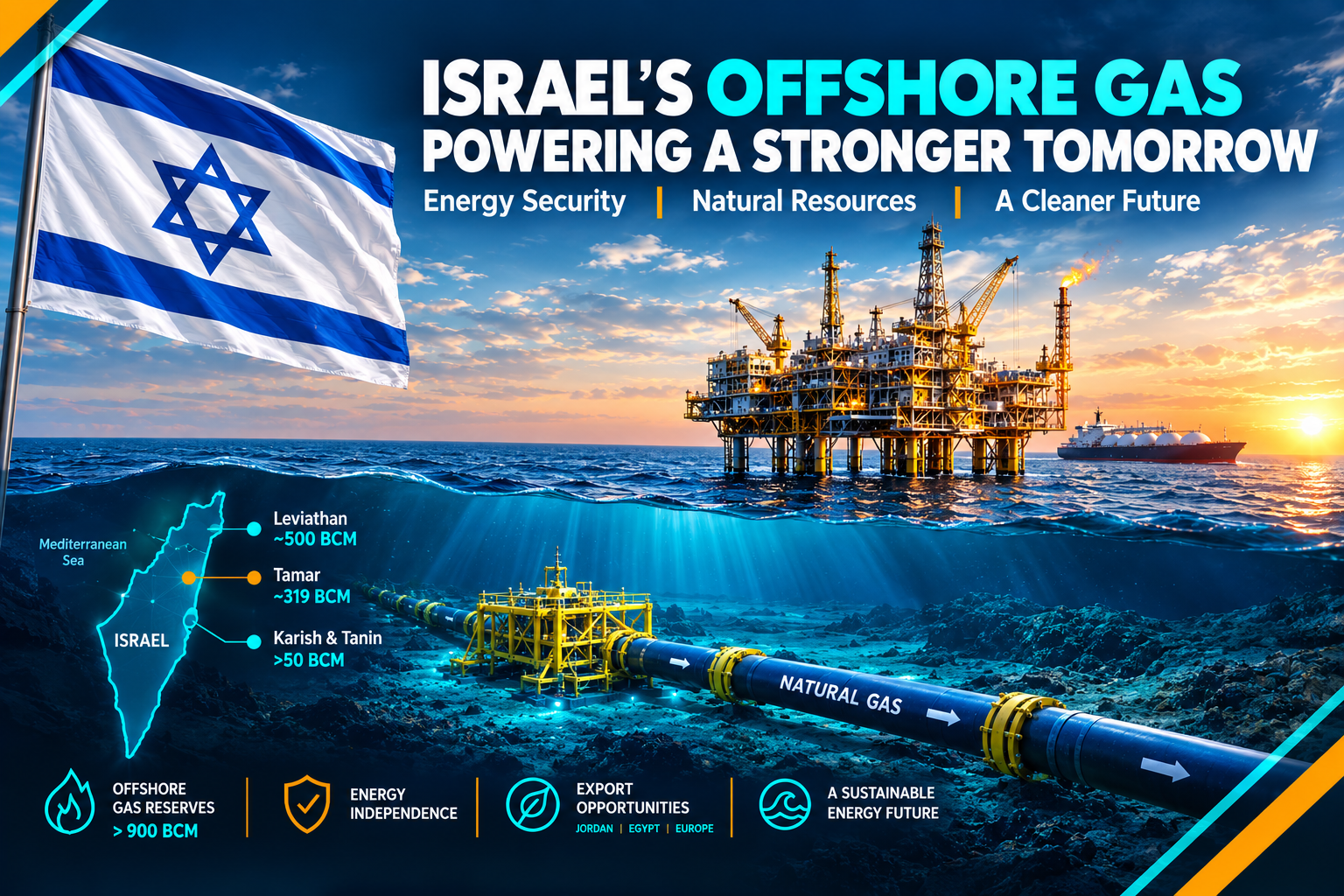
To understand where Israel stands today, you have to look at how dramatically its fuel supply has changed over the last fifteen years. For decades, the country had to import almost all of its fuel. That dynamic flipped with a series of massive offshore gas discoveries in the Mediterranean:
-
Tamar (2009): Holding roughly 319 billion cubic meters (BCM) of natural gas, Tamar came online in 2013 and gave the domestic market its first real taste of energy independence.
-
Leviathan (2010): A massive discovery with an estimated 500 BCM in reserves. It started commercial production in late 2019.
-
Karish and Tanin: Smaller fields discovered between 2012 and 2013, adding over 50 BCM to the total reserve pool.
All told, Israel sits on over 900 BCM of proven natural gas reserves.
This fuel abundance allowed the Ministry of Energy to set a firm target: completely phase out coal-fired power generation by 2025. Natural gas now fires around 70% of Israel's electricity generation, with gas also replacing heavy fuel oil and diesel across domestic industrial plants.
Because domestic consumption hovers around 12 BCM a year, there is plenty of room for export. Israel has signed major export deals totaling 83 BCM to supply Jordan and Egypt, while actively exploring options to supply Europe through Eastern Mediterranean pipelines or LNG setups.
The 2024 Energy Numbers: Production Closes the Gap
Fresh data from 2024 shows just how far this domestic energy expansion has come. For the first time in modern history, primary energy production has practically caught up with domestic consumption.
Israel 2024 Energy Snapshot
| Metric | Value | Global Rank / Details |
|---|---|---|
| Primary Energy Production | 1.09 Exajoules (EJ) | #48 |
| YoY Production Growth | +10.4% | — |
| Production Fuel Source | 97.3% Fossil Fuel | 2.7% Renewables |
| Primary Energy Consumption | 1.10 Exajoules (EJ) | #54 |
| YoY Consumption Growth | +0.71% | — |
| Per Capita Consumption | 117.1 Gigajoules | #56 |
| Consumption Fuel Mix | 99.4% Fossil Fuel | 0.6% Low-Carbon |
To put these numbers into context:
-
Production reached 1.09 Exajoules (EJ) in 2024, up 10.4% from 0.99 EJ in 2023. That accounts for about 0.17% of all primary energy produced globally.
-
Consumption hit 1.10 EJ in 2024, a slight 0.71% bump from 2023. On a per-person basis, that works out to 117.1 Gigajoules annually.
-
Fossil fuels dominate the mix. Of the primary energy consumed in 2024, fossil fuels (gas, oil, and remaining coal) made up 99.4%, while renewables sat at just 0.6%.
Looking back at historical data from 1980 through the 2000s, Israel produced almost no primary energy of its own—generating a tiny 0.0055 EJ in 1980 while consuming 0.38 EJ. Even by 2010, local production was only at 0.06 EJ against 0.99 EJ of consumption. The jump to 1.09 EJ of output in 2024 represents a complete turnaround of the country's primary energy balance.
What This Means for AI Data Centers and Mining Operations
A grid backed by domestic gas gives Israel something rare: bulletproof energy security. But having reliable power on tap doesn't automatically make a country a prime haven for power-hungry AI clusters or crypto mining operations. Turning raw fuel into functional gigawatts comes with a completely different set of structural headaches.
The reality comes down to a few practical trade-offs:
-
Power Price vs. Grid Reliability: Having domestic gas keeps the grid stable and protects against foreign supply shocks. However, retail and industrial electricity tariffs in Israel are still significantly higher than in dedicated crypto-mining regions (like parts of North America, Scandinavia, or heavily subsidized areas in the Gulf). You can cross-check these exact figures against our live electricity price tracker.
-
Climate and Space Constraints: High-density compute thrives on cheap dirt and cold air—two luxuries Israel simply doesn't have. A warm Mediterranean climate inflates cooling bills right out of the gate, forcing operators to run heavy chillers or invest in direct-to-chip liquid cooling loops. Factor in steep land prices, and sprawling, low-cost server halls become economically non-viable very quickly.
-
AI vs. Raw Crypto Mining: Proof-of-Work Bitcoin mining relies almost exclusively on finding the lowest possible kWh price—margins are paper-thin, so high power costs are a dealbreaker. AI data centers, on the other hand, care deeply about low latency, fiber infrastructure, grid reliability, and proximity to engineering teams.
While Israel’s natural gas reserves ensure a stable, self-sufficient grid, local energy pricing and physical constraints mean the country is far better suited for specialized, high-margin AI research infrastructure than for massive, ultra-low-cost crypto mining farms.
Frequently Asked Questions
Q1: How do electricity costs in Israel compare to popular crypto-mining spots?
Businesses in Israel usually pay around $0.11 to $0.13 per kilowatt-hour for their electricity. On the flip side, big Bitcoin miners are always chasing dirt-cheap power—usually looking for rates between $0.03 and $0.06 in places like Paraguay or Scandinavia. Because of that price gap, setting up a massive crypto mining farm in Israel just doesn't make much financial sense.
Q2: Why is Israel a better fit for AI projects rather than Bitcoin mining?
Think of Bitcoin mining as a race to find the absolute cheapest electricity—that's basically all that matters for their profit margins. The facilities that power AI, however, play by different rules. They need super-fast internet connections, a power grid that never blinks, and to be right next door to top-tier software engineers. Israel has an incredible tech scene and highly reliable power, which makes it a great home for advanced tech projects, even if the monthly electricity bill is a bit higher.
Q3: Does Israel's heavy use of fossil fuels clash with big companies' green energy goals?
It definitely can be a hurdle. In 2024, almost all of the energy Israel produced and used came from fossil fuels. For global tech giants that have promised to go 100% carbon-free, relying on a gas-heavy grid is a real challenge. However, Israel is actively working to change this and is aiming to bump up its green energy—mostly through large solar farms and battery storage—to 30% by 2030.
Q4: How do the weather and real estate affect data center costs in Israel?
Running thousands of powerful computers packed tightly together generates a ton of heat. Israel’s warm Mediterranean weather means companies have to spend a fortune on heavy-duty air conditioning and advanced liquid cooling just to keep the machines from overheating. Combine those high cooling bills with very expensive real estate, and building huge, sprawling server warehouses becomes pretty pricey compared to building them in colder, more open countries.
Q5: Why is having its own natural gas such a big deal for Israel's tech infrastructure?
Not too long ago, Israel had to import almost all its fuel, which meant the local power grid was at the mercy of global supply chains and international price spikes. Now, thanks to massive offshore gas discoveries, local natural gas covers about 70% of the country's electricity. For tech companies that absolutely cannot afford a power outage, this means they get a secure, steady flow of electricity without having to worry about international fuel shortages or shipping delays.
References & Data Sources
- Ministry of Energy (Israel): Transforming the Future of Energy Report (PDF)
- U.S. Energy Information Administration (EIA) / Worldometer: Israel Primary Energy Production & Consumption Data (2024)
- Startup Nation Central: EnergyTech Ecosystem & Innovation Map (PDF)