
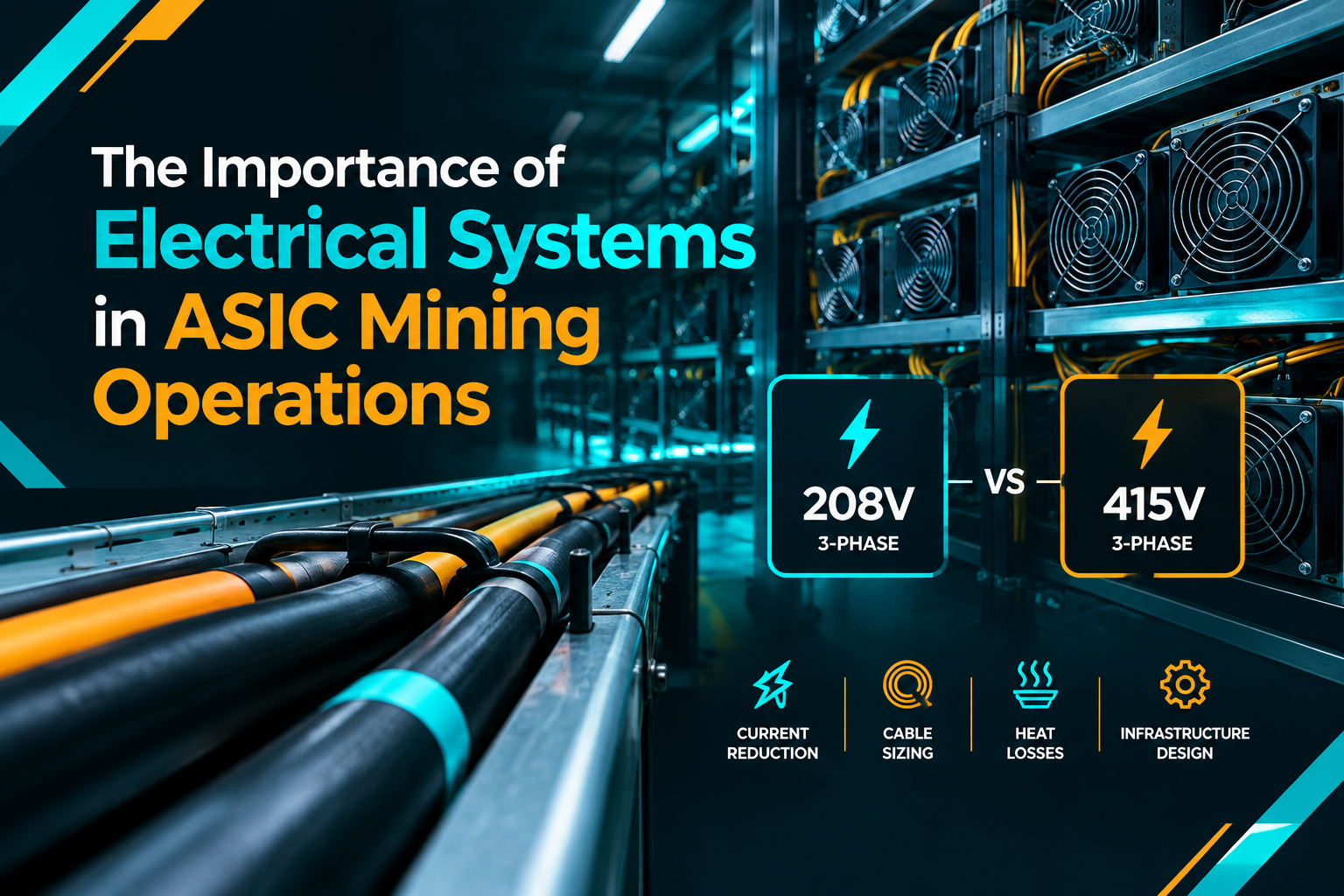
The Importance of Electrical Systems in ASIC Mining Operations
When an ASIC mining operation grows beyond a small installation, the electrical system becomes just as important as the mining hardware itself.
A 100 kW mining setup may look simple on paper: connect the miners, supply them with electricity, and keep them running. In practice, however, the voltage used to distribute that power can have a major effect on current, cable sizing, voltage drop, heat losses, and the overall design of the electrical infrastructure.
This is where the difference between 208V and 415V three-phase power becomes important.
For a small installation, the difference may not justify a major change in electrical architecture. But once a mining farm reaches 100 kW, 250 kW, 500 kW, or more, reducing unnecessary current can become a significant advantage.
Why Voltage Matters in a Large Mining Farm
The basic relationship is straightforward:
Power = Voltage × Current
For a three-phase system, the relationship is:
P = √3 × V × I × PF
where:
- P is power in watts
- V is line-to-line voltage
- I is current
- PF is power factor
Assuming the same power and approximately the same power factor, increasing the voltage reduces the current required to deliver that power.
This is particularly useful for ASIC mining because modern mining facilities can operate continuously at very high electrical loads.
Consider a simplified 100 kW installation operating at a power factor close to 1.
At approximately 208V three-phase:
I ≈ 100,000 / (√3 × 208) ≈ 278A
At approximately 415V three-phase:
I ≈ 100,000 / (√3 × 415) ≈ 139A
The 415V system therefore needs roughly half the current to deliver the same 100 kW.
That difference becomes increasingly important as the mining farm grows.
208V vs 415V at 100 kW
A simple comparison illustrates the effect:
| Mining Load | 208V 3-Phase | 415V 3-Phase |
|---|---|---|
| 100 kW | ~278 A | ~139 A |
| 250 kW | ~694 A | ~348 A |
| 500 kW | ~1,388 A | ~696 A |
| 1 MW | ~2,776 A | ~1,391 A |
These are simplified calculations assuming a power factor of 1. Actual operating current will depend on the power factor, PSU efficiency, load characteristics, and electrical configuration.
The important point is the relationship: doubling the distribution voltage approximately halves the current for the same power.
For a large ASIC farm, that can have consequences throughout the electrical system.
The Real Difference: Resistive Power Loss
One of the most important reasons to reduce current is conductor loss.
The power dissipated as heat in a conductor is commonly expressed as:
P loss = I² × R
This is important because the current is squared.
If current is reduced by half, resistive losses in the same conductor resistance fall to approximately one-quarter.
For example, imagine that the electrical distribution system has a certain resistance and must deliver the same 100 kW load.
If the 208V system carries approximately 278A and the 415V system carries approximately 139A, the current ratio is about 2:1.
The theoretical I²R relationship therefore gives:
(278 / 139)² ≈ 4
In other words, under the same conductor-resistance assumptions, the higher-voltage distribution system can have roughly one-quarter of the resistive conductor losses.
This does not mean that the entire mining farm automatically becomes 75% more efficient. The miners themselves, their PSUs, transformers, cooling systems, and other equipment still consume energy.
The comparison specifically concerns the losses associated with electrical distribution.
Why This Matters More as Mining Farms Get Larger
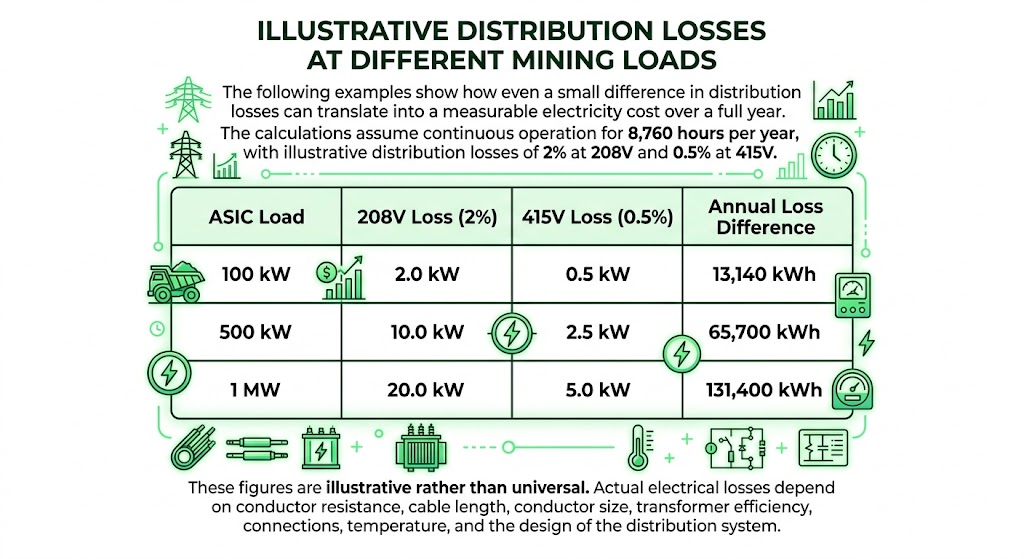
A few hundred watts of electrical distribution loss may not seem significant in a small installation.
At 1 MW, however, even a small percentage of unnecessary electrical loss can represent a substantial amount of energy.
ASIC miners typically operate 24 hours a day. A loss that occurs continuously becomes much more important over months and years.
This is one reason large industrial and data-center-style electrical installations often use higher distribution voltages.
The objective is not simply to give the ASIC more voltage. The objective is to move the required amount of power through the facility with less current.
Voltage Drop Becomes More Important at 208V
Voltage drop is another important consideration.
Every electrical conductor has resistance. When current flows through it, some voltage is lost between the source and the load.
The effect becomes more noticeable when:
- the electrical run is long,
- the conductor is undersized,
- the current is high,
- many loads share the distribution system,
- or the system is already operating close to its voltage limits.
This can be particularly relevant in mining facilities where the transformer or main electrical panel may be located some distance from the mining containers, racks, or ASIC rooms.
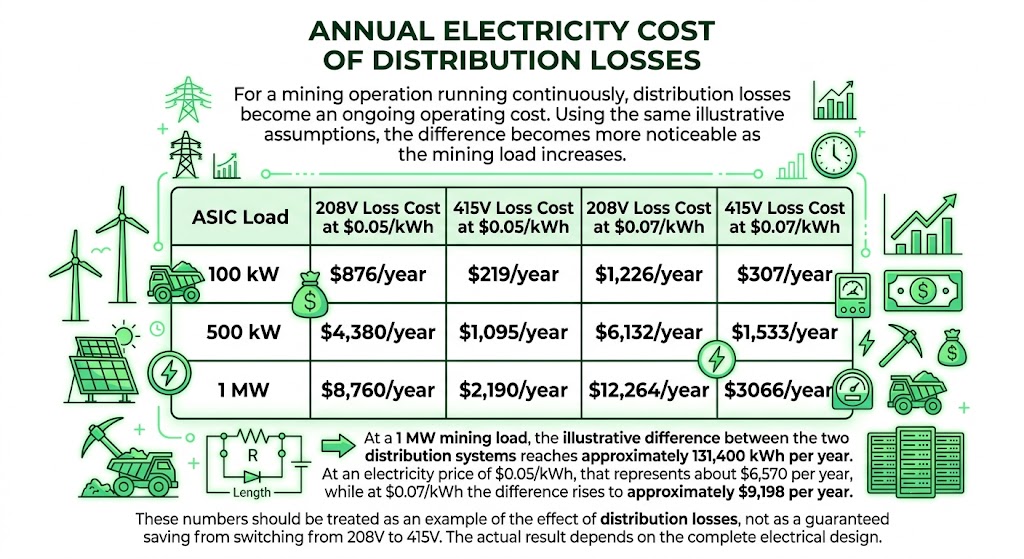
A 208V system requires substantially more current than a 415V system for the same power.
That higher current makes voltage-drop management more demanding.
For example, a 100 kW load requiring roughly 278A at 208V is considerably more demanding on a long feeder than the same load requiring approximately 139A at 415V.
This does not mean that 208V cannot be used for large mining operations. It means that the electrical distribution needs to be designed carefully.
Cable Size and Distribution Equipment
Lower current can also affect the physical electrical infrastructure.
Higher current generally requires:
- larger conductors,
- larger breakers,
- larger busbars,
- greater attention to thermal limits,
- and potentially more parallel conductors.
At 100 kW, the difference between approximately 278A and 139A is already substantial.
At 500 kW, the difference becomes much more difficult to ignore.
A 500 kW load at 208V three-phase can require approximately 1,388A under simplified assumptions.
At 415V, the same load requires approximately 696A.
That can influence the selection of:
- transformers,
- switchgear,
- distribution panels,
- busbars,
- feeders,
- breakers,
- cables,
- and power distribution units.
The higher-voltage architecture can therefore make the distribution side of a large mining farm more manageable.
415V Does Not Automatically Mean Lower Mining Costs
There is an important distinction here.
Using 415V instead of 208V does not automatically make an ASIC miner consume less electricity.
If the ASIC and its power supply require a certain amount of electrical power, the miner still needs approximately that amount of power regardless of whether the upstream distribution system operates at a higher voltage.
The potential savings come from how efficiently that electricity is distributed.
There are also conversion losses.
For example, if electricity is supplied at a higher distribution voltage and then transformed to another voltage before reaching the mining equipment, the transformer introduces its own losses.
The complete system therefore needs to be evaluated rather than looking at voltage alone.
The ASIC Power Supply Is the First Limitation
This is one of the most important points when designing a mining facility.
You cannot simply decide that 415V is better and connect a standard ASIC power supply directly to 415V.
The input voltage range specified by the PSU manufacturer must always be respected.
Many ASIC power supplies are designed around particular input-voltage ranges. Some support wide input ranges, while others are intended for specific electrical configurations.
A 415V three-phase distribution system may therefore feed transformers, PDUs, or other distribution equipment before the final voltage reaches the ASIC PSU.
The correct architecture depends on the equipment being installed.
The mining hardware should be selected first, followed by the electrical distribution design around its actual requirements.
208V Can Still Make Sense
There are situations where 208V is perfectly practical.
A smaller mining installation may already have 208V three-phase power available, particularly in a commercial or industrial building.
If the electrical runs are relatively short and the total load is moderate, the additional current may not justify rebuilding the entire distribution system.
For example, an existing facility with suitable transformers, panels, and wiring may be able to operate a mining installation efficiently at 208V.
The important question is not simply:
"Is 415V better than 208V?"
A better question is:
"Which distribution architecture delivers the required mining load safely and efficiently at the lowest overall infrastructure cost?"
Distance Changes the Equation
The physical layout of the mining facility should also influence the decision.
If the main electrical equipment is close to the ASIC racks, voltage drop may be relatively easy to control.
If power must travel a long distance to reach mining containers or remote buildings, current becomes more important.
A higher distribution voltage can reduce current and therefore help control voltage drop and conductor losses.
This becomes increasingly useful when a facility contains multiple mining areas connected to a central electrical distribution point.
For a large mining farm, designing the electrical network around the physical layout can be just as important as selecting the nominal voltage.
Future Expansion Should Be Considered
A mining facility rarely stays at exactly the same capacity forever.
A site may begin with 100 kW and later expand to 250 kW, 500 kW, or several megawatts.
Designing the electrical system only for the initial ASIC count can create problems later.
If future expansion is expected, the operator should consider:
- transformer capacity,
- available utility capacity,
- switchgear ratings,
- feeder capacity,
- spare breaker positions,
- cooling requirements,
- cable routes,
- and the expected future ASIC load.
Higher-voltage distribution can become particularly attractive when the planned expansion involves hundreds of kilowatts or megawatts of continuous load.
Power Factor Also Matters
Current calculations are often simplified by assuming a power factor close to 1.
Real installations should use the actual characteristics of the equipment.
Power factor affects the current required for a given amount of real power. A lower power factor means that more current is required to deliver the same useful power.
This can increase the burden on the electrical distribution system and contribute to voltage-drop and conductor-heating concerns.
Modern mining PSUs can have good power-factor characteristics, but the actual specification should be checked rather than assumed.
Safety Is Not Optional
Higher voltage can improve distribution efficiency, but it also increases the electrical hazard.
Running a 415V or 480V system isn't a simple plug-and-play swap—it takes proper electrical engineering, solid isolation, dedicated grounding, and strict maintenance protocols. At the end of the day, chasing lower line losses should never come at the expense of safety.
Any sizeable facility needs to be designed and commissioned by licensed electrical professionals who size the protection gear specifically for the real-world fault levels and heavy operating conditions on-site.
Conclusion: Which Voltage Makes More Sense for 100 kW+ Mining?
For a small installation, 208V can be perfectly reasonable, particularly when the infrastructure already exists.
As the continuous mining load increases, however, the advantages of higher-voltage distribution become more significant.
At 100 kW, the difference in current is already substantial:
-
208V three-phase: ~278A
-
415V three-phase: ~139A
At 500 kW:
-
208V three-phase: ~1,388A
-
415V three-phase: ~696A
That lower current can help reduce I²R losses, voltage drop, conductor requirements, and the overall burden placed on distribution equipment.
But the final decision should not be based on voltage alone.
The ASIC PSU input specification, transformer losses, cable length, conductor sizing, power factor, existing utility infrastructure, cooling system, expansion plans, and electrical installation costs all need to be considered together.
For a 100 kW+ ASIC mining operation, the electrical system should be treated as part of the mining infrastructure rather than simply a method of delivering power to the machines.
The miners may determine how much electricity the facility needs, but the distribution architecture determines how efficiently and reliably that electricity reaches them.