Introduction: The 2026 ASIC Mining Profitability Equation in a High-Difficulty Environment
In 2026, the mining landscape is defined by two brutal realities: all-time high network difficulty and volatile global energy prices. Mining is no longer a "set and forget" operation; it is a game of marginal gains. The technical truth is simple: reducing electricity costs is the most direct path to increasing net profit. Every $0.01 saved per kWh for a single high-power ASIC (e.g., 3500W) translates to roughly $306 in additional annual profit per machine. In a small farm of 10 units, that represents over $3,000 in pure bottom-line growth without the capital expenditure of buying new hardware.
Silicon Optimization for ASIC Efficiency: Undervolting and Auto-Tuning Techniques
The most immediate way to cut costs is by optimizing how the chips consume power at the board level. You can undervolt your ASIC chips by using custom firmware, like Braiins or VNish, to reduce the voltage they receive. This lowers power usage while maintaining most of the processing speed, improving energy efficiency per unit of work.
Our 2026 firmware introduced Dynamic Frequency Scaling with Auto-Tuning, which evaluates the silicon quality of each hashboard and adjusts frequency accordingly. Underperforming or overheating sections are slowed down, while efficient sections are pushed higher, ensuring optimal energy use without wasting power on inefficient circuits.
Advanced ASIC Cooling Strategies in 2026: Immersion Cooling vs Air Cooling Efficiency
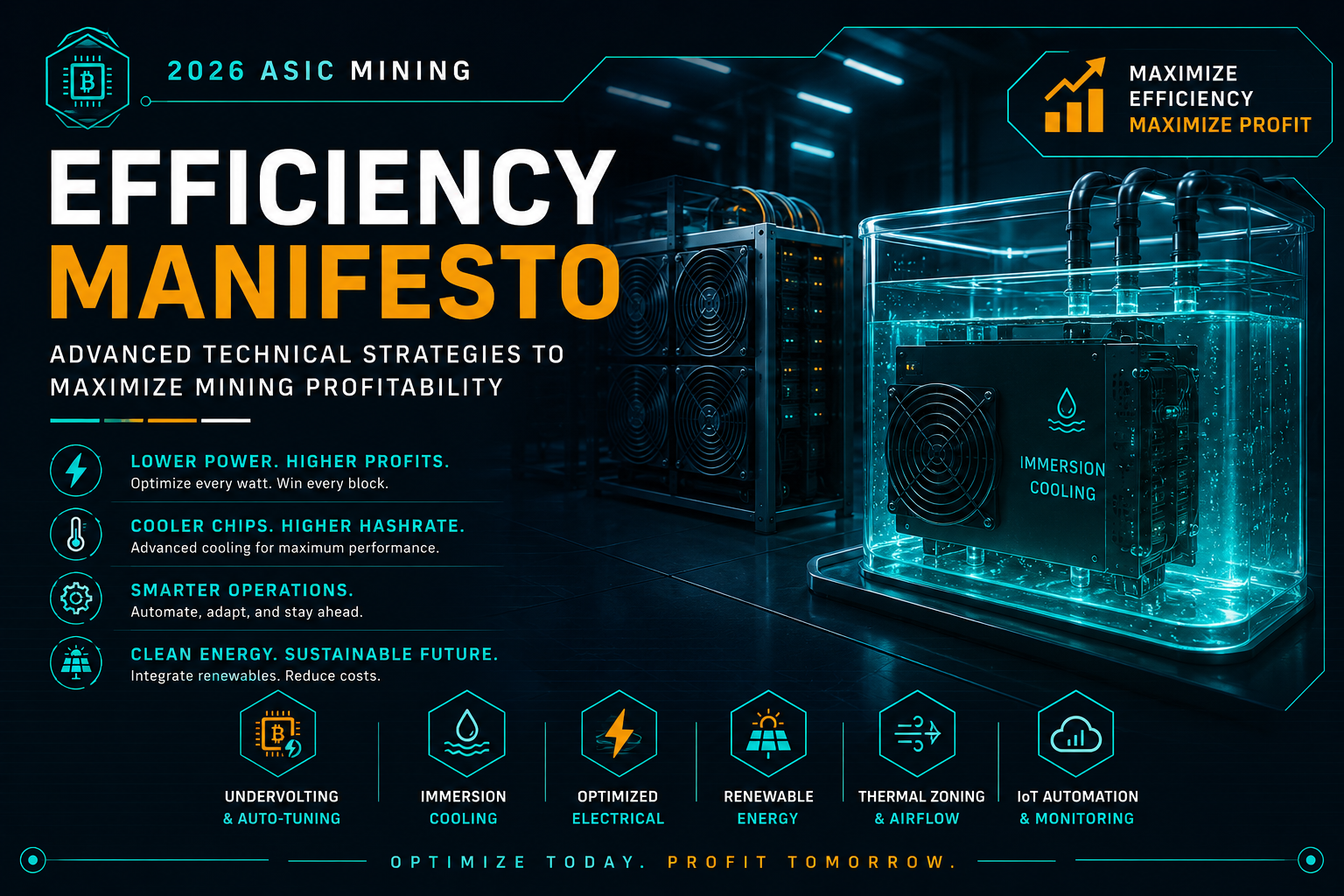
In 2026, traditional air cooling is often a hidden profit killer due to fan energy consumption and thermal resistance. Immersion cooling places ASICs directly into dielectric fluid, eliminating the need for internal fans that typically consume 5% to 10% of total power.
The table below summarizes the real-world impact of each optimization strategy on ASIC mining efficiency in 2026:
| Optimization Strategy | Power Saving | Efficiency Gain | Cost Impact | Complexity |
|---|---|---|---|---|
| Undervolting + Auto-Tuning | 5% – 15% | High | Very High | Medium |
| Immersion Cooling | 5% – 10% (Fan Removal) | Very High | Very High | High |
| High Voltage (240V / 415V) | 2% – 5% | Medium | High | Low |
| DC-Coupled Solar | 5% – 8% | High | Very High | High |
| Thermal Zoning (Air Cooling) | 3% – 7% | Medium | Medium | Medium |
| IoT Automation & Load Control | Variable | High | Very High | High |
Liquid cooling keeps your chips at a rock-solid temperature, which cuts down on power leakage and keeps everything running smoothly. But the real win is that you can actually recycle about 95% of that heat. Instead of just wasting it, you can run it through an exchanger to heat your water or your floors, turning a "waste" product into a massive cost-saver.
Electrical Infrastructure Optimization for Mining Farms: Voltage, Phase Balancing and Power Factor Control
Energy losses often occur before electricity even reaches the miner due to poor electrical design. Running miners on higher voltage (240V in the US or 415V 3-phase in Europe) reduces current for the same power load, minimizing I²R losses and improving PSU efficiency, which typically exceeds 94%.
Maintaining a power factor above 0.9 is essential. A low power factor leads to reactive power, increasing system stress and potentially resulting in penalty charges from utility providers.
Renewable Energy Integration for ASIC Mining: DC-Coupled Solar and Energy Storage Systems (ESS)
DC-Coupled Solar Systems: Traditional solar setups convert DC to AC and then back to DC for ASIC operation, causing unnecessary losses. DC-coupled systems feed solar energy directly into mining infrastructure, avoiding 5–8% conversion losses.
Peak Shaving with LFP Batteries: Battery storage can be programmed to discharge during peak electricity pricing and recharge during off-peak or solar surplus periods, ensuring miners avoid expensive grid power.
Thermal Zoning and Airflow Optimization for Air-Cooled ASIC Mining Facilities
If using air cooling, proper room design is critical to avoid thermal inefficiencies.
-
Cold/Hot Aisle Containment: Separating intake (cold) and exhaust (hot) air prevents recirculation, which increases internal resistance, forces fans to work harder, and reduces efficiency.
-
Positive Pressure Ventilation: Maintaining slightly higher pressure in the cold aisle improves airflow through heatsinks and prevents dust accumulation, which acts as a thermal insulator.
Smart Mining Automation and Real-Time IoT Monitoring for Cost Optimization
This approach involves creating an IoT dashboard connected to your mining pool, enabling dynamic load balancing. Instead of shutting down systems under stress conditions, operations can shift to efficiency mode by underclocking units.
Electricity arbitrage allows miners to pause operations during peak pricing periods and resume during lower-cost windows. This strategy, often automated, can significantly reduce annual energy costs.
Conclusion: The Evolving Skill Set of the 2026 Professional ASIC Miner
In 2026, mining is a brutal fight for every cent. If you’re wasting a few watts here or letting your rigs run even slightly too hot, you’re not just being inefficient—you’re basically burning your own cash.
Having a warehouse full of gear doesn't mean you've won anymore. The real advantage goes to the person who actually knows how to tune their machines. Today, you aren't just a "miner"—you’re playing a high-stakes game with energy grids and data. Being efficient isn't some extra perk; it’s the bare minimum just to stay in the game. If you aren't constantly tweaking your setup, the network is going to price you out of existence before you even realize what happened.
The future belongs to the people who live and breathe automation and treat their power usage like a science. Because at this level, making a profit isn't a stroke of luck. It’s a deliberate, hard-fought choice.
FAQ: ASIC Mining Efficiency and Profit Optimization in 2026
Q1: What is the most effective way to increase ASIC mining profitability in 2026?
The most effective strategy is reducing electricity cost per kWh. Even small reductions significantly impact annual net profit, especially in farms running multiple high-power ASIC units.
Q2: Is immersion cooling better than air cooling for Bitcoin mining?
Immersion cooling typically improves efficiency by eliminating internal fan consumption, stabilizing chip temperatures, reducing thermal stress, and enabling heat recovery.
Q3: How does undervolting improve ASIC efficiency?
Undervolting reduces the voltage supplied to ASIC chips, lowering power consumption while maintaining most of the hash rate. Combined with auto-tuning firmware, it optimizes performance per watt.
Q4: Why is high-voltage power supply recommended for mining farms?
Running miners at higher voltage reduces current, minimizes I²R losses, and improves PSU efficiency, lowering overall energy waste.
Q5: What is DC-coupled solar in crypto mining operations?
It connects solar generation directly to mining infrastructure, avoiding multiple energy conversions and reducing losses by approximately 5–8%.
Q6: How does electricity arbitrage work in ASIC mining?
It involves pausing mining during peak electricity pricing and resuming during off-peak periods, often managed through automated systems.
Q7: What skills will be essential for ASIC miners in 2026?
Automation, energy optimization, electrical fundamentals, firmware tuning, and data analytics will be critical for long-term profitability.