Introduction
Why Solar Technology Selection Matters for Modern Energy Infrastructure
The Power Grid is Evolving: Why Precision Solar Engineering is the Only Way Forward
The global energy landscape isn't just shifting; it's buckling under a fundamentally new kind of pressure. We are no longer simply powering cities—we are powering hyperscale intelligence and industrial-grade cryptographic consensus. As AI architectures relentlessly push the boundaries of "intelligence per watt" and massive crypto mining facilities demand unwavering, 24/7 base-load stability, our baseline electricity requirements have entered uncharted territory. Today, a single advanced data center can easily draw the power equivalent of a mid-sized municipality.
According to the International Energy Agency (IEA), global data center electricity consumption could exceed 1000 TWh annually by 2030, driven largely by artificial intelligence workloads and high-performance computing infrastructure.
This sheer surge in demand is forcing a hard reality check for governments, institutional investors, and private operators. Traditional energy generation and distribution models simply cannot scale fast enough, or cleanly enough, to keep up.
Solar generation has naturally emerged as the frontrunner to bridge this massive deficit. However, the industry is currently plagued by a dangerous misconception: treating solar panels as a one-size-fits-all commodity. They absolutely are not.
Deploying the wrong photovoltaic architecture in a specific climate doesn’t just shave a few percentage points off your yield—it can trigger severe thermal degradation, slash power output by 20% to 40%, and permanently cripple a project’s ROI. A solar module engineered to perform flawlessly in the temperate, low-UV zones of Northern Europe will often bake and degrade rapidly under the brutal thermal loads of the Algerian Sahara or the broader Middle East. Conversely, deploying arid-optimized technology in coastal, high-humidity environments introduces an entirely different set of operational failure vectors.
Today, developing a utility-scale solar asset is no longer just about mounting glass in the sun. It is an exercise in rigorous thermodynamic engineering. It requires aligning geographic data, solar irradiance, and extreme environmental stressors with the exact, unforgiving load profiles of high-compute infrastructure.
In this breakdown, we cut through the marketing noise to examine the core solar technologies dictating the market in 2025. We will rank the tier-one manufacturers and provide a hard, data-backed framework to help you engineer an energy system that actually survives and thrives in your specific operational environment.
Solar Technologies, Companies, and Best Use Cases
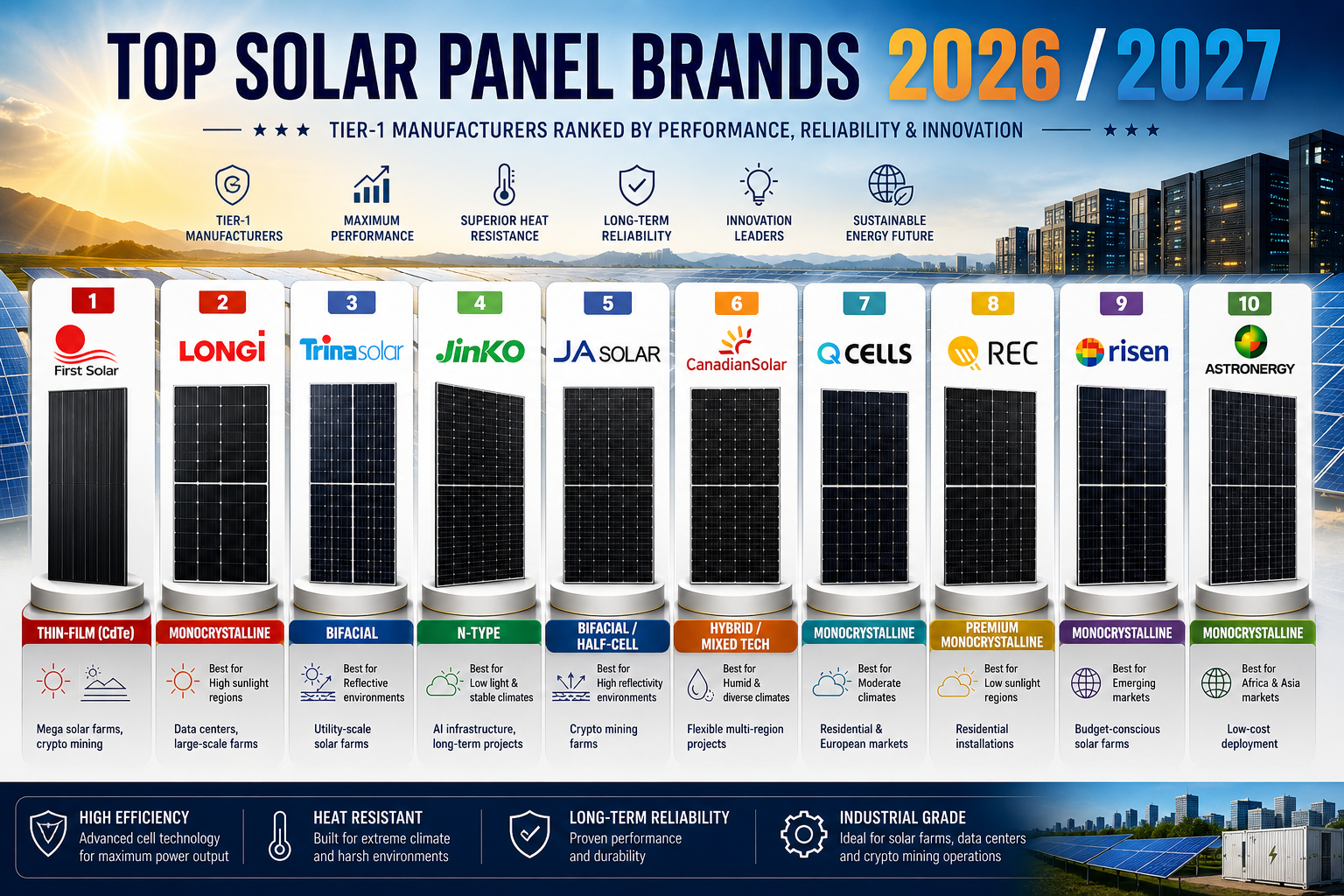
| Rank | Company | Technology | Best Environment | Not Ideal For | Best Use Case |
|---|---|---|---|---|---|
| 1 | First Solar | Thin-Film (CdTe) | Hot, dusty, desert environments | Low space efficiency | Mega solar farms, crypto mining |
| 2 | LONGi Solar | Monocrystalline | High sunlight regions | Extreme heat conditions | Data centers, large-scale farms |
| 3 | Trina Solar | Bifacial | Reflective environments (sand, light surfaces) | Poor installation conditions | Utility-scale solar farms |
| 4 | Jinko Solar | N-Type | Low light and stable climates | Heavy dust environments | AI infrastructure, long-term projects |
| 5 | JA Solar | Bifacial / Half-cell | High reflectivity environments | Shaded or obstructed areas | Crypto mining farms |
| 6 | Canadian Solar | Hybrid / Mixed technologies | Humid and diverse climates | Extreme desert conditions | Flexible multi-region projects |
| 7 | Q-Cells | Monocrystalline | Moderate climates | Harsh environments (dust, heat) | Residential and European markets |
| 8 | REC Group | Premium Monocrystalline | Low sunlight regions | Industrial-scale farms | Residential installations |
| 9 | Risen Energy | Monocrystalline | Emerging markets | High-performance industrial use | Budget solar farms |
| 10 | Astronergy | Monocrystalline | Africa and Asia | Advanced high-performance systems | Low-cost deployment |
Solar Panel Performance by Climate, Efficiency, and Industrial Application
| Solar Technology | Typical Efficiency | Temperature Performance | Best Geographic Regions | Typical Industrial Use |
|---|---|---|---|---|
| Thin-Film (CdTe) | 16–19% | Excellent heat tolerance | North Africa, Middle East, Australian desert | Mega solar farms, crypto mining facilities |
| Monocrystalline Silicon | 20–23% | Moderate heat resistance | USA, Southern Europe, China | Utility-scale solar farms, data centers |
| Bifacial Panels | 20–24% | Good thermal performance | Deserts, snowy regions, reflective terrains | Utility-scale farms and large infrastructure |
| N-Type Silicon | 22–25% | Very stable long-term performance | Northern Europe, Canada, Japan | AI data centers, high-efficiency solar plants |
| Perovskite (Emerging) | Laboratory potential up to 30% | Still under development | Future global deployment | Next-generation solar farms |
Solar Panel Technologies by Climate Type and Geographic Regions
Real-world solar performance is dictated more by the environment than by a spec sheet. To get the best results, you have to match the technology to the climate:
-
Arid/Desert: High heat and dust make Thin-Film (CdTe) and Bifacial panels the best choice due to their superior heat tolerance and improved performance in dusty environments.
-
Tropical/Humid: In areas with heavy cloud cover and humidity, Thin-Film or Bifacial panels excel at capturing diffused light.
-
Temperate/Cold: For regions with limited sunlight, high-efficiency Monocrystalline panels are used to maximize energy harvest from shorter days.
-
Coastal: Proximity to the sea requires salt-mist resistant coatings and reinforced frames to prevent corrosion from salt and wind.
| Climate Type | Environmental Conditions | Example Regions | Recommended Solar Technology | Main Reason |
|---|---|---|---|---|
| Dusty Extreme Desert Climate | Very high temperatures, sandstorms, heavy dust | Sahara (Algeria, Tunisia, Libya, Egypt, Niger, Western Sahara), Arabian Peninsula | Thin-Film (CdTe) / Bifacial | Better heat tolerance and improved performance in dusty environments |
| Hot Desert Climate | High solar irradiance, hot temperatures, low humidity | Texas, Arizona, Nevada, New Mexico, Interior Australia | Monocrystalline / Bifacial | High efficiency under strong sunlight |
| Very Cold Climate | Low temperatures, snow, lower sunlight | Canada, Alaska, Northern Europe, Scandinavia | N-Type / High-Efficiency Monocrystalline | Better performance in low light and cold environments |
| Humid Tropical / Subtropical Climate | High humidity, clouds, strong sunlight | Florida, Brazil, Southern China, Southeast Asia | Monocrystalline / Hybrid modules | Balanced efficiency in humid environments |
The Human Side of the Math: Why Context is King
In utility-scale solar, cheap is a trap. When you are building in a brutal environment like the Sahara or the Middle East, the real question isn't "What is the price of the panel?" but "How much energy will this panel actually spit out at 2:00 PM in 50°C heat?"
That is where the profit is won or lost:
-
The Heat Trap: Standard panels "choke" as they get hot. In the desert, efficiency isn't just a spec; it's a battle. Technologies like Thin-Film (CdTe) are engineered to "breathe" in high temperatures, ensuring they generate more power during peak hours that standard panels simply can't handle.
-
The "Sand Bonus": Don't leave energy lying on the ground. Using Bifacial N-Type panels over reflective desert sand is like getting a 20% "free bonus" on your output without significantly increasing construction costs. It’s the smartest way to squeeze every cent out of your land.
-
The Long Game: For strategic infrastructure—like AI data centers that never sleep—you need "marathon" panels, not "sprinters." Technologies like TOPCon and HJT degrade much slower over time. This ensures stable cash flow for investors in year 20 just as much as in year 1.
-
Field Resilience: Dust in arid zones isn't just dirt; it's an "asset killer." Investing in anti-soiling coatings or robotic cleaning isn't a luxury—it’s a financial move that keeps your energy output (E_t) at its peak and your maintenance costs (OPEX) under control.
The Takeaway: Don’t just shop for a low price tag; shop for an "energy engine" that is precisely engineered to thrive in your specific climate.
Conclusion: Strategic Adaptation Is the Future of Solar Energy Infrastructure
Strategic Adaptation: The Future of Energy Infrastructure
The future of utility-scale solar isn't a popularity contest among top-tier manufacturers—it’s a rigorous exercise in environmental and industrial adaptation.
In hyper-arid, high-heat environments like the Algerian desert, the thermal resilience of thin-film modules and the albedo-harvesting capabilities of bifacial architectures provide a massive, compounding operational edge. Conversely, deploying in low-irradiance zones strictly demands the aggressive conversion efficiency of advanced monocrystalline or N-type silicon just to maintain baseline economic viability.
As the massive energy footprints of hyperscale AI data centers and industrial crypto mining facilities continue to multiply, these highly optimized solar installations will transition from simple power plants into the most critical, strategic infrastructure assets on the global grid.
This article is based on data and analysis from leading global energy organizations, research institutions, and industry reports to ensure accuracy and reliability.
FAQ: Solar Panel Technologies for Utility-Scale Solar Farms
Q1: What is the best solar panel technology for desert environments?
Thin-film CdTe solar panels are often the best choice for desert regions. They handle extreme heat better than traditional silicon panels and maintain stable performance under high temperatures and dusty conditions. This makes them ideal for large solar farms in places like the Middle East, North Africa, and other hot, arid climates.
Q2: Are bifacial solar panels better for large solar farms?
Bifacial panels can generate additional electricity by capturing sunlight reflected from the ground. In environments with reflective surfaces such as sand, snow, or light-colored soil, they can increase energy production by 5–20%. This makes them especially valuable for utility-scale solar farms.
Q3: Which solar panels perform best in low sunlight regions?
Advanced monocrystalline and N-type silicon panels perform best in low-irradiance environments. These technologies offer higher conversion efficiency and better performance during cloudy conditions, making them ideal for Northern Europe, Canada, and other regions with lower solar intensity.
Q4: How do solar farms power data centers and crypto mining facilities?
Solar farms supply electricity directly to high-energy infrastructure such as AI data centers and crypto mining operations. By pairing solar generation with battery storage or grid integration, operators can create stable energy systems capable of supporting continuous computing workloads.
Q5: What factors determine the best solar technology for a specific location?
Choosing the right solar technology depends on several variables, including solar irradiance, temperature levels, humidity, dust exposure, land availability, and energy demand. Matching panel technology with local environmental conditions is essential for maximizing efficiency and long-term return on investment.