The Quantum Leap: Exploring Artificial Intelligence, Next-Gen Hardware, and the New Era of Crypto Mining
For a long time, PC gaming, enterprise AI, and crypto mining pretty much kept to their own lanes. But today, those boundaries have completely dissolved. The sudden explosion of decentralized compute networks, local LLMs, and adaptive mining algorithms has changed the game. Choosing a graphics card is no longer just about a gamer hunting for a few extra frame rates; it’s evolved into a serious, calculated exercise in infrastructure engineering.
When you are responsible for maintaining a technical ecosystem, evaluating hashrates, and deploying scalable hardware platforms, choosing a GPU can no longer be based on raw, brute-force power alone. It requires analyzing architectural design, memory bandwidth constraints, thermal efficiency, and power-to-revenue math. Here at ASICMINING360.COM, we view this choice as a precise engineering matrix—if you choose correctly, you build a resilient, highly optimized rig; choose poorly, and your margins get entirely eaten up by operating costs and hardware bottlenecks.
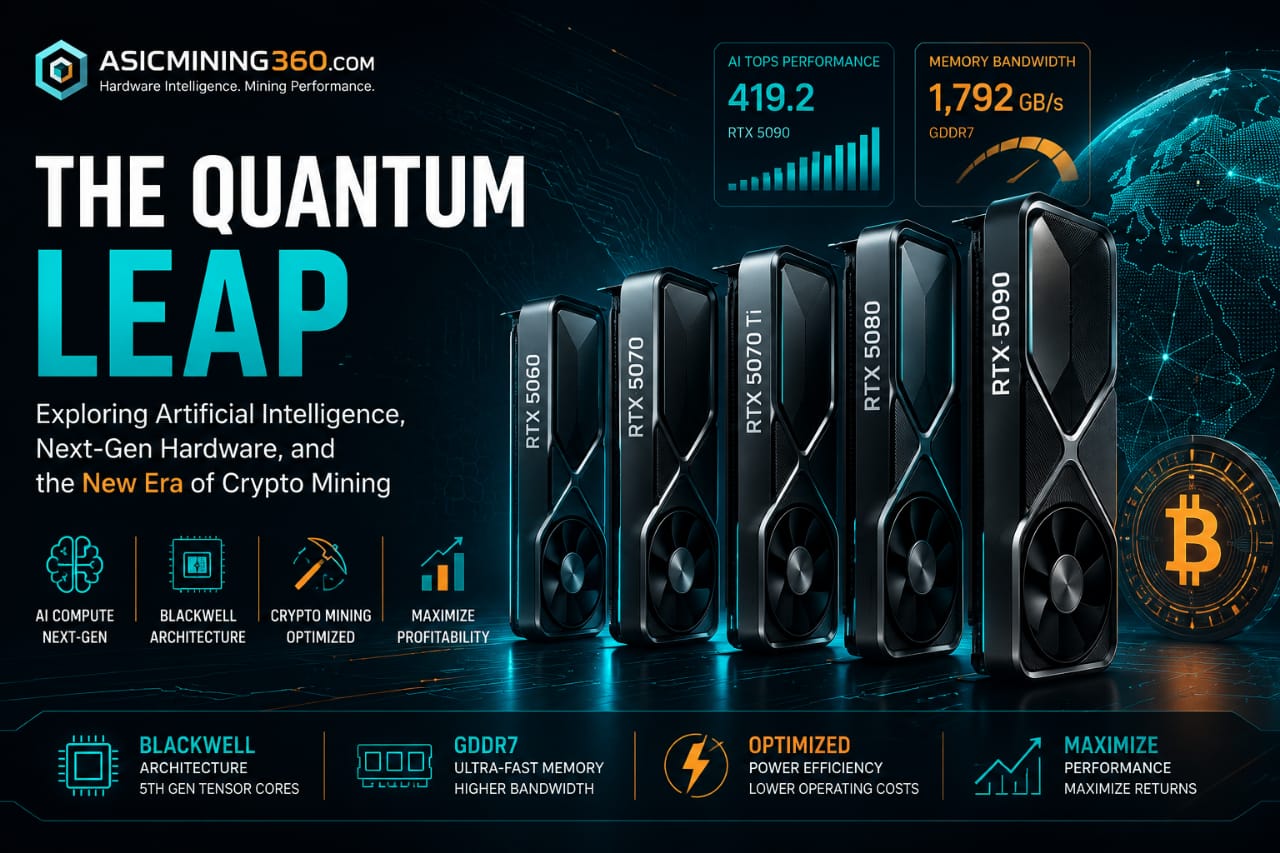
With NVIDIA's cutting-edge Blackwell architecture (RTX 50 Series) setting new baselines for consumer and enterprise compute, understanding the technical differences between each performance class is critical. Let’s dive straight into the deep end, breakdown the data, and look at how each specific tier shapes up under the hood.
Deep-Dive Technical Specifications: The Blackwell Architecture
The transition to the RTX 50 Series marks a monumental milestone: the consumer debut of GDDR7 memory technology paired with fifth-generation Tensor Cores. This means significantly higher data transfer rates at much lower latencies—a massive advantage for memory-intensive workloads like local AI training and complex mining DAG sizes.
To give mining operators and developers a transparent look under the hood, our engineering team at ASICMINING360.COM has mapped out the raw data across the four primary tiers of the current Blackwell generation, outlining exactly how NVIDIA splits these processing engines:
Comprehensive Hardware Comparison Table
| Technical Parameter | NVIDIA RTX 5060 | NVIDIA RTX 5070 | NVIDIA RTX 5070 Ti | NVIDIA RTX 5080 | NVIDIA RTX 5090 |
|---|---|---|---|---|---|
| GPU Silicon Die | GB206-250 | GB205-300 | GB203-300 | GB203-400 | GB202-300 |
| CUDA Cores | 3,840 | 6,144 | 8,960 | 10,752 | 21,760 |
| Tensor Cores | 120 (5th Gen) | 192 (5th Gen) | 280 (5th Gen) | 336 (5th Gen) | 680 (5th Gen) |
| Memory Capacity | 8 GB | 12 GB | 16 GB | 16 GB | 32 GB |
| Memory Type | GDDR7 | GDDR7 | GDDR7 | GDDR7 | GDDR7 |
| Memory Bus Width | 128-bit | 192-bit | 256-bit | 256-bit | 512-bit |
| Memory Bandwidth | 448 GB/s | 672 GB/s | 896 GB/s | 960 GB/s | 1,792 GB/s |
| AI TOPS (Compute) | 76.8 | 123.5 | 177.4 | 225.1 | 419.2 |
| Rated TDP (Wattage) | 145W | 250W | 300W | 360W | 575W |
Granular Architectural Breakdown
1. The RTX 5060: Mainstream Efficiency
The RTX 5060 is built on the compact GB206-250 die. It pulls a highly restrictive 145W TDP, making it a masterpiece of raw electrical efficiency. However, because it relies on a narrow 128-bit memory bus, it is naturally throttled when handling large dataset transfers or heavy memory-bound mining algorithms. It shines as a low-cost, cool-running node for basic workloads.
2. The RTX 5070 & 5070 Ti: The Mid-Tier Powerhouses
The standard RTX 5070 steps up to the GB205-300 die, boosting core counts significantly and expanding to a 192-bit bus. But the real star for heavy compute is the RTX 5070 Ti. Utilizing a scaled-down version of the premium GB203 die, it unlocks a massive 256-bit memory bus and jumps to 16 GB of lightning-fast GDDR7 memory. This configuration delivers a blistering 896 GB/s of bandwidth, putting it on par with previous-generation flagship performance.
3. The RTX 5080: Enthusiast Compute
The RTX 5080 utilizes the fully realized GB203-400 core architecture. With 10,752 CUDA cores and an aggressive memory clock, it pushes bandwidth close to a full terabyte per second (960 GB/s). It acts as a premium processing unit for high-density rigs, though it requires meticulous thermal planning to manage its 360W power envelope.
4. The RTX 5090: The Silicon Monolith
Representing the absolute peak of consumer engineering, the RTX 5090 features a massive 750 mm² GB202-300 die packed with 21,760 CUDA cores. It utilizes an unprecedented 512-bit bus to feed an immense 32 GB GDDR7 VRAM pool, moving data at a staggering 1,792 GB/s. It is a zero-compromise, enterprise-grade accelerator packaged for enthusiast deployment, drawing up to 575W under full peak loads.
The Strategy: Choosing and Optimizing the Right Mining Fleet
When building multi-GPU mining rigs or scaling up node deployments, looking at a single card's performance in a vacuum is a trap. Experienced operators use a highly specific set of rules to choose and optimize their hardware:
1. The Core Decision Rules
-
The Return on Investment (ROI) Ratio: Avoid chasing highest-framerates or top-tier single-card hashrates if the entry cost is artificially inflated. Calculate the total cost of the hardware against its daily net yield. In many deployment scenarios, purchasing three RTX 5070 Ti units provides significantly more aggregate bandwidth, memory channels, and stable hashrate distribution than deploying a single, highly expensive RTX 5090 for the exact same capital expenditure.
-
Why the Memory Bus is King: If you are running algorithms that constantly hammer your VRAM—like Ethash derivatives or memory-hard altcoins—here is the golden rule: prioritize memory bus width over raw core clocks every single time. Opting for a 256-bit card like the RTX 5070 Ti or 5080 builds a wider, far more efficient data highway than a cramped 128-bit interface. This extra breathing room is what keeps your hashing pipeline smooth and completely eliminates those frustrating data stalls that tank your efficiency during epoch changes.
-
The Strategy of Algorithm Alignment: Think of your hardware array like a toolset; you have to pick the right blade for the material. GPUs are the chameleons of the infrastructure world. They thrive on agility—making them perfect for complex, memory-elastic tasks like decentralized AI compute routing or rendering networks. However, if you’re looking at raw, static cryptographic protocols like Bitcoin's SHA-256, don't waste your silicon's potential. Leave that heavy lifting to dedicated ASIC miners. Consumer chips simply can't compete with the specialized, single-minded efficiency of a dedicated mining rig on those networks.
2. Post-Purchase Optimization Tactics
Once your hardware is mounted on the frame, the real work begins. To maximize long-term infrastructure health and operational margins, run through this staging checklist:
-
Under-Volting Protocols: Never run a mining or heavy AI compute fleet at factory stock profiles. Use specialized kernel utilities to lock core voltages while maintaining clock stability. Dropping an RTX 5070 Ti from its standard 300W profile down to a locked 180W-200W sweet spot preserves up to 95% of its raw hashing performance while drastically altering your power bills.
-
Thermal Pad Remediation: Next-gen GDDR7 memory clocks run extremely fast, generating localized thermal pockets on the PCB. Monitor memory junction temperatures meticulously, not just the core temperature. If necessary, swap stock thermal pads for high-conductivity aftermarket alternatives to prevent early thermal throttling and safeguard your investment.
-
Infrastructure Balancing: Ensure your host system scales cleanly with your graphics array. A multi-GPU configuration demands heavy +12V rail power supplies, native PCIe 5.1/12V-2x6 power routing to eliminate cable-melt risks, and adequate open-air spacing to handle rapid heat dissipation.
The Bottom Line: If you're looking to protect your margins and keep your overhead low, our verdict at ASICMINING360.COM is clear: building your array around the RTX 5070 Ti is the smartest play on the board right now. It hands you the uncompromised 256-bit bus and 16 GB of next-gen memory you actually need, without forcing you to pay a massive price premium or inherit the brutal cooling headaches that come with top-tier flagship cards. Keep the rigs cool, lock down your voltages from day one, and let the architecture do the heavy lifting.