The Landscape of Computational Power in 2026
The landscape of computational power has shifted dramatically since the early days of hobbyist mining. In 2026, the distinction between general-purpose hardware and specialized silicon has never been more critical for investors and technologists to understand. To fully understand where crypto-economics stands today, you first need to get a handle on the sheer scale of the math behind it all.
A modern high-end graphics card in 2026 performs roughly 36 trillion calculations per second. To conceptualize this, imagine every person on Earth performing one complex long-multiplication problem every second; you would need approximately 4,400 Earths working in perfect synchrony to match the output of a single GPU sitting in a desktop computer.
Industrial Bitcoin mining operations need a tremendous amount of electricity. It's like trying to move a mountain with a spoon; the scale of power needed is a key consideration for anyone involved in this field.
CPU vs GPU vs ASIC: Key Differences in Mining Hardware
Understanding where to deploy capital requires a deep dive into the "brains" of these machines. The fundamental difference lies in flexibility versus throughput.
CPU Mining Explained: Flexibility and Limitations in 2026
The Processing Unit (CPU) is the "jumbo jet" of the computing world. While a top-tier CPU in 2026 might only have 24 to 64 high-performance cores, those cores are incredibly versatile. They handle complex logic, branching instructions, and the management of operating systems. However, like a jet, they have limited "cargo" space for repetitive data.
GPU Mining Explained: Parallel Processing Power and Use Cases
The Graphics Processing Unit (GPU) is a "cargo ship" designed for bulk transport. A GPU contains over 10,000 specialized cores (such as CUDA cores). While these cores move much slower than CPU cores, they move massive amounts of data simultaneously.
-
CUDA Cores: Simple binary calculators that perform basic arithmetic, essential for rendering and certain mining algorithms.
-
Tensor Cores: Specialized matrix-multiplication engines. These are the backbone of the 2026 AI revolution and Generative AI, handling trillions of operations for neural networks.
-
Ray Tracing (RT) Cores: Purpose-built hardware for simulating the physical behavior of light.
ASIC Mining Explained: Maximum Efficiency for SHA-256
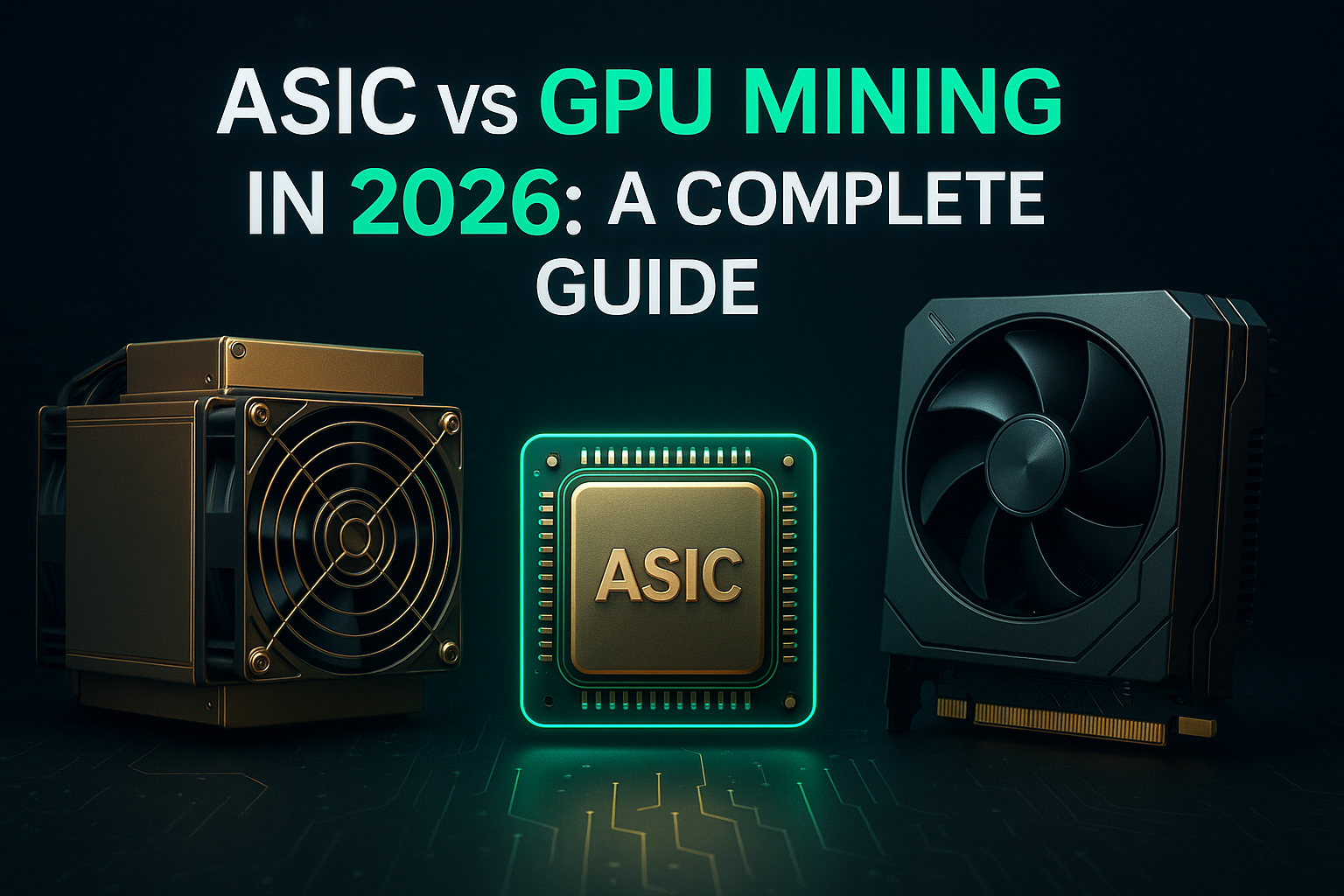
The Application-Specific Integrated Circuit (ASIC) is neither a jet nor a ship; it is a fixed pipeline built for one, and only one, task. While a GPU can switch from mining an Altcoin to rendering a 3D film, an ASIC designed for the SHA-256 algorithm (Bitcoin) can do nothing else. However, it does that one task with an efficiency that renders all other hardware obsolete.
GPU Architecture in 2026: Transistors, SMs, and GPCs Explained
When we examine a flagship chip—such as the GA102 or its 2026 successors—we see 28 billion+ transistors organized in a strict hierarchy. These chips are divided into Graphics Processing Clusters (GPCs) and Streaming Multiprocessors (SMs).
GPU Binning Explained: How It Impacts Mining Profitability
A crucial realization for hardware investors is the concept of Binning. During manufacturing, microscopic dust or lithography errors often deactivate small portions of a chip. Rather than discarding a $2,000 piece of silicon, manufacturers deactivate the faulty cores and sell the chip as a lower-tier model.
-
A "Flawless" chip becomes a 90-series card.
-
A chip with minor defects becomes an 80-series or 70-series card.
From a mining or AI-workstation perspective, this means the physical silicon in an 80-series card is often identical to a 90-series, just artificially throttled or partially disabled. For those building mining rigs or AI clusters in 2026, understanding the performance-per-watt of different "bins" is the difference between profitability and a loss.
Memory Bottleneck in Mining: GDDR6X vs DDR5 Performance
Mining is a "data-hungry" endeavor. In 2026, the GPU's onboard memory (VRAM) acts like multiple cranes loading a ship. While standard CPU memory (DDR5/6) might move data at 60 GB/s, high-end GPU memory like GDDR6X utilizes a wide 384-bit bus to achieve speeds exceeding 1.1 terabytes per second. If your mining algorithm is "memory-hard," the speed of these Micron-manufactured chips is more important than the core count of the GPU itself.
Mining Profitability in 2026: ASIC vs GPU Economics
ASIC vs GPU Mining Comparison in 2026
| Feature | ASIC Mining | GPU Mining |
|---|---|---|
| Primary Use | Bitcoin (SHA-256) | Altcoins / AI / Rendering |
| Hashrate | ~200–300 TH/s | ~100–150 MH/s |
| Energy Efficiency | Very High | Moderate |
| Electricity Needs | Industrial Scale | Flexible |
| Initial Cost | $3,000 – $10,000+ | $1,500 – $5,000 |
| Flexibility | None | High |
| Resale Value | Low | High |
| Best For | Large Mining Farms | AI + Crypto Hybrid Use |
If you are entering the market in 2026, you must choose your path based on the Hardware Evolution Scale.
Bitcoin Mining with ASICs: Costs, Hashrate, and ROI
Mining Bitcoin with a GPU is no longer a viable financial strategy. Modern ASICs generate upwards of 250 Trillion hashes per second (250 TH/s). To match one single ASIC, you would need over 2,600 high-end graphics cards. The electricity cost alone would bankrupt a GPU miner in days.
Advice: Only invest in SHA-256 (Bitcoin) mining if you have access to sub-$0.04/kWh electricity and industrial-grade cooling.
GPU Mining and AI Compute in 2026: New Revenue Models
In 2026, GPU "mining" has evolved into Compute Provisioning. High-end GPUs are now frequently leased out to AI startups to train Small Language Models (SLMs) or perform complex 3D renders.
-
Pros: Resale value. A GPU can be sold to a gamer or a video editor if the crypto market dips. An ASIC is essentially a paperweight if its specific coin fails.
-
Cons: Higher management overhead. GPUs require complex driver management, cooling, and PCIe bandwidth considerations.
Thermal Management and Infrastructure
Whether you are running a single rig or a warehouse, the laws of thermodynamics are your primary constraint. Most of a graphics card’s weight in 2026 is the heatsink and vapor chamber. The Voltage Regulator Modules (VRMs) convert 12V input into roughly 1.1V for the GPU, but this process generates immense heat as it supplies hundreds of watts.
For the 2026 investor, Cold Wallet Integration is the final step of the hardware lifecycle. As rewards are earned, the "hot" wallet on the mining server is a security liability. Expert practitioners utilize hardware-isolated cold wallets (like Ledger or Trezor) to "sweep" profits daily. To safeguard your energy investment, it's important to protect against the known network weaknesses that can be found in mining software.
Risks of Crypto Mining in 2026: Regulation, Difficulty, and Hardware Lifespan
-
Network Difficulty: As more efficient ASICs enter the market, the "difficulty" of mining increases. Your hardware does not get slower, but your share of the global "lottery" gets smaller.
-
Regulatory Shifts: The US and global markets are increasingly scrutinizing the energy consumption of data centers. When we think about long-term viability, considering green or stranded energy mining projects presents a unique outlook. These projects are a key aspect of future planning.
-
Hardware Lifecycle: In 2026, the jump between silicon generations is narrowing. The "leap" from a 30-series to a 50-series or 60-series is less about raw speed and more about efficiency (Hashes per Watt).
Conclusion: ASIC vs GPU Mining – Which Strategy Wins in 2026?
Mining in 2026 is no longer a "get rich quick" scheme; it is a high-precision commodity business. If you are looking for a hands-off, long-term investment in the backbone of the blockchain, ASIC mining in specialized data centers is the standard. However, if you prefer a versatile asset that can pivot between crypto-mining, AI processing, and high-end rendering, a GPU-based cluster offers a superior "exit strategy" and broader utility. Success in this field requires more than just buying the most expensive card. It requires an understanding of the silicon binning, the memory bandwidth constraints, and the cold-storage security protocols that protect your yield.
FAQ: ASIC vs GPU Mining in 2026
Q1: Is GPU mining still profitable in 2026?
GPU mining is no longer highly profitable for traditional cryptocurrencies like Bitcoin. However, GPUs remain valuable for altcoins, AI workloads, and rendering services. Many miners now generate income by leasing GPU power for AI training, making GPUs a flexible and diversified investment compared to ASICs.
Q2: Why are ASIC miners more efficient than GPUs?
ASIC miners are designed for a single algorithm, such as SHA-256, allowing them to achieve extremely high efficiency and hash rates. Unlike GPUs, which are general-purpose, ASICs eliminate unnecessary processes and focus only on mining, resulting in lower energy consumption per hash and higher overall profitability.
Q3: What is the main risk of investing in ASIC mining?
The biggest risk is lack of flexibility. ASICs can only mine specific algorithms, so if profitability drops or regulations change, the hardware becomes nearly useless. Additionally, increasing network difficulty and rapid hardware obsolescence can reduce returns over time.
Q4: What is “binning” and why does it matter for miners?
Binning is the process of classifying chips based on manufacturing quality. Higher-tier GPUs have fully functional cores, while lower-tier models have some disabled. For miners, understanding binning helps optimize performance-per-watt and choose cost-effective hardware with similar underlying silicon.
Q5: Should beginners choose ASIC or GPU mining in 2026?
Beginners should consider GPUs if they want flexibility, resale value, and multiple revenue streams like AI computing. ASIC mining is better suited for experienced operators with access to cheap electricity and industrial infrastructure, as it requires higher capital and operational efficiency.
Q6: How important is electricity cost in mining profitability?
Electricity cost is the most critical factor in mining profitability. Even the most efficient hardware can become unprofitable if energy prices are high. Successful mining operations typically rely on electricity costs below $0.04/kWh and optimized cooling systems to remain competitive.