Introduction
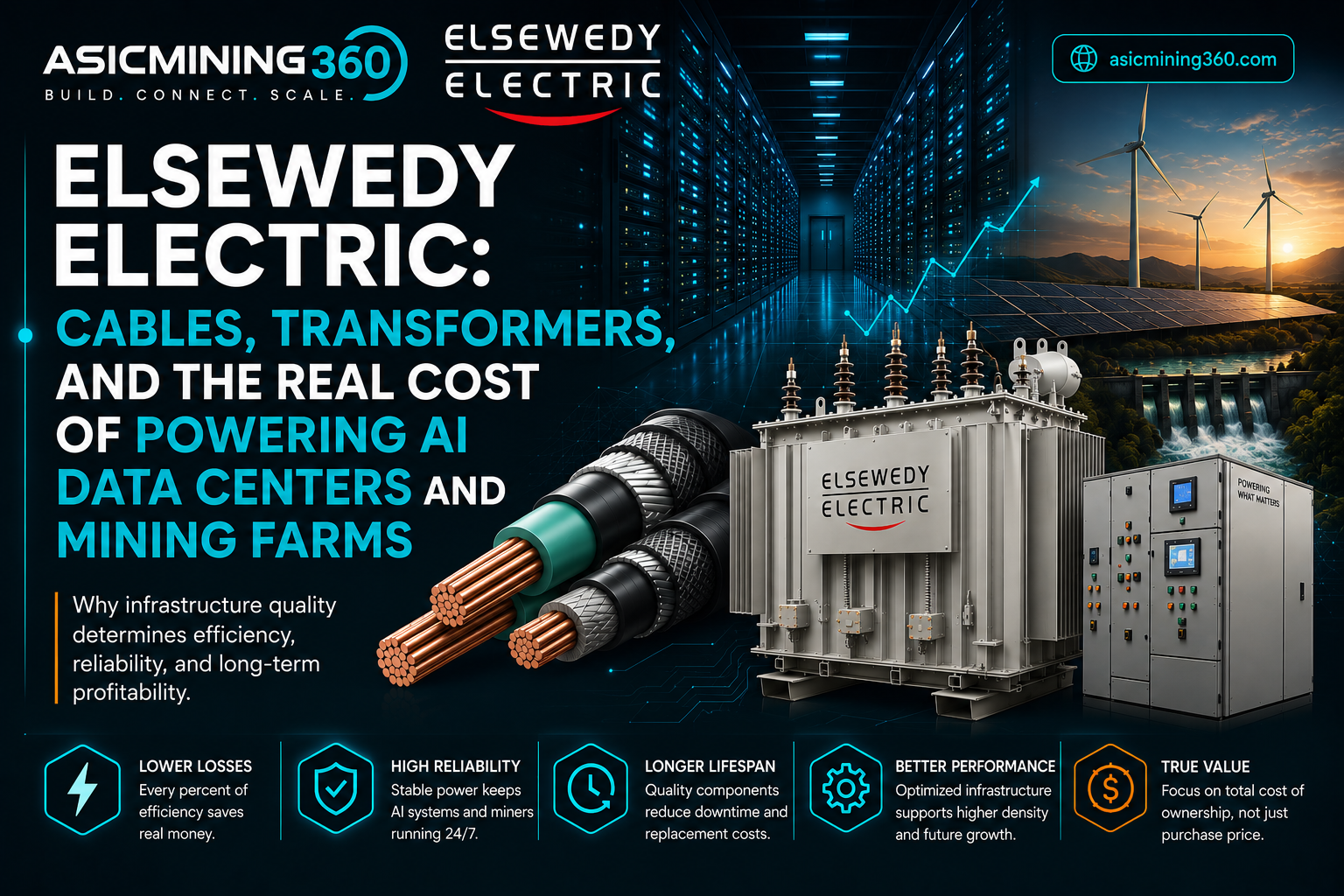
Electricity is becoming one of the most important constraints in the expansion of artificial intelligence, cloud computing, data centers, and cryptocurrency mining. The issue is no longer simply whether a facility can obtain enough electricity from the grid. For a large AI data center or a mining farm running thousands of machines around the clock, power availability, reliability, electrical losses, and infrastructure cost can determine whether a project is economically viable.
This is why some large-scale data center and mining projects are moving toward dedicated power infrastructure, including on-site generation and direct connections to renewable energy projects such as solar, wind, and hydropower. In these projects, the generation source is only one part of the equation. The electricity still has to be collected, transformed, transmitted, distributed, and delivered safely to thousands of servers, ASIC miners, cooling systems, pumps, and other loads.
That makes the quality of the electrical infrastructure extremely important.
A power plant can generate hundreds of megawatts, but if the electrical system surrounding it is poorly designed, part of that energy can be lost as heat and electrical losses before it reaches the final load. For facilities where electricity is one of the largest operating expenses, even relatively small losses can accumulate into substantial costs over years of continuous operation.
This is where cables and transformers become much more than ordinary electrical components.
And this is also where Elsewedy Electric, an Egyptian multinational that grew from a cable manufacturer into a much broader energy and infrastructure group, becomes an interesting company to examine.
From Cable Manufacturer to Energy and Infrastructure Group
Elsewedy Electric's history is closely connected with cables, but the company has expanded considerably beyond that original business.
Today, its activities cover areas including power generation, transmission, distribution, engineering and construction, transformers, busway systems, building solutions, industrial development, infrastructure investments, and other electrical and industrial products.
Its Engineering & Construction sector alone reports more than 500 projects across 45 countries, with projects representing 40 GW according to the company's published figures.
The company has also developed industrial infrastructure on a large scale. Elsewedy Industrial Development says it has developed more than 60 million square meters of industrial parks over roughly the past 15 years. Its activities also extend into logistics infrastructure, including the development and operation of strategic assets such as the October Dry Port in Egypt.
Elsewedy's Building Solutions business adds another layer, offering integrated solutions covering heavy equipment, power generation, MEP systems, and smart solutions. The company says this business has served more than 700 customers, supplied more than 11,000 units, and completed more than 90 projects.
This expansion matters because a modern data center or large mining operation does not need a single electrical product. It needs an entire electrical ecosystem.
The Electrical Infrastructure Behind a Large Data Center
Consider a simplified path for electricity generated by a large solar, wind, hydroelectric, or conventional power plant:
Power Generation → Step-Up Transformer → High-Voltage Transmission → Substation → Medium-Voltage Distribution → Transformer → Low-Voltage Distribution → Data Center / Mining Facility
Every stage introduces equipment, and every stage has the potential for electrical losses or reliability problems.
For an AI data center, the challenge is even greater because high-density computing loads can operate continuously. GPU clusters require not only electricity for computation but also substantial power for cooling, networking, storage, backup systems, pumps, and other infrastructure.
Crypto mining has a similar characteristic. An ASIC mining farm may operate 24/7, meaning electricity costs continue accumulating every hour the machines are online.
That is why the price of the electrical equipment itself should not be the only purchasing criterion.
The more useful question is:
What is the relationship between purchase price, electrical performance, reliability, service life, and long-term operating cost?
This is where the concept of price-to-quality value becomes important.
Three Cable Categories That Matter for Power Infrastructure
Elsewedy Electric offers a very broad cable portfolio. However, not every cable category is equally relevant when discussing the construction of power infrastructure for AI data centers, mining farms, or large power-generation projects.
Three categories stand out.
1. Low-Voltage Cables
Low-voltage cables are used closer to the final electrical load.
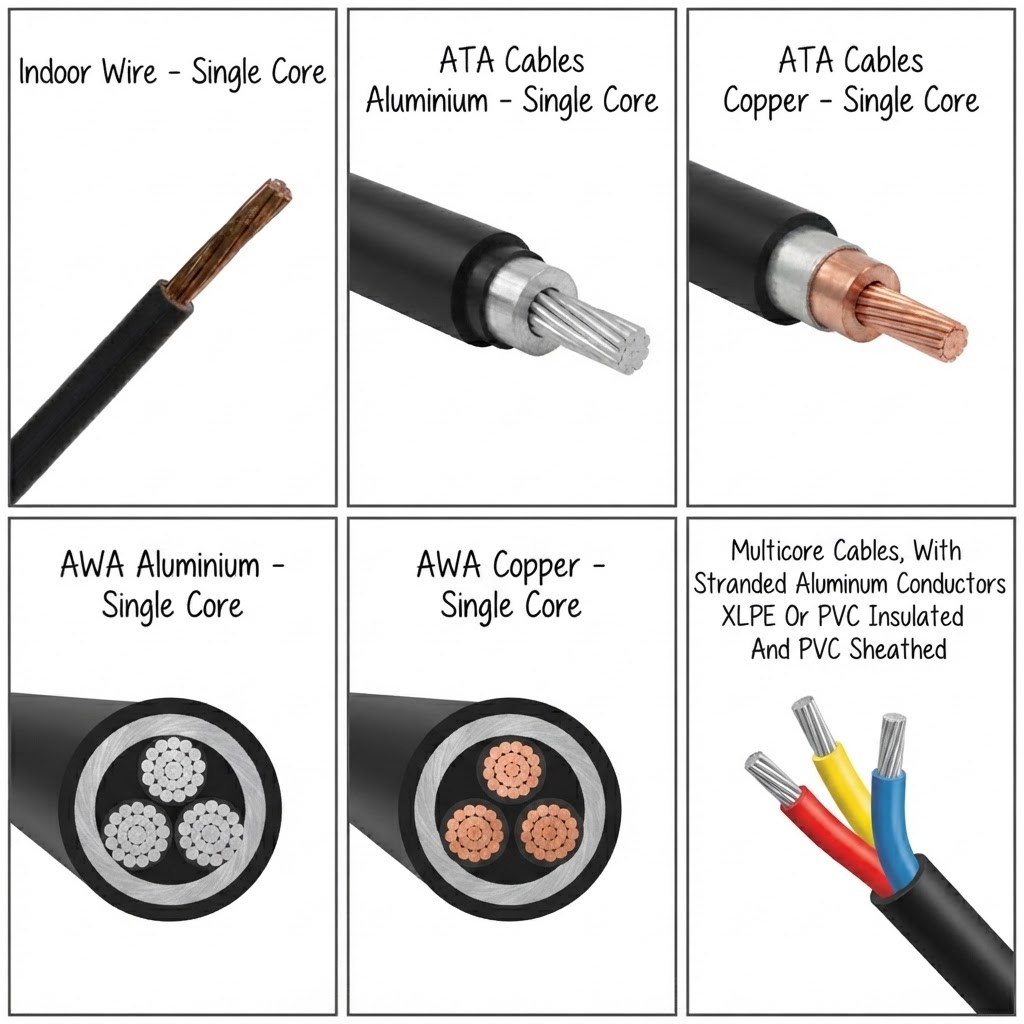
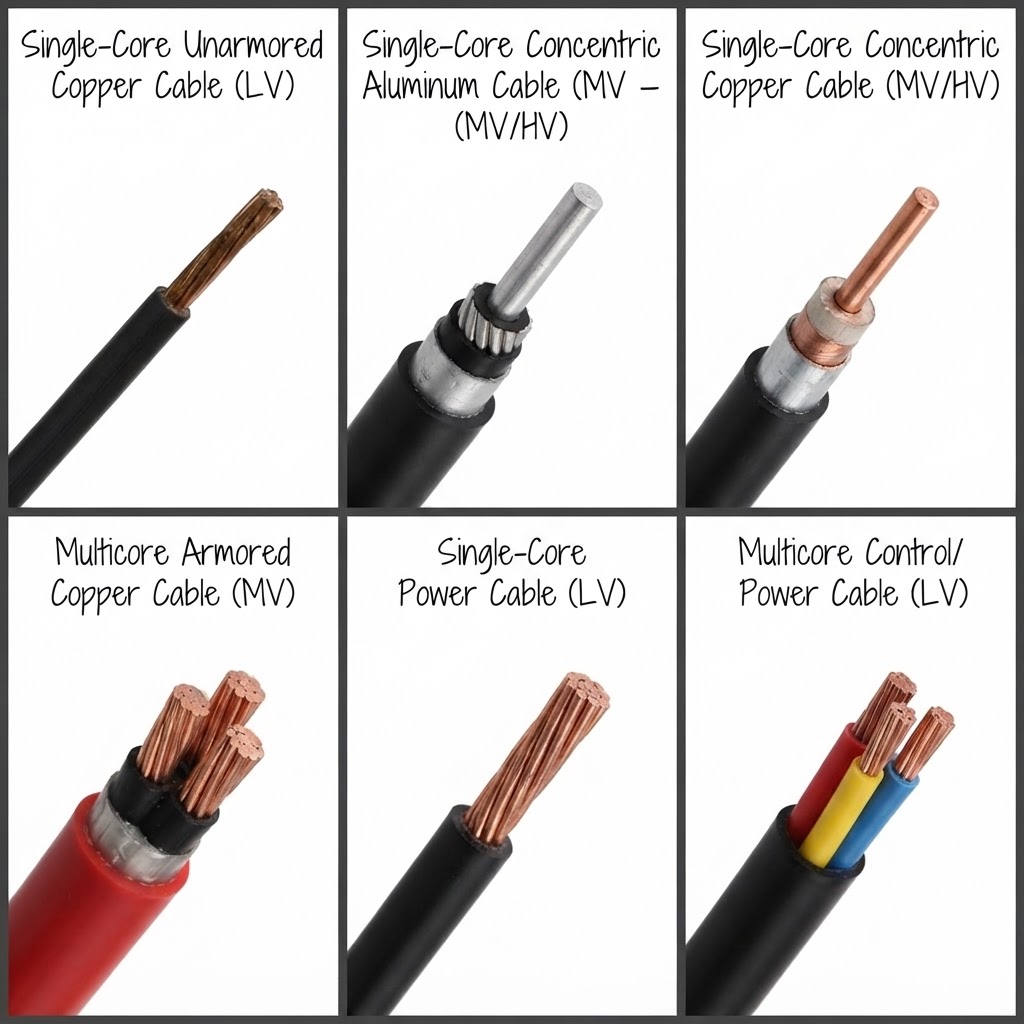
Elsewedy produces a range of low-voltage cables for residential, commercial, industrial, and infrastructure applications. Its portfolio includes rigid and flexible constructions, copper conductors, PVC insulation, and several armored and unarmored configurations.
The company lists products including:
- Indoor wires
- Single-core ATA cables
- Single-core AWA cables
- Multi-core unarmored cables
- Multi-core SWA cables
- Multi-core STA cables
- Single-core unarmored cables
The company also offers both copper and aluminum conductor options in different constructions, along with XLPE and PVC insulation systems.
For a data center, low-voltage cabling can become important inside electrical distribution systems, control areas, equipment connections, panels, and other downstream applications.
The important point is that low voltage does not mean low importance. Poorly selected conductors, inappropriate sizing, inadequate installation, or excessive resistance can increase losses and heat.
For a facility operating continuously, these losses become an operating-cost issue rather than simply an engineering detail.
2. Medium-Voltage Cables
Medium-voltage cables become much more interesting when discussing large power projects.
Elsewedy's medium-voltage portfolio is designed for utility, industrial, infrastructure, and renewable-energy applications. The company lists operating voltages up to 18/30 kV, with single-core and three-core configurations and both armored and unarmored constructions.
The cables use technologies including:
- Compacted copper or aluminum conductors
- Conductor screening
- XLPE insulation
- Metallic insulation screening
- PVC outer sheathing
The company states that these products are designed and tested according to IEC 60502.
Applications include power distribution networks, utility infrastructure, industrial facilities, renewable-energy projects, underground installations, cable trays, and duct systems.
This makes medium-voltage cable particularly relevant to renewable-energy projects.
Imagine a large solar farm supplying electricity to an AI data center. Electricity generated by thousands of solar modules is converted through inverters and collected into electrical networks before reaching transformers and the transmission system.
The medium-voltage network can therefore become an important link between generation equipment and the substation.
The same principle applies to wind farms and other large renewable projects.
3. High-Voltage and Extra-High-Voltage Cables
At the other end of the infrastructure are high-voltage and extra-high-voltage cables.
Elsewedy Electric states that its HV and EHV cable systems are designed for power transmission networks, renewable-energy projects, power-generation plants, utility infrastructure, industrial facilities, and large-scale developments.
The company's published specifications extend to 500 kV.
At these voltage levels, the objective is efficient transmission over long distances while controlling electrical losses and maintaining network stability.
This is particularly relevant when a power-generation project is located far from the final electricity consumer.
A solar or wind project, for example, may be built where renewable resources are strongest rather than directly beside the data center. Electricity therefore has to travel through transmission infrastructure before reaching the load.
This is why high-voltage infrastructure is an important part of the economics of large-scale electricity projects.
How the Three Cable Levels Fit Together
| Cable category | Example from Elsewedy's portfolio | Main role | Relevance to large power projects |
|---|---|---|---|
| Low Voltage | Copper/Aluminum, XLPE/PVC, armored and unarmored cables | Final distribution and equipment connections | High inside facilities |
| Medium Voltage | Up to 18/30 kV | Collection and distribution | Very high for renewable and industrial projects |
| High Voltage / EHV | Up to 500 kV | Long-distance transmission | Critical for connecting generation to the grid |
| Busway | Powerlink, PowerCast, PowerTrack | High-current distribution inside facilities | Particularly relevant to large electrical facilities |
The fourth item, busway, deserves a separate mention.
Elsewedy manufactures Powerlink & Spine sandwiched busway, PowerCast cast-resin busway, PowerTrack open-track busway, and PowerLite lighting busway. Its busway facility in 10th of Ramadan City covers more than 36,000 square meters and is described by the company as one of the largest busway manufacturing facilities in the Middle East and Africa.
The company also describes it as Africa's first epoxy-insulated busway manufacturing facility and says the plant holds ASTA Diamond certification.
For large facilities with high electrical loads, busway systems can provide another approach to distributing power within the installation.
Transformers: The Other Critical Piece
Cables cannot solve the entire power-distribution problem.
Transformers are equally important because electricity generally needs to be transformed between different voltage levels as it moves from generation to transmission and finally to distribution.
Elsewedy Electric manufactures transformers across several sites in the Middle East, Africa, and Asia. Its published portfolio reaches 400 MVA and 500 kV.
The company lists:
- Power transformers
- Oil distribution transformers
- Cast-resin dry transformers
- Auto-transformers
Its power transformers are designed for applications including transmission substations and generation step-up units.
That last application is particularly important.
A generation facility produces electricity at a certain voltage. Before electricity can be transmitted efficiently over a long distance, the voltage is generally stepped up. Later, substations progressively transform it to lower voltages suitable for distribution and final consumption.
In other words: Generator → Step-Up Transformer → HV/EHV Network → Substation → MV Network → Transformer → LV System → Load
For an AI data center or mining facility, every transformation stage must be engineered carefully.
Elsewedy says it uses advanced manufacturing processes, including magnetic-field analysis, to help optimize core and winding designs for stability and efficiency. The company also reports more than 20 years of transformer production, around 3,000 employees in this business, 10 factories in 10 countries, and exports to more than 70 countries.
Why Cable and Transformer Quality Can Affect Electricity Costs
There is an important misconception when comparing electrical equipment.
The cheapest cable or transformer is not necessarily the cheapest solution.
A cable has electrical resistance. When current flows through it, some power is lost as heat. In simplified terms, resistive losses are associated with I²R, meaning that losses increase with the square of current and with resistance.
This is particularly important for high-load facilities.
Suppose a mining farm runs continuously for years. Or an AI data center operates thousands of GPUs every hour of the year.
Even a relatively small amount of unnecessary electrical loss can accumulate into a meaningful amount of energy consumption over time.
That energy has to be paid for.
The same principle applies to transformers. Transformer efficiency, losses, thermal performance, design, loading, and operating conditions all influence the amount of electricity consumed or lost during operation.
Therefore, when calculating the real cost of an electrical system, the calculation should not stop at:
Equipment purchase price = $X
It should consider:
Total Cost of Ownership = Purchase Cost + Installation + Energy Losses + Maintenance + Downtime Risk + Replacement Cost
This is particularly important for facilities where electricity is one of the largest operating expenses.
Why Elsewedy's Price-to-Quality Position Is Interesting
This does not mean that Elsewedy products are automatically the highest-quality products available in every category.
There are global electrical-equipment manufacturers with extremely sophisticated technologies, long histories, and premium product lines.
But the interesting proposition with Elsewedy is the possibility of achieving a strong balance between quality, engineering capability, international standards, and cost.
For a hyperscale data center or a large renewable-energy project, spending more on a premium component can make sense if the additional performance or reliability justifies the price.
But not every project has an unlimited budget.
A solar power plant, for example, may require enormous quantities of cable, transformers, switchgear, civil works, and other equipment. A small difference in unit cost can become significant when multiplied across hundreds of kilometers of cable and large numbers of electrical components.
The same is true for mining farms.
If the objective is to reduce the cost per mined Bitcoin or another cryptocurrency, electricity efficiency and infrastructure cost are fundamental variables.
That makes price-to-performance and price-to-quality particularly relevant.
More Than Cables: The Company Behind the Equipment
one reason Elsewedy is interesting for large infrastructure projects is that its capabilities extend beyond manufacturing.
Its Engineering & Construction sector covers generation, transmission, distribution, public and civil works, water solutions, and other infrastructure activities.
The company reports projects in 45 countries and a project portfolio representing 40 GW according to its published figures.
Its industrial-development arm adds experience in utilities and industrial infrastructure, while Building Solutions provides integrated services covering power generation, MEP, heavy equipment, and smart solutions.
This creates a broader proposition:
Manufacturing + Engineering + Construction + Infrastructure + Power
For a large project owner, that can potentially reduce the complexity of dealing with multiple independent suppliers.
From Solar Farms to Hydropower and Conventional Generation
The same electrical principles apply regardless of how the electricity is generated.
A solar plant, wind farm, hydroelectric station, gas-fired plant, or other generation project still needs electrical equipment to move electricity from the generator to the grid or directly to a large consumer.
Elsewedy's broader Engineering & Construction activities include power generation, transmission, and distribution, while the group also participates in water and infrastructure projects.
The company's portfolio therefore goes beyond the image of a traditional cable manufacturer.
The interesting part for the data-center and mining industry is what happens after the electricity is generated.
A generation asset is only useful if its electricity can be moved efficiently and reliably to the place where it is needed.
Elsewedy Electric vs. Global Competitors
Elsewedy operates in markets where it encounters major international electrical-equipment companies such as Prysmian Group, Nexans, and Siemens Energy.
These companies have enormous international footprints and highly advanced product portfolios. In some applications, premium global suppliers may offer technologies or specifications that are particularly appropriate for demanding projects.
But the comparison should not simply be:
Which company makes the best cable?
A better question is:
Which supplier provides the required technical performance and reliability at the most economically attractive total cost?
For a hyperscale AI data center, a utility-scale solar farm, or a cryptocurrency mining operation, that distinction matters.
If a premium cable costs substantially more but provides a performance advantage that does not materially improve the economics of a particular project, the additional capital expenditure may not be justified.
On the flip side, going for the absolute cheapest option that ends up causing higher energy losses, needs constant upkeep, or burns out too fast can easily cost you way more money down the road.
The ideal position lies somewhere between those extremes.
The Bigger Lesson for AI and Crypto Mining Infrastructure
The future of AI computing and cryptocurrency mining is increasingly tied to electricity infrastructure.
More GPUs mean more electricity.
More ASIC miners mean more electricity.
More cooling capacity means more electricity.
More data centers mean more substations, transformers, cables, backup systems, and generation capacity.
That means electrical infrastructure is becoming a strategic part of the economics of computing.
For a new AI data center, the question should not only be:
"How much does the electricity cost per kWh?"
It should also be:
"How efficiently can we move that electricity from the generation source to the computing equipment?"
And for a mining operation:
"How much of the electricity we purchase actually reaches the ASICs, and how much is lost throughout the electrical infrastructure?"
These questions make cable and transformer selection far more important than they might appear at first.
Conclusion: Quality Does Not Have to Mean the Highest Price
Elsewedy Electric is an interesting example of how an Egyptian cable manufacturer has evolved into a broader international energy, engineering, manufacturing, and infrastructure group.
Its portfolio now covers everything from low-voltage cables to medium-voltage and high-voltage/EHV systems, busways, transformers, power generation, transmission, distribution, engineering and construction, and industrial infrastructure.
For projects serving AI data centers, cloud infrastructure, cryptocurrency mining, or large renewable-energy facilities, the company's relevance is not simply that it manufactures cables.
The bigger question is whether its combination of technical capability, international standards, manufacturing scale, geographic expansion, and competitive pricing can deliver the right balance between capital expenditure and long-term operating performance.
That balance is critical.
A more expensive product can sometimes be the right choice when its additional reliability or efficiency produces a measurable return. But paying the highest price does not automatically guarantee the best economics.
For a power-intensive project, the smarter approach is to evaluate the total cost of ownership: equipment price, electrical losses, reliability, maintenance, service life, and the financial impact of downtime.
In an AI data center or cryptocurrency mining farm operating around the clock, that calculation can be worth far more than the difference on a product quotation.
And ultimately, that is why the humble cable and transformer deserve much more attention in the economics of modern computing infrastructure than they usually receive.
FAQ
Q1: Why are we talking about cables and transformers when AI and crypto mining are all about computing power?
Because computation requires massive amounts of power, and getting that power to the machines efficiently is half the battle. AI data centers and crypto mining farms operate 24/7. If your electrical infrastructure is poorly designed, a significant portion of your electricity is lost as heat before it even reaches your GPUs or ASIC miners. over months and years of continuous operation, those small inefficiencies add up to massive financial losses.
Q2: Isn't it smarter to just buy the cheapest electrical equipment to keep construction costs down?
Not when you look at the big picture. The article highlights that the purchase price is only one part of the equation. Cheaper cables often have higher electrical resistance, which means more power is lost as heat (a principle known as I²R losses). You have to calculate the Total Cost of Ownership (TCO)—which factors in the initial price, ongoing energy losses, maintenance, and the massive financial risk of downtime.
Q3: If servers and miners use low voltage, why does the article focus on high-voltage and medium-voltage cables?
It comes down to where the power is generated. Modern, energy-hungry facilities are increasingly connecting directly to utility-scale renewable energy sources, like solar and wind farms. These power plants are usually located far away from the actual data centers. You need high-voltage cables to transmit that electricity across long distances efficiently, and medium-voltage networks to distribute it, before it finally gets stepped down to the low voltage your machines actually use.
Q4: Where does Elsewedy Electric fit into this infrastructure puzzle?
Elsewedy is highlighted as an example of finding the (sweet spot) between premium quality and cost-effectiveness. They aren't just a cable manufacturer anymore; they provide the entire electrical ecosystem, including transformers, busways, and full-scale engineering and construction. For developers building massive, gigawatt-scale projects, companies like Elsewedy offer a way to get highly reliable, international-standard electrical infrastructure without necessarily paying the premium prices of the biggest global brands.
Sources
All information and technical specifications included in this article are sourced directly from the official Elsewedy Electric Website and published corporate reports.
Disclaimer This article is completely independent and doesn't count as an ad, sponsored shoutout, paid promotion, or commercial endorsement for any company or product mentioned here. It’s written strictly for informational, educational, and analytical purposes when it comes to power infrastructure economics.