
Can We Cover the Sahara With Solar Panels and Power the World?
On this platform, we almost always stick to the gritty, unglamorous mechanics of energy—things like ASIC hardware efficiency, global power tariffs, AI compute loads, and network hash rates. But every once in a while, it is worth stepping back from the daily grind of charts and spreadsheets to tackle one of those massive, internet-famous ideas that sounds equal parts brilliant and absurd.
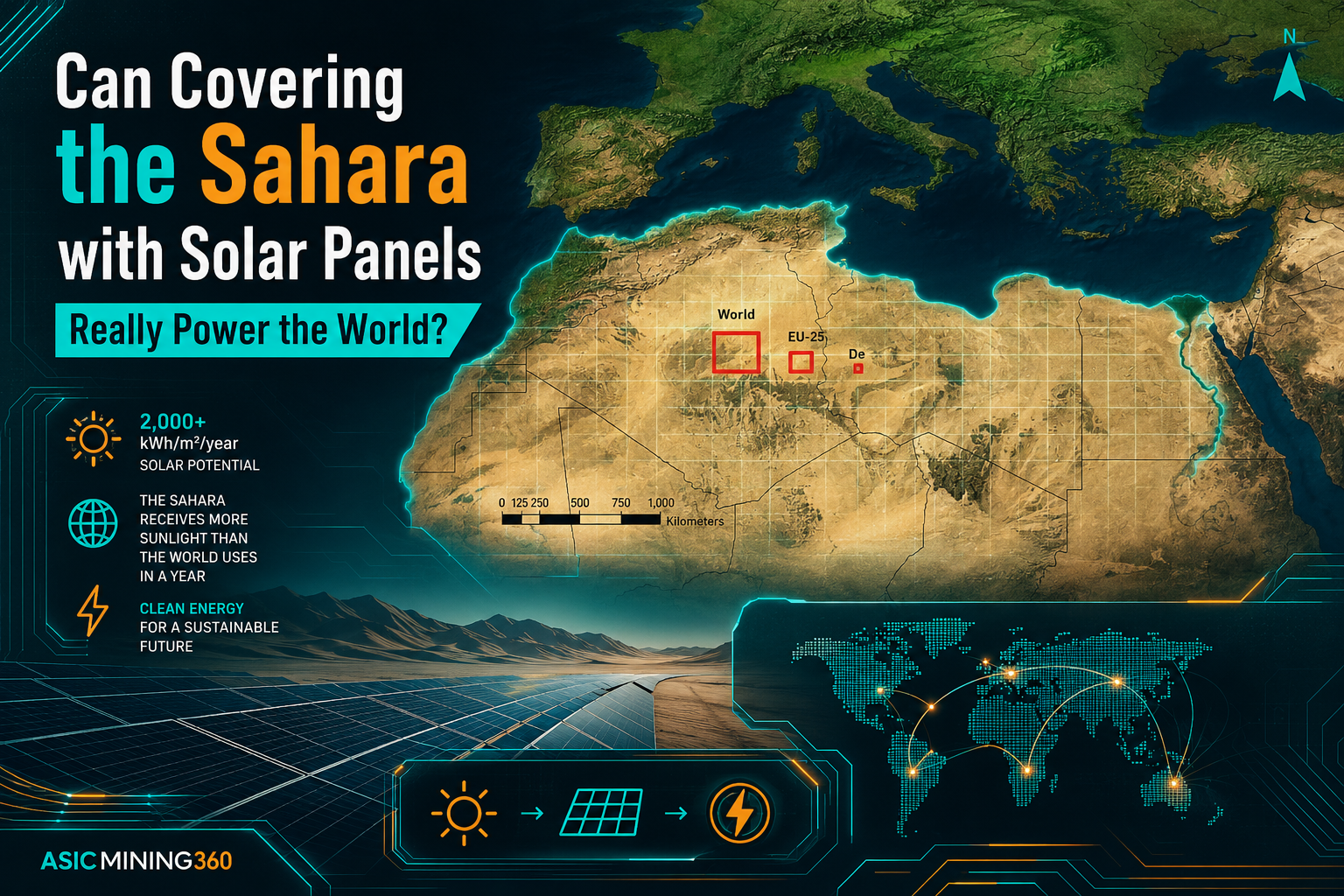
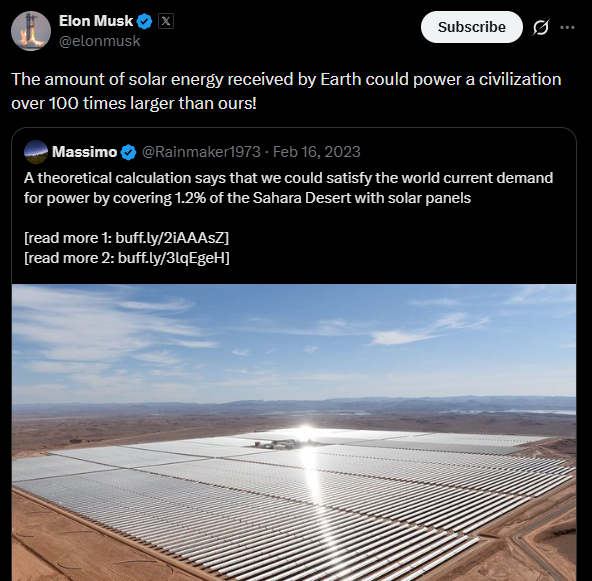
If you were on social media back in late December 2022, you might remember a post by Massimo (@Rainmaker1973) that went viral. It featured a map of North Africa with a few tiny, highlighted squares drawn across the Sahara, mostly sitting in Algeria and Libya. The claim attached to it was almost shockingly simple: if we covered just those modest patches of sand with solar panels, we would harvest enough electricity to run the entire planet. One square was labeled for Europe, an even smaller one marked "DE" for Germany, and a few others accounted for global demand. When Elon Musk jumped into the conversation and later posted a similar thought in February 2023—pointing out that the solar energy hitting Earth could easily power a civilization a hundred times larger than ours—the idea took off worldwide.
It leaves us with a fascinating question worth digging into: could we actually turn a massive chunk of the Sahara into a giant solar power station, and more importantly, could we do it without accidentally breaking the planet's climate in the process?
The Raw Numbers Look Almost Too Easy
If all you need is raw sunlight, the Sahara is essentially real estate heaven. Direct solar radiation maps show it sitting right at the top of global sunshine rankings, alongside places like the American Southwest, northern Mexico, outback Australia, southern Africa, and the Arabian Peninsula.
The funny thing is, nobody is suggesting we blanket the entire desert. Doing that would produce something like 18 times the electricity the entire world currently consumes, which is well beyond anything our grids could ever handle. To cover current global electricity demand using standard solar panels with a modest 15% efficiency rating, you only need roughly 500,000 square kilometers. That sounds huge until you realize it is about the size of Spain, placed inside a desert that spans over 9 million square kilometers. Add in the fact that, outside of the Nile Valley, the Sahara has one of the lowest population densities on Earth, and on paper, the land acquisition part of the project looks almost trivial.
Which raises the obvious question: if the math is that clean, why aren't construction crews out in the sand dunes right now?
When an Energy Project Turns into Planetary Terraforming
The reason is that a solar installation of this scale isn't just an extra-large power station; it is a full-blown weather modification engine.
Sure, covering a tiny fraction of the desert might work on paper for today's numbers, but global energy appetites keep climbing. Developing nations need more grid capacity, and any realistic setup has to build in extra headroom for battery storage, transmission losses, line maintenance, and backup redundancy. When climate researchers run long-term simulations for meaningful global impact, they often model much larger coverage areas, like turning 20% of the Sahara into solar farms. And that is where the physics gets messy.
Natural desert sand is pale and highly reflective. It has a high albedo, meaning it bounces a massive chunk of incoming solar heat straight back out into space. Solar panels, by contrast, are dark by design because they need to absorb as much radiation as possible. If you replace millions of square kilometers of bright sand with dark silicon, you fundamentally alter how the Earth handles solar energy. Instead of reflecting heat, the region starts trapping it.
In small doses, local heat absorption doesn't matter much. But expand that dark footprint over hundreds of thousands of square kilometers, and the trapped heat changes the temperature differential between the African landmass and the surrounding oceans. That shift in thermal balance alters atmospheric pressure systems, redirects wind currents, and rewrites moisture pathways. In several climate models, this extra warmth pulls in moist oceanic air, sparking heavy rainfall over the desert. More rain leads to plant growth, plants retain soil moisture and evaporate it back into the sky, and suddenly you trigger a self-sustaining feedback loop where the desert starts turning green.
History, Domino Effects, and Global Weather Disruption
That might sound like a bonus—after all, who wouldn't want clean power and a green Sahara? Scientists actually know this region was covered in lakes, rivers, and grasslands thousands of years ago during the African Humid Period. But the Earth's climate doesn't operate in isolated pockets, and what happens in North Africa creates ripples across the globe.
Computer models estimating a 20% desert solar coverage predict local temperature spikes of around 1.5°C, which in turn nudges the global average temperature up by roughly 0.16°C through oceanic and atmospheric feedback loops. Bump that solar coverage up to 50%, and local desert warming could reach 2.5°C. Now, it is vital to remember these figures come from virtual simulations built on specific assumptions, not real-world observations. But they serve as a warning that tweaking one enormous ecosystem can send unintended shockwaves through global climate patterns, affecting rainfall in South America or wind currents over Europe.
Nature Has a Habit of Laughing at Spreadsheets
You don't even need a sci-fi mega-project to see how real-world biology disrupts neat engineering plans. Look at what happened in China when they built massive solar farms across their arid desert regions.
On paper, the plan was flawless. But in practice, maintenance crews had to regularly wash dust off the panels using water. That runoff seeped into the ground directly underneath the arrays, where the panels provided rare, cool shade from the harsh desert sun. Unintentionally, the engineers created the ultimate greenhouse environment, and dense weeds began sprouting beneath the structures. Before long, the vegetation grew high enough to cast shade back onto the panels and tangle up the equipment, actively tanking power output.
The engineers had calculated irradiance, water volume, tilt angles, and electrical yields, but they completely overlooked the basic biological reality of what happens when you combine water and shade in a dry landscape. In the end, local managers found a wonderfully practical fix: they brought in herds of sheep. The sheep got to graze in the shade, and the panels stayed clear of overgrown grass. It is a funny picture—cutting-edge solar tech maintained by livestock—but it illustrates a serious point: reality always invades the spreadsheet.
The Real World Is Always More Complex
When you scale up to hundreds of thousands of square kilometers in the Sahara, the unpredictable domino effect grows exponentially worse. You change soil moisture, which changes plant life, which shifts insect populations, which alters bird migration routes, which ultimately reshapes entire regional ecosystems. A single tweak to surface reflectivity sets off a long line of falling dominoes, and by the time the last one falls, you might be facing consequences that nobody knows how to undo.
So, can we power the entire planet using solar panels in the Sahara? In pure mathematical terms, absolutely. The land area needed is a drop in the bucket compared to the sheer size of the desert, and the sun shines almost endlessly.
But mathematics doesn't have to deal with abrasive sandstorms eating away at glass, endless high-voltage transmission losses across oceans, geopolitical border disputes, grid-scale storage hurdles, or delicate ecological feedback loops. The real question isn't whether we have the technology to gather that much energy. It is whether we could pull off an intervention of that magnitude without changing the planet in ways we might deeply regret. Models and calculations can give us clues, but when you tamper with a global ecosystem, you don't get a dry run—the real world is the final test.