The Bitmain Antminer S23: 2026’s High-Stakes Mining Reality
Let’s be honest: by 2026, the "Wild West" days of Bitcoin mining are firmly in the rearview mirror. Mining today isn't a hobby you run out of a spare bedroom; it’s a high-precision, industrial-grade competition where the difference between a profit and a loss is measured in fractions of a cent.
At current electricity rates, even a 10 J/TH miner can lose money in under 3 months if deployed incorrectly.
Enter the Bitmain Antminer S23 series.
On paper, the specs are staggering. We’re looking at energy efficiency hovering between 9 and 12 J/TH—pushing right up against the boundaries of what modern ASIC physics can actually handle. But if there’s one thing we’ve learned this year, it’s that raw hashrate is no longer the king. In a market defined by razor-thin margins, your hardware is only as good as your electricity bill and your cooling setup.
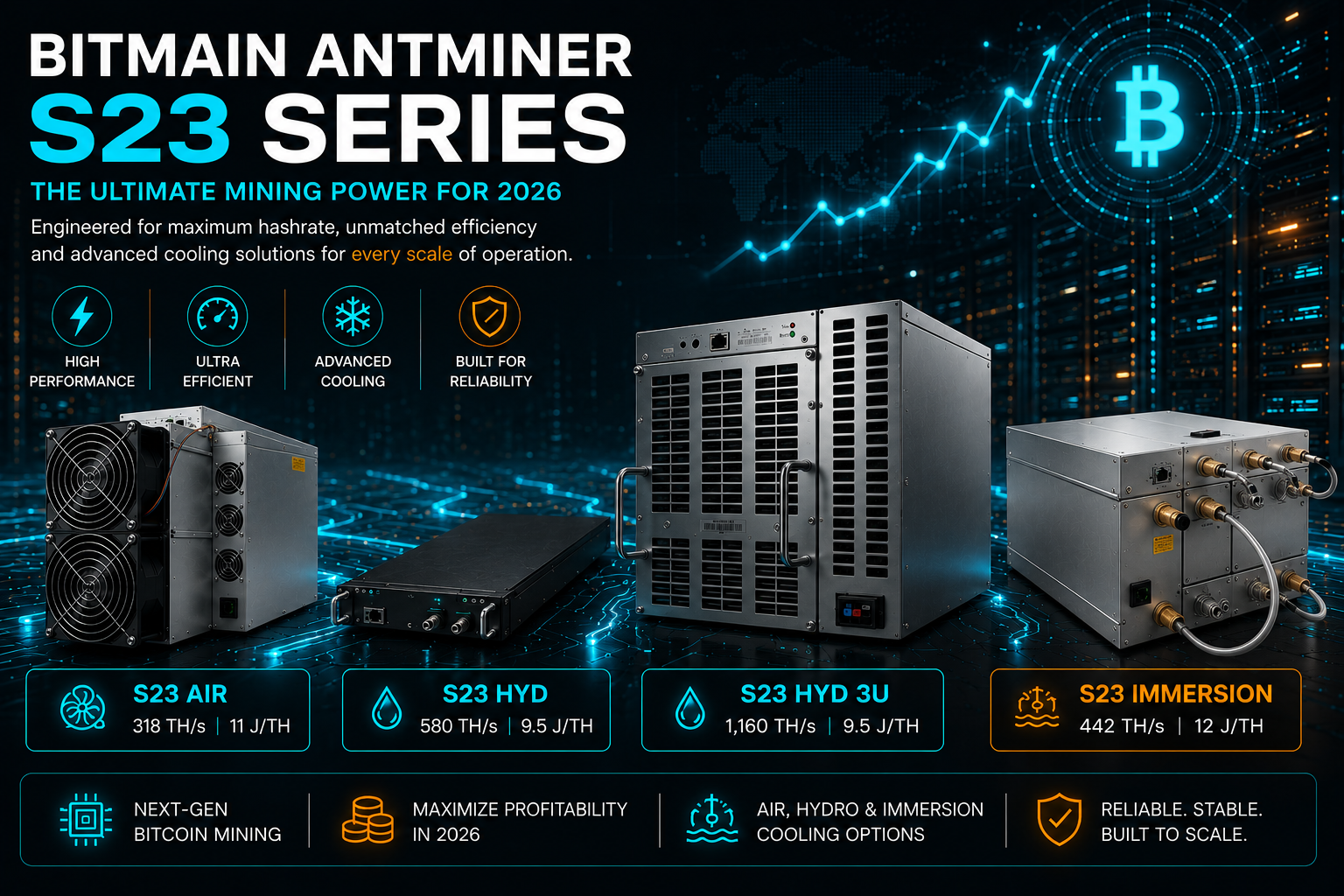
The S23 lineup isn't just one machine; it’s a specialized toolkit. Whether you’re looking at the standard air-cooled units, the high-performance hydro-cooled loops, or the heavy-duty immersion systems, Bitmain is clearly signaling that the "one-size-fits-all" era is over. Each configuration targets a specific type of operator, from the industrial farm in a cold climate to the massive data centers running liquid-cooled stacks.
In this guide, we’re cutting through the marketing gloss. We aren't just looking at the spec sheets—we’re looking at real-world deployment. We’ll break down which S23 model actually makes sense for your specific infrastructure, how the 2026 energy landscape changes the ROI math, and why your choice of cooling might be more important than the chips themselves.
Antminer S23 Series Comparison Table: Specifications, Efficiency and Ratings
| Specification | S23 Hyd 3U | S23 Hyd | S23 Immersion | S23 Air |
|---|---|---|---|---|
| Hashrate | 1,160 TH/s ⭐⭐⭐⭐⭐ | 580 TH/s ⭐⭐⭐✩✩ | 442 TH/s ⭐⭐✩✩✩ | 318 TH/s ⭐✩✩✩✩ |
| Power Consumption | 11,020 W ⭐⭐⭐✩✩ | 5,510 W ⭐⭐⭐⭐✩ | 5,304 W ⭐⭐⭐⭐✩ | 3,498 W ⭐⭐⭐⭐⭐ |
| Efficiency (J/Th) | 9.5 J/Th ⭐⭐⭐⭐⭐ | 9.5 J/Th ⭐⭐⭐⭐⭐ | 12 J/Th ⭐⭐✩✩✩ | 11 J/Th ⭐⭐⭐✩✩ |
| Cooling Type | Hydro Cooling ⭐⭐⭐⭐✩ | Hydro Cooling ⭐⭐⭐⭐✩ | Immersion Oil ⭐⭐⭐⭐✩ | Air Cooling ⭐⭐✩✩✩ |
| Noise Level (approx.) | 50 dB ⭐⭐⭐⭐✩ | 50 dB ⭐⭐⭐⭐✩ | 50 dB (quiet) ⭐⭐⭐✩✩ | High (fans) ⭐⭐✩✩✩ |
| Voltage | 380–415 V ⭐⭐⭐⭐✩ | 380–415 V ⭐⭐⭐⭐✩ | 380–415 V ⭐⭐⭐⭐✩ | 380–415 V ⭐⭐⭐⭐✩ |
| Dimensions (L×W×H) | 900×486×132 mm ⭐⭐✩✩✩ | 410×170×209 mm ⭐⭐⭐✩✩ | 293×236×364 mm ⭐⭐⭐✩✩ | 410×170×209 mm ⭐⭐⭐✩✩ |
| Weight | ≈ 42 kg ⭐✩✩✩✩ | 13.5 kg ⭐⭐⭐✩✩ | 17.15 kg ⭐⭐✩✩✩ | ≈ 14.5 kg ⭐⭐⭐✩✩ |
| Connectivity | Ethernet ⭐⭐⭐⭐✩ | Ethernet ⭐⭐⭐⭐✩ | Ethernet ⭐⭐⭐⭐✩ | Ethernet ⭐⭐⭐⭐✩ |
| Firmware / OS Support | Bitmain Firmware ⭐⭐⭐⭐⭐ | Bitmain Firmware ⭐⭐⭐⭐⭐ | Bitmain Firmware ⭐⭐⭐⭐⭐ | Bitmain Firmware ⭐⭐⭐⭐⭐ |
| Ease of Deployment | Industrial Setup ⭐✩✩✩✩ | Hydro Setup ⭐⭐⭐✩✩ | Immersion Setup ⭐⭐⭐✩✩ | Standard Plug & Mine ⭐⭐⭐⭐⭐ |
| Approx. Price (USD) | $28,000–$32,000 ⭐✩✩✩✩ | $7,950–$14,790 ⭐⭐⭐✩✩ | $8,800–$11,500 ⭐⭐⭐✩✩ | $4,999–$8,268 ⭐⭐⭐⭐✩ |
| Total Score | 39 / 60 ⭐⭐⭐✩✩ (3.25/5) | 45 / 60 ⭐⭐⭐⭐✩ (3.75/5) | 40 / 60 ⭐⭐⭐✩✩ (3.33/5) | 41 / 60 ⭐⭐⭐✩✩ (3.42/5) |
The table above lays out the main differences across the S23 series models. It covers things like hashrate, how much power they use, energy efficiency, and the cooling methods. We also look at noise levels, physical size, weight, and how they connect to networks. Firmware details, ease of deployment, and price are also included.
For industrial settings, hydro and immersion models offer top hashrate and efficiency. This makes them a strong choice when performance is a priority.
Let's look at the costs versus the benefits. We need to consider our current resources and what we’re trying to achieve. What are the key areas for us to focus on? We should evaluate the options carefully and decide on a strategy that makes financial sense while still moving us forward. The latest models such as the S23 Hyd 3U offer improved technical capabilities. However, their high prices make the return on investment less attractive, affecting their overall appeal.
User-Friendly Models: Best Antminer S23 Options for Small Miners
The S23 Air and standard hydro units are more accessible for smaller miners due to lower price and simpler deployment.
Weight & Cooling Considerations: Choosing Between Air, Hydro, and Immersion
Immersion and hydro models require careful handling and advanced infrastructure, while air-cooled models are lighter and easier to install. Overall, the table allows miners to quickly identify the best device for their setup, balancing between efficiency, upfront cost, and ease of use in 2026.
FAQ: Bitmain Antminer S23 Series (2026)
Q1- What is the Bitmain Antminer S23 series?
The Bitmain Antminer S23 series is the ninth generation of ASIC miners designed for Bitcoin mining, focusing on higher efficiency, stronger performance, and multiple cooling options including air, hydro, and immersion.
Q2- Which Antminer S23 model is the most powerful?
Based on the comparison table, the S23 Hyd 3U offers the highest hashrate in the series, making it the most powerful option in terms of raw mining performance.
Q3- What is the difference between air-cooled, hydro, and immersion models?
Air-cooled models use fans and are easier to deploy, while hydro and immersion models rely on liquid-based cooling systems that offer better thermal performance but require more advanced infrastructure.
Q4- Are Antminer S23 miners profitable in 2026?
The article explains that despite strong technical performance, current profitability is limited by Bitcoin’s price, which affects return on investment even for the most powerful machines.
Q5- Which Antminer S23 model is best for small miners?
According to the article, the S23 Air and standard hydro units are more accessible for smaller miners due to their lower price and simpler deployment.
Q6 - What should I consider before buying an Antminer S23?
You should consider factors such as power consumption, cooling requirements, available infrastructure, upfront cost, and how these align with your mining goals and resources.
Q7- Why are the newer Antminer S23 models so expensive?
The newer models include many advanced ASIC chips that deliver higher hash power and better performance, which increases their manufacturing cost and final price.
Q8- How important is cooling when choosing an Antminer S23?
Cooling is a key factor because hydro and immersion models require more complex setups, while air-cooled models are lighter and easier to install, making cooling choice critical for deployment and operation.