Introduction
Mining in 2026 isn't about who has the biggest rig anymore; it’s about who has the sharpest pencil. We’ve officially moved past the era of "plug it in and watch the sats roll in." Today, Bitcoin mining is a high-stakes game of inches where the difference between a thriving operation and a digital paperweight comes down to fractions of a cent in electricity costs.
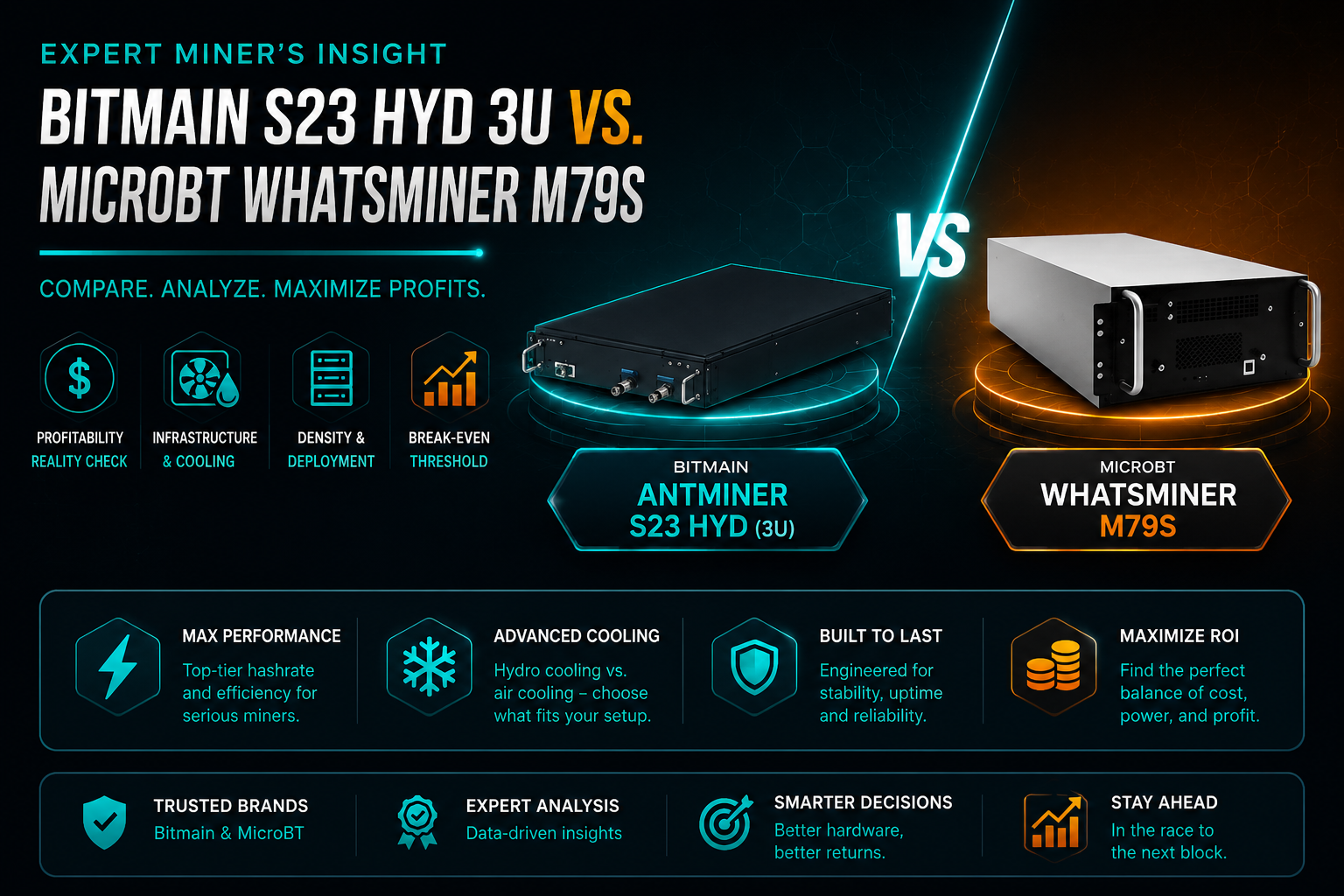
In this corner of the ring, we have the two undisputed heavyweights of the current cycle: the Bitmain Antminer S23 Hyd 3U and the MicroBT WhatsMiner M79S.
These machines represent the absolute peak of ASIC engineering, but they aren't interchangeable. They represent two very different philosophies on how to survive—and win—in a market defined by razor-thin margins. While both are designed to squeeze every possible hash out of a watt, their approaches to cooling, power density, and infrastructure requirements are worlds apart.
What We’re Actually Looking At:
In this breakdown, we’re cutting through the spec-sheet noise. A "theoretical" terahash doesn't pay the bills—real-world uptime and operational efficiency do. We’re going to dive into:
-
The Profitability Reality Check: How these units stack up across different energy price tiers.
-
Infrastructure & Cooling: Why your choice of facility might make one of these a "no-go" from day one.
-
Density & Deployment: A look at the physical footprint and the logistical weight of scaling these units.
-
The Break-Even Threshold: Identifying the "sweet spot" where these machines actually start paying for themselves.
The goal here is simple: we want to help you figure out which machine fits your specific operational DNA, rather than just chasing the highest number on a glossy brochure.
| Comparison Criteria | Bitmain Antminer S23 Hyd (3U) | MicroBT WhatsMiner M79S |
|---|---|---|
| Build Quality | Excellent ★★★★★ | Good ★★★★☆ |
| Hashrate Performance | 1160 TH/s ★★★★☆ | 1350 TH/s ★★★★★ |
| Efficiency (Energy/Hash) | 9.5 J/TH ★★★★★ | 14.81 J/TH ★★★★☆ |
| Dimensions & Weight | **900×486×132 mm | 21.5 kg** ★★★★★ |
| Market Price (Est.) | $28,000 ★★★★★ | $18,000 ★★★★★ |
| Power Consumption | 11,020 Watts ★★★★★ | 20,000 Watts ★★★★★ |
| Daily Revenue (0 Cost) | ~$45.00 / day ★★★★★ | ~$49.00 / day ★★★★★ |
| Operational Noise | 50 dB (Silent) ★★★★★ | 50 dB (Silent) ★★★★★ |
| Profit @ $0.04/kWh | $34.42 ★★★★★ | $29.80 ★★★★☆ |
| Profit @ $0.08/kWh | $23.84 ★★★★☆ | $10.60 ★★★★★ |
| Break-Even Elec. Cost | $0.17 / kWh ★★★★★ | $0.10 / kWh ★★★★★ |
| Final Verdict | ⭐⭐⭐⭐☆ (4.0 / 5) | ⭐⭐⭐☆☆ (3.4 / 5) |
The CAPEX vs. OPEX Tug-of-War (The "Hidden" Strategy)
Here’s the deal: If you’ve got access to dirt-cheap power—think stranded gas or subsidized industrial rates under $0.03/kWh—the WhatsMiner M79S is a CAPEX dream. You’re saving $10,000 upfront per unit. That’s a massive head start on your ROI.
But, if you’re paying 'normal' industrial rates or operating in a region where power prices spike, the Antminer S23 Hyd is your insurance policy. It’s built for the long game. When the network difficulty jumps or BTC price gets shaky, the S23 stays profitable while the M79S risks becoming an expensive space heater.
Infrastructure: Don’t Melt Your Wires
A quick reality check on the electrical side: Running an M79S isn't like plugging in a toaster. At 20,000 Watts, you’re looking at massive amperage requirements. You’ll need heavy-duty industrial breakers and specialized PDU (Power Distribution Unit) setups. Before you pull the trigger on a fleet of M79S units, make sure your transformers and wiring can actually handle the load. If your infrastructure is older, the lower-draw S23 Hyd is much kinder to your facility's heartbeat.
Turning Waste into Wealth (Heat Recovery)
In 2026, green mining is a massive trend. Since both these beasts are liquid-cooled, you’re sitting on a goldmine of thermal energy. In 2026, smart miners aren't just venting heat; they’re selling it. The closed-loop systems in these units make it easy to hook up a heat exchanger. Whether you’re pre-heating water for a nearby facility or heating a greenhouse, the efficiency of the S23 Hyd makes it a perfect 'silent partner' for secondary heating businesses. It turns a waste product into a second revenue stream.
The "Future-Proof" Verdict
In the mining world of 2026, Efficiency = Survival. The Bitmain S23 Hyd (9.5 J/TH) is effectively 'halving-proof.' It’s designed to keep hashing even when the market gets ugly. The M79S is a high-performance dragster—incredible speed and power, but it needs the right 'track' (cheap power) to stay in the race.
My advice? If you’re building a professional, high-density farm for the next five years, go with the S23. If you’ve found a pocket of nearly free energy and want to scale fast on a budget, the M79S is your weapon of choice.
Cooling System Design & Liquid Requirements
Let's talk about how much cooling liquid these machines hold. Both models are top-notch in water cooling tech. The amount of liquid each one holds depends on how its inside parts are set up. Since they work with a closed-loop system, hooked up to outside cooling units, the liquid gets split between what's inside the machine itself and what's needed for the outside setup.
Here are the basic numbers for just the inside of each machine:
-
Bitmain Antminer S23 Hyd (3U)
This one's built for racks and moves liquid with high pressure and constant flow.
Inside Liquid Amount: About 4 to 6 liters in its cooling pipes.
Heads up: Because it's a 3U size, the water paths are designed to keep flow easy, so it needs strong pumps to move water well over the hashboards. -
MicroBT WhatsMiner M79S
The M79S is a strong machine made specifically for water cooling built right in.
Inside Liquid Amount: About 5 to 8 liters.
Heads up: WhatsMiner models often use slightly wider pipes, which means more liquid touches the chips. This leads to it holding more liquid than some similar Bitmain models.
Stuff Investors Should Know (Beyond What's Inside)
When you're figuring out how much liquid you'll actually need, don't just look at the machine itself. Think about these things:
-
Outside Cooler (Dry Cooler): This is the biggest piece. One of these dedicated to a single machine needs another 15 to 30 liters of liquid (a mix of distilled water and glycol).
-
Pipe Length: For every meter of pipe connecting the miner to the outside cooler, you're adding roughly 0.5 to 1 liter, depending on how wide the pipe is.
-
Liquid Type: It's always a good idea to use deionized/distilled water mixed with glycol (around 20% to 50% glycol) to stop rust and freezing. This is super critical for MicroBT systems, which need high-quality liquid to keep their warranty valid.
Pro Tip: Never fill the system with regular tap water. The minerals and salts will cause buildup and blockages in the tiny channels of the hashboards in just a few months. That will make the chips overheat and cause lasting damage.
Frequently Asked Questions (FAQ)
Q1. Which miner is more efficient in 2026: Bitmain S23 Hyd 3U or WhatsMiner M79S?
The Bitmain Antminer S23 Hyd 3U is significantly more efficient, with an efficiency of around 9.5 J/TH compared to the WhatsMiner M79S at 14.81 J/TH. This means the S23 Hyd consumes less electricity per terahash, making it more suitable for locations with higher power costs.
Q2. Which one is more profitable with expensive electricity?
If your electricity price is above $0.08/kWh, the S23 Hyd 3U is clearly the better choice. It has a higher break-even electricity price (around $0.17/kWh) compared to the M79S (around $0.10/kWh), which means it stays profitable in more regions.
Q3. How much cooling liquid do these miners need?
-
Bitmain S23 Hyd 3U: Around 4 to 6 liters inside the machine.
-
WhatsMiner M79S: Around 5 to 8 liters inside the machine.
However, a full setup including the external dry cooler and pipes usually requires 20 to 40+ liters of cooling liquid per machine, depending on the system design.
Q4. Can I use tap water for liquid cooling?
No. You should never use tap water. Always use distilled or deionized water mixed with glycol. Tap water contains minerals that can clog microchannels, cause corrosion, and permanently damage the hashboards.
Q5. Which miner is better for high-density mining farms?
The Bitmain S23 Hyd 3U is generally better for high-density farms because it is lighter, designed for rack mounting, and offers much better efficiency, which reduces power and cooling costs at scale.
Q6. Is the WhatsMiner M79S still a good option?
Yes, especially if you have very cheap electricity (below $0.05/kWh) and want a lower upfront hardware cost. It delivers higher raw hashrate, but at the cost of much higher power consumption.
Q7. How noisy are these water-cooled miners?
Both models operate at around 50 dB, which is considered very quiet for ASIC miners. The main noise usually comes from pumps and external cooling fans, not from the miners themselves.
Q8. Which one has a better return on investment (ROI)?
It depends on your electricity price:
-
With cheap power, the M79S can generate slightly higher gross revenue.
-
With average or expensive power, the S23 Hyd 3U usually delivers a better and safer ROI thanks to its superior efficiency.
Q9. What should I consider besides hashrate and efficiency?
You should also look at:
-
Physical size and weight (rack limits and space density)
-
Cooling infrastructure cost
-
Electricity price volatility
-
Warranty conditions and coolant quality requirements
Q10. Which miner is the safer long-term investment for 2026?
For most investors, the Bitmain S23 Hyd 3U is the safer long-term choice because it is more energy-efficient, more tolerant to higher electricity prices, and better suited for professional, high-density mining farms.