Breaking Down the Proto Rig Specs: How 12,000W and 3nm Chips Redefine Mining Power
| Specification | Proto Rig |
|---|---|
| Manufacturer | Proto (Block Inc.) |
| Chip Process | 3nm ASIC Mining Chip |
| Power Consumption | Up to 12,000W |
| Voltage | 208–240V |
| Cooling System | High-Velocity Air Cooling |
| Fans | 6 Industrial Fans |
| Noise Level | ~80 dB |
| Hashboards | 9 Modular Hashboards |
| Dimensions | 390 × 290 × 500 mm |
| Design Philosophy | Modular & Upgradeable Mining Infrastructure |
| Expected Lifecycle | Up to 10 Years (Modular Upgrade Model) |
| Estimated Price | $5,000 – $8,000 |
Why Bitcoin Mining Hardware Is Transitioning From Disposable ASIC Machines to Modular Open Infrastructure Systems Like Proto Rig
Bitcoin mining has evolved beyond a simple hardware race into a full-blown infrastructure war. We’ve entered a new industrial era where success isn't just about raw power; it’s about building systems that can actually survive, adapt, and scale without hitting a dead end every few years.
For over a decade, the industry has been stuck in a wasteful "rip-and-replace" cycle. Miners buy expensive hardware, run it into the ground, and then toss it aside the moment a slightly better ASIC hits the market. This constant churn hasn't just drained capital and created massive waste—it’s also handed a massive amount of control to a tiny group of manufacturers.
But we're seeing a fundamental shift in design philosophy. Mining hardware is finally being treated like long-term infrastructure rather than disposable tech. Leading this charge is the Proto Rig by Proto (Block Inc.). It’s a modular system designed to challenge the status quo of how mining gear is built and maintained.
The brilliance of the Proto Rig is its modularity. Instead of trashing an entire unit, operators can swap out hashboards, cooling systems, or individual components as needed. This approach doesn't just extend the life of the hardware; it cuts down on downtime and completely redefines what true "efficiency" looks like for industrial-scale operations.
How Legacy ASIC Miners Created the “Rip and Replace” Problem in Bitcoin Mining and Why Modular Design Is the Solution
Limitations of Legacy ASIC Miners and Infrastructure Inefficiency
Early on, it was obvious that traditional mining hardware just wasn’t built for the long haul. Most legacy setups fail to maximize the power they’ve already got, forcing owners into a frustrating cycle of ripping out and replacing entire machines every few years.
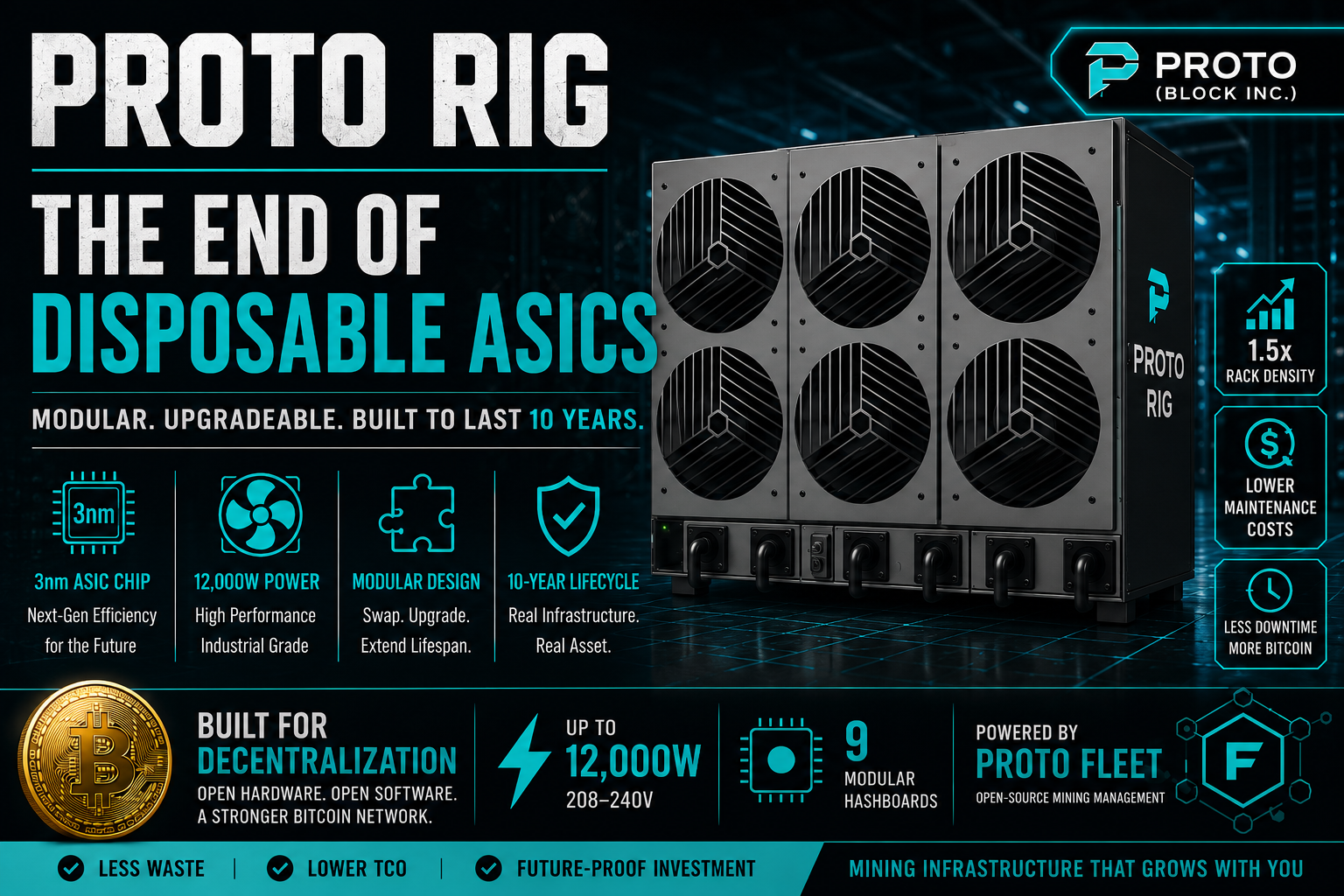
The Proto Rig changes that dynamic. It’s built specifically to solve the "rack space" problem, squeezing every bit of value out of your existing electrical footprint. In fact, it delivers over 1.5x more power per foot of rack space than the standard "shoebox" miners that currently dominate the industry.
By packing nine hashboards into a sturdy, compact frame, Proto has made maintenance incredibly simple—swapping out a component is honestly about as easy as loading a dishwasher. This modular design flips the script on the hardware's lifespan, turning what used to be a short-term purchase into a 10-year infrastructure asset.
For operators, this means cutting costs by up to 20% with every upgrade cycle and virtually eliminating the headache of repair-related downtime.
Inside Proto Rig Architecture: 3nm Semiconductor Chips, Modular Hashboards, and Industrial-Grade Cooling System Design
How the 3nm Mining Chip Improves Bitcoin Mining Efficiency
Pursuant to the goal of supporting mining decentralization, Proto is building in the open, leveraging strengths in ASIC design to develop the most advanced semiconductor process available. At the heart of the Proto Rig lies the 3nm mining chip, a specialized processor designed to help operators survive and thrive in the fifth mining epoch and beyond. This high-density architecture requires immense power and thermal regulation; thus, the rig is engineered to handle a massive 12,000W output on 208-240V infrastructure.
Modular Thermal Management and High-Velocity Air Cooling Design
To manage this heat, Proto utilizes a high-velocity Air Cooling system with 6 industrial-grade fans, maintaining an acoustic profile of 80 dB. This design ensures that if a fan or board fails, the rest of the machine keeps hashing, allowing for toolless, on-the-rack repairs in literally seconds. By offering these 3nm chips as standalone products, Proto aims to unlock mining system innovation, putting the tools for development into the hands of the many rather than the few, and empowering global developers to think beyond the envelope of current heat reuse and energy solutions.
Bitcoin Mining Profitability and ROI Breakdown of Proto Rig Modular ASIC Infrastructure at Industrial Scale
Estimated Bitcoin Mining Profitability at $0.08 Electricity Cost
Ushering in a more open and equitable global economy requires a hardware ecosystem that is both transparent and highly performant. The Proto Rig represents a compelling, differentiated solution that brings better product experiences to the mining industry. In a real-world operational environment with an electricity cost of $0.08 per kWh, the rig empowers the user to generate a daily profit of $9.00.
Investment Cost, Long-Term ROI, and Infrastructure Longevity
While an initial investment of $5,000 to $8,000 might seem like a lot, the rig offers a very clear path to ROI, typically breaking even around the 630-day mark. But the real story here isn’t just the payback period; it’s the staying power. Most old-school miners eventually end up as boneyards—just piles of junk used for spare parts—whereas the Proto Rig stays in the game as a primary asset that actually gets more cost-effective as time goes on.
When you pair this hardware with Proto Fleet, their open-source management software, you’re looking at a total shift in how mining works. We’re moving away from the disposable status quo and toward a world where infrastructure is reliable, repairable, and built to be upgraded. It’s finally making the day-to-day operation of Bitcoin mining both practical and sustainable.
Key Features
-
Future-Proof: 3nm Modular Design
-
Lifecycle: 10-Year Infrastructure
-
Efficiency: 1.5x Rack Density
FAQ: Proto Rig Bitcoin Mining Hardware and Modular ASIC Infrastructure
Q1: How does the Proto Rig differ from traditional ASIC miners?
Traditional ASIC miners follow a “rip and replace” model where the entire machine becomes obsolete after a few years. Proto Rig introduces a modular architecture where components such as hashboards can be swapped individually. This design increases hardware lifespan to roughly 10 years and significantly reduces maintenance costs and downtime.
Q2: How much electricity does the Proto Rig consume?
The system is engineered to operate at approximately 12,000W using standard 208-240V mining infrastructure. Because of this high power requirement, the rig is typically deployed in professional mining facilities or optimized industrial environments with proper electrical capacity and cooling systems.
Q3: What is the estimated profitability of the Proto Rig?
Under example conditions with electricity priced at $0.08 per kWh, the rig can generate around $9.00 in daily profit. However, mining profitability varies depending on Bitcoin price, network difficulty, mining pool fees, and local electricity costs, so actual earnings may fluctuate significantly.
Q4: What is the expected return on investment (ROI) for the Proto Rig?
With a purchase price ranging between $5,000 and $8,000, the estimated ROI period is approximately 630 days based on the profitability scenario described. Long-term returns improve due to the modular design, which allows upgrades without replacing the entire machine.
Q5: Why is modular mining hardware important for decentralization?
Modular mining hardware lowers barriers to entry by making equipment easier to repair, upgrade, and maintain. This reduces dependence on a few dominant manufacturers and encourages innovation from independent developers, contributing to a more decentralized and resilient Bitcoin mining ecosystem.
Q6: What is Proto Fleet and how does it help miners?
Proto Fleet is an open-source mining fleet management platform designed to work with Proto hardware. It enables operators to monitor performance, manage multiple miners, and perform diagnostics at scale. Open-source infrastructure also encourages community development and transparency within the mining ecosystem.
Note: Mining profitability figures mentioned in this article are approximate and may not reflect real-time results. Cryptocurrency prices and network difficulty change continuously, while electricity costs remain relatively fixed. Because of these fluctuations, actual mining income can vary significantly. For the most accurate and updated profitability estimates for each mining device, we recommend using the profitability calculator available on our website, which analyzes current network data, electricity costs, and hardware performance.