
Introduction
Sometimes, opportunities in cryptocurrency mining appear out of nowhere.
We recently came across a video on Reddit featuring an iBeLink BM-S3, with the person behind the video claiming that the machine was generating more than $200 per day at the time of recording.
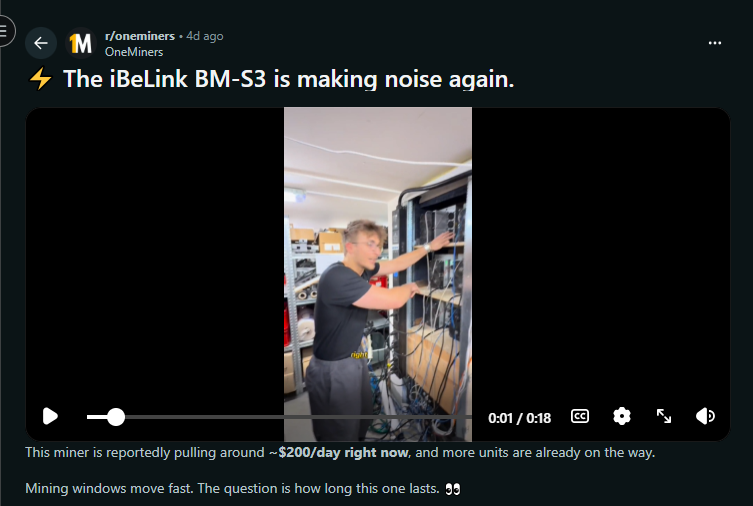
A Reddit post on r/oneminers showing the iBeLink BM-S3 generated discussions after claiming ~$200/day revenue.
The statement immediately attracted attention, especially because the BM-S3 is not a new generation of ASIC. It was originally designed for BLAKE2b-based Siacoin mining, and under normal market conditions, older hardware can easily become unattractive when electricity costs and network competition are taken into account.
Yet there it was: an older machine apparently generating a surprisingly high daily return.
One commenter offered an important explanation:
The new fork’s coin price can have a big impact, but it’s only part of the equation. Profitability can change quickly as the coin price moves, more miners join, network difficulty rises, and rewards get spread across more hashrate.”
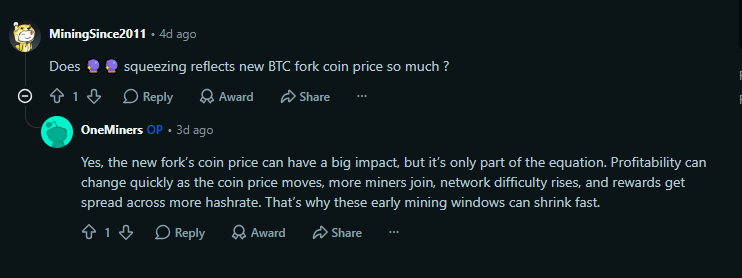
Discussion on Reddit explaining how price surges and difficulty spikes impact early mining windows.
That comment gets to the heart of the opportunity.
Mining Opportunities Can Come From Different Directions
There is no single reason why an ASIC can suddenly become profitable.
One possibility is a sharp increase in the price of the coin being mined.
Zcash provides a recent example. In September 2026, ZEC moved above $1,000 for the first time since 2016, reaching an intraday high of about $1,021.58 on September 4. The move significantly changed the economics of Zcash mining and brought Zcash ASIC profitability back into focus.
The hardware did not suddenly become more efficient.
The mining algorithm did not suddenly change.
The economics changed because the value of the asset being produced changed.
But there is another way these opportunities can appear.
When a New Mining Market Opens
The second possibility is even more interesting: a new network or a major change to an existing network can create demand for hardware that previously had limited use.
That is what makes the current BLAKE2b story particularly unusual.
BTCB2 split from Bitcoin on August 8, 2026, and later activated BLAKE2b proof-of-work at block 961,640 on August 30. Because BLAKE2b is associated with a different class of mining hardware than Bitcoin's traditional SHA-256d ASICs, the change created an opportunity for machines originally built for Siacoin mining.
Suddenly, hardware that had looked much less interesting under its original mining economics had another market to serve.
That is the type of event that miners watch for.
The Window Can Be Very Short
However, there is an important lesson behind the $200-per-day claim.
A profitable mining opportunity is not necessarily a permanent one.
When miners discover a new opportunity, they react.
More machines are switched on. More hashrate enters the network. Difficulty rises, and the same block rewards are distributed among a larger amount of computational power.
We have already seen this effect discussed around the new BLAKE2b market. A recent Reddit discussion described early returns of around $1,000 per day on some hardware before additional hashrate entered the network, with estimates later moving closer to $100. Another commenter noted that a sharp coin-price increase can push revenue higher, but rising hashrate and difficulty can compress those returns just as quickly.
This is why the number shown in a profitability calculator—or in a mining video—should always be treated as a snapshot, not a guarantee.
The Real Opportunity Is in Recognizing the Change
For miners, the interesting part is not simply finding an ASIC that is profitable today.
It is understanding why it became profitable.
If the reason is a temporary price spike, the opportunity can disappear when the market falls.
If the reason is a new mining network, the opportunity can shrink as miners discover it and network difficulty increases.
And sometimes both things happen at the same time.
That combination can produce spectacular numbers for early participants, but it can also make the market extremely competitive very quickly.
The recent BM-S3 story is therefore bigger than one machine or one $200-per-day claim.
It demonstrates a fundamental characteristic of ASIC mining:
hardware can remain the same while its economic value changes dramatically.
An ASIC that appears obsolete under one set of conditions can suddenly become useful again because a coin rises sharply in price or because a new mining opportunity opens for its algorithm.
For miners willing to monitor new networks, forks, algorithms, prices, and difficulty, these moments can be worth watching closely.
But the same rule always applies: the earlier the opportunity is discovered, the more quickly the rest of the mining market may arrive.