
Introduction
The cryptocurrency mining market has changed dramatically in 2026. Bitcoin remains the dominant proof-of-work network, but the profitability of specialized mining hardware can move independently from Bitcoin itself. Changes in coin prices, network difficulty, available hashrate, and new proof-of-work networks can suddenly create demand for ASICs that previously had much narrower economic value.
One of the most interesting examples in 2026 is the iBeLink BM-S3, a specialized ASIC designed around the Blake2B-Sia algorithm and originally intended for Siacoin (SC) mining.
The BM-S3 delivers 19 TH/s at approximately 3,100 W, with a rated efficiency of around 163 J/TH. iBeLink lists the first batch as released in March 2024.
But the story became considerably more interesting in August 2026, when a Bitcoin-derived chain adopted BLAKE2b proof-of-work. This created a new mining market for hardware originally developed for the Sia ecosystem.
What Is the iBeLink BM-S3?
The BM-S3 is a purpose-built ASIC miner rather than a general-purpose mining machine.
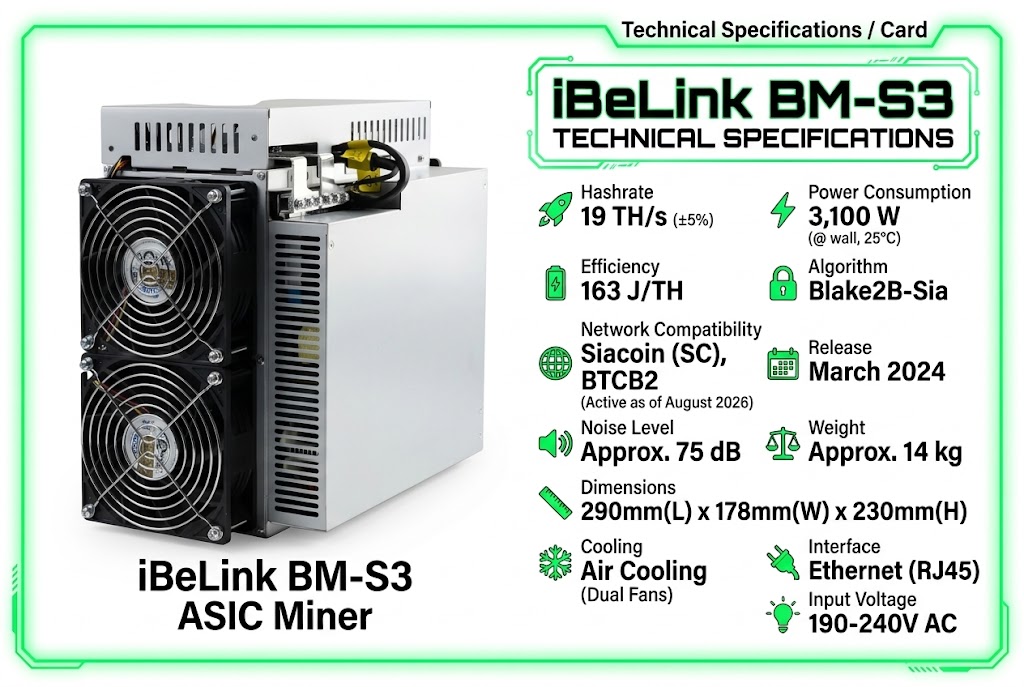
Its primary configuration is:
-
Hashrate: 19 TH/s
-
Power consumption: 3,100 W
-
Efficiency: 163 J/TH
-
Algorithm: Blake2B-Sia
-
Primary cryptocurrency: Siacoin
-
Release: March 2024
-
Noise: approximately 75 dB
-
Weight: approximately 14 kg
-
Power input: 190–240 V AC
-
Connection: Ethernet
-
Cooling: air cooling
The official iBeLink specifications state that the 3,100 W figure is measured at the wall under controlled conditions and can vary depending on ambient temperature and firmware mode.
The machine is therefore designed for continuous operation rather than occasional desktop use.
The BM-S3 Is a Specialized ASIC
The most important thing to understand about the BM-S3 is its specialization.
The machine was designed around Blake2B-Sia, which is the proof-of-work algorithm associated with Sia mining. ASIC specialization provides much higher efficiency than attempting to perform the same workload with a conventional CPU or GPU.
That efficiency comes with a trade-off, however.
A GPU can be redirected toward many different algorithms and computational tasks. An ASIC cannot offer the same flexibility. Its economic value depends heavily on the networks that use a compatible proof-of-work algorithm.
This is why the events of August 2026 were significant for BM-S3 owners.
BM-S3 Power Consumption
At 3,100 W, the BM-S3 consumes approximately:
3.1 kW × 24 hours = 74.4 kWh per day
At different electricity prices, the approximate electricity cost is:
| Electricity price | Daily energy cost | Monthly cost |
|---|---|---|
| $0.04/kWh | $2.98 | $89.28 |
| $0.07/kWh | $5.21 | $156.24 |
| $0.10/kWh | $7.44 | $223.20 |
| $0.15/kWh | $11.16 | $334.80 |
| $0.20/kWh | $14.88 | $446.40 |
This is one of the few parts of ASIC economics that can be calculated directly from the machine's specifications.
At $0.07/kWh, for example, electricity costs about $5.21 per day if the machine operates continuously at its rated power.
The much more difficult variable is revenue.
Why BM-S3 Profitability Figures Are So Different
Public profitability calculators currently produce substantially different results for Blake2B-Sia hardware.
That difference is important because it prevents a single daily-profit number from being treated as a reliable long-term estimate.
One earlier profitability snapshot supplied for the 19 TH/s BM-S3 showed approximately $116.73/day in income and $111.52/day after $5.21 in electricity costs. However, other calculators and later market conditions have produced dramatically different figures.
ASIC Miner Value's current data, for example, can show negative daily profitability for both the BM-S3 and BM-S3+ under its current assumptions.
The difference is not necessarily a contradiction in the hardware specifications. The machines still consume roughly the same amount of electricity. What changes is the revenue side of the calculation.
Mining revenue can move rapidly when a new network attracts additional hashrate.
What Does the Mining Community Say?
Community discussions provide a useful explanation for the extreme volatility.
A September 17, 2026 discussion on Reddit described older Siacoin ASICs as having effectively returned to life after BTCB2 launched on Blake2b. The post claimed that some units initially generated around $1,000/day, but that this had fallen toward approximately $100/day as additional hashrate entered the network.
This is not an audited profitability figure and should not be interpreted as a guaranteed BM-S3 return. It is a miner's observation of an unusually fast-changing market.
Another Reddit discussion from September 18 described an iBeLink BM-S3 being repaired and continuously rented for mining, with the user reporting earnings of around $1,000 in BTC from the rental period. Again, this is an individual community report rather than standardized hardware testing.
These reports illustrate why BM-S3 profitability can appear dramatically different from one website to another.
The most useful conclusion is not that the machine permanently earns $40, $100, or $1,000 per day. Instead, the evidence suggests that Blake2b mining experienced an exceptionally volatile profitability window in September 2026.
BM-S3 and the 2026 BLAKE2b Opportunity
The major change came after the Bitcoin-derived BTCB2 chain split from the Bitcoin ledger on August 8, 2026, followed by the activation of BLAKE2b proof-of-work at block 961,640 on August 30.
This created a new destination for BLAKE2b ASIC hardware.
The effect was immediate enough to attract attention from mining communities. A report published September 21 described approximately 5.1 PH/s of network hashrate in early September and roughly 30.4% growth in a single week.
For ASIC owners, this creates a classic early-mining dynamic:
high initial profitability → new miners enter → network hashrate rises → competition increases → profitability falls.
That mechanism explains why profitability calculators can become outdated very quickly.
The BM-S3+ Is a Different Model
The BM-S3 should also not be confused with the newer BM-S3+.
The two models have different specifications:
| Model | Hashrate | Power | Efficiency | Release |
|---|---|---|---|---|
| BM-S3 | 19 TH/s | 3,100 W | 163 J/TH | March 2024 |
| BM-S3+ | 25 TH/s | 3,400 W | 136 J/TH | April 2025 |
The BM-S3+ therefore provides a higher hashrate while consuming only modestly more power, resulting in better nominal energy efficiency. Current iBeLink and ASIC Miner Value listings distinguish the two models clearly.
This distinction is essential when comparing profitability reports online.
Advantages and Limitations
The BM-S3's main technical advantage is its specialization. It provides 19 TH/s of Blake2B-Sia hashing power in a relatively compact 14 kg chassis.
Its main limitations are power consumption, noise, and algorithm dependence.
At approximately 75 dB, it is not a quiet residential appliance. The 3.1 kW electrical load also requires appropriate electrical infrastructure, and iBeLink specifies a 190–240 V supply.
For large-scale deployment, hosting can therefore make more sense than operating the machine in a normal residential environment.
Conclusion
The iBeLink BM-S3 is an interesting example of how quickly ASIC economics can change.
Originally designed as a 19 TH/s, 3,100 W Blake2B-Sia ASIC for Siacoin, it entered a much broader conversation in 2026 after the emergence of a Bitcoin-derived BLAKE2b proof-of-work network.
The machine's electricity requirement is relatively straightforward to calculate: at $0.07/kWh, operating continuously costs approximately $5.21 per day.
Its revenue is much less predictable.
Reports ranging from tens of dollars to roughly $100 or even much higher figures can appear because network conditions changed rapidly after BTCB2 introduced BLAKE2b mining. Community reports indicate that the initial profitability window attracted substantial additional hashrate, compressing returns rapidly.
For that reason, the BM-S3 should be evaluated primarily through its hashrate, efficiency, electricity cost, and the current state of the networks accepting its proof-of-work, rather than through a single profitability number.
FAQ
Q1: What exactly is the iBeLink BM-S3, and what algorithm does it run?
It's a dedicated ASIC box that iBeLink launched back in March 2024 for the Blake2B-Sia algorithm. The machine puts out 19 TH/s while pulling around 3,100 watts from the wall. Even though it was originally built specifically for Siacoin (SC), you can set it to mine pretty much any chain running on BLAKE2b proof-of-work.
Q2: Why did everyone suddenly start talking about the BM-S3 in late 2026?
Things changed in August 2026 when BTCB2—a Bitcoin spin-off—switched its proof-of-work algorithm over to BLAKE2b. Before that, these rigs were pretty much tied to Siacoin with limited options. The switch gave this hardware a fresh target, triggering a quick spike in payout rates and making older Blake2b ASICs hot again almost overnight.
Q3: How power-hungry is the BM-S3, and what will it cost to run daily?
Drawing 3,100W means the rig chews through 74.4 kWh every 24 hours if left running non-stop. If you’re paying around $0.07 per kWh for electricity, that works out to about $5.21 a day—or roughly $156 a month. What you actually end up paying comes down to whatever your local utility company charges per kilowatt-hour.
Q4: Why are online profit calculators showing completely different numbers for this rig?
Your electricity bill stays constant, but mining payouts can swing wildly. When BTCB2 first went live on BLAKE2b, early miners saw huge daily returns. Word spread quickly, miners flooded the network with massive amounts of hashrate, difficulty shot up, and profits dropped fast. Because network conditions were shifting by the hour, tracking sites gave completely different estimates depending on when you refreshed the page.
Q5: How does the standard BM-S3 stack up against the BM-S3+?
It comes down to hashing power and wall efficiency:
-
BM-S3: 19 TH/s drawing 3,100W (163 J/TH).
-
BM-S3+: 25 TH/s drawing 3,400W (136 J/TH).
The Plus version gives you an extra 6 TH/s for only a small bump in power draw, making it noticeably more efficient per gigahash.
Q6: Can I just set up a BM-S3 in my house?
You really shouldn't. For starters, it requires a dedicated 190–240V line to handle the 3.1 kW load—a standard wall socket won't handle it. On top of that, the fans blast at around 75 dB, which sounds like a shop vacuum running right next to you 24/7. Unless you have a soundproofed garage, most people send these machines to a dedicated hosting facility.
![Siacoin Mining [BLAKE2b]: Why Is SC So Profitable?](https://res.cloudinary.com/duoaxhyqn/image/upload/v1790011975/blog/covers/WhatsApp%20Image%202026-09-21%20at%2019_1790007875902_d46vt6.jpg)