
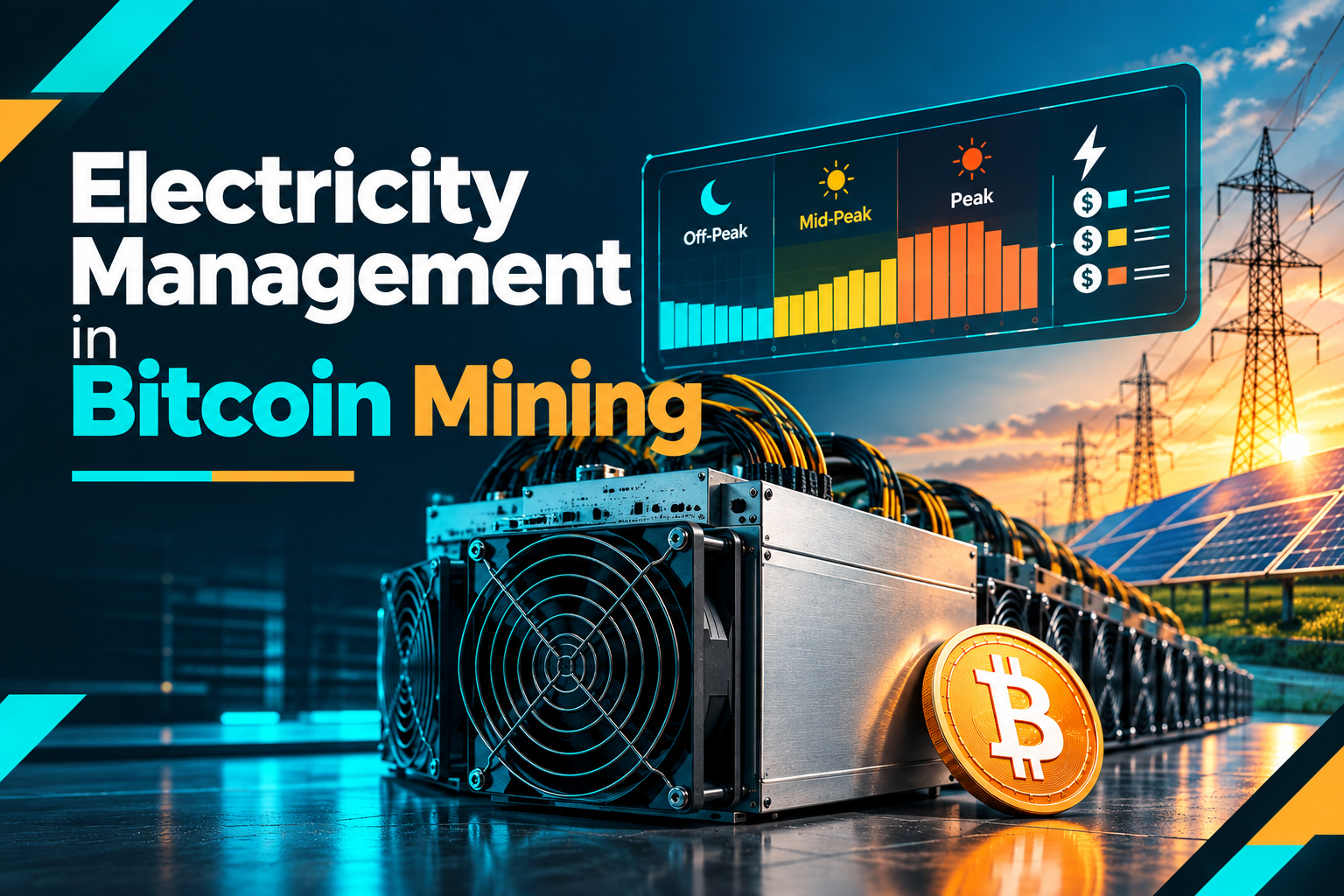
Electricity Management in Bitcoin Mining
Electricity is one of the few major costs in Bitcoin mining that miners can actively manage.
Bitcoin's price can move sharply within hours, and network difficulty changes over time. A mining machine, however, continues consuming electricity at roughly the same rate whether Bitcoin is trading higher or lower. This makes the electricity tariff behind an ASIC just as important as its hashrate or efficiency.
For miners operating under a time-of-use (TOU) electricity plan, the price paid for each kilowatt-hour can change depending on the time of day. That creates an opportunity: instead of treating electricity as a fixed expense, you can adjust when your hardware operates.
How Time-of-Use Pricing Works
A TOU tariff basically splits the day into a few different price tiers. The Exact hours depend on your local power company, but most plans usually feature some mix of:
-
Peak hours: electricity is more expensive because demand is high.
-
Off-peak hours: electricity is cheaper when grid demand falls.
-
Shoulder or mid-peak periods: prices sit somewhere between the two.
For a normal household, shifting electricity consumption might mean running a washing machine later or charging an EV overnight.
For Bitcoin miners, the impact can be considerably larger because an ASIC can consume several kilowatts continuously.
Consider an ASIC drawing 3.5 kW. Running it for 24 hours requires:
3.5 kW × 24 = 84 kWh
At $0.07 per kWh, that is approximately $5.88 per day in electricity.
But if the tariff rises to $0.20 during several peak hours, those same operating hours become substantially more expensive. The important question is therefore not simply how much electricity the machine consumes, but what each kilowatt-hour costs while the machine is running.
When Should a Miner Shut Down?
This is where mining profitability becomes a scheduling problem.
Suppose your ASIC is profitable at an electricity rate of $0.07/kWh but becomes unprofitable at $0.20/kWh. Continuing to run the machine through the expensive period does not necessarily make sense.
The calculation should compare the expected Bitcoin revenue during that period with the complete operating cost:
Mining revenue − electricity − pool fees − additional cooling costs = operating margin
If the electricity consumed during a particular period costs more than the expected mining revenue generated during those same hours, shutting down temporarily can reduce the loss.
This does mean producing less Bitcoin. But fewer mined coins can sometimes be preferable to generating coins at a negative operating margin.
Automating Peak and Off-Peak Mining
Manually turning an ASIC on and off every day is not particularly practical.
Fortunately, miners can automate the schedule.
One approach is to use a properly rated switching device or power-management system to disconnect the miner before an expensive tariff begins and restore power when the cheaper period starts.
The other option is software-based scheduling. Depending on the firmware and hardware configuration, a miner can be configured to reduce or stop hashing during selected hours and resume operation later.
For example, if expensive electricity begins at 4 p.m. and ends at 8 p.m., a miner could operate normally outside that window and remain offline during those four hours.
The exact schedule should always come from the actual electricity tariff rather than assuming that nighttime is automatically cheaper.
Cheap Electricity Is Not Always at Night
Traditional TOU plans often make overnight electricity cheaper, but modern power markets are becoming more complicated.
Large amounts of solar generation can push electricity prices lower during daylight hours, particularly around periods of strong solar production and relatively weak demand. In some markets, the cheapest electricity may therefore occur in the afternoon rather than overnight.
For miners, this creates an interesting possibility.
A flexible ASIC operation can potentially follow the cheapest electricity periods instead of following a fixed "mine at night" schedule.
This is especially useful for smaller mining operations that do not have to maintain continuous production.
Hardware Efficiency Still Matters
Scheduling can reduce electricity costs, but it does not solve the underlying efficiency problem.
ASIC efficiency is commonly expressed in joules per terahash (J/TH). A lower J/TH value means the machine requires less energy to perform the same amount of hashing work.
Imagine two machines producing approximately 200 TH/s. If one consumes substantially more electricity to deliver that hashrate, its profitability becomes more sensitive to every increase in the electricity tariff.
This is why upgrading to a more efficient ASIC can provide a longer-term buffer against changing power prices.
However, the purchase price must be included in the calculation. The electricity savings from the newer machine need to justify the additional capital cost over the expected operating period.
What About Solar Power?
Solar energy can also reduce exposure to grid electricity prices, but there is an important technical distinction between solar generation and 24-hour solar-powered mining.
Running an ASIC entirely from solar power requires enough generation capacity to cover the mining load and, without grid support, substantial battery storage for periods without sunlight.
That battery system can represent a significant portion of the project's total cost.
A more practical configuration for some miners is a hybrid solar-grid system.
During daylight hours, the ASIC can consume electricity generated directly by the solar installation. When solar production falls, the operation can switch to grid electricity, preferably during a cheaper tariff period.
This approach avoids making a large battery bank responsible for maintaining continuous ASIC operation.
The Real Optimization Is Timing
Time-of-use pricing does not make an inefficient miner efficient. It simply gives the operator another variable to control.
The most useful approach is to combine several factors:
Electricity price + ASIC efficiency + Bitcoin revenue + network difficulty + operating schedule
A miner should therefore monitor the actual tariff, calculate the machine's energy consumption, and compare the cost of running during each pricing period with expected mining revenue.
For some operations, continuous 24-hour mining will remain the most practical option. For others, temporarily shutting down during expensive periods, using solar during the day, or upgrading to a lower-J/TH ASIC can materially change the economics.
The key is to stop thinking of electricity as a single daily price. When your tariff changes throughout the day, the time at which an ASIC consumes electricity becomes part of the mining strategy itself.